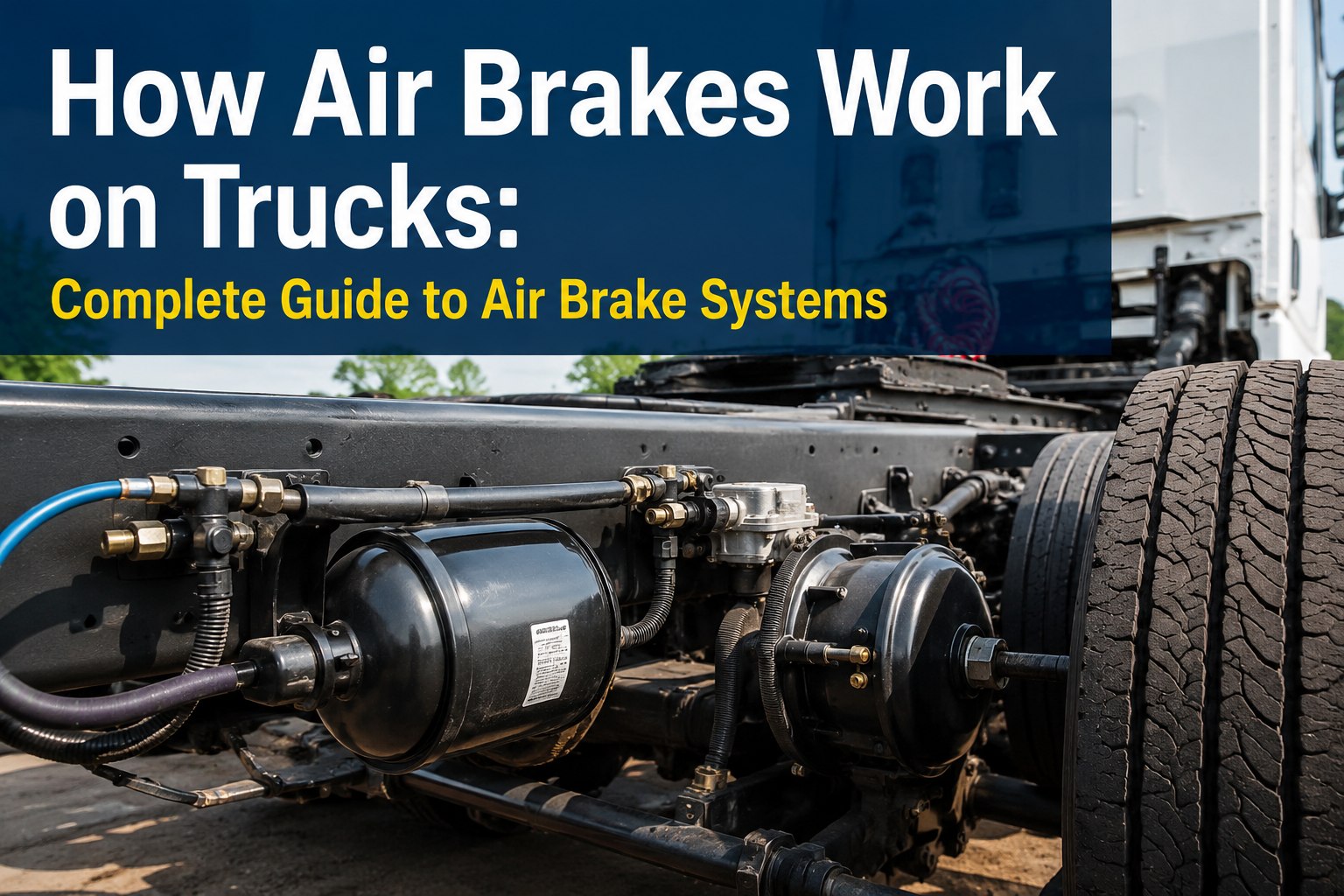
Air brakes work opposite to what most people think. On a car, you press the pedal and hydraulic pressure applies the brakes. On a commercial truck, the brakes are already applied by powerful springs — and compressed air is what holds them off so the truck can move. Lose the air, and the springs slam the brakes on automatically. This inverted design is why commercial vehicles use air brakes: it fails safely. If a line ruptures, a chamber fails, or the compressor stops, the truck stops. That physics — springs applied, air release — is the foundation of every air brake system, from a straight-truck box van to a triple-trailer combination. This guide walks through exactly how air brakes work: the four-stage air flow from compressor to brake shoe, the two-circuit primary/secondary split that keeps trucks stoppable even after single-point failures, the specific components that convert air pressure into wheel-stopping friction, the failure modes that appear in this order predictably, the warning signs drivers should recognize, and the maintenance rhythm that keeps air brakes safe across a fleet. Understanding the system is the difference between fixing a symptom and preventing a runaway. Ready to track air brake defects across an entire fleet? Start a free trial of our fleet maintenance software, or reach out to our support team for a walkthrough.
How Air Brakes Work on Trucks: Complete Guide to Air Brake Systems
Springs apply the brakes. Air holds them off. That's the whole system — and understanding it is the difference between fixing symptoms and preventing runaways.
The Core Principle: Fail-Safe by Design
Air brakes on commercial trucks work exactly opposite to hydraulic brakes on cars. Understanding this one principle explains every other design choice in the system.
The 4-Stage Air Flow: Compressor to Brake Shoe
Air moves through four distinct stages on its way to actually stopping the wheels. Each stage has its own components, its own function, and its own failure modes.
The Two-Circuit Design: Why Redundancy Matters
Federal Motor Carrier Safety Regulations require every commercial truck to have two separate brake circuits. Not for performance — for redundancy. Here's why that matters and how it works.
The 8 Components That Actually Make Brakes Work
Every commercial air brake system has eight critical components that turn compressed air into wheel-stopping friction. Here's what each one does and how it fits into the whole.
Spring Brakes: The Emergency and Parking System
Every commercial truck has a second set of brakes built into the same chambers — the spring brakes. These are what make air brakes fail-safe. Here's how they actually work.
The Air Flow Journey (Visualized)
Follow compressed air from the compressor all the way to the wheel. Every component in the chain has to work — a single failure anywhere stops the whole flow.
Track air brake defects across your entire fleet
Chamber leaks, stroke measurements, and slack adjuster wear captured at every DVIR. Auto-routing of safety-critical brake defects to maintenance.
The 6 Warning Signs of Air Brake Problems
Air brake problems usually announce themselves before catastrophic failure. Learn these six warning signs and you can address issues in the shop instead of on the road.
The 5 Most Common Air Brake Failure Modes
Most air brake problems fall into five categories. Understanding which one you're dealing with determines the fix — and the prevention.
System Leaks
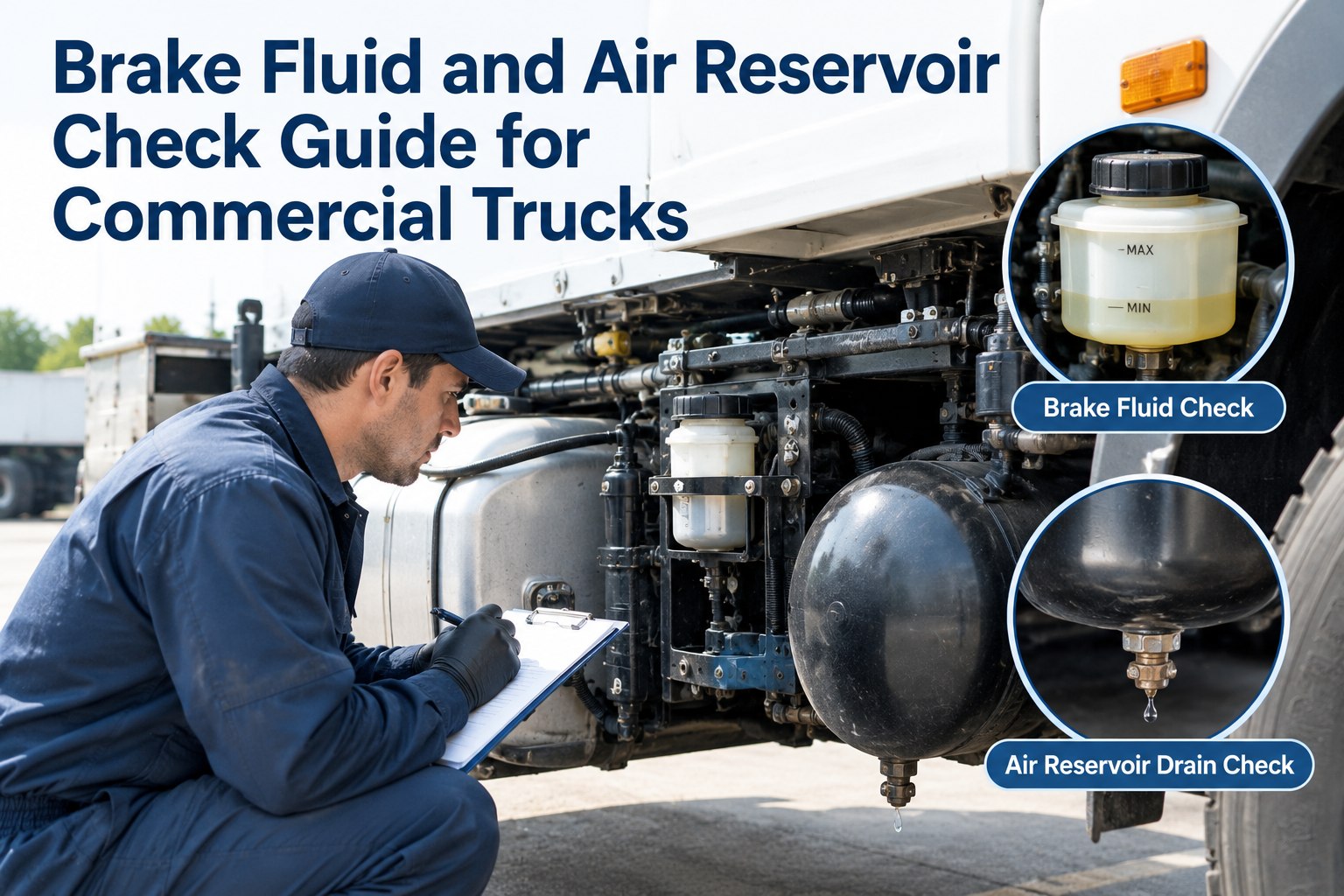
Air lines, chamber diaphragms, fittings, or reservoir seams develop leaks. Compressor runs constantly to compensate. Eventually system can't hold pressure. Prevention: daily soap-water inspection of key connection points.
Slack Adjuster Wear
Automatic slack adjusters wear internal cams. Push rod stroke exceeds adjustment limits. Braking force reduces progressively. Prevention: measure stroke at every PM. Replace worn adjusters at threshold.
Brake Chamber Failure
Diaphragm rupture, seal failure, or spring degradation in the chamber body. Full-service or spring-brake function lost. Prevention: replace chambers at manufacturer intervals — usually 250,000–500,000 miles.
Air Dryer Contamination
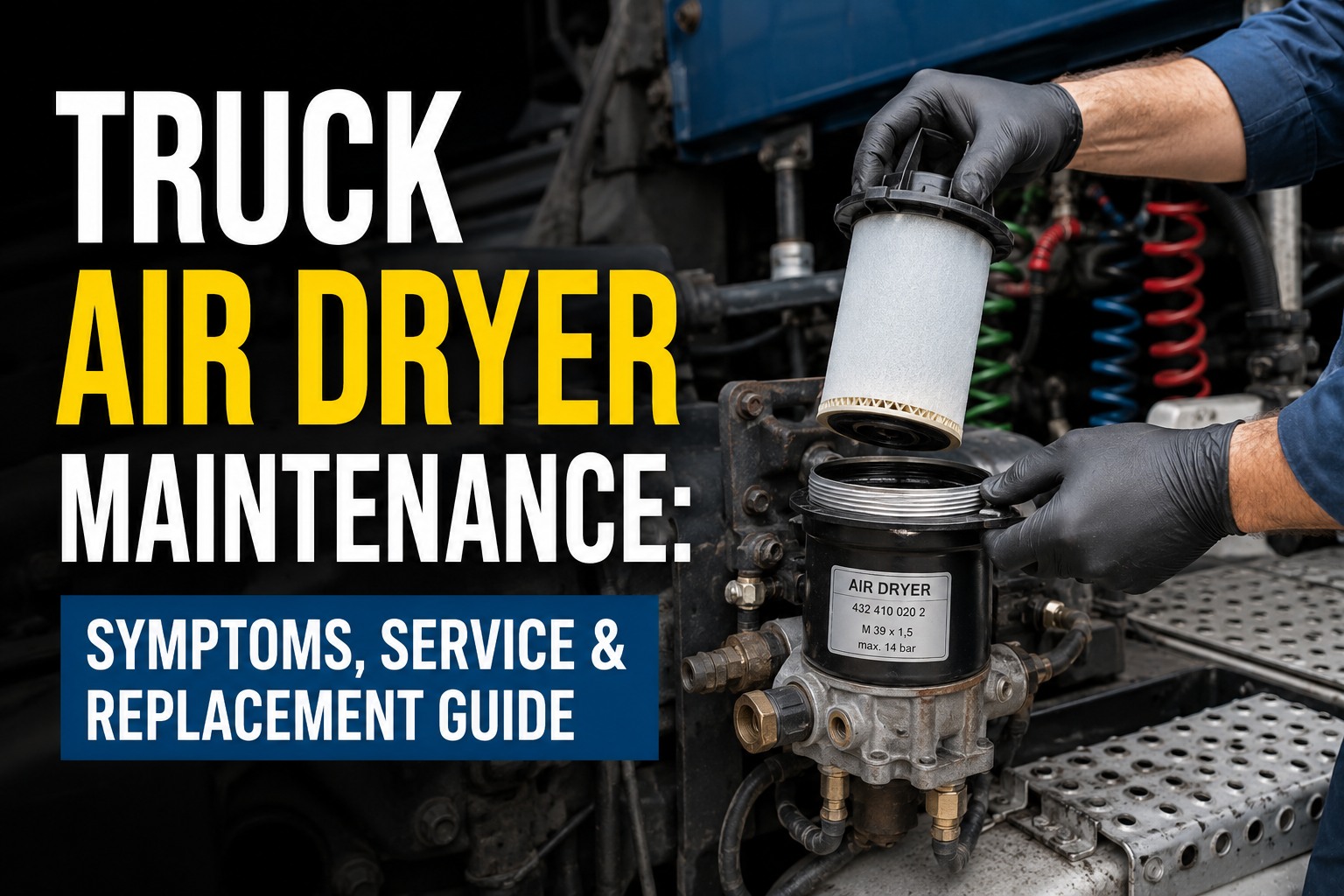
Moisture bypasses failed dryer, freezes in lines during cold weather, corrodes internal components. Prevention: replace dryer desiccant per schedule. Drain tanks daily to remove moisture already past the dryer.
Compressor Wear
Compressor loses efficiency over 500K–1M miles. Struggles to maintain governor cut-out pressure. Prevention: replace compressor at manufacturer interval, or when air-up time exceeds specification.
Air Brake Maintenance: The Rhythm That Keeps Systems Safe
Air brake maintenance follows a specific cadence — daily driver checks, monthly PM tasks, quarterly service items, and annual major inspections. Skip any one and problems accumulate.
The Physics: Why PSI Values Matter
Every PSI reading on an air brake system has a specific meaning. Understanding what each threshold represents makes diagnosis intuitive instead of guesswork.
Frequently Asked Questions
Air brakes on commercial trucks work opposite to car brakes. Powerful springs push the brakes on by default. Compressed air (100–125 PSI) pushes the springs back and holds the brakes off so the truck can move. When the driver presses the pedal, air is metered through a foot valve to brake chambers, which push rods against slack adjusters, which rotate S-cams, which press brake shoes against drums. Any air loss automatically reapplies the brakes. Track air brake health in our fleet maintenance software.
Three reasons: fail-safe design (air loss automatically applies brakes, unlike hydraulic where fluid loss disables them), unlimited pressure supply (compressor can generate more air as long as engine runs, whereas hydraulic fluid volume is fixed), and easy trailer integration (air lines can connect and disconnect between tractor and trailer instantly, whereas hydraulic couplers require bleeding). These advantages become essential at 80,000 pounds gross weight.
Eight critical components: air compressor (generates pressure), air dryer (removes moisture), governor (controls pressure), reservoir tanks (store air), foot valve (driver control), brake chambers (convert air to force), slack adjusters (multiply force), and S-cams with brake shoes (create friction). Plus the two-circuit design (primary and secondary) that provides redundancy against single-point failures.
Air loss activates a sequence of safety responses. At 60 PSI, low-air warning (buzzer or light) alerts the driver. Between 20–45 PSI, spring brakes automatically apply — powerful springs inside the same brake chambers push the brakes on regardless of air pressure. The truck slows and stops automatically. This is why air brakes are called fail-safe: the system defaults to stopped, not moving, when air is lost. Contact our team to discuss brake safety monitoring.
Five failure modes dominate: system leaks (~40% of failures, usually at chamber diaphragms or line fittings), slack adjuster wear (~25%, from age or missed PM adjustments), brake chamber failure (~15%, from diaphragm rupture or spring degradation), air dryer contamination (~12%, from missed desiccant service), and compressor wear (~8%, from age past 500K–1M miles). Daily driver inspection catches the first three; PM schedule catches the last two.
Air brake inspection is required daily by the driver (pre-trip and DVIR), monthly or 15,000 miles for preventive maintenance including stroke measurement, quarterly or 50,000 miles for air dryer service and governor testing, and annually or 100,000 miles for major inspection including brake shoes and drums. Skipping any one interval causes problems to accumulate. Try free: sign up here.
Track air brake health across the whole fleet
Chamber leak alerts from DVIR. Stroke measurements per wheel at every PM. Automatic slack adjuster wear tracking. Air dryer service scheduling. Compressor age monitoring. All the data a fleet needs to keep air brakes fail-safe — one platform, one workflow, one source of truth for every truck.