The diesel turbocharger is the most engineered component under your hood and the smallest — a matchbook-sized turbine spinning at over 100,000 RPM, handling exhaust temperatures above 1,400°F, single-handedly delivering the torque that makes a modern diesel worth owning. Without it, a 6.7L Cummins or Duramax would make roughly half the horsepower and about 40% of the torque. With it working right, that same engine produces up to 400 hp and pulls 30,000+ pounds up highway grades. And when it fails, it fails spectacularly — often sending debris downstream into the intercooler, intake manifold, and even cylinders, turning a $2,000 turbo replacement into a $10,000+ engine rebuild. The statistic that matters most: over 90% of diesel turbocharger failures result from oil starvation, oil contamination, or foreign object damage — all preventable with proper maintenance. Turbos are designed to last the life of the engine (150,000+ miles is normal, many go past 300,000), yet fleet data shows premature turbo replacements consistently rank in the top 5 diesel repair categories because owners skip oil changes, ignore air filters, and shut down hot after highway pulls. This guide walks through exactly how a diesel turbocharger works stage by stage, the anatomy inside the housing, the 6 failure symptoms every driver must recognize, the smoke-color diagnostic chart that pinpoints the problem, and how Truck Inspection & Maintenance turns performance complaints and smoke observations into tracked defects — free forever for up to 3 vehicles.
How a Diesel Turbocharger Works: The Complete 2026 Guide
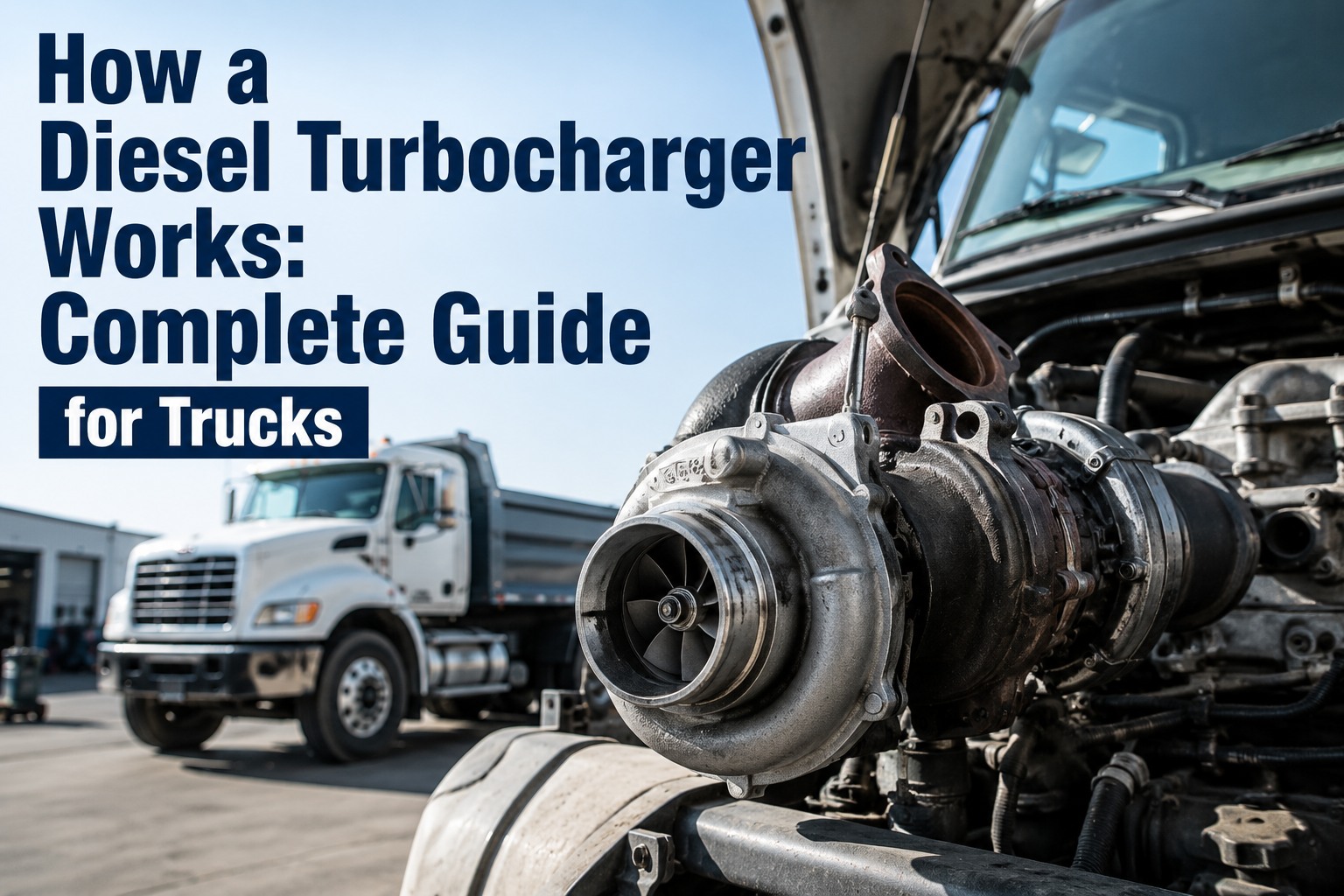
The matchbook-sized turbine spinning at 100,000 RPM that makes modern diesels worth owning — and what happens when it stops.
How It Actually Works — 4-Stage Cycle
A turbocharger is fundamentally a heat-recovery machine. It captures energy that would otherwise be wasted out the exhaust pipe and uses it to compress incoming intake air. More air in = more fuel burned = more power. Here's the exact 4-stage cycle happening thousands of times per second:
Anatomy — What's Actually Inside
Understanding the internal components helps you understand why failure modes look the way they do. Everything hinges on one central shaft — hot exhaust side on one end, cool compressor side on the other, floating on a thin film of oil:
Turbine Housing
CHRA (Bearing Housing)
Compressor Housing
The 6 Warning Signs of Turbo Failure
Failing turbos rarely fail all at once — they announce themselves clearly if you know what to listen for and look at. Every driver, mechanic, and safety manager needs to recognize these six symptoms in the order they typically appear:
Loss of Power & Sluggish Acceleration
Truck feels weak under load, especially on grades. Longer to spool up. Needs more throttle for the same response. Boost gauge (if equipped) reads lower than normal. Most common first symptom.
Whining or Whirring Noise
High-pitched whine that rises directly with engine RPM. Sound of worn journal bearings letting the shaft wobble. Different from a boost leak "whoosh" — bearing whine tracks engine speed precisely.
Excessive Exhaust Smoke
Color tells the story: black = overfueling from lost boost, blue = oil burning through worn seals, white = coolant intrusion. Smoke color is the single most diagnostic symptom.
Rapidly Dropping Oil Level
Oil consumption suddenly rises. Blue smoke on hard acceleration. Oil residue in the intercooler or intake piping. Worn turbo seals letting oil escape into the combustion chamber = expensive.
Check Engine Light & DTCs
Boost pressure codes (P0234, P0299), MAP sensor discrepancy codes, VGT actuator codes on variable geometry units. ECU may derate the engine to protect it. Codes are late-stage indicators.
Compressor Wheel Play
Remove intake tube, grasp compressor wheel. Radial (side-to-side) play touching housing = worn bearings. Any axial (in-out) play = bearing failure. Ball-bearing turbos should have essentially zero play.
Smoke Color Diagnostic — The Fastest Test
Before pulling anything apart, look at the exhaust. Diesel exhaust smoke color is one of the most diagnostic signals available and pinpoints the failure mode within seconds. Here's what each color tells you:
Overfueling / Lost Boost
What it means: Turbo isn't producing full boost pressure. Engine adds fuel to compensate but can't burn it fully without enough air. Incomplete combustion = black soot.
Likely cause: Boost leak (charge pipe, intercooler boot, clamp), failing turbo, clogged air filter, stuck VGT vanes on modern trucks.
Oil Burning
What it means: Engine oil is entering the combustion chamber and burning. Sweet-smelling blue-gray smoke, especially on hard acceleration or over-run.
Likely cause: Worn turbo seals letting oil past into intake OR into exhaust. Also worn valve guides or piston rings — but with other turbo symptoms, seals are the prime suspect.
Coolant Intrusion
What it means: Coolant is entering combustion. Sweet-smelling white cloud that doesn't clear as the engine warms. Distinct from cold-start condensation which fades within a minute.
Likely cause: Head gasket failure, cracked head, EGR cooler failure — not typically turbo-related but critical to diagnose immediately. Continued driving = engine death.
Why Turbos Fail — The 90% Rule
Here's the diagnostic reality every fleet manager needs to internalize: over 90% of diesel turbocharger failures trace back to one of just four root causes. Address these and you extend turbo life dramatically. Ignore them and no amount of premium parts saves you:
Oil Starvation
Insufficient oil flow to bearings. Turbo shaft floats on a thin pressurized oil film — lose that film for even seconds at 100,000 RPM and bearings destroy themselves. Causes: skipped oil changes, wrong-grade oil, blocked oil supply line, cold-start heavy throttle before oil pressure builds.
Oil Contamination
Dirty oil grinds bearings from the inside. Coolant contamination, soot loading, fuel dilution all destroy the oil's ability to protect. Causes: extended oil-change intervals, poor filtration, ignored coolant leaks.
Foreign Object Damage
Ingested debris hits the spinning wheel. Even small particles cause chipping, imbalance, and eventually catastrophic failure. Causes: torn air filters, failed intake components, debris from prior turbo failure not cleaned up.
Other Causes
Hot shutdowns coking the oil, over-boosting from performance tuning, VGT actuator failures on variable geometry units, and normal wear at 300,000+ miles. All manageable with maintenance discipline.
Every whine, every smoke observation, every MPG drop belongs on your DVIR
A driver mentions "the truck sounded a little different today." Nobody writes it down. Three weeks later the turbo lets go on a highway grade and sends metal into the intake. Truck Inspection & Maintenance turns every performance complaint, smoke observation, and unusual noise into a documented DVIR item — GPS-tagged, timestamped, routed to your shop as a defect work order. Sign up free for up to 3 vehicles.
Maintenance Best Practices — Extend Turbo Life 2×
The best turbo is the one you never have to replace. Six practices dramatically extend turbo life on heavy-duty diesels. Fleets that follow them consistently see original turbos go past 300,000 miles without issue:
Follow Oil Change Intervals Strictly
The single highest-ROI maintenance decision. Clean oil is 90%+ of turbo longevity. Follow manufacturer intervals — under severe duty (heavy towing, extreme temps), change more frequently, not less.
Cool Down Before Shutdown
After hard driving or towing, idle 1–2 minutes before shutdown. Turbo housing may be 800°F+ — hot shutdown coats the oil against hot bearings, coking the oil and destroying bearings over time.
Warm Up Before Heavy Throttle
Cold oil is thick and doesn't reach turbo bearings fast enough. Idle 30–60 seconds after cold start before driving. Avoid heavy throttle until oil reaches operating temperature.
Change Air Filter On Schedule
Every particle that gets past the filter hits the compressor wheel at 100,000 RPM. Change on manufacturer schedule. Never operate with damaged or torn filter — even one large hole = turbo death.
Fix Oil & Coolant Leaks Fast
Small oil leaks lower level over time — turbo can starve at low oil condition even briefly. Coolant leaks contaminate oil chemistry. Neither is a "next month" problem when a turbo is in the loop.
Address Symptoms Immediately
Every whine, MPG drop, smoke observation, or boost complaint gets logged and diagnosed. Early catches save $2,000+ repairs. Ignored symptoms turn $2,000 turbo repairs into $10,000+ engine rebuilds.
Real Repair Cost Breakdown
Turbocharger repair costs vary enormously by vehicle class. Here's the honest cost picture across the range — and why catching it early matters so much:
Diesel Pickup Trucks
2500/3500 series pickups (Cummins, Duramax, Power Stroke). Turbo replacement including labor and parts. Remanufactured units offer 20–30% savings vs new OEM.
Class 8 Commercial Trucks
Cummins ISX, Detroit DD15, Volvo D13, Cat C15. Turbo unit alone $2,500–$4,500 OEM. Labor 6–10 hours. VGT actuator recalibration may add cost.
Turbo + Engine Damage
Failed turbo sending debris downstream through intercooler into cylinders. Piston damage, cylinder scoring, valve damage. Full teardown & rebuild territory.
Frequently Asked Questions
How long should a diesel turbocharger last?
With proper maintenance, diesel turbochargers commonly exceed 150,000 miles and often last the life of the engine — 300,000+ miles is normal. Severe duty applications like heavy towing or extreme temperatures reduce lifespan. Excellent oil maintenance extends it dramatically. Variable geometry turbos (VGT) require more attention than fixed geometry designs because of the moving vane mechanism. Bottom line: turbo failure before 100,000 miles almost always signals a maintenance issue, not a manufacturing defect.
Can I drive with a failing turbocharger?
Not recommended for long. A failing turbo can send debris into the engine causing catastrophic damage — turning a $2,000–$4,000 turbo repair into a $10,000+ engine rebuild. If you notice power loss, smoke, or bearing whine, get the truck diagnosed immediately. Short trips to reach a shop are usually safe if you drive gently — no heavy throttle, low RPMs, cool down before shutdown. Emergency shutdown risks internal damage from continued oil starvation.
What's the difference between a VGT and a fixed geometry turbo?
Fixed geometry turbos have static vanes optimized for one RPM range — great at their sweet spot, weak elsewhere. VGT (Variable Geometry Turbo) uses movable vanes that adjust automatically for optimal boost across all RPMs. Modern diesel trucks use VGTs: 2003+ Ford Power Stroke, 2004.5+ GM Duramax, 2007.5+ Ram Cummins. VGTs deliver better low-end response and higher top-end power but have more moving parts to maintain and cost more to replace.
How much does turbocharger replacement cost?
Light-duty diesel pickups: $1,500–$4,000 including parts and labor. Heavy-duty commercial trucks (Cummins ISX, Detroit DD15, Volvo D13, Cat C15): $3,000–$6,500+. Catastrophic failures where turbo debris enters the engine can hit $8,000–$20,000+ with cylinder damage. Remanufactured units offer 20–30% savings vs new OEM but verify quality — cheap aftermarket turbos often fail within 30,000 miles. Talk to our team about tracking symptoms early.
Should I rebuild or replace a failed turbocharger?
Rebuild if: housing is undamaged, only the CHRA (bearing/shaft assembly) is worn, cost matters more than warranty. Replace if: housing is cracked or scored, VGT actuator has failed, foreign object damage is significant, or the shop can't guarantee balance on the rebuilt unit. Reputable rebuilds cost 40–60% of new, but demand professional balancing — a rebuilt turbo out of balance destroys itself within hours at 100,000 RPM.
How does Truck Inspection & Maintenance help catch turbo problems early?
Every whine complaint, MPG drop, smoke observation, and power-loss report belongs on the daily DVIR — captured, timestamped, GPS-tagged, and routed to your shop as a defect work order. A single "the truck sounded off today" mention is data; three complaints in two weeks is a pattern that catches a failing turbo before it sends metal into the intake. Free forever for up to 3 vehicles with no hardware. Sign up in 10 minutes to see the workflow.
A $2,000 turbo repair becomes a $10,000 engine rebuild when the warnings aren't logged.
Every whine complaint, smoke observation, MPG anomaly, and power-loss mention is a data point that either sits in a driver's memory or on a digital DVIR. Truck Inspection & Maintenance captures them GPS-tagged, timestamped, and routed to your shop as defect work orders before the turbo sends debris downstream. Free forever for up to 3 vehicles with no hardware and no contracts. Set it up in 10 minutes.