Here's the thing most drivers never quite get told about IFTA: you don't pay fuel tax where you buy the fuel — you pay it where you burn it. Fill up cheap in one state, drive those gallons through a higher-tax state, and you owe the difference. That's the entire point of the International Fuel Tax Agreement, and it's why one quarterly return filed with your home state settles up with all 58 member jurisdictions at once. It's genuinely a simplification. What trips carriers up isn't the concept — it's the recordkeeping, because you can't reconstruct state-by-state mileage from memory three months later, and every gallon you can't document is a gallon the auditor assumes you never paid tax on. This guide covers who has to file, how the tax actually works, the 2026 deadlines, the records you must keep, the audit traps that catch people, and how fleet management software turns filing from a weekend of receipts into a review step.
Compliance Guide · IFTA Fuel Tax Reporting · 2026
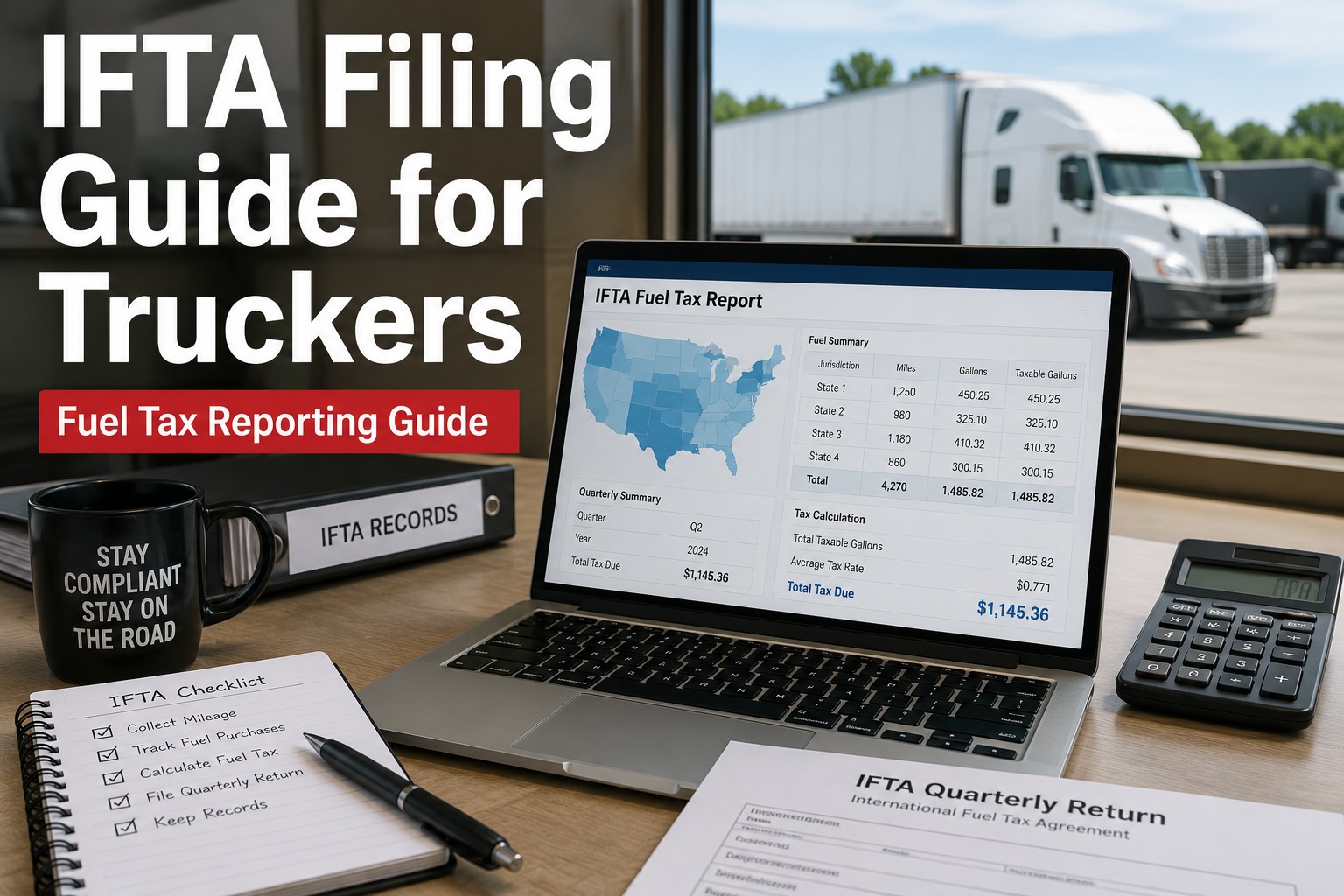
IFTA Filing Guide for Truckers
Who must file, how fuel tax is redistributed across jurisdictions, the quarterly deadlines, and the recordkeeping that keeps an audit boring.
48 + 10
US states and Canadian provinces in the agreement
4
Returns per year — even with zero tax owed
4 years
How long every supporting record must be kept
$50 or 10%
Late penalty — whichever is greater, plus interest
Do You Actually Have to File?
IFTA applies to what the agreement calls a qualified motor vehicle operating across jurisdiction lines. If your truck meets either size test and you cross a state or provincial line, you're in:
The vehicle test
Over 26,000 lbs gross vehicle weight, or three or more axles regardless of weight. Either one qualifies — the axle count alone can pull a lighter truck in.
The travel test
Operating in two or more IFTA member jurisdictions. Even a single mile across a state line in the quarter triggers the requirement.
The exception worth knowing: if you operate only within one state, or make very few interstate trips a year, temporary trip permits may make more sense than a full IFTA license. Everyone else needs an IFTA license and decals from their base jurisdiction — displayed on both sides of the cab. Running without valid decals can mean fines from several hundred to over a thousand dollars, and in some states being placed out of service until you get a permit.
The Concept Everyone Gets Wrong
IFTA isn't an extra tax. It's a redistribution system — and understanding it makes every other part of filing make sense:
"I paid tax at the pump, so I'm done"
You did pay fuel tax when you fueled up — but you paid it to whichever state you happened to stop in, which may not be where you actually used that fuel.
You owe tax where the miles happened
IFTA calculates the fuel you consumed in each jurisdiction based on your miles there, credits what you already paid at the pump, and settles the difference — one return, one payment, to your base jurisdiction.
Why that matters in practice: buy cheap fuel in a low-tax state and run those gallons through a high-tax state, and you'll owe the gap on your return. Do the reverse and you may end up with a credit. Neither is cheating — it's exactly how the system is designed to work, which is why accurate per-state mileage is the number that drives your entire bill.
The 2026 Filing Calendar
Returns are due the last day of the month following each quarter's end. Four deadlines, every year, without exception — and you file even if you owed nothing or didn't run at all that quarter:
Jan - Mar
Due April 30
Apr - Jun
Due July 31
Jul - Sep
Due October 31
Oct - Dec
Due January 31
Two timing details that catch people: if a due date lands on a weekend or holiday, it moves to the next business day. And tax rates themselves change every quarter — on January 1, April 1, July 1, and October 1 — so always pull current rates from your base jurisdiction before filing rather than reusing last quarter's numbers. A trip that straddles a quarter boundary gets split at the date: miles before the cutoff belong to the earlier return.
What You Must Track
Every IFTA return rests on two record families. Total mileage isn't enough — the agreement requires distance broken out by each jurisdiction you entered:
Distance records
Fuel records
How the Filing Actually Works
Once the records are clean, the math is mechanical. Every IFTA return follows the same five steps:
Total your miles by jurisdiction
Add up every mile driven in each state and province during the quarter, plus your total miles across all jurisdictions.
Total your fuel purchased
Sum all gallons bought in each jurisdiction, supported by receipts or card statements — these become your tax-paid gallons.
Calculate your fleet MPG
Divide total miles by total gallons consumed. This average fuel economy is what converts miles into gallons burned per state.
Work out gallons used per jurisdiction
Divide each state's miles by your fleet MPG to find the fuel actually consumed there — the taxable basis for that jurisdiction.
Net tax owed against tax paid
Apply each jurisdiction's current rate to gallons burned, subtract the tax already paid at the pump there, and the differences net into one payment or credit.
Free · Up to 3 Vehicles
Make quarterly filing a review, not a weekend
Fleet management software captures state-by-state mileage and fuel purchases as they happen — so when the deadline arrives, your jurisdiction totals, fleet MPG, and supporting records are already assembled instead of scattered across a glovebox. Records stay organized and retrievable for the full four-year retention window. Sign up free for up to 3 vehicles and stop rebuilding your quarter from receipts.
What late or sloppy filing actually costs
Miss a deadline and the standard penalty is $50 or 10% of the net tax due, whichever is greater — with interest accruing at roughly 1% per month on unpaid tax until it's settled. It escalates from there: repeated delinquency can lead to suspension or revocation of your IFTA license, which takes your authority to run interstate with it. Filing late with a zero balance still triggers the minimum penalty, so a quarter with no tax owed is not a quarter you can skip.
The Audit Traps
IFTA audits aren't random misfortune — they're usually triggered by patterns in your own returns. These are the four that draw attention:
Round numbers
Mileage rounded to the nearest thousand or state splits that look estimated is the single most common trigger. Real trips produce untidy numbers.
MPG that doesn't add up
Auditors cross-check reported miles against fuel consumed. A fleet MPG that swings wildly between quarters, or sits outside industry norms, invites a closer look.
Missing fuel receipts
Every undocumented gallon is treated as tax-unpaid and removed from your credits — recalculating the return upward, plus penalties and interest.
A history of amended returns
Repeatedly correcting past filings signals unreliable records, and that pattern itself raises your audit profile.
Staying Audit-Ready
The carriers who sail through audits aren't lucky — they treat recordkeeping as a daily habit rather than a quarterly scramble:
Reconcile weekly, not quarterly
Check state mileage against your logs every week. Catching a gap at seven days is trivial; catching it at ninety is reconstruction.
Keep everything four years
Retain all supporting records for at least four years from the return's due date or filing date, whichever is later. Paper or digital is fine — readable is what counts.
Let GPS do the mileage
Automatically captured, timestamped location data is the strongest evidence you can hand an auditor, and it splits quarter-boundary trips correctly on its own.
Organize by quarter and vehicle
A tidy folder per vehicle per quarter — mileage summary, fuel documentation, the filed return — ends audits faster and with fewer findings.
Frequently Asked Questions
What is IFTA and who has to file?
The International Fuel Tax Agreement is a pact among 48 US states and 10 Canadian provinces that lets interstate carriers file one fuel tax return instead of one per state. You must file if you operate a qualified motor vehicle — over 26,000 lbs GVW, or with three or more axles regardless of weight — in two or more member jurisdictions. Carriers running only intrastate, or making very few interstate trips a year, may use trip permits instead.
When are the 2026 IFTA deadlines?
Returns are due the last day of the month after each quarter closes: April 30 for Q1, July 31 for Q2, October 31 for Q3, and January 31 for Q4. If a deadline falls on a weekend or holiday, it shifts to the next business day. You must file all four quarters even if you owed no tax or didn't operate. Contact our team about automating your quarterly compliance.
Do I still file if I owe nothing?
Yes — and this catches a lot of owner-operators. A quarterly return is required whether you owe tax, are due a credit, ran in only some jurisdictions, or didn't operate at all. Filing late with a zero balance still triggers the minimum penalty, and missing multiple quarters can lead to your IFTA license being suspended or revoked. Treat every quarter as a filing quarter, regardless of activity.
What records do I need to keep, and for how long?
You need distance records showing miles by jurisdiction with trip dates, origins, destinations, routes, and odometer readings — plus fuel records with purchase dates, locations, gallons, fuel type, and receipts or card statements. Everything must be retained at least four years from the return's due date or filing date, whichever is later. Both paper and electronic records are acceptable as long as they're readable when an auditor asks.
What are the penalties for filing late?
The standard penalty is $50 or 10% of the net tax due, whichever is greater, plus interest of roughly 1% per month on unpaid balances until settled. Persistent non-compliance escalates to license suspension or revocation, which effectively ends your interstate authority. Operating without valid IFTA decals is separate and can bring fines of several hundred to over a thousand dollars, and in some states an out-of-service order.
What triggers an IFTA audit?
Mostly patterns in your own filings. Mileage rounded to suspiciously neat numbers or state splits that look estimated is the most common trigger. Auditors also cross-reference reported miles against fuel consumption, toll records, and industry benchmarks, so an implausible or wildly fluctuating fleet MPG draws scrutiny — as does a history of amended returns. Clean, granular, automatically captured records are the best protection. Sign up free to keep audit-ready records automatically.
Four Deadlines, Zero Scrambling
Turn IFTA from a quarterly project into a background task.
Fleet management software captures state-by-state mileage and fuel purchases as they happen, keeps four years of audit-ready records organized by vehicle and quarter, and has your jurisdiction totals ready before the deadline instead of after a weekend of receipts. Free for up to 3 vehicles. Works with your existing telematics, no contracts.