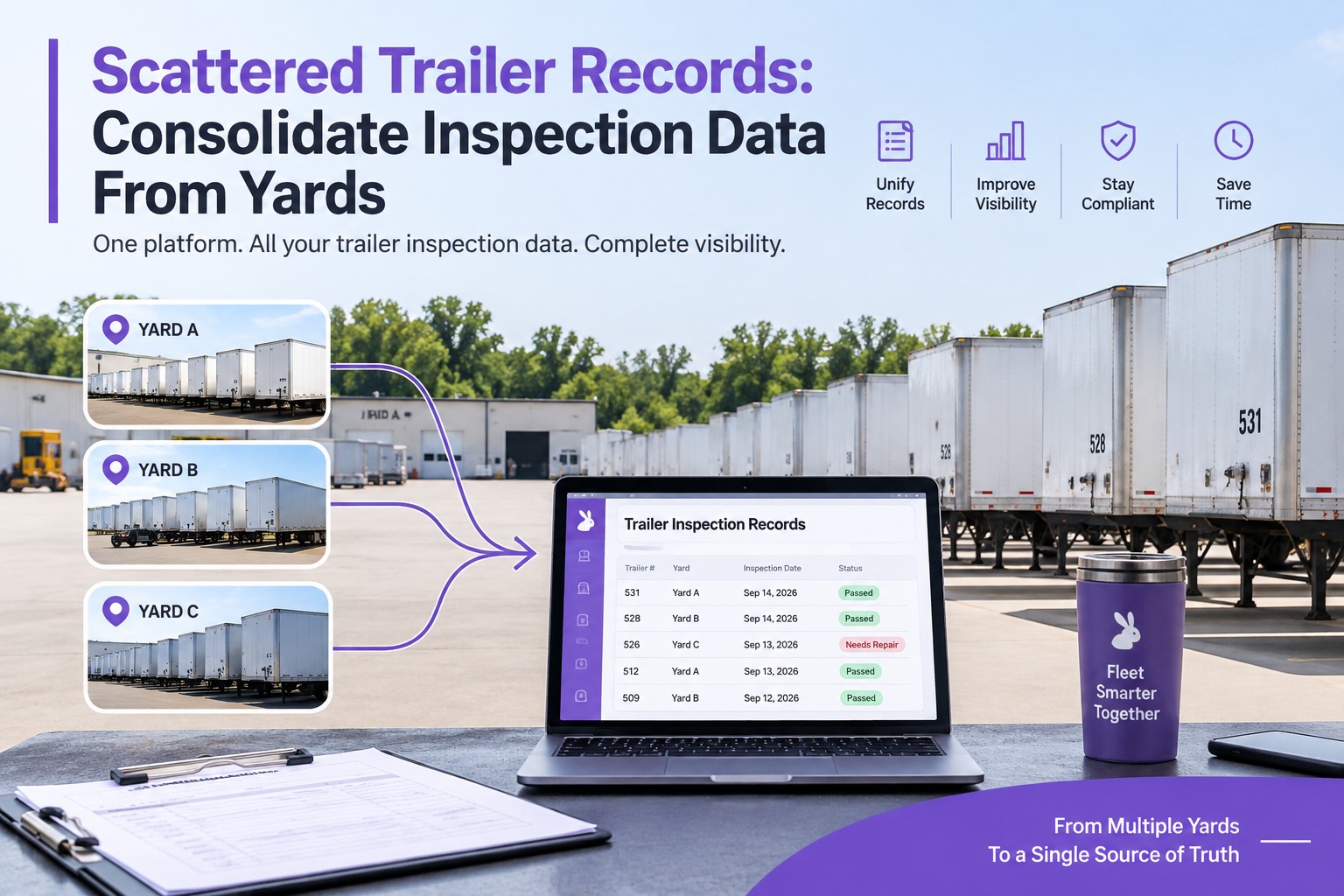
A trailer that runs Dallas–Phoenix–Atlanta over six months isn't in one file cabinet it's in three, in three different yards, on three different clipboards, and if the DOT walks in tomorrow, someone spends a day driving to pull them. That's the multi-yard problem in one sentence: the trailer moves, the records don't. Consolidating them isn't a filing project — it's a workflow change that turns three inboxes into one asset record that follows the trailer wherever it goes. Start free and put every yard's records in one place.
Trailer Records · Multi-Yard · Unified Asset History
Stop Chasing Trailer Records Across Three Yards on Audit Day
Every trailer that crosses yards carries its history with it — on paper, that history stays behind in whichever inbox it last touched. Truck Inspection & Maintenance Management Software gives every trailer one asset record that every yard writes to and every yard can read, so the file is always where the trailer is.
1 recordper trailer, not per yard
Every yardreads and writes to the same asset file
14 mo§396.21 retention automatic, wherever garaged
The Scattered-Records Problem in One Picture
The problem isn't complicated — it's what happens when a trailer that crosses yards has records that don't. Every yard becomes its own filing system, and the asset's real history exists nowhere except in three separate places.
🚛
Trailer T-4471
Runs Dallas → Phoenix → Atlanta rotation
📍 Dallas South
- Annual §396.17 (Feb)
- 3× DVIRs with defects
- Wheel-seal repair (Mar)
📍 Phoenix West
- 2× DVIRs — clean
- Brake service (Jul)
- Tire replace × 2 (Jul)
📍 Atlanta East
- Repeat wheel-seal defect (Sep)
- 2× DVIRs since arrival
- Coupling wear noted
The truth nobody sees
The wheel seal was already fixed at Dallas in March; Atlanta is now seeing the same defect return. On paper, that pattern is invisible until someone drives to Dallas and reads the file.
What Scattered Records Actually Cost
The pain isn't the filing. It's the four things that happen when a fleet can't see a trailer's full history in one place.
🔁
Repeat repairs get missed
A defect fixed at Yard A returns at Yard B — but the mechanic doesn't know it's the third time. Root cause never gets found because the pattern is invisible.
📋
DOT audits become a scramble
Auditor asks for last year's DVIRs on 40 trailers. If records are yard-local, that's 40 phone calls, 3 overnight envelopes, and a bad first impression.
⚖️
Litigation exposure grows
A missing DVIR from the wrong yard on the wrong date is what plaintiff attorneys build cases around. Chain of custody has to be clean, wherever the trailer was.
💰
PM slips at handoff
Trailer arrives at a new yard. That yard doesn't know when the last B-service happened. Either it gets repeated or it gets skipped — both cost money.
The Asset-Record Model — One File Per Trailer, Forever
The fix isn't a bigger filing cabinet. It's a change in what the record belongs to. On paper, the file belongs to the yard; digital, it belongs to the trailer. When the trailer moves, the record moves with it — automatically, because it never lived at the yard in the first place.
BEFORE
Records live at the yard
Dallas
Phoenix
Atlanta
✕ no lines ✕
Three folders, three yards, three versions of the truth. Trailer moves; the folder stays.
AFTER
Records live with the trailer
T-4471
ONE FILE
Dallas
Phoenix
Atlanta
One asset record. Every yard writes to it; every yard reads it. Trailer moves; the record is already there.
What a Unified Trailer Record Actually Contains
The asset record isn't a folder of scanned DVIRs. It's the trailer's full operating history, structured so any of the six most-asked questions can be answered in one click.
01
Identity & specs
VIN, unit number, year/make/model, trailer type, registered state, home terminal, purchase date.
02
DVIR history
Every pre-trip and post-trip, from any yard, chronological. Every defect, every photo, every signature.
03
Annual §396.17
Current sticker date, next-due date, full report from last inspection, inspector credentials per §396.19.
04
Work-order history
Every repair, every parts consumption, every mechanic sign-off — regardless of which yard's shop did the work.
05
PM schedule & compliance
Next service due (by miles / hours / calendar — whichever hits first), last service completed, on-time percentage.
06
Repeat-defect flags
Automatic pattern detection across yards — same defect ≥3× in 30 days surfaces even if each occurrence was at a different terminal.
The pattern that used to be invisible A wheel seal fixed in Dallas returning in Phoenix is a chronic issue. On paper, that's three separate defects across three separate files — invisible as a pattern. In one asset record, it's a repeat-defect flag on day 1, and a root-cause conversation instead of a fourth reseal.
The Consolidation Playbook
Rolling a scattered-records fleet onto one asset record isn't a Big Bang project. Four phases, one yard at a time, and the fleet keeps running the whole time.
Phase 1
Digitize the intake
Every new DVIR and work order from Day 1 filed to the asset record, not the yard inbox. Doesn't touch legacy paper — starts building the forward record.
Week 1–2
Phase 2
Backfill the last annual
For every trailer: scan and attach the current §396.17 sticker photo and the current PM baseline. Not the whole history — just enough to make the asset record legally defensible today.
Week 2–4
Phase 3
Roll out the cross-yard write access
Each yard's mechanics and inspectors are given login access. They now write to the asset record, not the yard folder. The paper stays for a week as backup, then retires.
Week 4–8
Phase 4
Retire the yard filing cabinet
Legacy paper is archived to cold storage or destroyed per retention policy. Every future DOT audit is answered from the asset record. Fleet manager gets their weekly rolled-up view.
Week 8+
One Trailer, One Record, Every Yard
Truck Inspection & Maintenance Management Software gives every trailer its own asset record — DVIRs, annuals, work orders, PM schedule, repeat-defect flags — that every yard writes to and every yard reads. When a trailer moves from Dallas to Atlanta, so does its full history. When DOT asks, the record exports in three minutes; when a mechanic in Atlanta sees a returning defect, the pattern is already flagged.
The Six Questions Consolidation Should Answer
A unified record earns its keep by answering the six questions that scattered records make hardest. If any of these still take a phone call to a yard, the consolidation isn't done.
Q1When was this trailer's last annual §396.17?One click on the asset record — sticker date, next-due date, inspector credentials.
Q2Has this defect happened before, at any yard?Repeat-defect flag surfaces the pattern automatically — no cross-yard phone calls.
Q3Where is this trailer garaged today?Current-terminal field on the asset — determines which yard the §396.21 record must be retrievable at.
Q4What's the trailer's total wheel-seal repair history?Filter the work-order feed by component — full history across every yard, one list.
Q5Is any yard falling behind on this trailer's PM?PM compliance shows the last completed service, the next due, and whether the current yard has capacity.
Q6Can you export 12 months of DVIRs on demand?Date range, asset selection, PDF or CSV — one operation, minutes, not a day of chasing files.
Frequently Asked Questions
Where do the records legally have to be kept?
Under §396.21, inspection reports must be retained at the location where the vehicle is normally garaged. Historically that meant paper files at the yard; the FMCSA has since clarified that electronic retention accessible from the garaging location satisfies the rule. In practice, this means one cloud-based asset record accessible from any yard the trailer visits is fully compliant — you don't need physical files at every terminal, just retrievable access. The 2026 eDVIR final rule makes this even more explicit for DVIR retention.
Start free with §396.21-compliant retention
Do all my yards need the same maintenance system to make this work?
They need to write to the same asset record — but they don't necessarily need to run identical workflows. Some fleets have a centralized shop system at the biggest terminal and use the software at satellite yards for inspections and lightweight work orders that all flow into the same record. What breaks consolidation is when a yard runs completely separate infrastructure whose data never syncs. Our software rolls up all yards into one asset view regardless of who's doing the writing.
Contact us to plan a mixed-yard rollout
What do we do with the years of paper we already have?
Two options. The compliance-driven answer: retain what's still inside the §396.21 14-month window in physical form at the appropriate garaging location, and scan the most-recent annual into the asset record so the trailer file is defensible today. The full-consolidation answer: bulk-scan everything into cold storage attached to each trailer's asset record — a 40-trailer fleet's historical file usually digitizes in a few days with a document scanner. Most fleets pick the compliance answer first and do the full scan over the next quarter.
Start free and begin the forward record today
How do we handle drop-and-hook where a trailer moves without a driver?
This is exactly where scattered records break down most often — the trailer moves independent of a driver, so nobody carries its file to the next yard. On a unified asset record, the trailer's DVIRs are attributed to the trailer itself, not to whichever tractor happened to be pulling it. Whoever hooks up next reads the last DVIR before dispatching; whoever drops sees the trailer's full defect history before parking. Attribution is by trailer, not by driver — which is how §396.11 was written in the first place.
Contact us to configure drop-and-hook attribution
One Trailer · One Record · Every Yard
Retire the Yard Filing Cabinet, Not the Records It Held
Truck Inspection & Maintenance Management Software consolidates every yard's DVIRs, annuals, work orders, and PM history into one asset record per trailer — visible to every terminal, exportable on demand for DOT, and automatically pattern-flagged so a defect fixed in one yard never returns silently at another. Fleets use it to answer audit requests in minutes, catch chronic issues before they cascade, and end the phone-tree scramble on inspection day.
No credit card required. Free for up to 3 trucks. Built for FMCSA-compliant fleets.