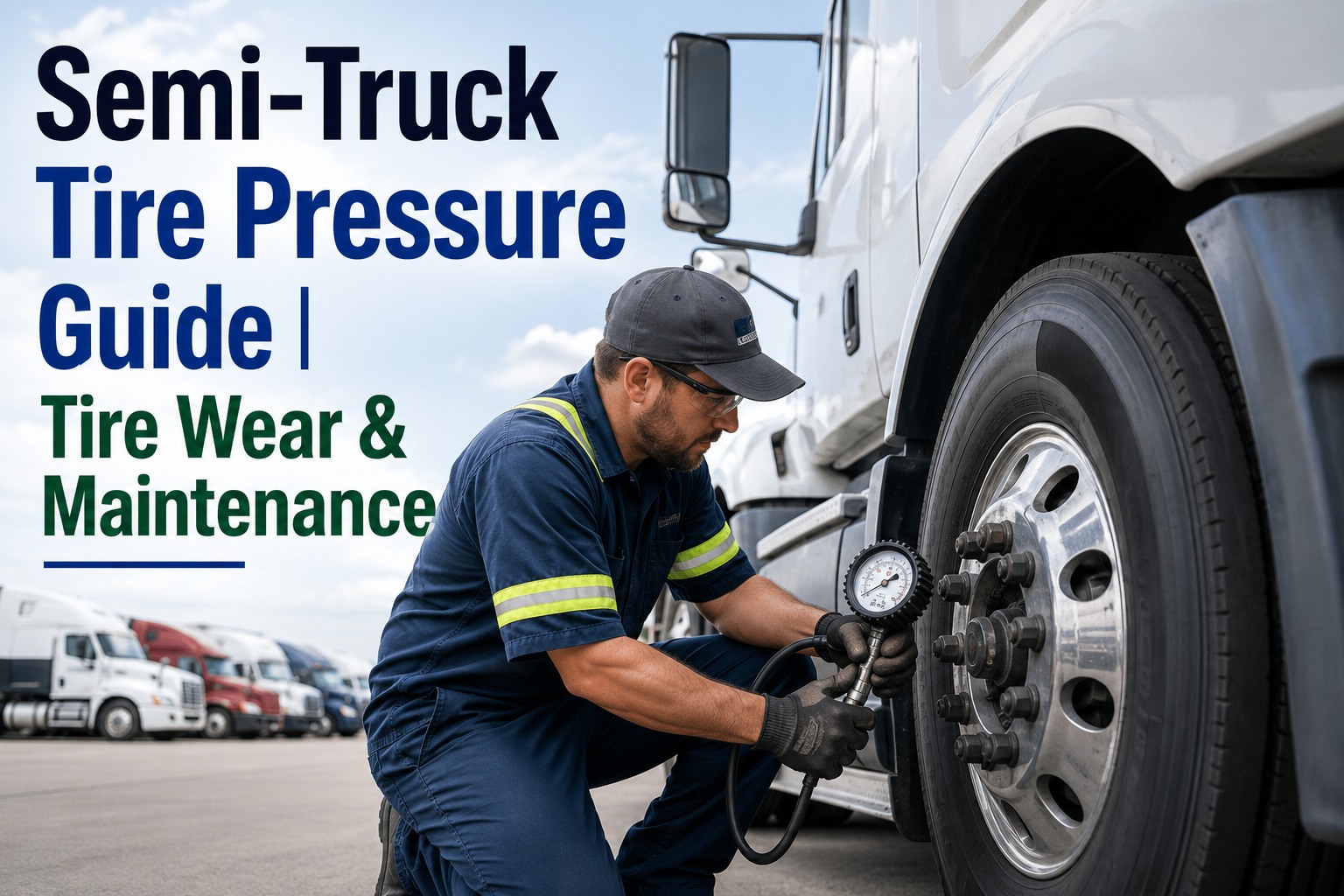
A worn semi-truck tire is a diagnostic readout, not just an expense. Shoulders worn on both edges while the center still has depth? That's underinflation, and the tire has been telling you for thousands of miles. Center worn while the shoulders look fine? Overinflation. Feathered edges you can feel by running a hand across the tread? Alignment. Scalloped dips around the circumference? Worn shocks. Every pattern maps to a specific mechanical cause, which means a tire you're about to throw away is also the cheapest diagnostic tool on the truck — and the one most fleets read only after they've already paid for the damage twice, once in fuel and once in premature replacement. Track tire pressure and wear free. This guide covers correct pressure by position, how to read every major wear pattern back to its root cause, the legal tread-depth minimums, and the inspection cadence that catches problems while they're still cheap.
Semi-Truck Tire Pressure and Wear: The Complete Guide
Every wear pattern has a cause you can fix. Learn to read tires like fault codes — pressure by position, pattern-to-root-cause diagnosis, legal tread limits, and the checks that catch problems before a blowout does.
What Underinflation Actually Costs
Pressure isn't a maintenance detail — it's the single variable that most affects tire life, fuel burn, and blowout risk. The numbers are stark, and the damage is invisible until it isn't.
Reading the Wear Pattern
This is the core skill. Each pattern points at a specific mechanical cause — diagnose it correctly and you fix the problem instead of replacing tires on a schedule dictated by a fault you never found.
Getting Pressure Right
The most common mistake in fleet tire management is running one pressure across every truck and every load. Correct pressure is a function of the weight that tire is actually carrying.
Inflate to the manufacturer's load-and-inflation chart for the weight actually on that axle. The number molded into the sidewall is a maximum, not a target.
Measure before driving, or after the truck has sat at least three hours. Heat from running raises pressure and hides an underinflated tire.
A pressure mismatch between paired duals makes one tire carry more than its share, wearing it faster and overloading the casing.
Pressure moves with ambient temperature, so seasonal swings need re-checking — a set-and-forget pressure drifts out of spec on its own.
Typical Pressure by Position
Each position does a different job and carries a different load. These are common operating ranges — treat them as orientation, and set actual pressure from your tire manufacturer's chart.
Carries steering control and directional stability. Underinflation here is the most dangerous — a steer blowout compromises control of the vehicle.
Transmits power to the road and provides primary traction. Dual pairs must be matched to each other to share load evenly.
Engineered for low rolling resistance and fuel economy. Often the most neglected position because it's furthest from the driver's routine.
The Wear Story Is Only Useful If Someone Records It
Reading a wear pattern once tells you about one tire. Recording it by position across the fleet tells you that unit 214's right steer has feathered twice in eighteen months — which is an alignment problem, not a tire problem. Truck Inspection & Maintenance captures tread depth and wear findings per position during pre-trip inspections, routes defects into work orders, and builds the per-vehicle history that turns a recurring pattern into a root cause you can actually fix.
Legal Tread Depth Minimums
Under 49 CFR 393.75, tread depth is measured in every major groove — and one shallow spot in one groove is a citation. Note the steer requirement is double the others.
Minimum in every major groove on front wheels of a truck, tractor, or bus. Measured at any point — one thin spot fails the tire.
The same rule applies, at half the depth. Readings can't be taken on a wear indicator or on debris.
Many safety-conscious carriers replace steer tires early, at around 5/32", to keep a margin above the legal floor.
The Causes Behind the Wear
Pressure gets the attention, but mechanical faults do quiet, relentless damage. These three account for most abnormal wear that isn't inflation-related.
Toe out of spec by even a sixteenth of an inch drags a tire sideways roughly eight feet for every mile driven — invisible, continuous wear. Align at least annually and after any curb strike, pothole hit, or component replacement.
The leading cause of cupping, and the most destructive irregular wear pattern there is. A tire that isn't held firmly against the road bounces, and each bounce scrubs rubber off in a scalloped arc.
Out-of-balance assemblies vibrate at highway speed and wear unevenly. Rebalance whenever tires are installed or rotated, and include bushings, bearings, and hub seating in every PM.
The Inspection Cadence
Tires are the most maintenance-intensive component on a commercial truck, and tire failures are among the most common causes of roadside breakdowns. A layered routine catches problems at each level.
What PSI should semi-truck tires be?
There isn't one correct number, and that's the most important thing to understand about commercial tire pressure. Typical operating ranges run roughly 100 to 110 psi for steer tires, 100 to 120 psi for drive tires, and 100 to 110 psi for trailer tires, but those are orientation figures only. The correct pressure is determined by the manufacturer's load-and-inflation chart for the weight actually being carried on that axle — not a single fleet-wide number, and definitely not the maximum pressure molded into the sidewall, which is a ceiling rather than a target. Fleets that run one pressure across every truck and every load are the ones that generate the most shoulder and center wear, because the same psi that's correct for a loaded run is wrong for a light one. Always measure cold, before driving or after the truck has sat at least three hours, since heat from running inflates the reading and masks an underinflated tire. Start a free trial to track pressure by position.
What does wear on both shoulders mean?
Both outer edges wearing faster than the center, with the center still holding good depth, is the signature of underinflation. When pressure is low the tire sags under load, shifting weight onto the edges of the contact patch and away from the center rib. It's most common on steer and drive tires, and it's especially prevalent in fleets that run a single inflation pressure regardless of load. The opposite pattern — center worn while the shoulders look fine — means overinflation, where the tire crowns and rides on its center rib with a reduced contact patch. Both conditions cut traction and shorten tire life, and underinflation additionally generates the excess heat that's the leading cause of blowouts. The fix in both cases is the same discipline: inflate to the load chart for the actual weight on the axle, check pressures cold, and verify TPMS calibration if equipped rather than trusting a sensor that may have drifted. Ask about wear pattern tracking.
What is the legal minimum tread depth?
Under 49 CFR 393.75, tires on the front wheels of a bus, truck, or truck tractor must have a tread groove pattern depth of at least 4/32 of an inch measured at any point on a major tread groove. Drive and trailer tires follow the same rule at a minimum of 2/32 of an inch in every major groove. Two details matter in practice: the measurement applies at any point, so a single shallow spot in a single groove is enough to earn a citation even if the rest of the tire looks fine, and readings can't be taken on a wear indicator bar or on debris lodged in the groove. The thin decoupling groove at the shoulder is excluded from the measurement. Because these are legal floors rather than safety targets, many carriers replace steer tires around 5/32" to keep a margin — steer tires directly affect vehicle control in an emergency, which makes running them to the legal minimum a poor trade. Start free and log tread depth per position.
What causes cupping or scalloped wear?
Cupping — scooped, scalloped dips spaced around the circumference of the tread — is most often caused by worn shocks, and it's the most destructive irregular wear pattern a tire can develop. The mechanism is straightforward: a shock absorber's job is keeping the tire pressed firmly against the road surface, and when it's worn the tire bounces slightly as it rolls. Each bounce scrubs rubber off in an arc, producing the characteristic scooped pattern. Out-of-balance wheel assemblies produce similar irregular wear along with vibration at highway speed. Worn bushings and wheel bearings contribute too, which is why shocks, struts, bushings, and bearings all belong in every preventive maintenance inspection rather than being checked only when something obviously fails. The important point is that cupping is never a tire problem — replacing the tire without replacing the shock simply starts the same process over on new rubber. Start free and catch suspension wear early.
How often should tire pressure be checked?
Weekly cold pressure checks are a realistic standard for most fleets, with more frequent checks during significant temperature swings since ambient temperature moves pressure on its own. That sits inside a layered routine: drivers should visually inspect tires before every trip for cuts, bulges, embedded debris, and obviously low tires as part of the pre-trip walkaround; tread depth and wear patterns should be measured and recorded at every preventive maintenance interval along with an inspection of shocks, bushings, and bearings; and alignment and balance should be checked at least annually and after any significant impact such as a curb strike or pothole. TPMS provides continuous monitoring and is well worth it on critical assets, though sensors need calibration checks rather than blind trust. The reason for this cadence is simple: tires are the most maintenance-intensive component on a commercial truck and among the most common causes of roadside breakdowns. Start free and schedule tire checks.
Stop Replacing Tires You Could Have Saved
Abnormal wear is a symptom, and the tire is telling you what's wrong. Truck Inspection & Maintenance records pressure and tread depth by position, captures wear findings during pre-trip inspections, routes defects into work orders, and builds the per-vehicle history that turns a repeating pattern into a diagnosed alignment or suspension fault — so you fix the cause instead of buying the same tire twice.