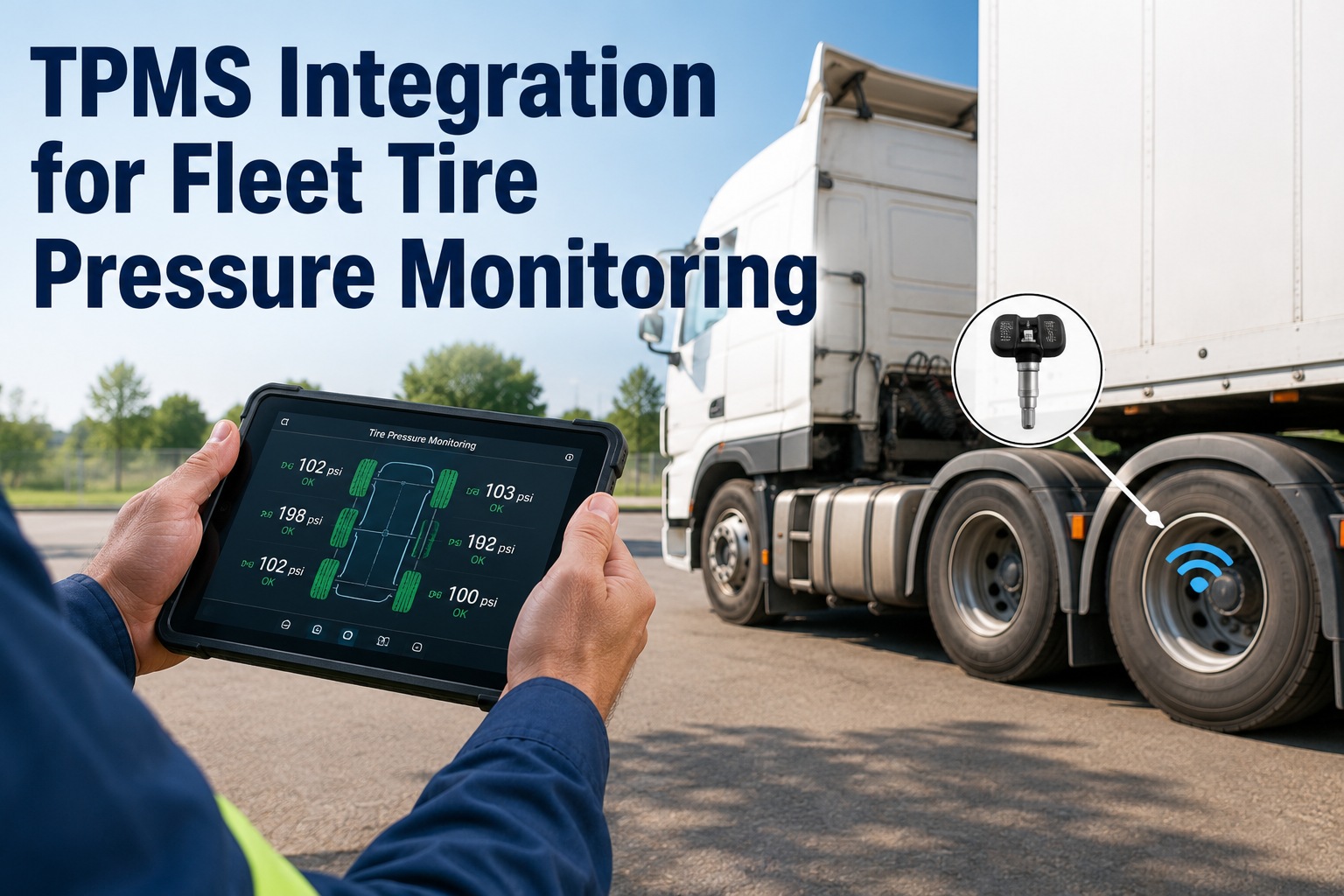
A driver in an 18-wheeler cannot see or feel a low tire on a 53-foot trailer. Eighteen tires, each carrying four to six thousand pounds at over 100 PSI, and the first sign of trouble is usually the blowout itself — the one that shreds the trailer underbody, damages cargo, and can trigger a multi-vehicle crash. It's no accident that the FMCSA lists tire issues as the number-one vehicle factor in large-truck crashes. And the ones that don't fail catastrophically fail quietly instead: every under-inflated tire silently burns extra fuel, sheds tread life, and inches toward the roadside service bill. Monitor every tire in real time free. Integrating TPMS sensors with Truck Inspection & Maintenance closes that visibility gap — live pressure and temperature from every wheel position, tiered alerts before a tire becomes a failure, automatic work orders, and predictive warnings weeks ahead of a blowout. This guide breaks down how the integration works, the pressure-fuel-safety math, and why tire data is the highest-ROI signal on the truck.
TPMS Integration for Fleet Tire Pressure Monitoring
See every tire before it fails. Stream live pressure and temperature from each wheel position into Truck Inspection & Maintenance — with tiered alerts, automatic work orders, and predictive warnings that catch a slow leak weeks before it becomes a blowout on the shoulder.
The Most Expensive Tire Is the One You Can't See
Tires rank as the third- or fourth-highest cost-per-mile line item for most fleets — but the sticker price of rubber is only part of it. The real cost hides in fuel waste, blowout damage, and downtime that a pressure gauge never captures until it's too late.
One Number, Three Costs
Tire pressure isn't just a safety metric — it's the single reading that drives fuel economy, tire life, and blowout risk all at once. Let a tire drift low and you pay on all three fronts simultaneously.
Every 1 PSI drop cuts fuel economy 0.2–0.3%; a 10 PSI drop costs about 2% — a nonstop tax on every mile.
A 10 PSI under-inflation strips 15–20% off tire life, forcing early replacement of your third-costliest line item.
Low pressure builds heat, and heat is what turns a tire into a blowout at highway speed — the top crash factor.
How the Integration Works
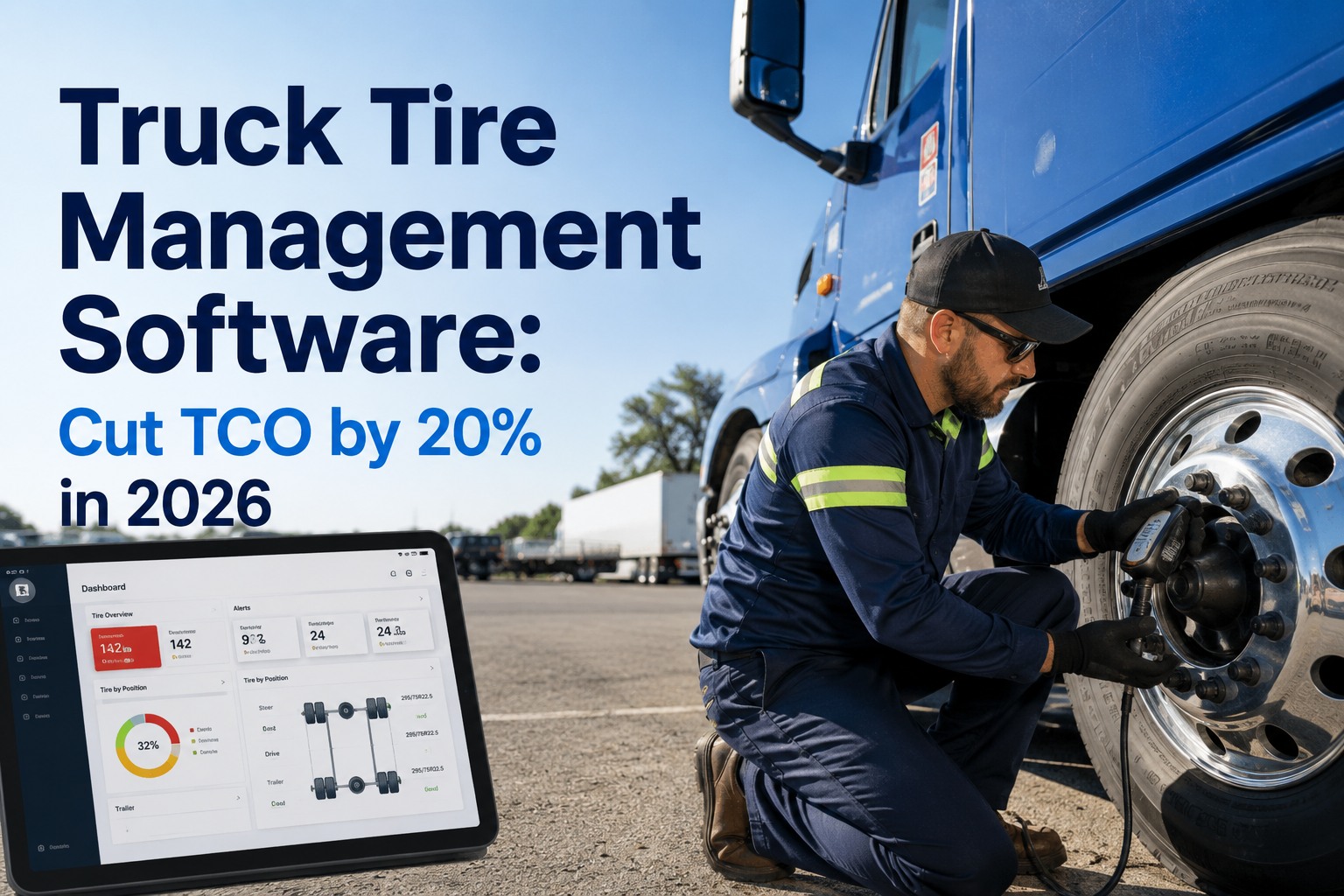
A sensor at each wheel position reads pressure and temperature continuously and sends it to the platform, which watches every reading against your thresholds — so a developing problem becomes an alert and a work order instead of a roadside surprise.
Alerts That Don't Get Ignored
The number-one reason TPMS deployments fail isn't the hardware — it's alert overload. Flood drivers with non-critical pings and they mute everything, including the alert that mattered. Tiered thresholds fix that by matching urgency to response.
Turn Tire Data Into Prevented Failures
Truck Inspection & Maintenance reads every tire's pressure and temperature in real time, grades each against tiered thresholds, alerts the right people, and fires a work order the moment a tire crosses the line — while storing every reading as roadside-ready maintenance evidence. The highest-ROI signal on the truck, finally acted on.
Predictive: Catch It Weeks Early
Standard TPMS warns you when pressure is already critically low — the last moment before failure. Connected to a maintenance platform that trends the data, tire signals become an early-warning system that reads the slope, not just the value.
A tire losing a pound every few days looks fine on any single reading. Trending the decline flags the slow leak one to three weeks before a standard low-pressure warning would ever trip.
Different wear or pressure-differential rates between the left and right tires on an axle point to alignment or suspension trouble — often detectable four to six weeks before a driver feels a pull or vibration.
A tire running hotter than its neighbors signals a dragging brake, bearing, or internal damage — heat being the precursor to the blowout, caught before it happens.
What It Monitors
Each data point the integration reads protects a different slice of tire economics — from the daily fuel bill to the catastrophic failure.
Real-time PSI at every wheel position across the full commercial range, matched to each tire's target.
Per-tire heat readings that expose the thermal buildup preceding a blowout and flag dragging brakes.
Pressure history per tire reveals slow leaks and gradual loss long before a single reading looks alarming.
Side-to-side and axle comparisons surface the alignment and load issues behind uneven tire wear.
Every reading, alert, and repair logged per tire — a roadside-ready record under 49 CFR 396.3.
Pressure, heat, trends, and repairs on every wheel position — the complete tire picture per asset.
Start free →Tire Data Is Compliance Data
Tire condition isn't just an economics question — it's a roadside inspection item with real CSA weight. Continuous monitoring turns that liability into documented proof.
FMCSA pre-trip rules require drivers to check tire condition; continuous TPMS is the most reliable way to satisfy that every day.
Catching a tire before it hits CVSA out-of-service criteria keeps trucks rolling and off the CSA record — where flat/low tires carry a severity weight of 2.
Every pressure reading and service action is stored under 49 CFR 396.3 and accessible at roadside, giving inspectors auditable evidence instantly.
A timestamped tire-health history is powerful evidence of due diligence if a tire-related incident ever reaches a courtroom.
Frequently Asked Questions
Three ways, all at once. It prevents blowouts, which cost $2,000 to $8,000 per event in cargo damage, roadside service, and downtime; it extends tire life by 15 to 25 percent through proper inflation, directly cutting your third- or fourth-largest cost-per-mile line item; and it improves fuel economy by 1 to 3 percent, since every 1 PSI of under-inflation burns 0.2 to 0.3 percent more fuel. For a 50-truck fleet, that adds up to roughly $87,000 to $175,000 a year in recovered waste, which is why the North American Council on Freight Efficiency rates TPMS with a high-confidence ROI of under one year. Start a free trial to capture those savings.
A basic TPMS light warns you only when pressure is already critically low — the last moment before failure, with no history and no context. Integrating sensors with a maintenance platform changes that in two ways. First, it trends every tire's readings over time, so it catches a slow leak one to three weeks before a standard warning would trip, and spots alignment issues from wear differentials four to six weeks early. Second, it turns an alert into action — an automatic work order, a logged compliance record, and tiered notifications that reach the right person. The dash light tells the driver; the integration tells the whole maintenance operation and documents it. See predictive tire monitoring.
Not with tiered alerting, which is specifically designed to prevent the alert fatigue that sinks most TPMS deployments. Instead of one undifferentiated alarm for everything, readings are graded into clear tiers: a normal reading just logs to the dashboard, a low tire prompts adding air at the next stop, a critical reading triggers an in-cab alert plus a manager notification with a 24-hour service window, and an out-of-service condition sets off an immediate alarm to stop the truck. Because urgency matches response, drivers learn that when an alert does sound, it means something — so they act on it instead of muting it.
Yes. A standard 53-foot semi trailer has eight tire positions, and monitoring the tractor too adds around ten more, so the integration is built to handle every wheel position across the combination — commonly 14 to 18 sensors or more. Each reading is matched to its exact position, so the dashboard shows precisely which tire needs attention rather than a vague fleet-level warning. Commercial tires run at 100 to 120 PSI, well above consumer ranges, and the supported sensors cover the full commercial pressure range so every tire on a heavy rig is accurately monitored. Start free and map your wheel positions.
Tire condition is a roadside inspection item with real CSA consequences — a flat or dangerously low tire is an out-of-service violation carrying a severity weight of 2. FMCSA pre-trip requirements obligate drivers to check tire condition, and continuous TPMS is the most reliable way to meet that obligation every single day. The integration stores every pressure reading, alert, and service record under 49 CFR 396.3, and those records are accessible at roadside through a mobile app, giving an inspector auditable maintenance evidence on the spot. That same timestamped history is strong proof of due diligence if a tire-related incident ever leads to litigation. Start free and build the record.
Stop Losing Tires You Never Saw Coming
Truck Inspection & Maintenance connects your TPMS sensors for real-time tire monitoring across every wheel position — tiered alerts that drivers actually act on, automatic work orders, predictive slow-leak and alignment warnings, and roadside-ready compliance records. Cut the fuel waste, prevent the blowout, and turn tires from a runaway expense into a managed asset.