Truck cab climate control occupies an unusual position in commercial fleet operations: it's simultaneously a driver wellbeing system, a federal safety compliance item, and a heavily EPA-regulated service category — and fleet managers commonly confuse which rules apply to which component. The most cited misconception: "AC is required by DOT." It isn't. FMCSA does not list air conditioning as required safety equipment in 49 CFR Part 393, so a broken AC alone is not a DOT violation. What FMCSA does require under §393.79 is a functional windshield defroster — and if the broken AC also disables the defroster, that becomes a DOT violation. This distinction matters operationally: a fleet skipping AC service to save cost may be technically DOT-compliant but still create driver health risks, anti-idle violations (most state laws exempt idling above 75°F for AC operation), and EPA exposure if refrigerant work is performed by uncertified technicians.
The regulatory landscape shifted significantly through 2024-2026. EPA's Section 609 certification under the Clean Air Act has long required certified technicians for any motor vehicle air conditioning (MVAC) service, but the refrigerant transition raised the stakes: R-134a (which dominated for two decades, GWP of 1,430) is being phased down in favor of R-1234yf (HFO-1234yf, GWP of 4 — a 99.7% reduction in greenhouse warming potential). R-1234yf is classified ASHRAE A2L (mildly flammable) and requires SAE J2843-certified service equipment, separate from R-134a equipment. Mixed fleets running both refrigerant types need J3030-certified dual machines and trained technicians on each. Illegal venting of refrigerant and uncertified service produce significant EPA fines, while compliant fleets document technician 609 certifications, refrigerant purchases by date/type/amount, and per-job service logs.
This guide is the complete truck cab HVAC inspection checklist for 2026: the 6-system inspection framework, the critical defrost vs AC regulatory distinction, R-134a vs R-1234yf refrigerant handling, EPA Section 609 service compliance, and the driver health and safety considerations that make HVAC more than a comfort issue. Start your free trial of our truck inspection and maintenance software to deploy HVAC inspection templates with EPA service record tracking — live in 10 minutes, free for up to 3 trucks.
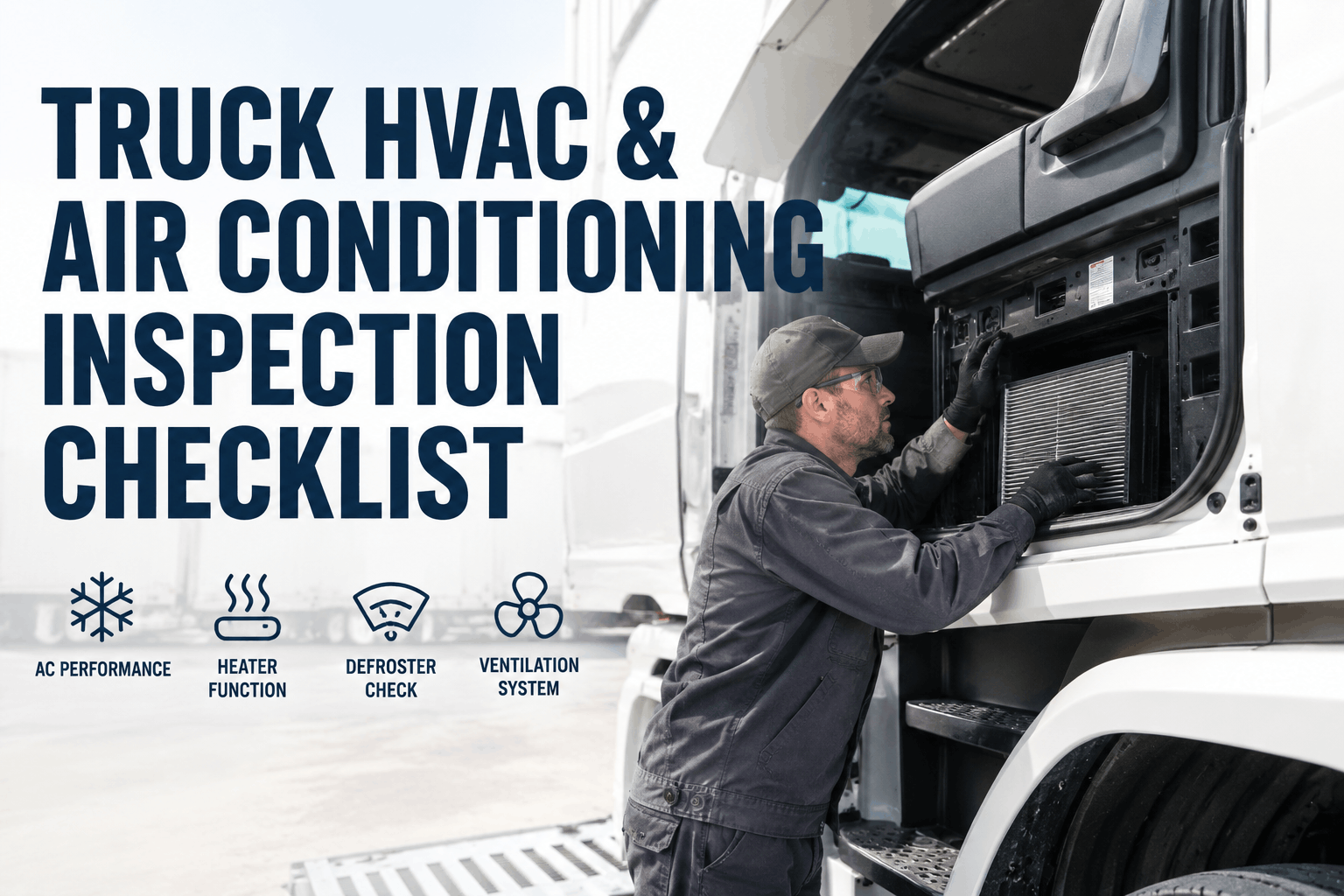
Truck HVAC & Air Conditioning Inspection Checklist
The 6-System HVAC Inspection Framework
Every cab climate inspection covers these 6 systems. Each has different failure modes, different inspection criteria, and different regulatory implications. Contact our sales team for help deploying HVAC inspection templates.
01 AC Cooling System
02 Heater System
03 Defroster — §393.79 MANDATED
04 Ventilation
05 Controls & Thermostat
06 Refrigerant & EPA Compliance
The Defrost vs AC Regulatory Distinction
This is the most-misunderstood HVAC compliance point in commercial trucking. Knowing the difference between what FMCSA requires versus what EPA regulates versus what's purely operational changes how you prioritize maintenance.
FEDERALLY REQUIRED
NOT FEDERALLY REQUIRED
The practical implication: a fleet operating in warm climates without functional AC isn't violating FMCSA rules, but creates real operational problems — driver heat stress reducing alertness, anti-idle violations (most state laws exempt idling above 75°F for AC), driver retention impact, and worker safety obligations under OSHA general duty clause. AC isn't a compliance item, but it's an operational one.
R-134a vs R-1234yf — The Refrigerant Transition
The refrigerant landscape is mid-transition through 2026. Most pre-2017 trucks use R-134a; newer trucks use R-1234yf. Fleets running mixed-vintage equipment must handle both — with different equipment and EPA Section 609 certification covering both refrigerants.
| Attribute | R-134a (Legacy) | R-1234yf (Current) |
|---|---|---|
| EPA status | Being phased down | Current standard |
| GWP (Global Warming Potential) | 1,430 | 4 |
| ASHRAE safety class | A1 (non-flammable) | A2L (mildly flammable) |
| Service equipment standard | SAE J2788 | SAE J2843 |
| Service fittings | R-134a unique | R-1234yf unique (no cross-contamination) |
| Common vehicle vintage | Pre-2017 trucks | 2017+ trucks (light-duty), heavy-duty growing |
| Per-pound cost (2026) | $20-$40 typical | $70-$150 typical |
Mixed fleets need SAE J3030-certified equipment that handles both refrigerants. Cross-contamination between R-134a and R-1234yf systems destroys both — service fittings are deliberately different sizes to prevent it. EPA 609 certification covers both refrigerants for the technician. Documentation requirements: technician 609 certification on file, refrigerant purchase records (date, type, amount, source), per-job service log (date, technician, refrigerant recovered/added, system serviced).
Driver Health & Safety Considerations
HVAC inspection isn't just compliance — it's driver wellbeing. Heat stress, hypothermia, and air quality issues all degrade driver performance and increase accident risk.
Heat Stress (Summer)
Hypothermia & Cold (Winter)
Carbon Monoxide Intrusion
Cabin Air Quality & Filtration
Anti-Idle Law Interaction
Frequently Asked Questions
Is a broken air conditioner a DOT violation on a commercial truck?
No — FMCSA does not list air conditioning as required safety equipment under 49 CFR Part 393. A broken AC by itself is not a DOT violation and will not result in an out-of-service order. However, there's an important caveat: if the broken AC also disables the windshield defroster, that IS a violation under 49 CFR §393.79 which requires a functional defrosting system. AC and defrost share many components (refrigerant lines, blower motor, evaporator), so AC failures can disable defrost. Even though AC alone isn't a compliance issue, fleets still service it for operational reasons: driver heat stress affects alertness and reaction time, most state anti-idle laws exempt idling above 75°F for AC operation, and driver retention significantly correlates with cab comfort. Start your free trial to deploy HVAC inspection workflow.
Who can legally service truck air conditioning?
Only technicians holding current EPA Section 609 certification under the Clean Air Act may service Motor Vehicle Air Conditioning (MVAC) systems on commercial trucks. This applies to any work involving refrigerant — recovery, recycling, recharging, or repairs affecting refrigerant containment. Section 609 certification is technician-specific (not shop-wide), administered through EPA-approved organizations, and doesn't expire (no renewal required). Fleet operators must maintain documentation of: technician 609 certifications on file, refrigerant purchase records (date, type, amount, supplier), and per-job service logs (date, certified technician name, refrigerant recovered/added, work performed). EPA fines for illegal venting and uncertified service can be severe. Drivers and operators may inspect AC operation (turning it on, observing performance) without certification — only refrigerant work requires it.
What's the difference between R-134a and R-1234yf refrigerant?
R-134a (HFC-134a) was the dominant automotive refrigerant from the mid-1990s through the 2010s, but it's being phased down due to a high Global Warming Potential of 1,430. R-1234yf (HFO-1234yf) is the current EPA-acceptable standard with a GWP of just 4 — a 99.7% reduction in greenhouse impact. R-1234yf is classified ASHRAE A2L (mildly flammable, requires specific service procedures), while R-134a is A1 (non-flammable). Service equipment differs: R-1234yf requires SAE J2843-certified machines, R-134a uses SAE J2788, and dual-refrigerant operations need SAE J3030 equipment. Service fittings are deliberately different sizes to prevent cross-contamination — mixing the two destroys both systems. Most pre-2017 trucks use R-134a; 2017+ vehicles increasingly use R-1234yf. Per-pound cost is significantly higher for R-1234yf ($70-$150 vs $20-$40), making leak prevention more economically important. Contact our sales team for refrigerant service workflow.
How often should truck HVAC be inspected?
HVAC inspection follows a tiered schedule. Daily pre-trip: defrost function check (especially in winter — required by §393.79), heater/AC operation verification, blower function. Weekly: cabin air filter visual, listen for unusual blower or compressor noise. Monthly: cabin air filter condition check, refrigerant pressure observation, condenser cleanliness. Twice yearly (spring/fall): comprehensive HVAC service — pre-summer AC inspection in spring (April-May) and pre-winter heater inspection in fall (September-October). The seasonal timing matters: AC problems discovered in July are emergency service at peak demand; heater problems discovered in December strand drivers in cold. Cabin air filter replacement at OEM-recommended intervals (commonly 15,000-30,000 miles). Defrost function should be tested before any winter operation, particularly after summer when defrost mode hasn't been used for months and components may have settled.
What does it cost to fix common truck HVAC problems?
Costs vary significantly by component and refrigerant type. Refrigerant recharge alone: $200-$500 for R-134a, $400-$1,200 for R-1234yf. Cabin air filter: $40-$120 parts + 15-30 minutes labor. Blower motor replacement: $300-$700. Compressor replacement: $800-$2,500 depending on truck. Condenser replacement: $400-$1,500. Heater core replacement: $600-$2,500+ (labor-intensive because dash often needs removal). Evaporator replacement: $1,000-$3,000 (similar dash-removal labor). The most expensive component to fix wrong is the refrigerant system itself — repairs by uncertified technicians can void warranty, fail EPA documentation, and create cross-contamination if R-134a and R-1234yf systems aren't kept separate. Always use EPA Section 609 certified service. Sign up free to track HVAC service costs across your fleet.
What's the most overlooked item in cab HVAC inspections?
Two tie for first. (1) Carbon monoxide intrusion from exhaust system leaks — exhaust pipes that have developed leaks ahead of or beside the cab can introduce CO through the fresh air intake. CO is odorless, causes drowsiness and impaired judgment, and reaches dangerous levels without warning. Inspect exhaust integrity during HVAC checks, especially after winter when corrosion accelerates. (2) Heater core leak warning signs — sweet coolant smell in cab, windshield fogging that won't clear, mysterious coolant loss without external leaks, oily film on inside of windshield. Heater core leaks worsen quickly and can leave drivers stranded in cold weather while simultaneously losing engine coolant. Other commonly overlooked items: cabin air filter (often never replaced), condenser fins (clogged with bugs and debris reducing cooling), refrigerant cap condition (cracked caps allow moisture intrusion that destroys systems), and blower wheel cleanliness (dust accumulation reduces airflow and worsens air quality). Talk to our sales team for comprehensive HVAC inspection templates.