Modern common-rail diesel engines run injector clearances of 1 to 3 microns — one-thirtieth the width of a human hair — at pressures north of 30,000 PSI. Diesel fuel isn't just what those systems burn; it's what lubricates every precision surface as fuel moves through the pump, rail, and injectors. Water changes that equation completely. Water has none of diesel's lubricity, corrodes ferrous and non-ferrous metals on contact, breeds microbial "diesel bug" colonies inside the tank, and flash-vaporizes on hot metal surfaces to pit the very components it just corroded. The frustrating part is that most water-in-fuel problems don't come from a single dramatic event. They come from small, repeated ingress — condensation on humid nights, damaged fill caps, contaminated bulk deliveries, aged water separators — that accumulates over months and destroys a $2,500 injector set, a $4,000 HPCR pump, or a $6,000 rail system before anyone notices the fuel filter has been slowly turning gray. This guide covers how water actually gets into diesel fuel, the seven symptoms drivers report before catastrophic failure, the damage cascade through the fuel system, the prevention practices that keep water out in the first place, the repair sequence when contamination is confirmed, and how Truck Inspection & Maintenance software turns fuel filter drains and water separator checks into tracked, scheduled events instead of forgotten line items. Ready to catch water in fuel before it destroys an injector set? Start a free trial of Truck Inspection & Maintenance, or contact our support team for a walkthrough.
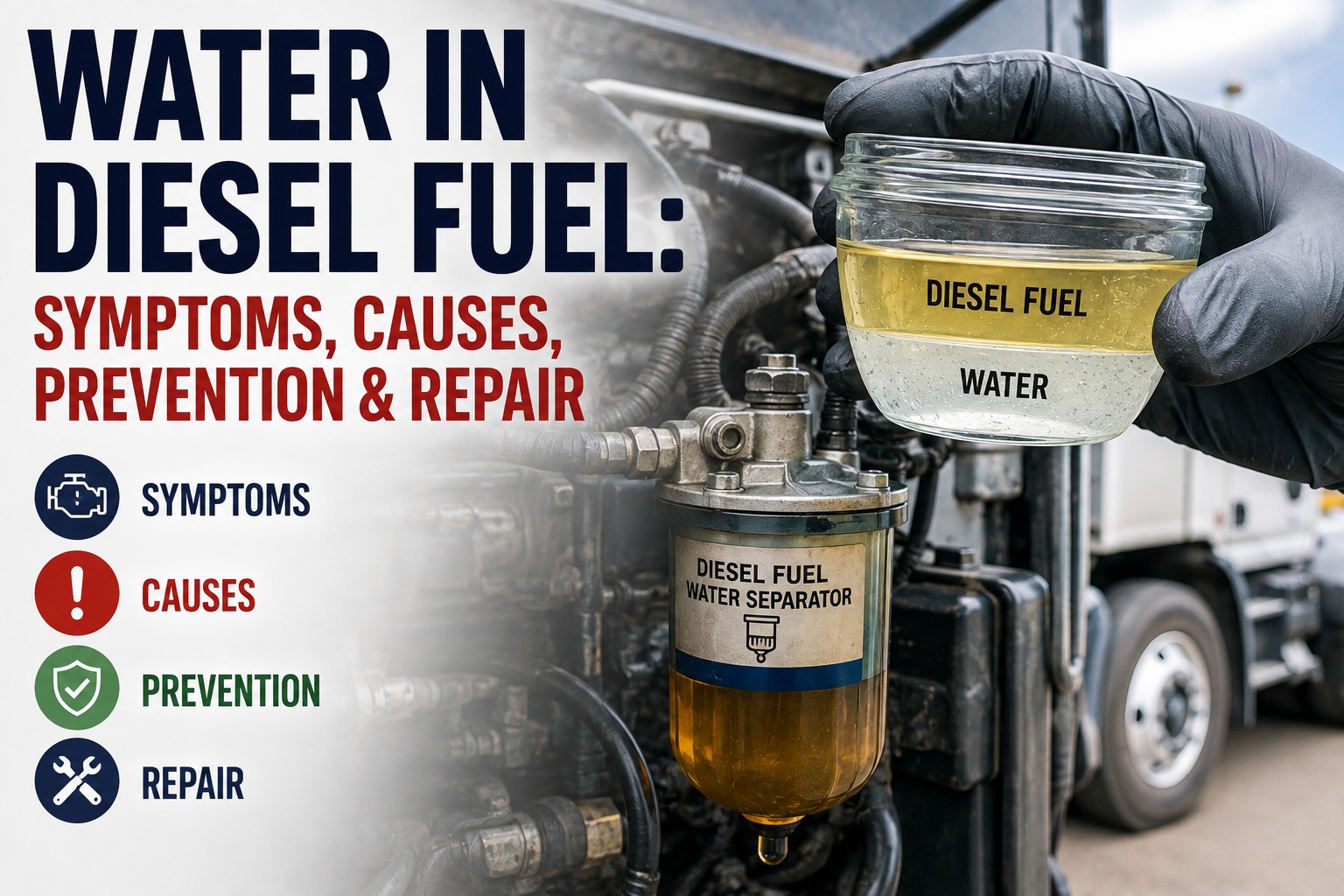
Water in Diesel Fuel: Symptoms, Causes, Prevention & Repair
The most destructive contaminant in a modern diesel engine — and the one most fleets don't spot until the injector invoice arrives.
How Water Actually Gets Into Diesel Fuel
Water contamination isn't one problem. It's five separate pathways, each with its own frequency and prevention strategy. Understanding the source is half the fix.
The 7 Symptoms Drivers Report First
Water contamination announces itself through a specific pattern of drivability complaints. Train drivers to escalate these seven — every one is a diagnostic trigger, not a tolerate-it problem.
The Damage Cascade: What Water Actually Destroys
Water doesn't damage the fuel system in one place. It cascades through every precision component in sequence — and the cost climbs at each stage. Understanding the chain explains why prevention beats repair every time.
How Water Damages Precision Components (Physics)
Water attacks the fuel system through five distinct mechanisms simultaneously. Each one destroys different parts in different ways — which is why water-in-fuel damage is so hard to isolate to a single component.
Turn water separator drains into a tracked, scheduled event
DVIR-driven fuel filter drain checks. Water separator sensor codes routed to maintenance. Fuel delivery lot tracking. Truck Inspection & Maintenance software makes contamination visible before it costs an injector set.
Prevention: The Five Practices That Keep Water Out
Every water-in-fuel prevention strategy comes down to five practices. Do them all, and water contamination becomes rare. Skip any one, and you'll see it eventually.
The Repair Sequence: What Happens After Water Is Confirmed
If water contamination is confirmed, the repair follows a specific sequence. Skipping steps guarantees recontamination and repeat failures. Here's the correct order.
The Cost Comparison: Prevention vs. Repair
Here's what the numbers actually look like at each stage of intervention. Every dollar spent on prevention prevents 100 spent on downstream repair.
Frequently Asked Questions
Seven main symptoms: hard starting or extended cranking, rough idle with random misfires, loss of power under load, water-in-fuel dashboard warning light, white smoke from a warm engine (not cold-start smoke), rising fuel consumption, and clogged fuel filters or slime in the water separator sump. Any single symptom is worth diagnosing; two or more together strongly indicate water contamination. Truck Inspection & Maintenance software captures these driver-reported symptoms at DVIR and routes them to maintenance immediately.
Five main pathways: tank condensation from temperature swings on partially filled tanks (the most common source), contaminated bulk deliveries from suppliers that didn't filter properly, damaged fuel caps or tank vents letting rain and moisture in, poorly maintained on-site yard bulk storage, and biodiesel blends absorbing atmospheric moisture. Humid climates, idle-heavy duty cycles, and older tank systems all accelerate water accumulation.
Water attacks the fuel system through six mechanisms simultaneously: lubricity loss (water has about 1/40th the lubricity of diesel), corrosion of steel and non-ferrous metals, pitting from water flash-vaporizing on hot surfaces, etching from water-induced sulfuric acid formation, microbial "diesel bug" growth at the fuel-water interface, and abrasive wear from rust particles carried through the system. Damage cascades from tank rust ($300–$1,500) up through HPCR pump destruction ($2,500–$5,500) and injector set replacement ($3,500–$9,000). Contact our team to see how the software tracks fuel system health.
Small amounts caught early are removed by draining the water separator sump — every pre-trip, every DVIR. Once water has reached the tank in quantity, the correct sequence is: stop operating the truck immediately, drain and flush the tank completely, replace all fuel filters and the separator element, inspect the lift pump and HPCR pump for damage, run an injector return-flow test to check for internal leakage, refill with verified fresh fuel from a different source, prime the system, then recheck the separator at 500 miles to confirm no continuing ingress.
Five practices work together: keep tanks full at end of shift to minimize condensation headspace, drain water separators daily at every pre-trip, inspect and replace worn fuel caps and vents at every PM, vet your fuel supply chain and request lot documentation on bulk deliveries, and maintain yard bulk storage with desiccant vents, sealed manways, and monthly water testing. No single practice is enough — the whole set is what keeps water out of the fuel system reliably.
No. Every mile driven with confirmed water contamination extends damage downstream through the fuel system. Water reaching the HPCR pump destroys precision surfaces in hours, not weeks. Water reaching the injectors ruins spray patterns and needle seats permanently. What starts as a $400 filter-and-flush job becomes a $10,000+ fuel system rebuild very quickly. Park the truck at the first confirmed water-in-fuel warning and diagnose before further operation. Try free: sign up here.
Truck Inspection & Maintenance software catches water in fuel before it destroys an injector set
Water separator drain tasks on every DVIR. Fuel filter service intervals per truck. Water-in-fuel warning codes routed straight to maintenance. Bulk delivery lot tracking and sample records. Injector return-flow test history per unit. Cost-per-mile visibility at the fuel system level. Everything a fleet needs to keep water out of the fuel and injectors alive to design life — one platform, one workflow, one source of truth.