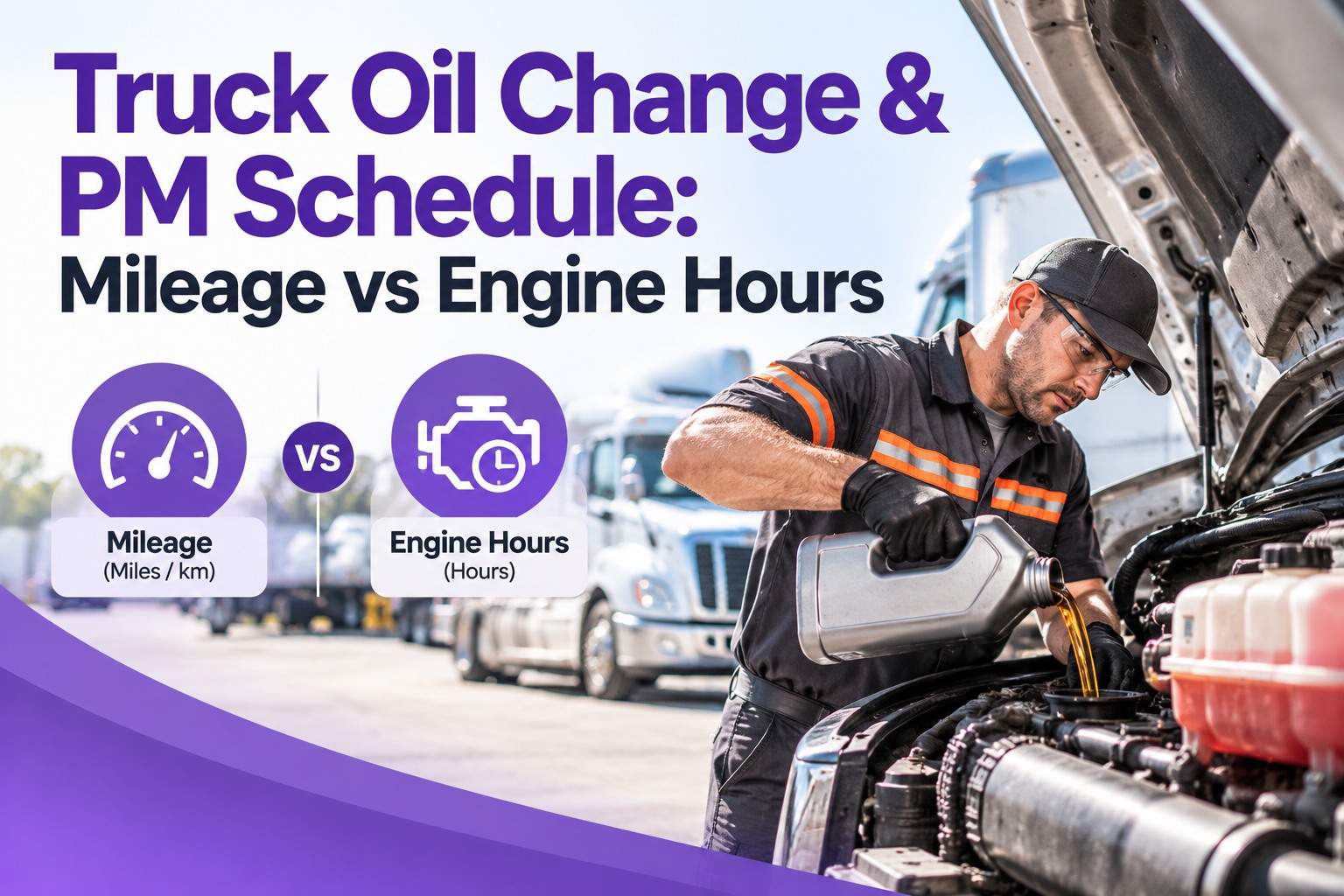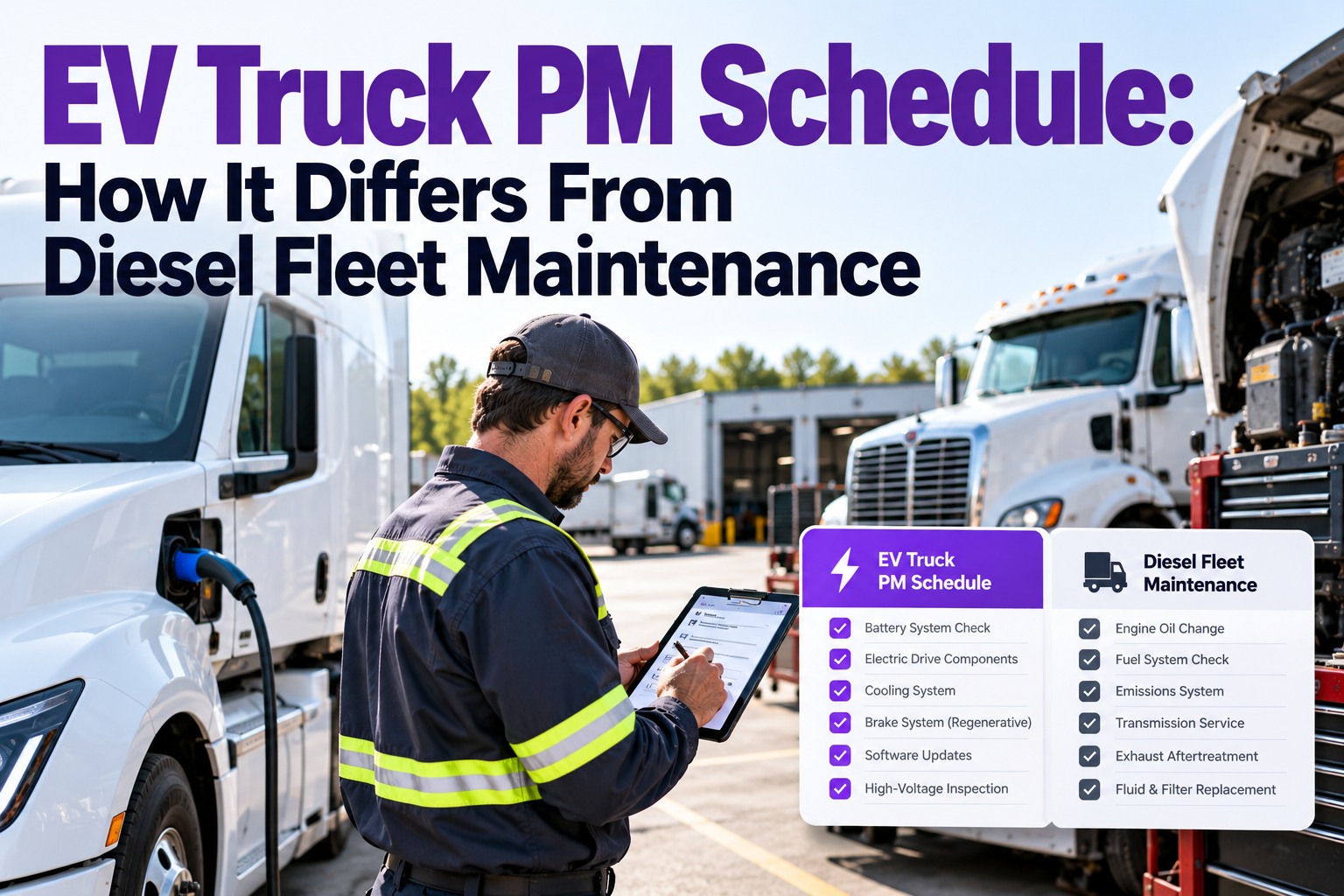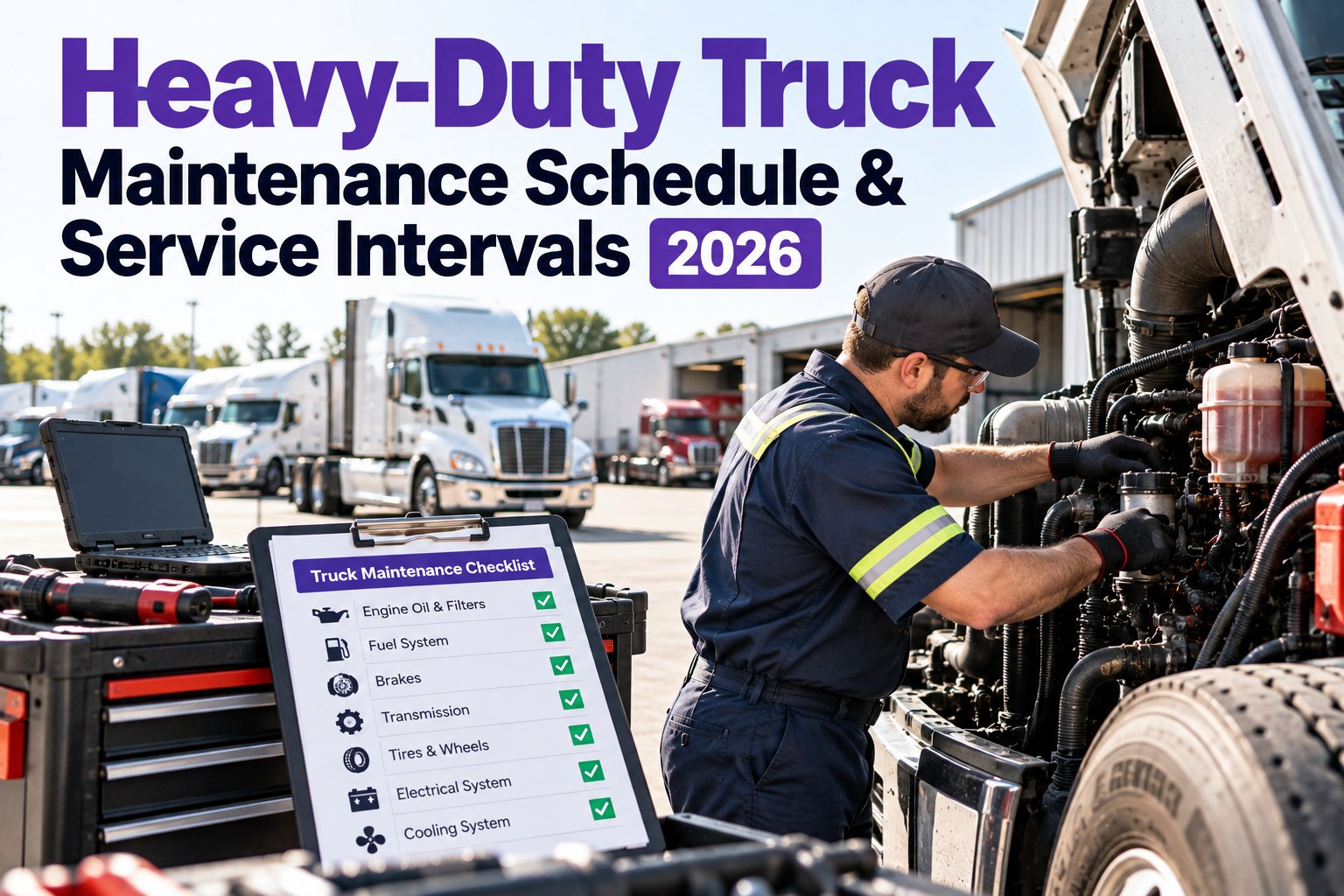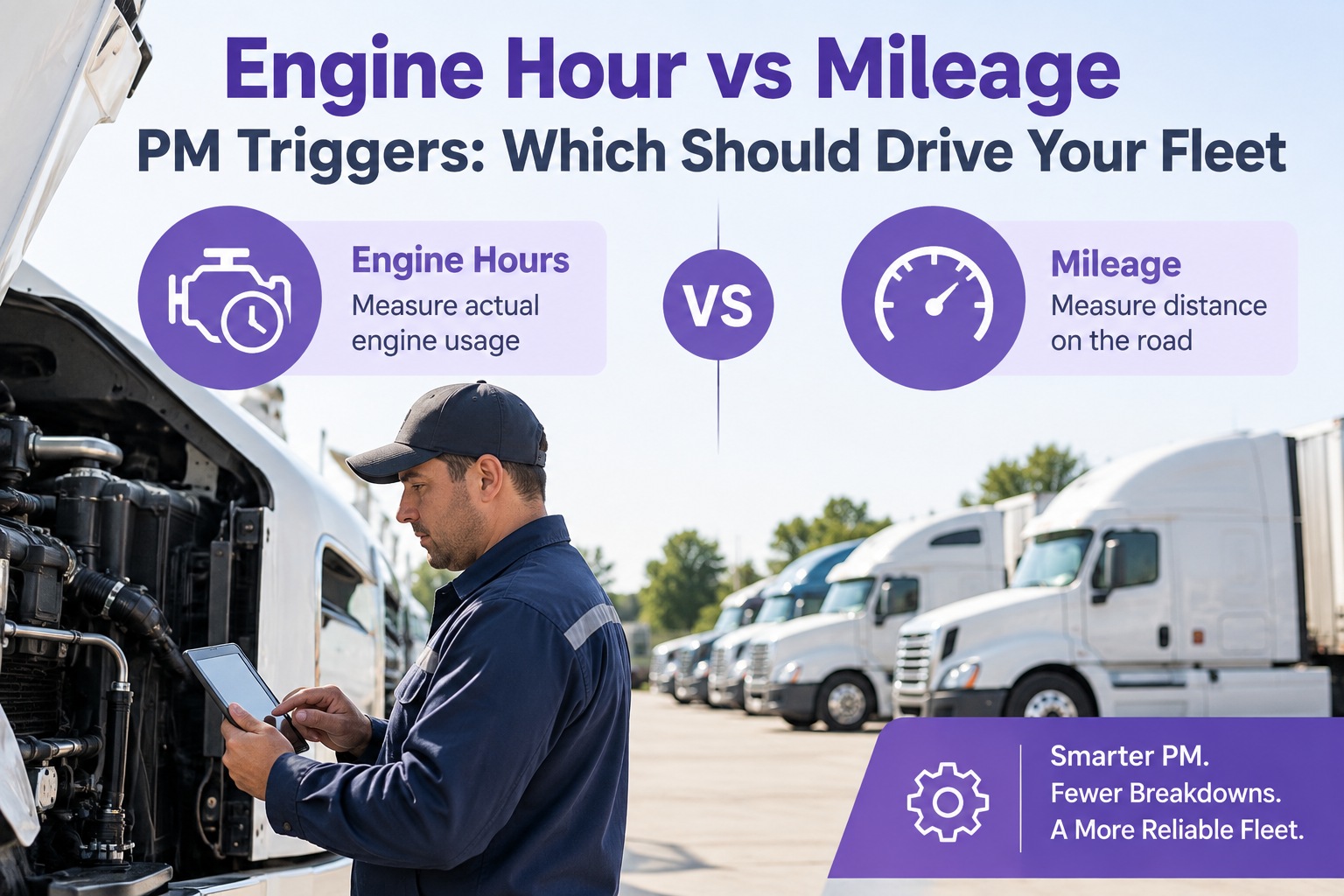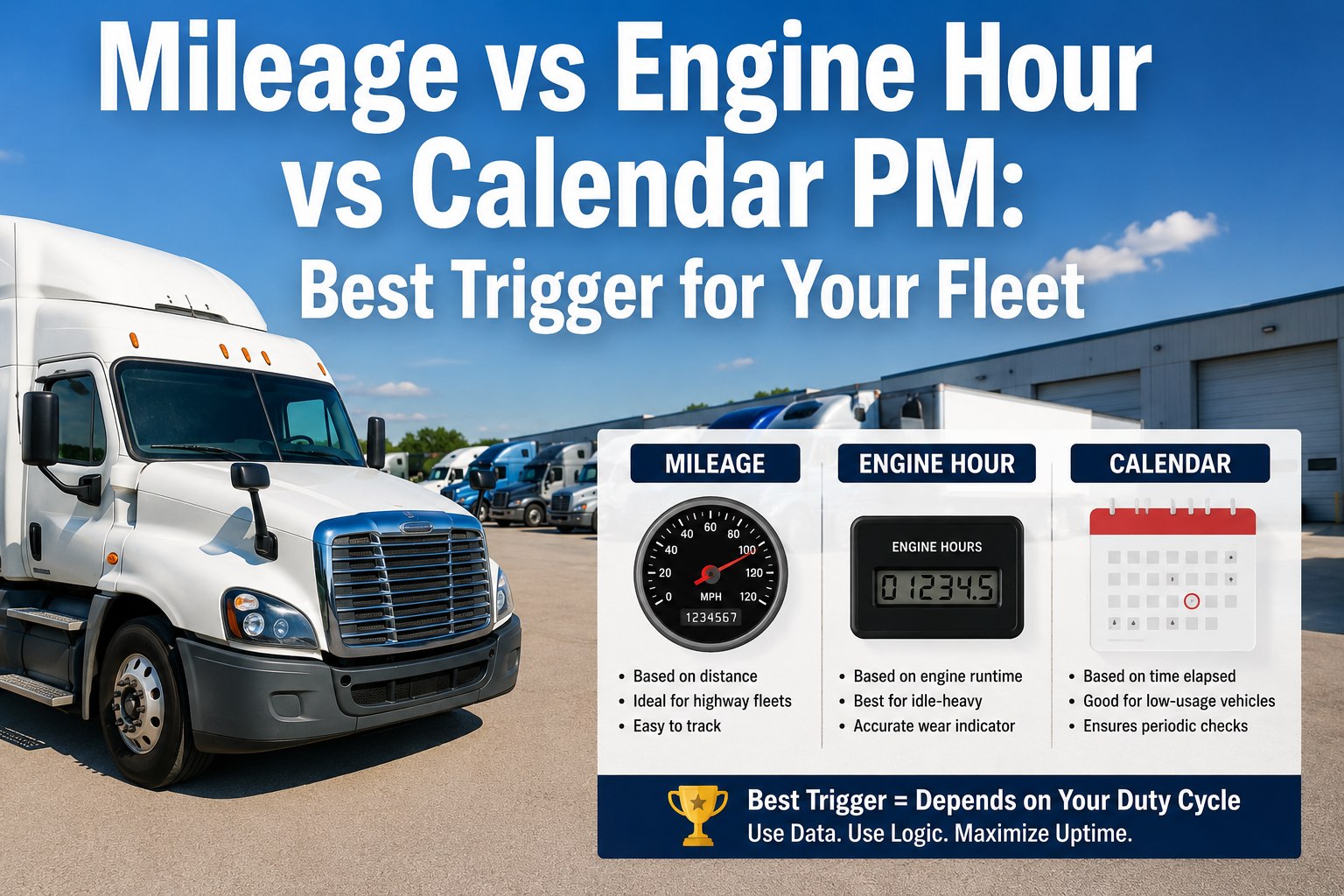
The most expensive PM interval is the one that fires for the wrong reason. A long-haul Class 8 running 120,000 miles a year gets over-serviced when the shop schedules on calendar time — the oil is fine at 30 days but the truck did 12,000 miles, so the interval already passed on mileage. A refuse truck running 25,000 miles a year but idling 40% of its shift gets catastrophically under-serviced on mileage — the engine has burned through 1,800 operating hours' worth of oil while the odometer barely moved. A rental fleet where trucks sit for weeks at a time gets under-serviced on both mileage and hours — the oil degrades chemically on the calendar even without the engine running. The fix is not picking one trigger and applying it fleet-wide. The fix is understanding that mileage, engine hours, and calendar time each measure a different kind of wear, and modern fleets run all three triggers in parallel with a "whichever comes first" rule that catches every dimension of degradation on every truck. Fleets that get this right report 45% fewer breakdowns, 28% lower repair costs, and PM compliance rates above 95%. Fleets that get it wrong burn 15–30% of their maintenance labor budget over-servicing highway units while missing wear on vocational units — the exact scenario CSA reviewers flag during compliance audits. This guide breaks down the three trigger types, the duty-cycle profiles each one fits, the first-to-occur hybrid model that catches everything, the OEM interval baselines you can start from, the real-world engine-hour-to-mileage conversion math, and how the free Truck Inspection & Maintenance app tracks all three triggers simultaneously per vehicle so no PM ever gets missed. Start free for up to 3 vehicles or contact our team for larger fleet rollouts.
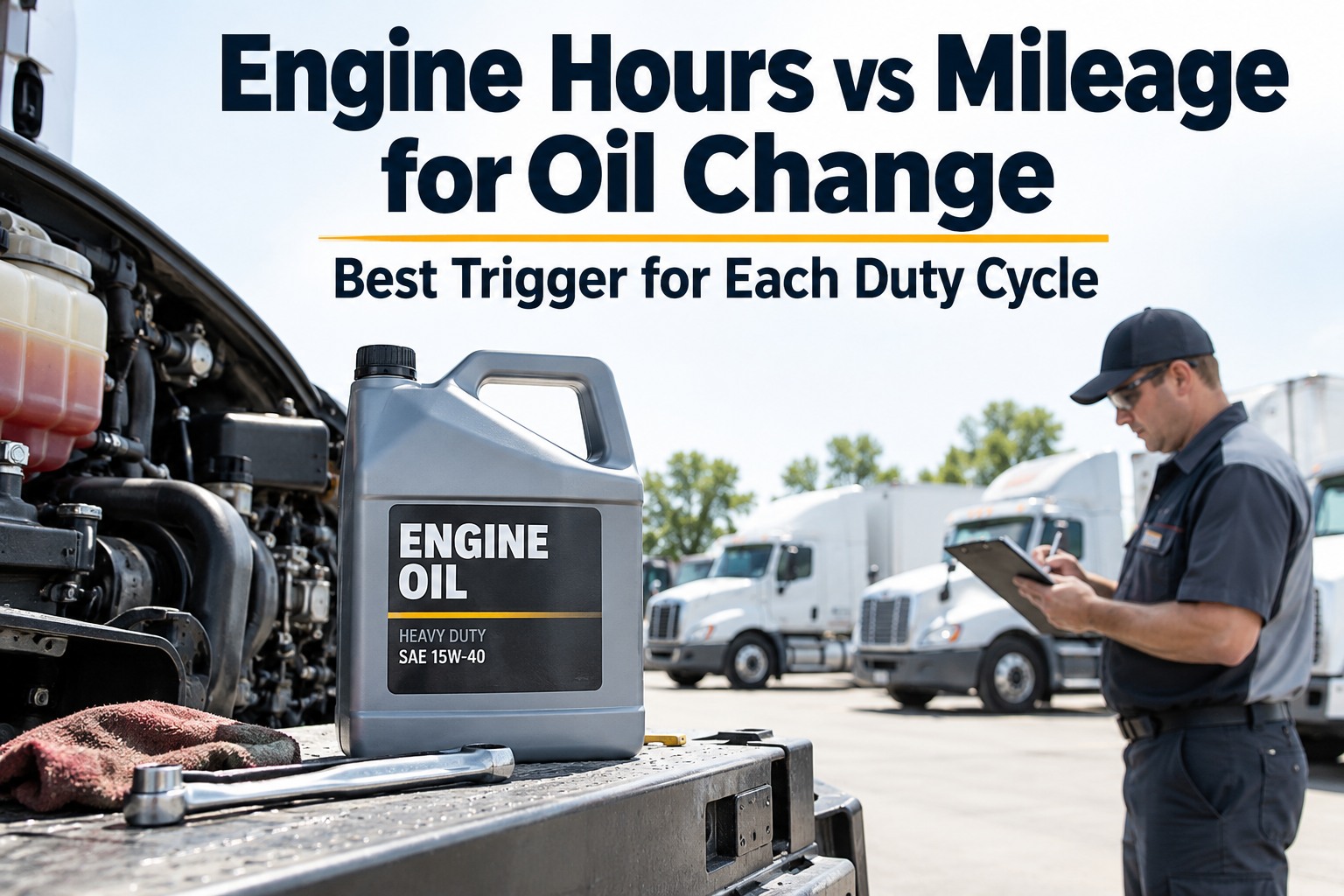
Mileage vs Engine Hour vs Calendar PM — Best Trigger for Your Fleet
Three triggers, three different measures of wear. Get the match right and PM compliance climbs above 95%; get it wrong and you burn 30% of your maintenance labor.
What Each Trigger Actually Measures
Miles, hours, and days each capture a different type of wear. Understanding what each is really counting is the difference between a right pick and expensive over-servicing:
Distance-Based Component Wear
Every mile driven turns the drivetrain, cycles the suspension, scrubs the tires, and rotates the engine at load. Mileage tracks mechanical work performed on the road. It is the right measure for long-haul, over-the-road, and highway-dominant fleets where the truck actually accumulates distance.
Run-Time Combustion Wear
Every hour the engine runs — moving or idling — burns fuel, cycles pistons, contaminates oil, and stresses valvetrain components. Hours capture wear that mileage cannot see. Critical for vocational, off-road, and idle-heavy applications where the engine works hard but the odometer barely moves.
Time-Based Chemical Degradation
Oil oxidizes on the calendar regardless of use. Rubber hoses, seals, and belts age. Coolant loses corrosion protection. Battery acid stratifies. Calendar time catches degradation that has nothing to do with how much the truck was worked. Essential floor for low-utilization and rental units.
The Engine-Hour to Mileage Conversion
The single most important number in fleet PM: 1 engine hour ≈ 25–33 miles of wear on most diesel commercial vehicles. This ratio is why mileage-only tracking fails on idle-heavy fleets:
Why This Number Matters
A refuse truck idling at the curb for 6 hours a day accumulates 150–200 miles of engine wear that never registers on the odometer. Track only mileage and you service the truck at 25,000 miles as scheduled — by which point the engine has actually seen 40,000+ miles of wear-equivalent load. Track engine hours in parallel and the PM fires when it should, not when the odometer says so.
Refuse truck, 25K miles/year, 40% idle: Odometer shows 25,000 miles. Engine hours show 1,800. Effective wear ≈ 25,000 + (1,800 × 30) = 79,000 mile-equivalents. Mileage-only PM misses two full service cycles per year.
Match the Trigger to Your Duty Cycle
Different duty cycles need different primary triggers. This is the decision matrix top fleet-maintenance directors use to assign trigger types by vehicle class:
Long-Haul Class 8
Highway-dominant, 100K+ miles/year, low idle. Mileage accurately reflects wear. Calendar as a backup for slow weeks. Skip hours-based unless truck idles heavily overnight.
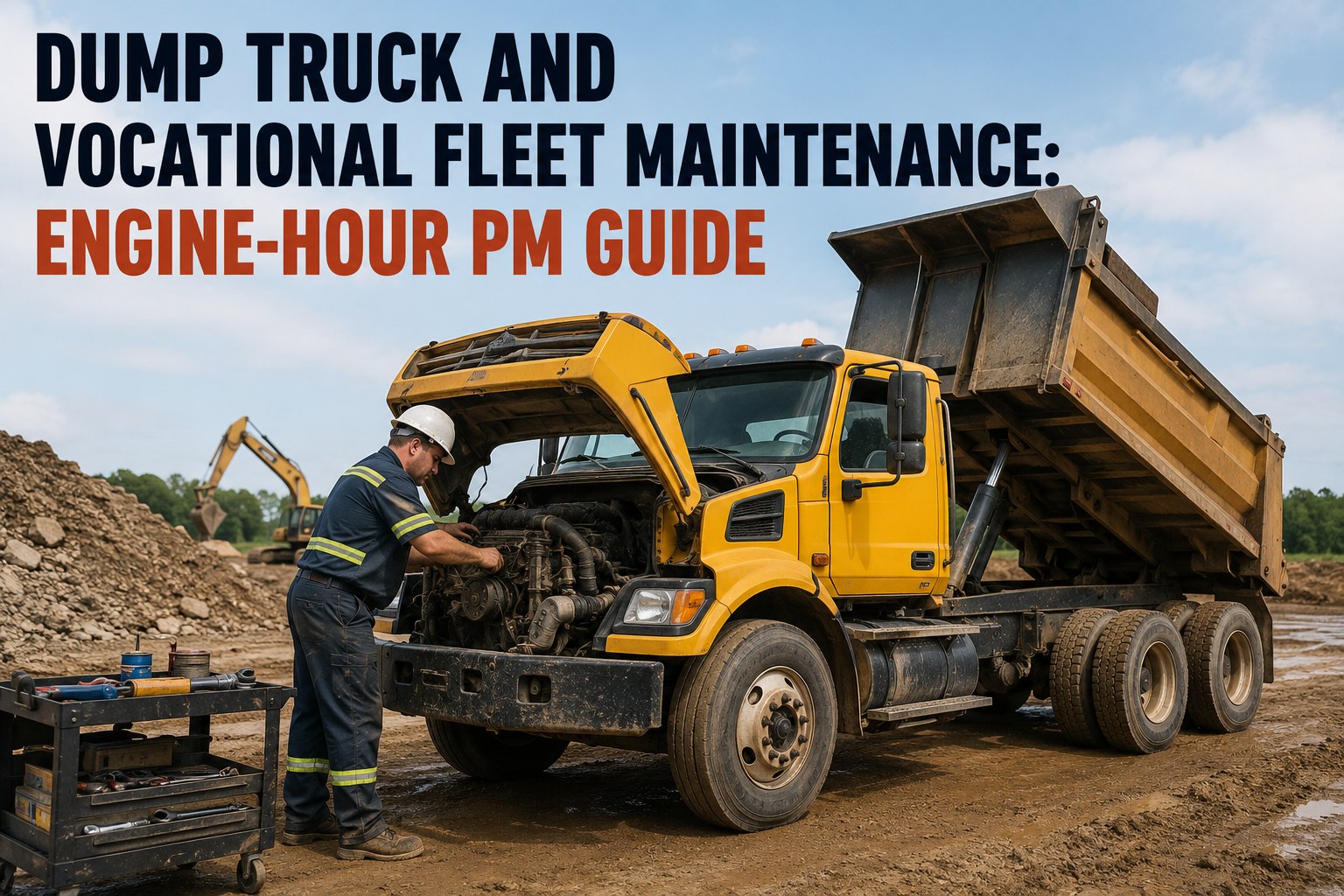
Refuse / Vocational
High idle, stop-and-go, low mileage. Engine hours capture the real combustion wear that mileage misses. Calendar as a safety floor for chemical degradation.
Regional / P&D
Mixed highway + urban. Neither trigger alone catches wear reliably. Run both in parallel; whichever fires first triggers PM. Standard for LTL, pickup and delivery, regional carriers.
Rental / Low-Utilization
Trucks sit for weeks. Oil oxidizes on the calendar even without operation. Time-based PM is the primary trigger; mileage acts as an accelerator if the unit gets rented heavily.
Construction / Off-Road
Equipment barely moves. Mileage is not a meaningful metric. Hours-based PM with severe-duty shortening (150–200 hrs instead of 250) for abrasive site conditions.
Yard / Terminal Trucks
Nearly zero mileage, engine runs continuously moving trailers. Hours capture 100% of the wear. Calendar for oil chemistry backstop.
The "First-to-Occur" Hybrid Rule
The industry consensus for mixed fleets — and the model every modern CMMS supports — is running all three triggers in parallel and firing PM on whichever threshold hits first:
PM Tier Structure at a Glance
Most fleets layer the 4-tier PM framework (A / B / C / D) on top of their trigger model. Each tier gets its own multi-trigger threshold:
All three triggers, tracked in parallel, on every truck — automatically.
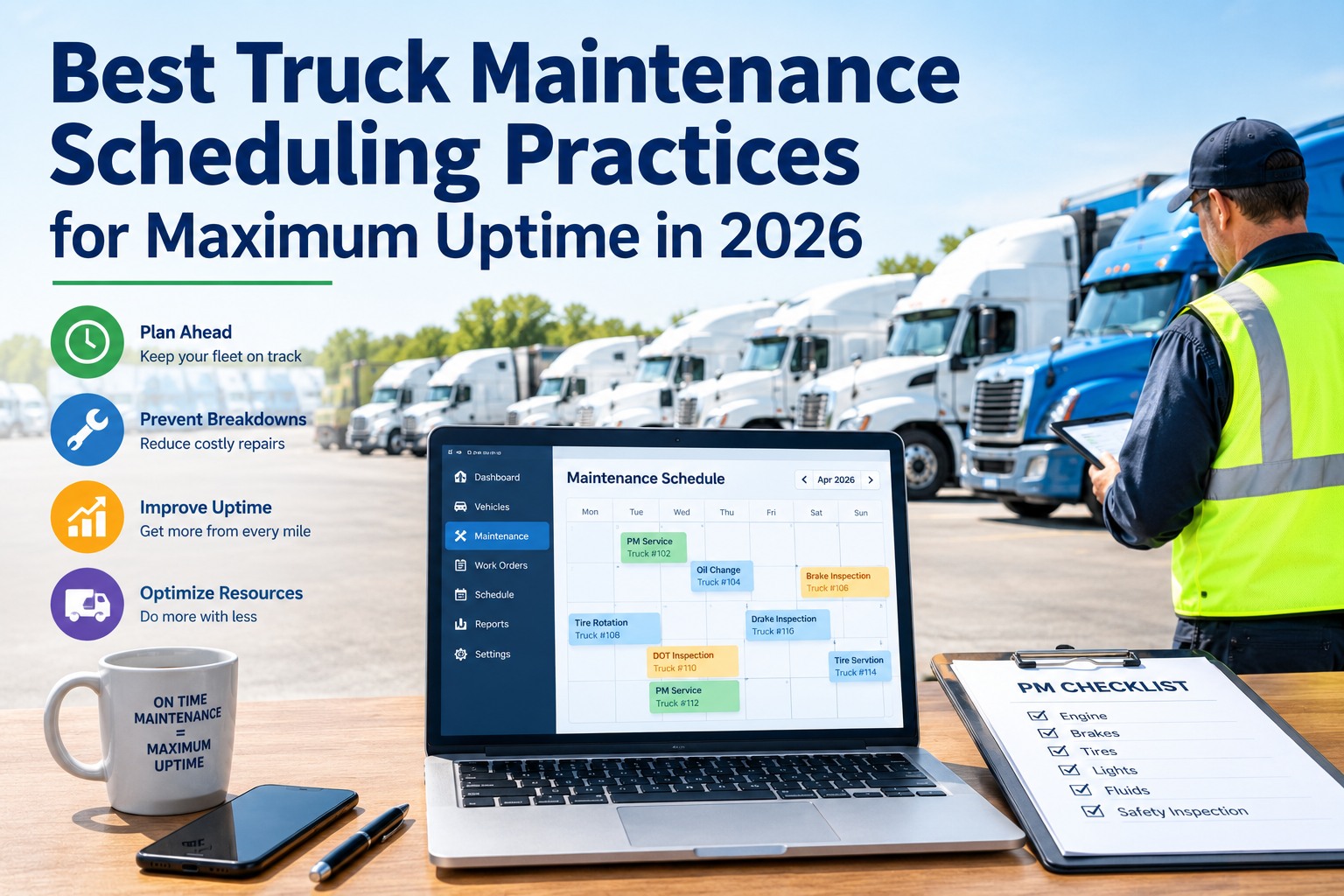
Truck Inspection & Maintenance tracks mileage, engine hours, and calendar days simultaneously per vehicle. First-to-occur logic fires PM work orders 10–14 days before threshold, routes to the shop queue independently of dispatch, and pulls the truck from high-mileage routes in its next cycle. Per-vehicle interval templates match each unit to its duty cycle. Alerts before overdue, dashboards for compliance rate, and audit-ready records built in. Create your free account in 10 minutes or talk to our fleet team for a live walkthrough.
The Cost of Getting the Trigger Wrong
Wrong-trigger PM is silent expensive. Both directions hurt — over-servicing wastes labor and parts; under-servicing causes catastrophic failures:
Calendar Applied to Highway Trucks
A long-haul Class 8 serviced every 90 days on calendar completes 4 PM cycles per year at ~30K miles each. Actual optimal interval is 10K miles → 12 cycles. The truck is over-serviced 3× the necessary rate — parts consumed, labor billed, revenue-hour downtime, all for oil that was fine.
Mileage Only on Idle-Heavy Trucks
A refuse truck tracked only on mileage misses two PM cycles per year. Oil degrades to acidic sludge, valvetrain wear accelerates, top-end failure at ~350K "miles" instead of 500K. Engine rebuild bill: $18,000. Roadside failure adds towing + shipper impact + CSA hit.
Frequently Asked Questions
What is the difference between mileage and engine hour PM triggers?
Mileage tracks distance traveled — every mile turns the drivetrain, cycles suspension, and rotates the engine at load. Engine hours track total run time whether the truck is moving or idling. A refuse truck idling 40% of its shift accumulates significant engine wear that mileage cannot capture. The rule of thumb: 1 engine hour ≈ 25–33 miles of wear equivalent on most diesel commercial vehicles. Mileage suits highway-dominant fleets; hours suit vocational and idle-heavy operations. Modern PM programs run both in parallel with a first-to-occur rule.
What is the "first-to-occur" rule in PM scheduling?
First-to-occur means a vehicle is serviced on whichever trigger — mileage, engine hours, or calendar time — reaches its threshold first, regardless of the others. For example, PM-A oil service configured at 10,000 miles OR 250 hours OR 90 days: a highway truck fires on mileage in 45 days, a yard truck fires on hours in 20 days, a rental unit fires on calendar at day 90. This eliminates the gaps that any single trigger would miss and works across mixed-duty fleets without needing to configure a single "average" interval that fits nobody perfectly.
How do I choose between calendar-based and mileage-based PM for my fleet?
Calculate two things: annual mileage per vehicle and average idle percentage. High mileage (over 80,000/year) with low idle → mileage primary. Low mileage (under 40,000/year) or high idle (over 30%) → hours primary with calendar backup. Low utilization or rental → calendar primary. Mixed use → run both mileage and hours in parallel with first-to-occur. The best programs never rely on a single trigger — they layer all three so no dimension of wear can be missed regardless of how the truck is being used week to week.
How often should a Class 8 truck receive preventive maintenance?
A Class 8 truck running roughly 120,000 miles per year typically generates about 22 PM events annually across all tiers, from PM-A oil service every 10,000 miles up through PM-D annual DOT inspections. Exact intervals should be adjusted for duty cycle and validated against your own maintenance history. Long-haul trucks lean toward the longer end of interval ranges (15K miles for PM-A); vocational or urban delivery lean toward the shorter end (10K miles) because of higher stress per mile. OEM specifications from your engine manufacturer are the baseline; duty cycle adjustments come from your own fleet data.
Can preventive maintenance scheduling actually reduce breakdowns?
Yes, and measurably. Fleets running structured, automated PM programs report roughly 45% fewer breakdowns and 28% lower repair costs than fleets relying on memory, paper logs, or dashboard warning lights. The math is simple: a $400 scheduled oil change catches wear before it becomes a $5,000 roadside emergency. Combining duty-cycle tiers with condition-based triggers commonly reduces total maintenance spend 15–25% annually while cutting unplanned failures. Contact our team to model your fleet's savings potential.
How does Truck Inspection & Maintenance handle multi-trigger PM tracking?
Truck Inspection & Maintenance tracks mileage, engine hours, and calendar time simultaneously for every vehicle in the fleet. Per-vehicle PM templates let you assign different interval sets to each duty-cycle profile — highway tractors on mileage-primary, vocational units on hours-primary, rental fleet on calendar-primary. The system generates PM work orders automatically 10–14 days before any trigger threshold is reached and routes to the shop queue independently of dispatch. Alerts fire before intervals lapse. Compliance dashboards show fleet-wide PM rate in real time. Free forever for up to 3 vehicles with no hardware. Sign up in 10 minutes.
Stop over-servicing highway units. Stop under-servicing vocational ones. Track all three triggers automatically.
Every day a fleet runs on a single PM trigger, some trucks are over-serviced and others are silently accumulating wear the system cannot see. Truck Inspection & Maintenance runs mileage, engine hours, and calendar time in parallel with first-to-occur logic — matching every truck to its duty cycle without configuration guesswork. Free forever for up to 3 vehicles. No hardware, no credit card, no contract to start.