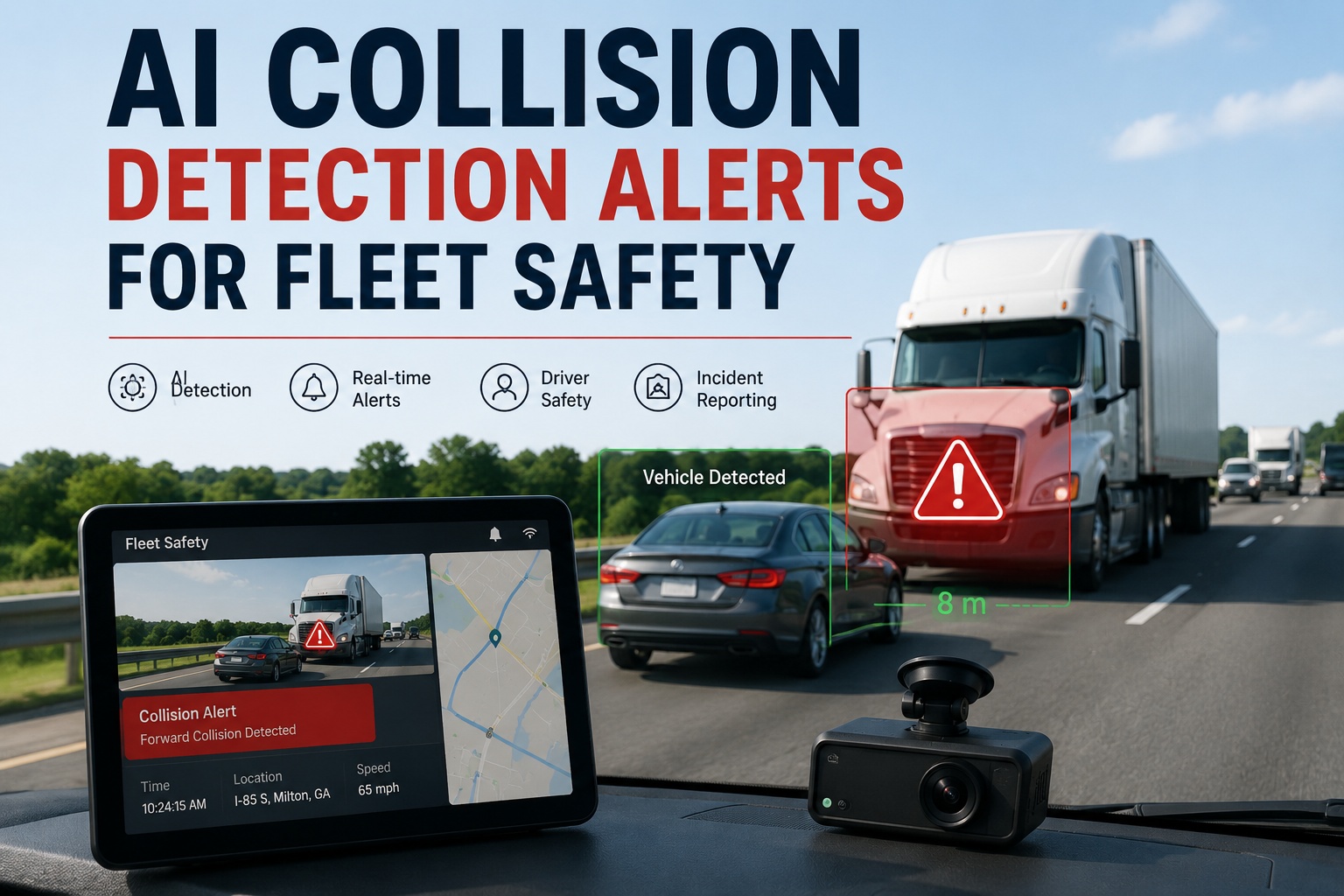
At 7:23 on a Tuesday morning, a fleet truck rear-ends a stopped sedan on the interstate. In the old world, what happens next is a slow-motion disaster of phone calls: the driver calls dispatch, dispatch calls the safety manager, the safety manager calls the insurer, and someone digs through the CMMS to prove the truck was in compliance. By the time the first notice of loss reaches the carrier, it's 9:47 — two hours and twenty-four minutes later. The dashcam footage was never pulled. The driver gave a recorded statement with no supervisor present. That delay was later cited as a factor in a $340,000 settlement. AI collision detection collapses those two-plus hours into seconds — the crash is sensed at the moment of impact, the footage is locked before it can be overwritten, and a complete incident package reaches the insurer while the vehicles are still on the shoulder. This guide walks through how it works, second by second, and how Truck fleet management software turns a crash into an automated response instead of a scramble.
Fleet Safety Guide · AI Collision Detection · 2026
AI Collision Detection Alerts for Fleet Safety
Detect a crash the instant it happens — then automate the footage capture, incident report, and insurer notification that used to take hours.
Prevent
Forward-collision & lane-departure warnings intervene before impact.
Detect
Sensor fusion confirms a crash the moment it occurs.
Respond
Footage locked, FNOL sent, maintenance queued — automatically.
How the AI Knows It's a Crash
A collision isn't detected by a single sensor guessing — it's confirmed by several agreeing. Modern systems fuse multiple data streams so a real impact is caught and a pothole isn't mistaken for one. This sensor fusion is what separates a trustworthy crash alert from a nuisance alarm:
Accelerometer
Measures sudden G-force. A spike above threshold in a given direction is the primary crash signal.
Gyroscope
Tracks rotation and orientation — catching spins, rollovers, and violent direction changes.
GPS & speed
Supplies exact location, speed at impact, and the speed differential that helps grade severity.
AI video
The forward lens confirms the event visually and reconstructs what happened in the seconds before.
Why direction matters: a sharp forward G-spike is a shunt collision; a similar spike backward is just hard braking. By reading the direction and combining it with rotation, speed, and video — plus signals like airbag deployment — the AI confirms a genuine crash and filters out the false positives that would otherwise train managers to ignore alerts.
The Response Cascade
The instant a crash is confirmed, a sequence fires automatically — each step racing a clock, because evidence and options both decay by the minute. This is the cascade that replaces the old chain of phone calls:
Crash confirmed
Sensor fusion validates the impact and classifies severity from G-force, speed differential, and impact characteristics.
Alert dispatched
A notification reaches the safety manager with location, severity, and driver ID — the instant handoff a phone call never delivered.
Footage locked
The dashcam clip — 30 seconds before and after impact — is pulled and secured before the camera's rolling buffer can overwrite it.
FNOL to carrier
A complete first-notice-of-loss package is assembled and sent to the insurer — with all supporting evidence already attached.
Severity Decides the Route
Not every impact deserves the same response, and forcing a fender-bender through the same process as a rollover wastes time on both. The AI grades severity at the moment of impact and routes each event accordingly:
Minor / fender-bender
Low G-force, low speed differential. Routes to a fast-track digital claim and a routine damage inspection — no emergency dispatch needed.
Major impact / rollover
High G-force, rotation, possible airbag deployment. Triggers priority alerts, evidence lock, and immediate notification to the people who need to act now.
Free · Up to 3 Vehicles
Turn a crash into a workflow, not a scramble
Truck fleet management software captures collision events from your AI cameras and telematics, locks the footage before it's overwritten, assembles the incident record with GPS, speed, and severity, and auto-creates the post-accident inspection — all without a dispatcher chasing phone calls. It connects to the cameras and trackers you already run. Sign up free for up to 3 vehicles and automate your incident response today.
Two Hours vs. Sixty Seconds
The whole case for automation lives in one comparison. Manual first-notice-of-loss typically takes 24-72 hours; automated detection collapses it to under a minute. And every hour of delay has a price:
Driver calls dispatch, dispatch calls safety, safety calls carrier
Footage often never pulled before it's overwritten
Storage & tow fees mount; witnesses scatter
Delayed FNOL cited in a $340,000 settlement
Impact detected and validated at the source
Footage locked within two minutes, evidence preserved
FNOL reported fast — up to $800 lower claim cost
30-50% shorter total claims cycle
What's in the Automated FNOL Package
The reason automated notification settles faster isn't just speed — it's completeness. Instead of a driver's vague phone call, the carrier receives a structured, sensor-verified package the moment it's assembled:
Why sensor-verified matters: objective crash data is far harder to fabricate or exaggerate than a phone account. It speeds honest claims and flags staged or inflated ones at the first-notice stage — meaningful when fraud costs US insurers an estimated $5-7 billion a year. The same reconstruction — speed, G-force, direction of impact, pre-crash behavior — also settles fault and subrogation faster.
Before the Impact: The Prevention Layer
The best crash response is the one you never need. The same AI that detects impacts also works to prevent them, watching the road ahead and the driver within, and intervening in the moment:
Forward-collision warning
Computer vision measures closing distance to the vehicle ahead and alerts before a rear-end impact.
Following-distance monitoring
Flags unsafe time-to-collision so drivers back off before tailgating becomes a crash.
Lane-departure alerts
Tracks lane markings to catch drifting from distraction or a microsleep.
Fatigue & distraction
Eye closure, head drop, and phone use trigger an in-cab alert to interrupt the behavior in time.
After the Impact: Back to Roadworthy
A crash isn't over when the report is filed — the vehicle still has to be inspected and repaired before it carries another load. Integration closes that last loop too, tying the incident straight into maintenance:
Auto post-accident inspection
A confirmed collision queues a mandatory damage inspection, so a crashed unit can't quietly return to service uninspected.
Defect-to-work-order
Damage found becomes a tracked work order with the incident footage and photos attached — no separate paperwork.
Compliance record on file
The vehicle's PM and repair history sit with the incident, ready for the carrier, an auditor, or a liability review.
Frequently Asked Questions
How does AI collision detection actually work?
It uses sensor fusion — combining an accelerometer (G-force), gyroscope (rotation and orientation), GPS (location and speed), and AI video. A crash is confirmed when a sudden G-force spike above a threshold occurs in a direction consistent with impact, corroborated by the other sensors and often airbag deployment. Combining signals is what lets the system detect a real crash while filtering out potholes, hard braking, and other false positives.
What is FNOL and why does automating it matter?
FNOL is First Notice of Loss — the first report of an incident to the insurer. Manually it takes 24-72 hours of phone calls; automated detection collapses it to under 60 seconds. That speed matters: reporting within 30 minutes can cut average claim cost by up to $800, evidence is preserved before it disappears, and a delayed FNOL has been cited as a factor in large settlements. Contact our team to see automated FNOL in action.
Will I get flooded with false crash alerts?
Not with a well-built system. Because detection relies on multiple sensors agreeing — G-force magnitude and direction, rotation, speed change, and video confirmation — routine events like potholes or hard braking don't trip it. Severity classification further separates a minor bump from a serious impact, so alerts stay meaningful and managers keep trusting them.
Do I need new hardware?
Usually not new-from-scratch. Collision detection runs on AI dash cams and telematics devices, and if your fleet already has them, integration connects to that existing hardware — pulling crash events, footage, and telematics into one platform. The value is less in the camera and more in what happens with the data: the automated capture, notification, and response cascade around each event.
How does collision detection help with fraud and liability?
Sensor-verified crash data is objective and hard to fabricate. Adjusters receive a full reconstruction — speed, G-force, direction of impact, and the pre-crash driving record — which speeds honest settlements and flags staged or exaggerated claims at the first-notice stage. With insurance fraud costing US insurers an estimated $5-7 billion a year, that verified record is a meaningful protection for your fleet.
What happens to the vehicle after a detected crash?
Integration ties the incident straight into maintenance. A confirmed collision can auto-queue a mandatory post-accident inspection, damage found becomes a work order with the footage attached, and the vehicle's compliance and repair history stays on file with the incident. That keeps a crashed unit from quietly returning to service uninspected and keeps your records audit-ready. Sign up free to connect safety and maintenance.
Seconds, Not Hours
Make every crash trigger a response, not a phone tree.
Truck fleet management software detects collisions through sensor fusion, locks the footage before it's overwritten, auto-assembles the FNOL package, and queues the post-accident inspection — while forward-collision and lane-departure warnings work to prevent the crash in the first place. Free for up to 3 vehicles. Works with your existing cameras, no contracts.