Dispatch needs the truck available now. Maintenance needs the truck offline for four hours. Neither one is wrong — they're operating on opposite clocks. And when the two sides don't share a live view of vehicle status, the collision plays out the same way every week: a dispatcher commits a truck to a 14-hour run without knowing it's due for a brake PM at midnight, or a tech pulls a unit for scheduled service while dispatch has already assigned the load. Roughly 22% of preventable fleet downtime traces to this coordination gap. This guide is how the two boards stop working against each other. Start free and give dispatch and the shop one shared view of every truck.
Dispatch and Maintenance Don't Have to Fight for the Same Truck
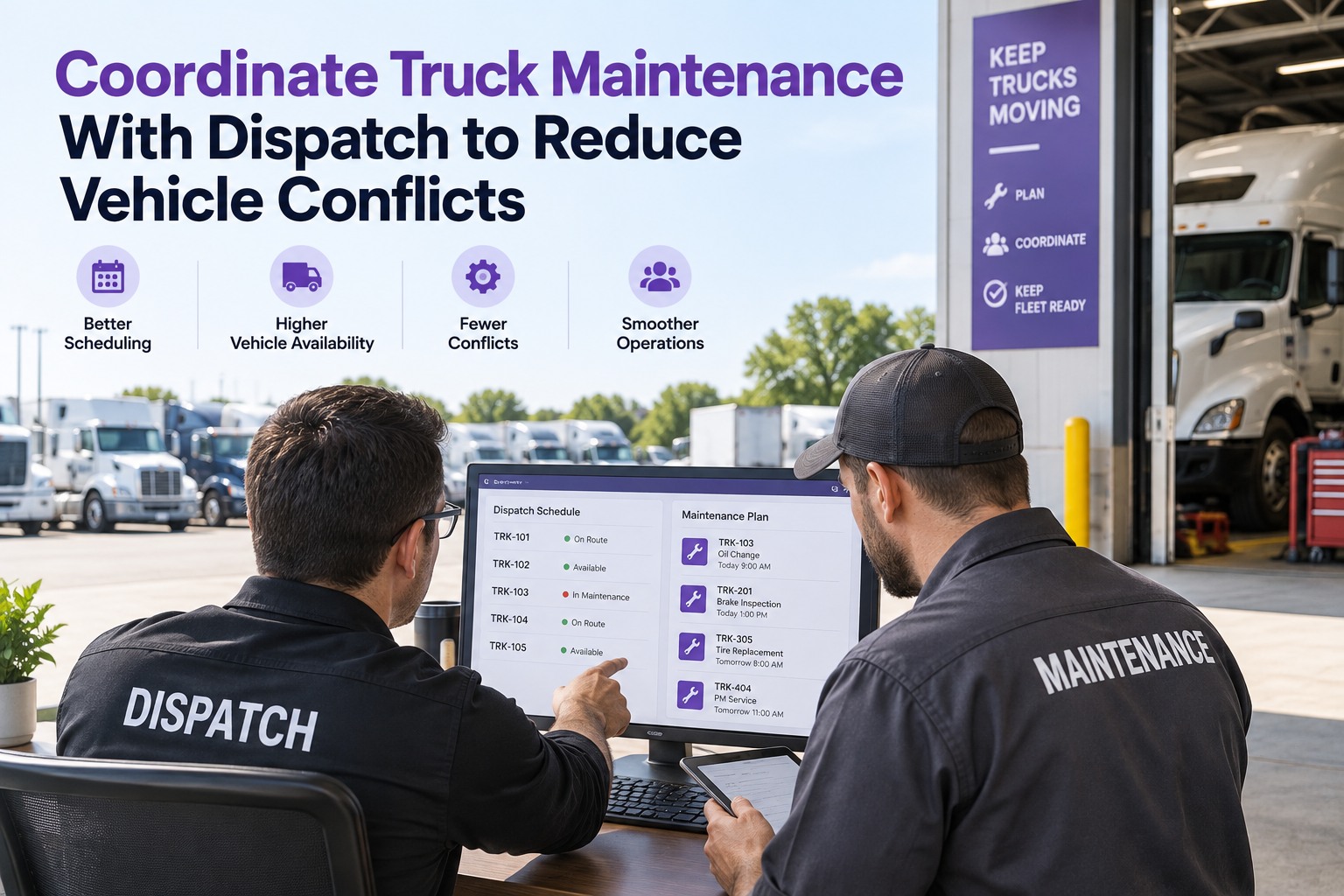
A pre-scheduled maintenance window that dispatch can see is a coordination system. A spreadsheet that only the shop reads is a collision waiting for Monday morning. Truck Inspection & Maintenance Management Software puts vehicle status on one screen both sides read: which trucks are in PM, which are due within 48 hours, which have windows pre-booked around live route commitments — so dispatch stops assigning trucks that are about to be pulled and the shop stops pulling trucks that are already committed.
The Opposite Clocks Problem — Why the Collision Happens Every Week
Dispatch's day starts when the first load needs coverage; the shop's day starts when the first work order needs a bay. Both are legitimate, and both are urgent — but they measure success in incompatible units. Dispatch counts loaded miles. Shop counts on-time PMs. Without a shared view, each side rationally optimizes for its own metric and the collision is baked in. The fix isn't asking either side to care about the other's KPI. It's giving them one view where both KPIs are visibly compatible.
- Optimize for loaded miles
- Every out-of-service unit is lost revenue
- Reacts to freight demand in real time
- Success = trucks assigned before deadline
- Optimize for PM on-time compliance
- Every deferred PM is future breakdown risk
- Plans work around bay and parts availability
- Success = 95%+ PM completion
The Shared Status Board — What Dispatch Needs to See About Every Truck
The centerpiece of coordination isn't a report — it's a live status view every dispatcher opens before they assign a load. Six status categories cover every operational state a truck can be in, and each one carries a different assignment rule. Green means go. Amber means schedule around. Red means don't touch. Once the dispatcher's board reads from the same source as the shop's board, the "I didn't know it was due" excuse disappears.
The Four Coordination Patterns — Which Model Fits Your Fleet
Not every fleet needs the same coordination structure. A single-terminal 30-truck fleet doesn't run the same handshake as a 200-truck multi-terminal operation. The four patterns below cover most real fleets — pick the one that matches your scale, and know when to move up a tier as you grow.
10-minute morning huddle between dispatch lead and shop lead. Yesterday's PM list, today's dispatch commitments, tomorrow's pre-booked windows. Low tech, high discipline.
One screen both sides read. PM engine writes status; dispatch reads status. No standup required — the board is the standup, refreshed every time a WO or DVIR changes.
Fleet manager pre-books PM windows a week out — every truck due in the next 7 days gets a slot assigned around known route commitments. Dispatch sees windows locked; shop sees a levelled load.
PM engine pulls freight forecast, pushes major services into predictable slow periods, staggers units across the year. Peak-season capacity protected before demand spikes.
The Right Coordination Model — Fewer Collisions, Higher PM Compliance
Our software runs all four coordination patterns on one platform — the same status board a 40-truck shop uses at daily standup is the one a 200-truck multi-terminal operation runs against a freight forecast. PM windows pre-book with visibility to dispatch, safety-critical defects hard-lock trucks from assignment, and the whole loop closes with a signed eDVIR at the end of every walkaround. Fleets that ran reactive PM at 60–70% typically clear 90% inside a quarter after switching to a coordinated model.
The Weekly Handshake — A Rhythm That Actually Sticks
The single most durable coordination pattern isn't software — it's a 30-minute weekly meeting between the fleet manager, the dispatch lead, and the shop lead, run in the same order every Monday. Below is the rhythm that works. The point of the meeting isn't the meeting — it's that everyone leaves with the same picture of the week ahead.
Frequently Asked Questions
Stop Letting Dispatch and the Shop Fight for the Same Truck
Shared live status board, pre-booked PM windows, weekly handshake rhythm. The two sides operate on one view of the fleet — collisions stop being weekly and start being rare.