DEF gets forgotten until it derates the truck. A warning fires at 10%, escalates at 5%, and by 0% the truck is counting down to a 5 mph crawl on the interstate shoulder. Under 2026 EPA guidance, heavy-duty trucks now get 650 miles or 10 hours of warning before harsher action kicks in — but that window is worthless if nobody sees the amber lamp. A single stranded tractor averages $1,800 in tow, service, and missed-appointment costs. Below is the DEF fluid level management program top-performing diesel fleets run in 2026 — warning ladder, fill discipline, ISO 22241 quality rules, winter protocol, and how the free Truck Inspection & Maintenance app tracks DEF on every DVIR. Sign up free or contact our team.
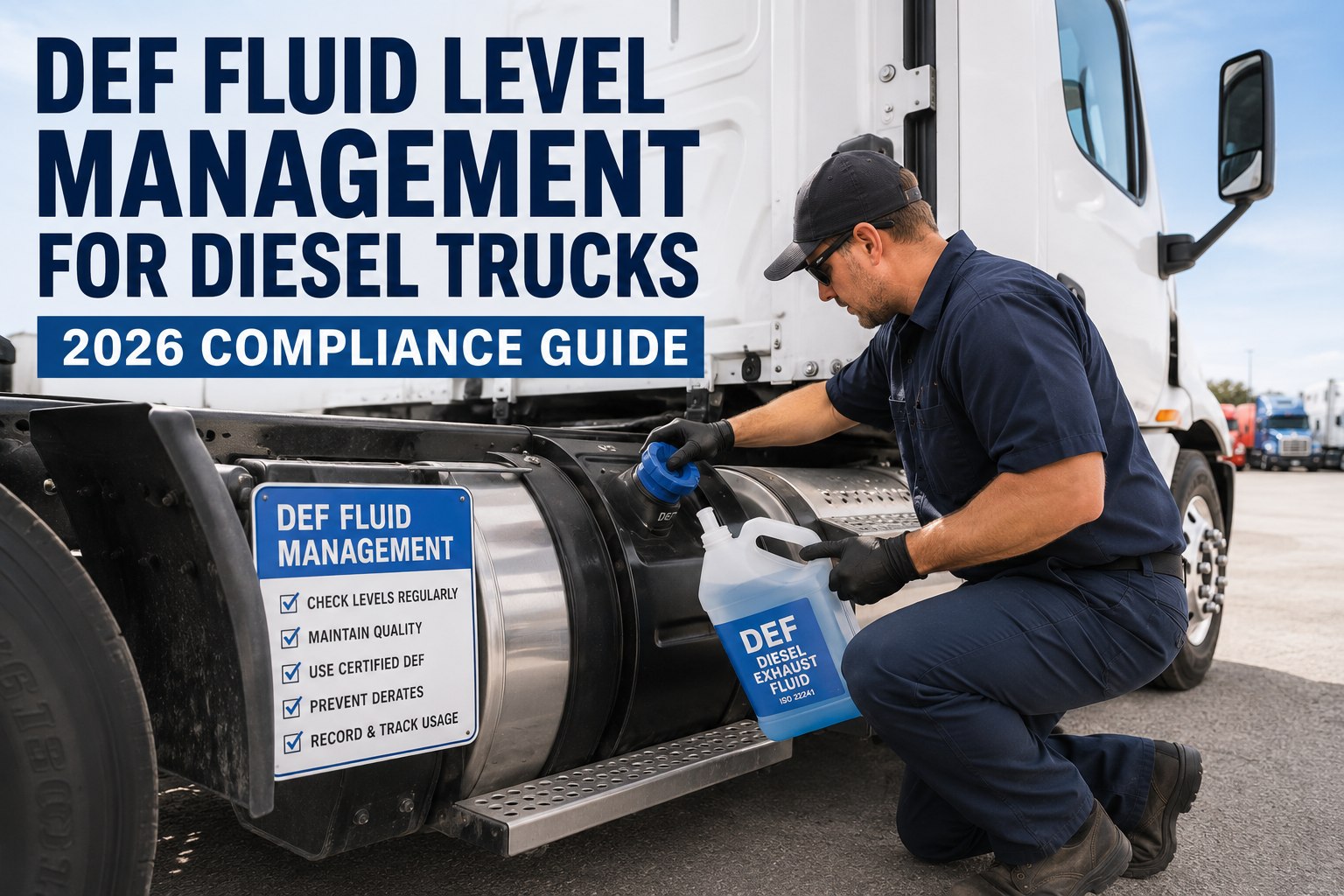
DEF Fluid Level Management for Diesel Trucks — 2026 Compliance Guide
The regulations changed in 2026. Your DEF workflow needs to change with them — before the next warning becomes the next derate.
What Changed in 2026 — And What Didn't
The EPA revised DEF derate guidance in 2026 to prevent sudden power loss on the interstate. The relief is real — but the underlying obligation to keep DEF topped off, clean, and above threshold has not gone away. Here is what every fleet manager needs to know:
650 Miles / 10 Hours Warning Window
Under 2026 EPA guidance, heavy-duty trucks now get a warning light for 650 miles or 10 hours after a DEF fault is detected before harsher action begins. This replaces the old rule where trucks could derate to 5 mph within hours of a low-DEF fault.
The Derate Still Comes
The warning window is longer, but the derate still fires if the fault is ignored. A truck run empty, filled with bad fluid, or operated with a failing quality sensor still ends the day at 5 mph — the new rule just gives you more time to catch it before that happens.
Tighten Your Fill & Track Discipline
The extra window is worthless if nobody sees the warning. Fleets that catch DEF faults during the 650-mile window run zero derate events per year. Fleets that don't see the warning until the driver calls from the shoulder run 6–12. Start tracking free and put every truck on the 25% rule this week.
The 4-Stage DEF Warning System
Every modern diesel steps through the same warning ladder as DEF drops. Knowing the exact stage — and the exact action required at each — is the difference between a $12 top-off and a $1,800 service call:
Signal: Amber "DEF Low" lamp illuminates. Approximately 800–1,000 miles of range remain at typical consumption.
Action: Top off at next fuel stop. No urgency, no derate risk. This is the window every fleet should be catching 100% of DEF events in.
Signal: Solid warning lamp, audible chime, dash message repeats every key cycle. Range drops to ~300–400 miles.
Action: Fill before next dispatch. Do not send the truck out on a route that exceeds remaining DEF range. Log the event — a truck that reaches 5% is a workflow failure.
Signal: Red warning. Restart countdown begins. Under 2026 EPA guidance, the warning-only period runs 650 miles or 10 hours from fault detection before harsher inducement.
Action: Refill immediately. Do not shut the truck off unless you have DEF on hand — a key cycle on an empty tank accelerates the inducement.
Signal: Vehicle speed capped at 5 mph. Some trucks prevent restart entirely. Load is stranded wherever the truck was when the derate landed.
Action: Tow or on-site service call. Refill alone may not clear the inducement — many systems require a scan-tool reset once fluid is restored.
The Real Cost of a Single Derate Event
Fleet managers who have never had a DEF derate underestimate the cost by 4–5×. Here is the real number, itemized from actual fleet data:
The 6 Ways a Fleet Ends Up in Derate
Every DEF derate traces back to one of six root causes. Five are pure workflow failures — preventable with basic tracking discipline. The sixth is a hardware fault caught only by inspection cadence. Not sure which pattern is hitting your fleet? Talk to our team for a free 15-minute derate-pattern review.
Nobody Saw the Amber Warning
Most common cause by far. Driver missed the 10% lamp, dispatch never asked, shop never checked. 800 miles of runway wasted.
Wrong Fluid in the DEF Tank
Driver grabs a windshield washer jug at the truck stop. Or a helpful bystander pours in diesel. DEF quality sensor fires within one drive cycle.
Contaminated Bulk Storage
Water, dust, or a used funnel contaminates the shop tote. Every truck filled from that tote inherits the fault.
Frozen Tank on Winter Morning
DEF freezes at 12°F. Factory tank heaters thaw it — but a failed heater on a -5°F morning strands the truck before it leaves the yard.
Expired DEF (12+ Months Old)
DEF degrades chemically after ~12 months, faster if stored above 86°F. Old fluid crystallizes and triggers a quality fault.
Failed DEF Pump or NOx Sensor
Hardware fault, not a fluid problem. Pump won't dose, or sensor sends implausible reading. ECM sees the fault as a quality issue and derates.
The One Rule That Prevents 80% of DEF Derates — Never Send a Truck Out Below 25%
Set the fleet-wide fill trigger at 25%, not at the 10% amber lamp. This single rule eliminates the entire category of "driver missed the warning" derates because the warning never fires in the first place. It costs nothing — DEF is the same price whether you pour it in at 25% or 5% — but it converts DEF management from a reactive workflow chasing dash warnings into a proactive top-off routine tied to the fuel fill. Every top-performing diesel fleet in 2026 runs this rule. Post it in every yard. Enforce it in every dispatch check — and automate the 25% flag on every driver DVIR so no truck slips through.
DEF Quality & Storage — The ISO 22241 Rules
Level is only half the battle. Bad DEF derates trucks just as fast as empty DEF. The ISO 22241 specification defines what qualifies as clean fluid — here are the rules that keep bulk storage compliant:
Exact Urea Concentration
32.5% high-purity urea, 67.5% deionized water. Dilute it and NOx conversion drops; concentrate it and crystals form. SCR is calibrated to this exact ratio.
Freeze Point
DEF freezes at 12°F (-11°C). Factory tank heaters thaw it in-service. Never dilute with water to "prevent freezing" — you destroy the concentration spec.
Max Storage Temp
Store below 86°F to preserve 12-month shelf life. Above that, urea decomposes to ammonia and fluid goes off spec — quality sensor catches it, ECM derates.
Shelf Life
12 months from manufacture in sealed containers, shorter once opened. Date-mark every tote on receipt. FIFO rotation. Discard anything past date.
Dedicated Equipment
DEF-only funnel, DEF-only transfer pump, DEF-only nozzle. Cross-contamination with fuel, coolant, or washer fluid triggers a quality fault within one drive cycle.
API-Certified Only
Buy only fluid carrying the API DEF certification mark. Off-spec fluid saves pennies and costs a $4,800 injector crystallization repair.
Winter DEF Protocol — The 12°F Problem
Every fleet manager loses trucks to winter DEF issues in the first cold snap. The protocol below stops that pattern before December:
Fall Prep — Tank Heater Test
Every diesel with a DEF tank heater gets tested before the first freeze. Simple ECM scan verifies heater draws current on demand. A $180 heater catch beats a January service call every time.
Storage Move Indoors
Bulk DEF totes move from unheated yard shed into heated shop before nighttime lows hit 12°F. Frozen bulk fluid is not damaged if thawed slowly, but repeated freeze-thaw cycles degrade concentration precision.
Cold-Morning Startup
Give the tank heater 5–10 minutes to thaw DEF before high-load driving on sub-freezing mornings. Rushing a frozen system stresses the pump and can trigger a fault the ECM interprets as a hardware failure.
Never Dilute Frozen DEF
Adding water to speed thaw destroys the 32.5% concentration. The truck runs, the quality sensor derates it 200 miles later. Frozen DEF thaws on its own — either through the heater or in a heated shop.
Running a fleet in a cold-climate region and want a fall-prep checklist tailored to your trucks? Get in touch and we'll send one over.
Track DEF level on every pre-trip. Catch the amber lamp before it becomes a derate.
Photo-verified DEF readings on every pre-trip, auto-flags for trucks below your 25% threshold, and consumption tracking per truck. Free forever for up to 3 vehicles — create your free account or talk to our team.
The 5 KPIs Every Fleet Should Track
You cannot manage DEF what you do not measure. These five metrics separate fleets running zero derate events per year from fleets calling tow trucks every month:
The headline number. Any non-zero result means the warning workflow failed somewhere. Investigate every event.
Trucks filling far less often than baseline are running low between fills. Trucks filling far more often may have a leak or pump fault.
If drivers skip the DEF line on the DVIR, the warning workflow has no data. Photo verification eliminates the skip.
A truck consuming outside the 2–3% band has a metering fault. Below 2% suggests injector issues; above 3% suggests a leak.
Any tote past 12 months is a derate waiting to happen. Automated FIFO alert prevents expired stock from reaching a truck.
All five KPIs are pre-built into the Truck Inspection & Maintenance dashboard — start your free account and see your fleet's numbers in under 10 minutes.
Frequently Asked Questions
What is the 2026 EPA rule change on DEF derate?
In 2026 the EPA revised guidance to require manufacturers to give diesel trucks a warning window of 650 miles or 10 hours after a DEF fault is detected before harsher power reduction begins. This replaces the older behavior where trucks could derate to as low as 5 mph within hours of a low-DEF fault, which posed a serious safety risk on highway shoulders. The change gives fleets more time to catch and correct DEF faults, but the derate still fires if the fault is ignored past the warning window.
At what DEF level should I fill the tank?
Set the fleet-wide fill trigger at 25%, well above the 10% amber warning. This single rule prevents most DEF derates because the warning never fires in the first place. DEF costs the same per gallon whether poured in at 25% or 5%, but the workflow difference is enormous: filling at 25% is a routine top-off tied to fuel fills, while chasing dash warnings at 5% is a reactive scramble that fails when drivers miss the lamp.
How much DEF does a diesel truck use per tank of fuel?
DEF is consumed at roughly 2–3% of diesel consumption. A truck averaging 7 mpg and burning 20,000 gallons of diesel per year uses 400–600 gallons of DEF over the same period. A truck consuming outside the 2–3% band has a metering fault — below 2% typically indicates an injector issue, above 3% suggests a leak. Tracking DEF consumption ratio per truck catches these faults months before they trigger a derate.
What happens if I put the wrong fluid in the DEF tank?
The DEF quality sensor detects the contamination within one drive cycle and triggers a fault. If diesel, coolant, or windshield washer fluid enters the DEF tank, the tank must be drained, flushed, and refilled with clean fluid — and depending on how far the wrong fluid traveled into the SCR system, injectors and dosing lines may need cleaning or replacement. A crystallized DEF injector runs $800–$4,800 to replace. Use ISO 22241 certified fluid only, from a dedicated DEF-only pump or funnel.
Can I dilute DEF with water to prevent freezing?
Never. DEF is a precise 32.5% urea, 67.5% deionized water mixture. Any dilution destroys the concentration and the quality sensor detects it within one drive cycle, triggering a derate 200 miles later. Factory diesel trucks have DEF tank heaters designed to thaw frozen fluid in-service — the freeze point is 12°F but the truck is engineered around it. Test tank heaters every fall before cold weather arrives.
How does Truck Inspection & Maintenance help with DEF management?
Truck Inspection & Maintenance adds DEF level tracking to every driver DVIR with photo verification, flags any truck reading below your fleet's fill threshold (typically 25%), logs fill events per truck to catch consumption anomalies, tracks bulk DEF stock age with FIFO alerts, and schedules fall tank-heater tests as recurring PM tasks. Free forever for up to 3 vehicles. Sign up in 10 minutes or contact our team for larger fleets.
The 2026 rules gave you 650 more miles of warning. Use them — or spend the year paying for tow trucks.
One missed amber lamp = one $1,800 service call. Track DEF level on every DVIR, catch faults before the derate, and stop paying for tow trucks. Free forever for up to 3 vehicles — no hardware, no contract, no credit card.