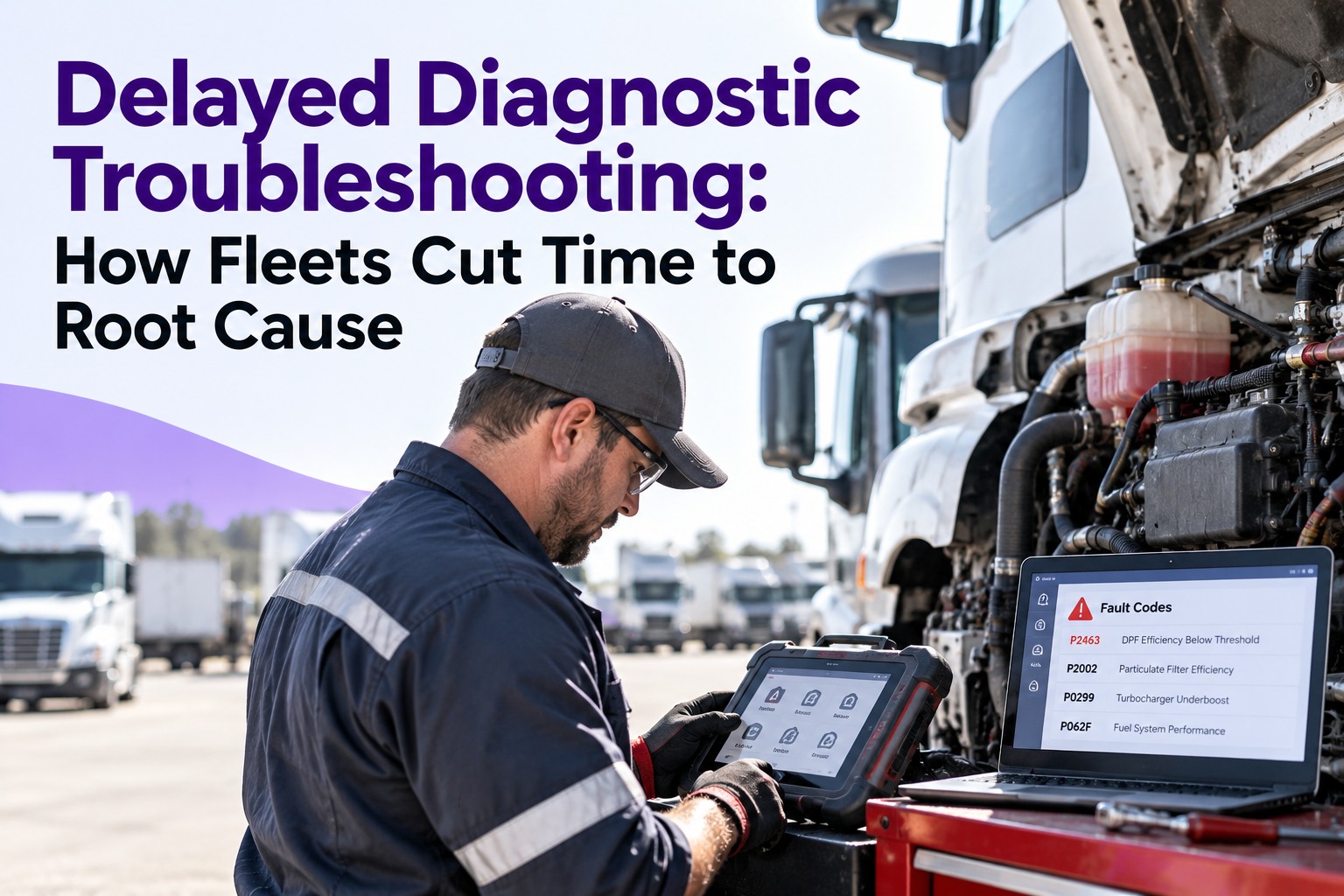
A fault lamp comes on. The truck still runs, so the code sits in a queue. Two days later a tech finally pulls it, guesses at the likeliest part, swaps it — and the light comes back on within a week. Now the same fault that started as a $200 sensor is a $2,000 repair with a truck down twice. The delay didn't just cost time; it let a small fault progress and sent the diagnosis down the wrong path. The fix isn't a faster mechanic — it's a structured workflow that gets from symptom to confirmed root cause without the guesswork, and without the days lost before anyone even looks. Here's how the best fleets compress time-to-root-cause. Start free and shorten your path to root cause with TIM.
Every Day a Fault Code Waits, the Repair Gets Bigger and the Diagnosis Gets Harder
Delay is where a cheap fix becomes an expensive one — the fault progresses, and the trail to the real cause goes cold. Truck Inspection & Maintenance Management Software captures the fault the moment it's flagged, routes it straight to a work order, and gives the tech a structured path from symptom to confirmed root cause — so nothing sits in a queue and no one swaps parts on a guess.
The Cost of Waiting — How a Small Fault Escalates
A delayed diagnosis isn't a flat cost — it compounds. Every stage a fault sits unaddressed, the price of fixing it climbs and the odds of a roadside failure rise. This is the escalation the structured workflow is built to interrupt.
Illustrative escalation, not fixed figures — the pattern (delay multiplies cost) holds even when the exact numbers vary by fault and fleet.
Where the Time Actually Goes
"Time to root cause" isn't one clock — it's four, and the delay usually hides in the first and the last. Fix the bottlenecks you can't see and the whole timeline compresses.
The Structured Diagnostic Workflow
Guesswork is what makes diagnosis slow. A structured sequence — the same one the best shops run every time — moves from symptom to confirmed cause without replacing parts that were never faulty. TIM runs this as a guided flow so each step feeds the next.
Confirm what's actually happening before touching a tool — reproduce it, note conditions. A misread symptom sends the whole diagnosis the wrong way.
Pull every DTC across all ECUs — not just the first one. Full access matters; diagnosing on a partial code set is diagnosing blind.
Multiple codes often trace to one underlying fault. Chase the root-cause code first, not the symptom codes it triggered.
Use live data and targeted electrical checks to confirm the failing component — before it's replaced, not after.
Fix, clear the code, and verify under the conditions that triggered it. The fault is closed only when it stays gone.
Five steps, in order, every time — that's what turns diagnosis from a hunt into a procedure. Contact our team to set this workflow up for your shop in TIM.
Symptom Code vs. Root-Cause Code — The Mistake That Wastes Hours
The single biggest time-sink in diagnosis is troubleshooting a symptom code first. One failure — say, a common ground circuit — can throw voltage-out-of-range codes for every sensor on it. Chase those symptoms one by one and you'll replace good parts for hours. Find the root-cause code first and the symptoms clear together.
- Diagnose codes in the order they appear
- Replace a part per code, test, repeat
- Hours lost on components that were never faulty
- Fault often returns — the real cause is untouched
- Correlate related codes to find the common source
- Confirm the failing component with live data first
- One repair clears the whole cluster of codes
- Fault stays gone — verified before the truck leaves
TIM ties every code to the vehicle's repair history, so recurring patterns and code clusters point to the real cause faster. Start free and correlate faults to history with TIM.
Reading the Code — What the Structure Tells You
Heavy-duty trucks (Class 6–8) use the J1939 protocol; lighter vehicles use OBD-II. Knowing how a code is built is the first step to reading it fast instead of looking up every character.
No Fault Sits in a Queue — TIM Routes It the Moment It's Flagged
Truck Inspection & Maintenance Management Software closes the detection gap that causes most of the delay: a fault flagged in an inspection or squawk becomes a work order immediately, with the vehicle's history attached and a structured troubleshooting path for the tech. Isolation is guided, the fix is confirmed before close, and every diagnosis builds the record that makes the next one faster.
Frequently Asked Questions
Diagnose It Once, Diagnose It Right, Diagnose It Fast
The difference between a $200 fix and a $2,000 one is rarely the fault — it's the time and the guesswork between the code and the cure. A structured workflow that acts the moment a fault is flagged, targets the root cause instead of the symptoms, and confirms the fix before the truck leaves is what keeps small problems small. TIM makes that workflow the default on every unit.