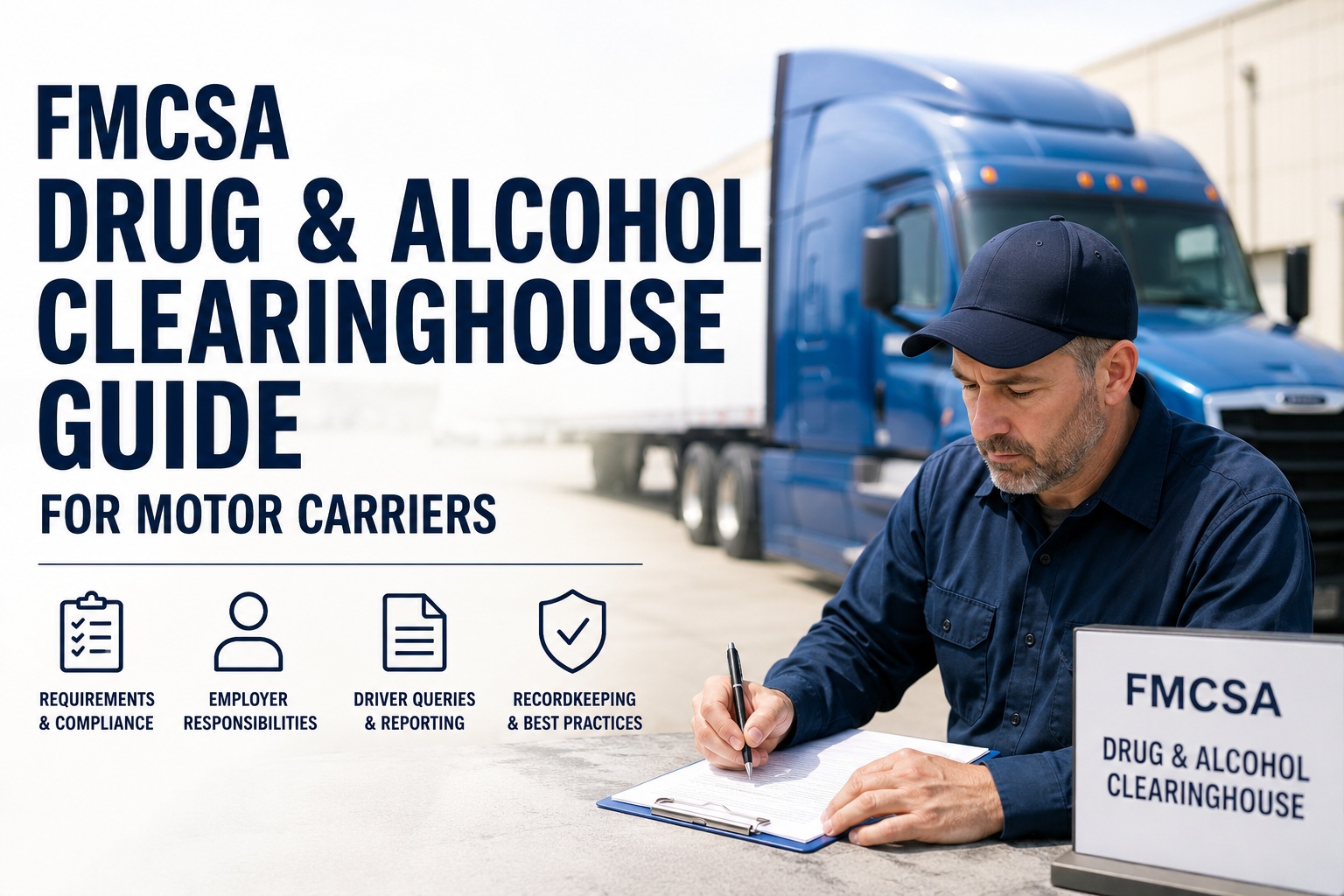
Under 49 CFR Part 382, every motor carrier employing CDL drivers in interstate commerce must operate a full DOT drug and alcohol testing program — no exceptions, no phase-ins, no "we're small so it doesn't apply to us." The program has to cover six specific testing situations, follow the DOT-wide collection and lab procedures under 49 CFR Part 40, integrate with the FMCSA Drug and Alcohol Clearinghouse, maintain written policies, train supervisors on reasonable-suspicion detection, and hit the 2026 minimum random testing rates of 50% for drugs and 10% for alcohol annually. Missing any of it isn't a paperwork problem — it's one of the 16 automatic-failure conditions on a DOT audit, and one of the most common reasons small carriers walk out of their New Entrant audit with a Conditional or Unsatisfactory rating. Individual violations carry civil penalties up to $16,000 under 49 CFR Part 386, and a positive test that goes unreported in the Clearinghouse is a "no D&A program" finding for the entire carrier. The good news: the program is documented in advance, the requirements are unambiguous, and once the systems are in place they run largely on autopilot with a C/TPA (Consortium/Third Party Administrator) handling most of the operational load. This guide covers exactly what the program has to include — the six test types with their specific triggers and timing, the setup checklist, Clearinghouse query requirements, the consequences pathway for positive results, the top violations that fail DOT audits, and how Truck Inspection & Maintenance software connects driver files, test records, and Clearinghouse status into one operational record so nothing falls through the cracks. Ready to run a compliant testing program without the audit anxiety? Start a free trial of Truck Inspection & Maintenance, or contact our support team for a walkthrough.
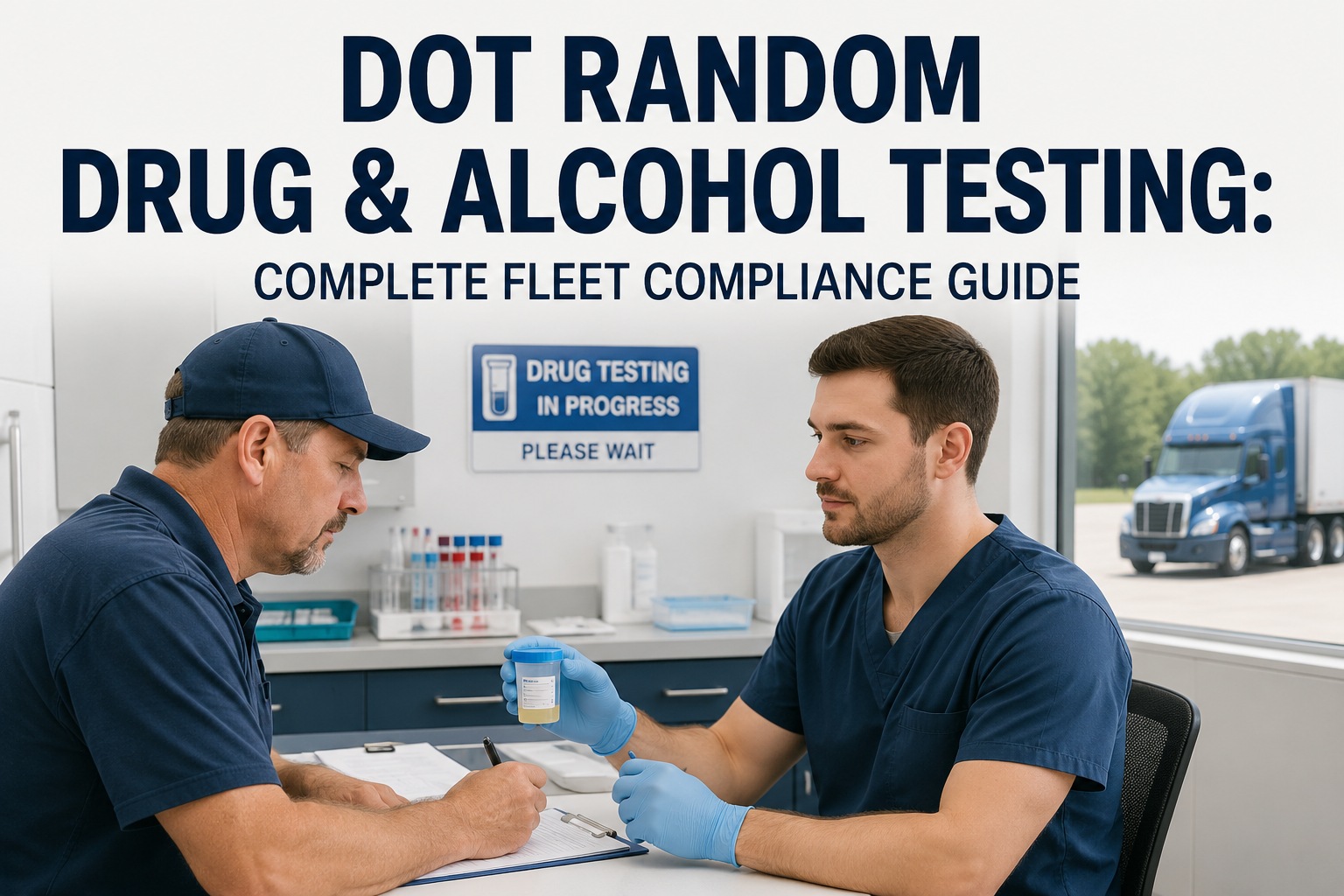
DOT Random Drug & Alcohol Testing: Complete Fleet Compliance Guide
Six test types. Two annual random rates. One Clearinghouse. Miss any single piece and you have a $16,000-per-violation audit finding. Here's exactly what the program requires.
Who's Covered? — Safety-Sensitive Definition
Not every employee needs testing — but every safety-sensitive driver does. The 49 CFR Part 382 definition captures who's in the program before you spend a dollar on collections.
The 6 Required Test Types
Every DOT-compliant program has to cover all six test types. Each has its own trigger, timing, and rules. Miss any category — even accidentally — and it's an automatic audit failure.
Program Setup — The 7-Piece Checklist
A DOT-compliant testing program isn't just "we do the tests." It's seven distinct pieces that all have to be in place before your first CDL driver hauls a load. Miss one and you fail your New Entrant audit.
Clearinghouse Query Requirements
The FMCSA Drug and Alcohol Clearinghouse is a separate system that tracks every driver's D&A violation history. Two query types are required — and missing either is an automatic-failure condition.
Never let a Clearinghouse query slip
Driver files digital. Clearinghouse query dates tracked per driver. Pre-employment holds until negative result received. Truck Inspection & Maintenance software links testing status directly to driver eligibility so no one drives with an unresolved violation.
Consequences of a Positive Test or Refusal
A verified positive test or refusal triggers a specific chain of events under 49 CFR Part 40. Every step has to happen in the right order — skipping any is a violation of its own.
Top 5 Audit-Failing Violations
The vast majority of DOT audit failures related to D&A testing trace back to these five patterns. All are automatic-failure conditions.
Record Retention Rules
Different D&A records have different retention periods. Missing a deadline is its own violation — records shouldn't be shredded just because "we don't need them anymore."
Frequently Asked Questions
The 2026 minimum random drug testing rate is 50% of the average number of driver positions annually. The minimum random alcohol testing rate is 10%. Under 49 CFR § 382.305, these are minimums — not suggestions. If you have 100 CDL driver positions, you must conduct at least 50 random drug tests and 10 random alcohol tests per calendar year. Individual drivers can be selected multiple times, and selections must be made from the entire pool using a scientifically valid random method giving every driver an equal chance every draw. The FMCSA Administrator can lower these rates when industry-wide violation data shows sustained low positive rates, but for 2026 the 50%/10% minimums remain in effect. Truck Inspection & Maintenance software tracks random selections and driver testing status per unit.
Under 49 CFR Part 382, six test types are required. Pre-employment (§ 382.301) — before any CDL driver operates a CMV, with a verified negative result required first. Random (§ 382.305) — unannounced testing throughout the year at 50% drug / 10% alcohol annual minimum rates. Post-accident (§ 382.303) — after qualifying accidents involving fatality, citation with injury, or citation with tow-away disabling damage. Reasonable suspicion (§ 382.307) — when a trained supervisor observes specific impairment signs. Return-to-duty (§ 382.309) — after completing the SAP process following a positive result or refusal, with directly observed collection. Follow-up (§ 382.311) — SAP-designed schedule minimum 6 tests in first 12 months, potentially continuing up to 5 years.
Seven pieces are required. Written testing policy distributed to every driver with signed acknowledgment. C/TPA (Consortium/Third Party Administrator) agreement — most small carriers cannot self-administer compliantly. Designated Employer Representative (DER) trained on Parts 382 and 40. Supervisor training — 60 minutes drug + 60 minutes alcohol signs per § 382.603. FMCSA Clearinghouse registration and query procedures. Scientifically valid random selection pool meeting 50%/10% minimum rates. Recordkeeping system supporting 5-year retention for positive results and 1 year for negatives. All seven must be operational before your first CDL driver hauls a load — not "we'll add it later."
Post-accident testing is required under § 382.303 when the accident involves any of three conditions: a fatality (mandatory testing regardless of citations), the driver received a citation and someone required transport for emergency medical treatment, or the driver received a citation and a vehicle required tow-away disabling damage. Alcohol tests must be administered within 2 hours of the accident. If not completed within 2 hours, document the reason. If not completed within 8 hours, stop attempts and document. Drug tests must be administered as soon as practicable, with attempts continuing up to 32 hours. Every attempt and every delay must be documented in writing. Contact our team to see how the software structures post-accident workflows.
The Clearinghouse is FMCSA's online database at clearinghouse.fmcsa.dot.gov that tracks every CDL driver's drug and alcohol testing violations, refusals, and return-to-duty status. Two query types are required. A full pre-employment query — with driver's written consent — must be run before any CDL driver operates. An annual limited query must be run for every current CDL driver each year; if it indicates any information exists, a full query must be run within 24 hours. Missing either query is a New Entrant automatic-failure condition and a compliance review finding. Employers must also report positive results and refusals to the Clearinghouse within 3 business days of verified receipt.
Six steps follow a verified positive or refusal. Immediate removal from all safety-sensitive duties. Report to FMCSA Clearinghouse within 3 business days. Evaluation by a DOT-qualified Substance Abuse Professional (SAP). Completion of SAP-designed education, treatment, or counseling. Return-to-duty test with directly observed collection and verified negative result before resuming duties. Follow-up testing schedule designed by the SAP — minimum 6 tests in first 12 months back on duty, potentially continuing up to 5 years. The driver cannot legally operate a CMV until every step is complete and the Clearinghouse shows return-to-duty status. Any employer allowing the driver to operate before completion faces an automatic-failure audit violation and civil penalties up to $16,000 per violation. Try free: sign up here.
Truck Inspection & Maintenance software connects driver files, testing, and Clearinghouse into one operational record
Digital driver qualification files. Pre-employment testing status linked to eligibility. Random selection tracking. Clearinghouse query dates per driver. Reasonable suspicion documentation. Post-accident testing workflows. SAP process tracking through return-to-duty. Follow-up testing schedules. Every piece of a compliant D&A program in one platform — so nothing falls through the cracks and every audit finds the records ready.