A diesel particulate filter is one of the few components on a truck that's designed to clog — on purpose. The DPF traps the soot in your exhaust to keep it out of the air, then periodically burns that soot off at high temperature in a process called regeneration. When the system works, this cycle is invisible; the filter fills, cleans itself, and fills again. When it doesn't, you get a fault code, a power derate, and — if it's ignored long enough — a $3,000 filter that a $200 sensor or a single highway drive could have saved. The trap most fleets fall into is subtle: short trips and stop-start routes never let the DPF get hot enough to regenerate, so soot compounds until the filter is beyond recovery. This guide explains how DPF regeneration works, the four levels of regen, the common fault codes, and the cheap-first diagnostic order — plus how truck maintenance software catches a soot problem before it becomes a replacement.
Diesel Emissions Guide · DPF & Regeneration · 2026
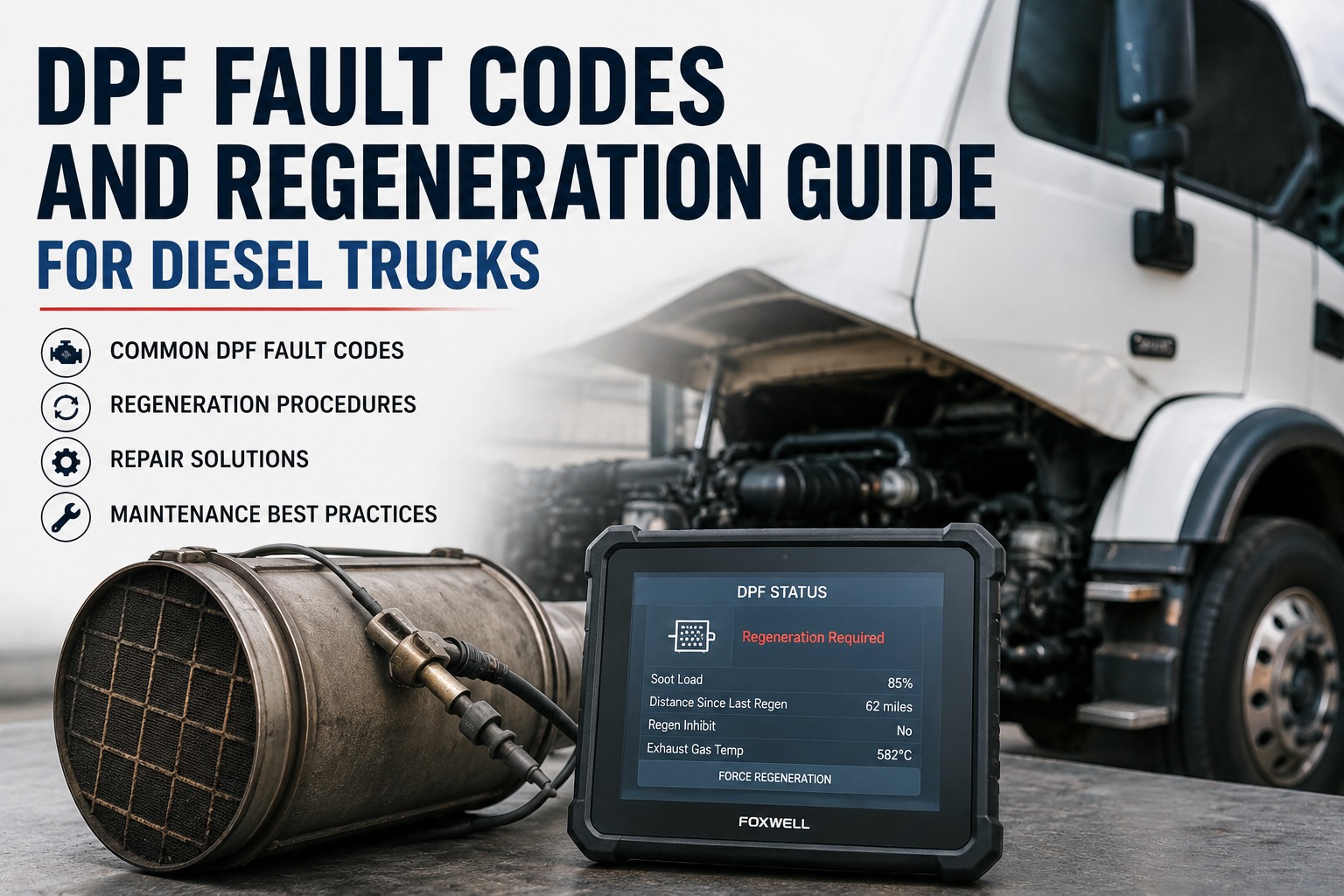
DPF Fault Codes and Regeneration Guide for Diesel Trucks
Understand the soot cycle, the four levels of regeneration, and the common DPF codes — so you clear a restriction cheaply instead of replacing the filter.
Soot
Trapped, then burned off in regeneration
4
Levels of regen, from automatic to replacement
15-25 min
Typical active regeneration duration
$3K+
DPF replacement a cheap fix often prevents
How a DPF Works: The Soot Cycle
The whole system is a loop. The filter captures soot from the exhaust, holds it until enough builds up, then burns it away at high heat and starts over. Every DPF code is a breakdown somewhere in this cycle:
Trap
The filter's honeycomb captures soot particles, letting cleaned exhaust pass to the tailpipe.
Fill
Soot accumulates. A differential pressure sensor reads the pressure drop across the filter to gauge the load.
Burn
At a soot threshold, regeneration raises exhaust temperature high enough to oxidize the soot into harmless gas.
Repeat
The filter is clean and the cycle restarts. When burning can't keep up with filling, a code sets.
The Four Levels of Regeneration
Regeneration isn't one thing — it's a ladder. Each level is a fallback for when the one before it couldn't clear the soot. Knowing which level your truck is stuck on tells you how serious the problem is:
Passive regeneration
Happens automatically during normal highway driving, when exhaust is naturally hot enough to burn soot. No driver action, no extra fuel — this is the system working exactly as intended.
Active regeneration
When soot passes a threshold, the ECM injects extra fuel to raise exhaust temperature and force a burn — typically 15-25 minutes. Usually invisible, though you may notice higher temps or a change in engine note.
Forced (parked) regeneration
When active regens keep failing and soot climbs too high, a technician commands a regen with a scan tool while the truck is parked. A recovery step — and a sign the normal cycle has been interrupted.
Cleaning or replacement
Once the filter is loaded beyond what regeneration can recover — often from accumulated ash, not just soot — it must be professionally cleaned or replaced. The most expensive outcome, and the one early action avoids.
The short-trip death spiral
Here's the trap that ruins more DPFs than any single failed part — a self-reinforcing cycle you can drive straight into without a warning light until it's late:
Short trips and stop-start driving never let exhaust reach regeneration temperature.
Passive regen can't happen, and active regens start but don't complete.
Soot keeps accumulating faster than it's burned, driving up backpressure.
The filter clogs past recovery — now it's a forced regen, a cleaning, or a replacement.
The break in the cycle is simple: a sustained highway drive lets the system complete a regen. Catching the pattern early — before soot compounds — is the whole game.
Common DPF Codes at a Glance
DPF faults show up as a cluster of related codes. Reading them together points to whether you're facing a soot problem, a sensor problem, or a regeneration problem:
DPF restriction — soot accumulation. The most common DPF code; can also be a faulty differential pressure sensor.
DPF efficiency below threshold — the filter isn't performing, usually from heavy soot loading or a sensor fault.
DPF regeneration incomplete — a regen started but didn't finish, letting soot persist.
DPF pressure sensor "A" range/performance — points at the sensor itself rather than the filter.
DPF soot accumulation (bank 1) — excessive soot load flagged on one bank of cylinders.
DPF regeneration frequency — the truck is regenerating too often or for too long, itself a warning.
Soot vs. Ash: Why a Perfect Regen Isn't Always Enough
This distinction explains a lot of confusing DPF behavior. The filter fills with two different substances, and only one of them regeneration can remove:
Soot — burns off
Carbon particles from combustion. Regeneration oxidizes soot into gas at high temperature, which is exactly what the cycle is designed to clear. Manage this with proper driving and working regens.
Ash — stays behind
Non-combustible residue, largely from engine oil. Regeneration can't burn ash away, so it slowly accumulates and permanently fills the filter — which is why even a well-regenerated DPF eventually needs physical cleaning or replacement.
Why this matters for diagnosis: if a truck keeps setting soot codes despite completing regens, the filter may be full of ash, not soot — and no amount of forced regeneration will fix it. That's the point where professional cleaning, not another regen, is the answer. Using the correct low-ash engine oil slows ash buildup and extends filter life.
Free · Up to 3 Vehicles
Spot the soot problem before the replacement
Truck maintenance software streams DPF codes, regeneration events, and backpressure trends from your trucks — so a filter regenerating too often, or a truck stuck on short routes that never complete a regen, surfaces as a pattern before it clogs past recovery. Every code and regen is logged against the VIN with its repair history. Sign up free for up to 3 vehicles and stay ahead of DPF faults.
Symptoms of a DPF Problem
A struggling DPF shows itself through the dash and the way the truck behaves — often well before a full restriction. Watch for these:
Warning lights
A check-engine light or a dedicated DPF/regen lamp signalling a soot or regeneration issue.
Power loss & limp mode
High backpressure chokes the engine, cutting power and eventually forcing a derate.
Frequent or constant regens
Regens firing far more often than normal — a sign soot isn't clearing and the filter is struggling.
Increased fuel use
Active regens burn extra fuel, and a restricted filter hurts efficiency — MPG drops noticeably.
High exhaust temperature
Abnormally high EGTs, especially during a regen that's fighting a heavily loaded filter.
Excess smoke
A filter not trapping or clearing properly can let visible smoke through the tailpipe.
Causes & the Cheap-First Rule
A DPF code doesn't automatically mean a clogged filter — and assuming it does is how expensive filters get replaced needlessly. Work the cheap, likely causes first:
Suspect the sensor first
A faulty or leaking differential pressure sensor sets restriction codes even on a healthy filter. Check the sensor and its hoses before condemning the DPF.
Try a highway regen
For mild soot loading, a sustained highway drive — sometimes with a proper regen commanded — can clear the filter without any parts at all.
Check for TSBs
Many false DPF-overload warnings are ECM software modeling errors fixed by a manufacturer reflash. Always check bulletins before replacing hardware.
Address the root cause
Failed regens often trace to EGR faults, low or wrong DEF, or a bad exhaust temp sensor. Fix what's stopping regeneration, not just the soot.
Consider ash, not soot
If regens complete but codes persist, the filter is likely ash-loaded and needs professional cleaning — another regen won't help.
Then clean or replace
Only once sensors, regeneration, and root causes are ruled out does cleaning or replacing the filter become the right call.
One thing to avoid entirely: removing or "deleting" the DPF is illegal on public roads under federal emissions law, fails inspection, and carries substantial fines. The right path is always to repair the cause and restore the system — which also protects the truck's resale value and keeps it compliant.
Repair Costs, Cheapest to Most Expensive
Like the other emissions codes, the range here is wide — and diagnostic order is what keeps most repairs at the affordable end:
Preventing DPF Faults
Most DPF trouble is a driving-pattern and maintenance problem, which means it's largely preventable:
Give it highway time
Regular sustained highway driving lets passive regeneration do its job. For short-route trucks, schedule periodic longer runs to complete a full regen.
Never interrupt a regen
Shutting down mid-regeneration leaves soot behind and compounds the problem. Let active regens finish before parking where possible.
Use low-ash oil & good DEF
Correct low-ash engine oil slows the ash loading that eventually fills the filter, and proper DEF keeps the whole aftertreatment system healthy.
Track regens & codes
Rising regen frequency is an early warning. Monitoring it across the fleet flags a developing DPF problem before it clogs past recovery.
Frequently Asked Questions
What is DPF regeneration?
Regeneration is how a diesel particulate filter cleans itself — it burns off trapped soot at high temperature, converting it into harmless gas. It happens in levels: passively during highway driving, actively when the ECM injects fuel to raise exhaust heat, and as a forced regen commanded by a technician when the automatic cycles can't keep up. Keeping regeneration working is the key to avoiding a clogged, restricted filter.
What is the most common DPF code?
P2463 — "Diesel Particulate Filter Restriction, Soot Accumulation" — is the most common. It means the system detects excessive soot in the filter or abnormal pressure readings across it. Importantly, it doesn't always mean the filter is clogged; a faulty differential pressure sensor can set the same code, which is why you should verify the sensor before replacing the DPF. Contact our team about fleet-wide DPF monitoring.
Why does my truck keep going into regeneration?
Frequent regens usually mean soot is building faster than it's being cleared — most often because of short trips and stop-start driving that never let the exhaust get hot enough for passive regeneration. It can also signal a failing sensor, an EGR problem, or a filter approaching its ash limit. Constant regens are a warning sign worth diagnosing before the filter clogs past the point a regen can recover.
Can I just drive to clear a DPF code?
Sometimes, yes. For mild soot loading, a sustained highway drive at speed lets the DPF reach temperature and complete a regeneration, which can clear the code with no parts or cost. But if the filter is heavily loaded, ash-fouled, or the problem is a sensor or EGR fault, driving won't fix it — and continuing to drive a badly restricted filter risks engine and fuel-system damage. Diagnose first if the code returns.
What's the difference between soot and ash in a DPF?
Soot is carbon from combustion, and regeneration burns it off — that's the normal self-cleaning cycle. Ash is non-combustible residue, mostly from engine oil, and regeneration can't remove it, so it slowly and permanently fills the filter. That's why even a truck with perfect regens eventually needs professional DPF cleaning: the ash has to be physically removed. Using correct low-ash oil slows this considerably.
How much does a DPF repair cost?
It depends entirely on the cause. A highway regen drive can cost nothing, a pressure or temperature sensor $150-500, a shop forced regen $150-400, and professional cleaning $400-1,000. A full DPF replacement runs $2,000-5,000 or more — which is exactly why catching the problem early, while it's still a sensor or a regen, matters so much. Deleting the DPF is illegal for on-road use and not a legitimate fix. Sign up free to track DPF health across your fleet.
Keep the Cycle Running
Turn DPF codes into cheap fixes, not filter replacements.
Truck maintenance software streams DPF codes, regeneration events, and backpressure trends from your fleet, flags a filter that's regenerating too often or never completing a regen, and logs every event against the VIN — so you clear a soot problem early and stay far from a five-figure replacement. Free for up to 3 vehicles. Works with your existing telematics, no contracts.