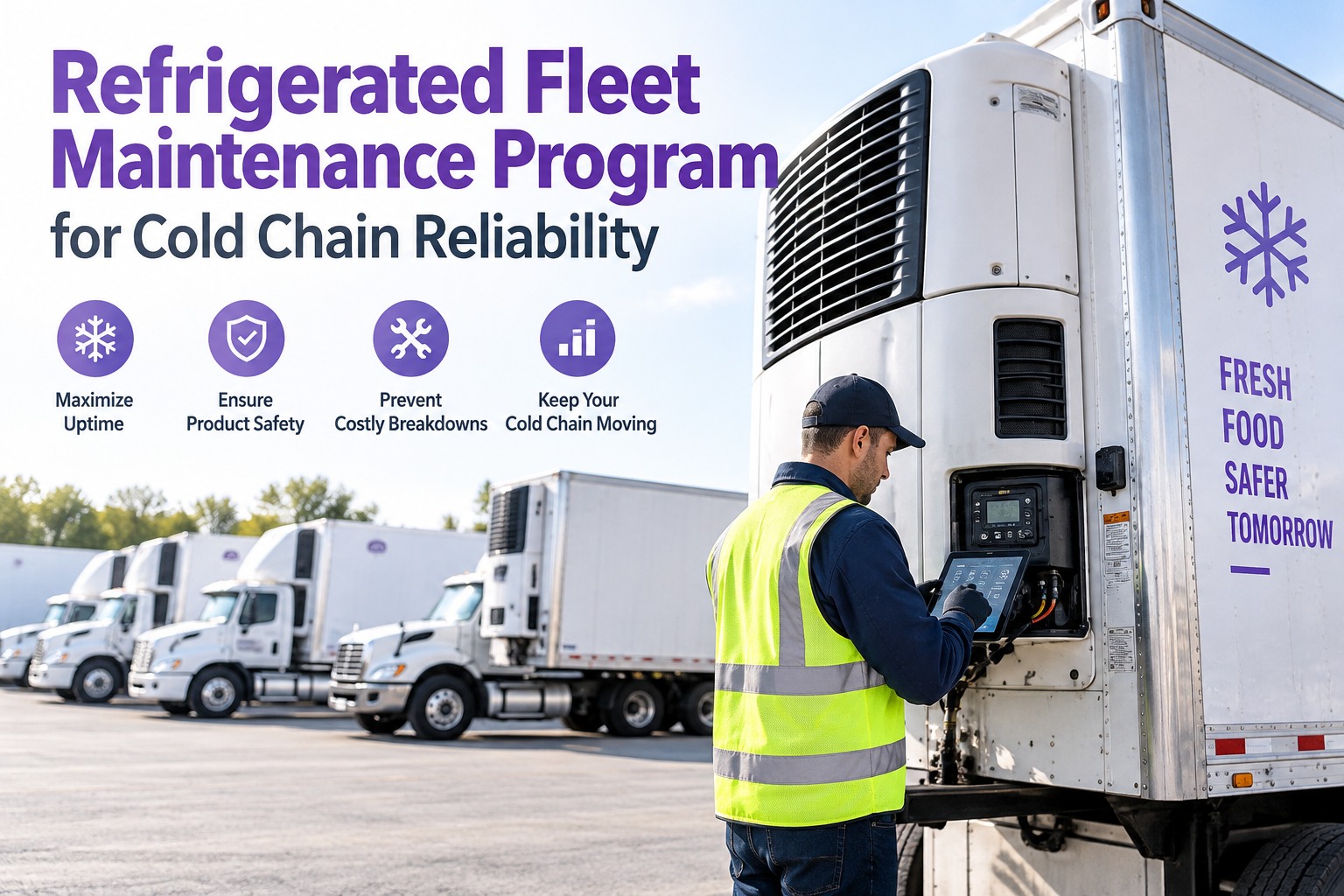
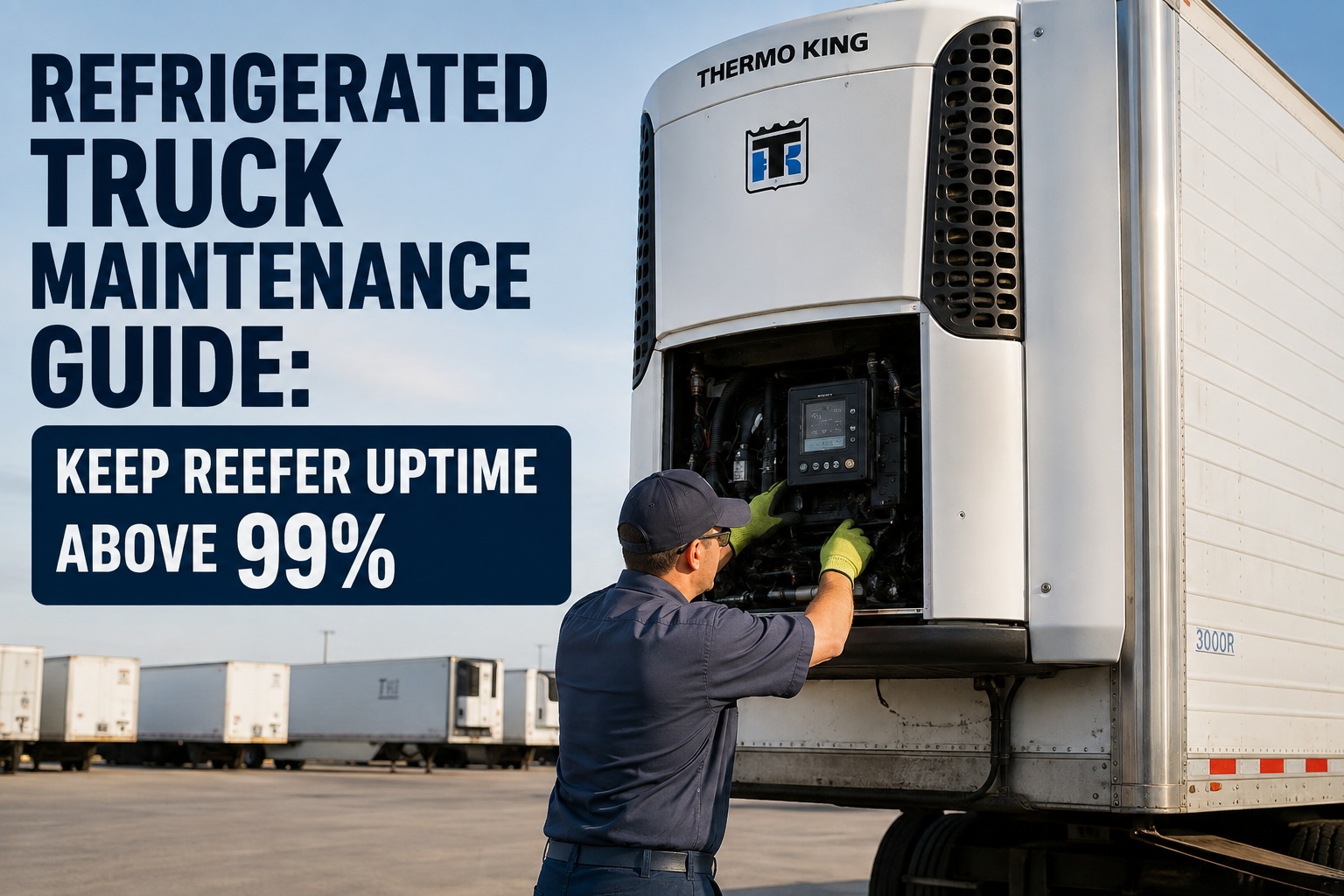
A refrigerated fleet isn't one asset per truck — it's three. The tractor pulls the load, the trailer carries it, and the reefer unit keeps it cold, and every one of them has its own PM schedule, its own service intervals, its own set of failure modes. Most fleets treat them as three separate systems maintained by three different people, which is exactly why the tractor is on time, the trailer skips its annual, and the reefer unit fails at 2 a.m. with $80,000 of pharmaceuticals on board. A cold-chain reliability program treats the three as one asset stack, coordinates their PM cadences, and gives dispatch one dashboard of what's ready to roll. Start free and coordinate tractor, trailer, and reefer PM on one platform.
Refrigerated Fleet · Tractor + Trailer + Reefer · One Program
A Maintenance Program That Treats the Whole Cold Chain as One Asset Stack
A cold-chain load rolls only when three assets are ready together — tractor, trailer, reefer unit. Truck Inspection & Maintenance Management Software coordinates PM cadences across all three, flags whichever is nearest due, and gives dispatch a single ready-to-roll view instead of three unrelated maintenance calendars.
3 assetstractor · trailer · reefer, one program
CoordinatedPM cadences aligned to reduce downtime
FSMA-readyrecords that satisfy 21 CFR 1.908
The Three Assets a Reefer Fleet Actually Runs
Each of the three components has its own PM cadence, its own failure modes, and its own service ecosystem. Understanding what each one needs — and what it costs when it isn't ready — is the foundation of a reliability program that actually works.
ASSET 1
🚚
Tractor
Class 8 diesel (or electric). Engine, drivetrain, brakes, tires. FMCSA-regulated with its own DVIR, §396.17 annual, and CDL scope.
PM cadence
A 15K · B 45K · C 100K miles
ASSET 2
🚛
Trailer (reefer body)
Insulated box, doors, floor drains, air-chute liner, rear-door seals. Has its own §396.17 annual inspection separate from the tractor.
PM cadence
Quarterly · Annual §396.17
ASSET 3
❄️
Reefer unit
Refrigeration engine (Thermo King, Carrier), condenser, evaporator, compressor, refrigerant loop. Manufacturer's own PM schedule.
PM cadence
Every 1,500–2,000 hours
The stacking problem A cold-chain load rolls only when all three assets are ready. If the tractor is fine but the trailer's annual expired, or the reefer needs a compressor service, dispatch has a truck with no legal load capacity. Coordinating the three PM cadences — so services stack rather than pull assets down on separate weeks — is the difference between 96% fleet availability and 82%.
The Tractor PM Program
Same as any diesel or electric tractor — miles-based intervals for engine, drivetrain, brakes, and running gear. The reefer context doesn't change what needs to be done; it changes how tightly the schedule needs to hold, because a tractor out of service holds a trailer with a running reefer waiting on it.
A-service (~15,000 mi)
Oil & filter, chassis lube, brake adjustment check, safety inspection. 1-2 hours.
B-service (~45,000 mi)
Full fluid replacement (transmission, differential), air-brake full test, tire rotation, alignment check. 4-6 hours.
C-service (~100,000 mi)
Coolant flush, injector inspection, turbo check, wheel-end service, aftertreatment DPF cleaning. 8-12 hours.
Annual §396.17
Full DOT annual inspection to Appendix G. Certified inspector, sticker required. 2-3 hours in addition to any concurrent PM.
The Trailer PM Program (Reefer Body)
The insulated body has its own set of failure modes — cold air escapes through worn door seals, condensation floods when drains clog, and load temperature runs uneven when the air chute fails. Every one of these takes down cold-chain integrity even with a perfectly healthy reefer unit.
🚪
Rear door seals
Check for compression, tears, gaps. A worn seal loses 5-10°F of cargo space uniformity — and every seal loses more in winter.
💨
Air chute liner
Fabric duct along the ceiling that distributes cold air front-to-back. Tears create hot spots; the mid-load sensor catches this first.
💧
Floor drains
Two or four floor drains per trailer, depending on model. Clogged drains flood the floor when defrost cycles run — water damages loads and stresses the floor.
🧊
Insulation & wall panels
Impact damage compresses the foam insulation. A damaged wall panel is a $15K repair; a cover-up delay makes it a $60K floor-and-wall rebuild.
🌡️
Return-air register
The top-front register the reefer reads. Blockage by cargo or ice buildup gives the reefer wrong data — it thinks temp is fine, cargo says otherwise.
📋
§396.17 annual (trailer)
Separate annual inspection for the trailer, including brake system, coupling, lights, and Appendix G items applied to the trailer scope.
The Reefer Unit PM Program
The refrigeration unit runs its own diesel engine (or electric motor), and its PM schedule is dictated by the manufacturer — Thermo King or Carrier — measured in operating hours, not miles. Ignoring the hours schedule is how compressor failures happen at $8,000-15,000 per rebuild.
Every 250 hrs
Fluid checks & belts
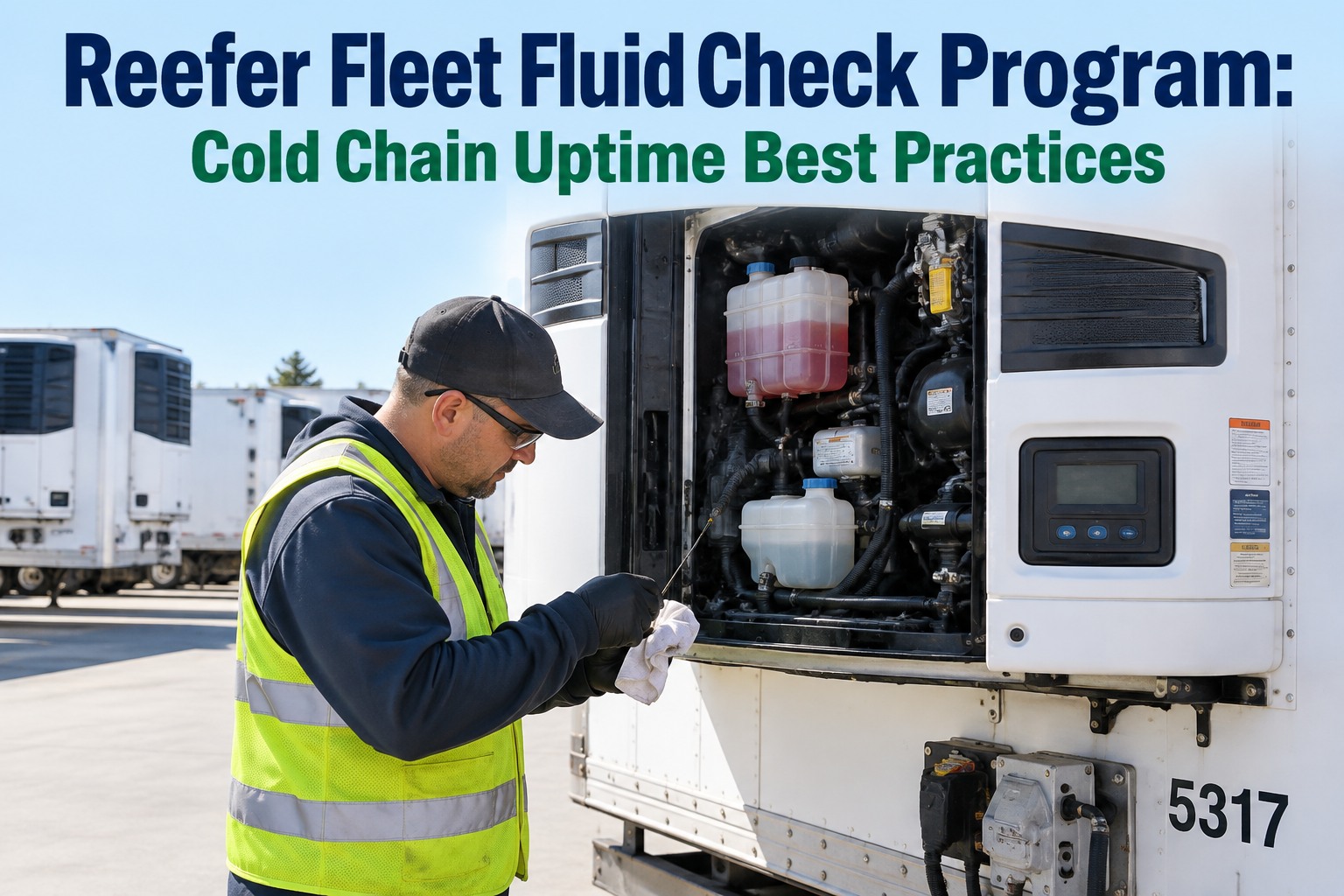
Engine oil level (reefer's own engine), coolant, refrigerant sight glass, belt tension. Fast walkaround service.
Every 1,500 hrs
Standard PM
Oil & filter, fuel filter, air filter, belt replacement if worn, refrigerant leak test with electronic detector, condenser/evaporator coil cleaning.
Every 3,000 hrs
Extended PM
Everything in the 1,500-hr service plus injector inspection, compressor valve service, defrost system check, microprocessor diagnostic dump for trending.
Every 6,000 hrs
Major service
Compressor inspection (often rebuild), condenser fan motor, evaporator fan bearing, refrigerant recovery + full recharge, EPA-certified.
Three PM Cadences, One Coordinated Schedule
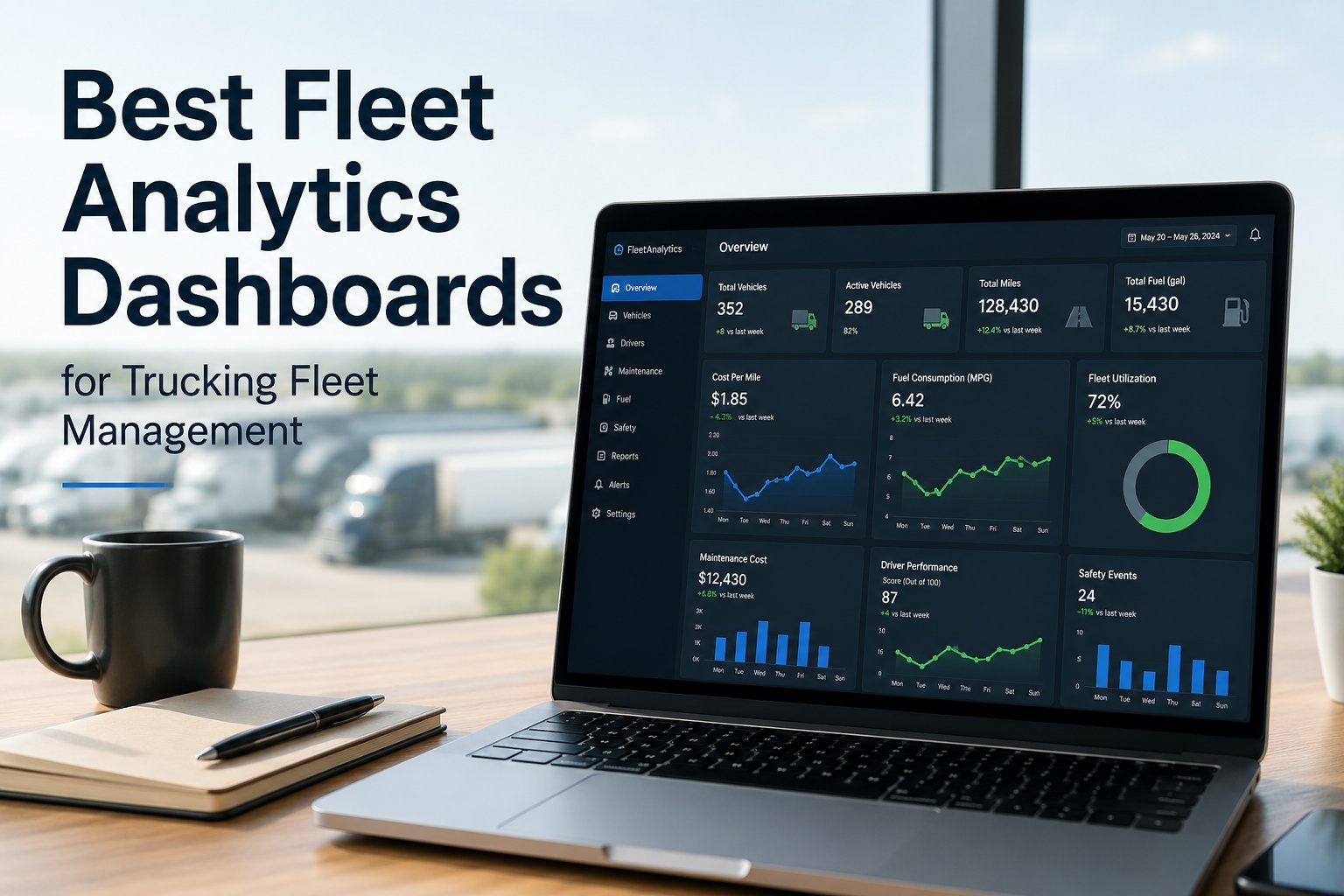
Truck Inspection & Maintenance Management Software tracks tractor mileage, trailer PM intervals, and reefer-unit hours independently — but coordinates the schedule so services stack. When a tractor B-service is due and the trailer is 200 miles from its quarterly, both land in the same shop visit. Dispatch sees one ready-to-roll status per rolling combination, not three separate calendars they have to reconcile.
The Coordinated Schedule — What Stacking Looks Like
The reliability gain isn't in doing more services — it's in doing them at the same shop visit when the intervals line up. A tractor at 44,000 miles and a trailer 300 miles from its quarterly and a reefer at 1,480 hours is one visit, not three. This is what the coordination looks like on an actual combination.
Coordinated PM · Tractor T-2247 + Trailer TR-4471 + Reefer R-4471
READY FOR STACKED SERVICE
Tractor T-2247
44,120 mi
B-service due at 45,000
Due in 880 mi
Trailer TR-4471
Q4 due
Quarterly PM + door seal check
Due this week
Reefer R-4471
1,480 hrs
1,500-hr standard PM at 1,500
Due in 20 hrs
Cold-Chain Reliability KPIs Worth Tracking
Reefer fleets need their own KPI stack — the standard fleet reliability metrics don't tell you whether cold-chain integrity is being maintained. Five KPIs that separate a fleet just running trucks from one running a real cold-chain reliability program.
KPI 01
Combination availability
% of tractor+trailer+reefer combinations ready to roll on any given day. This is the real fleet-uptime number for a reefer fleet.
Target: > 92%
KPI 02
Reefer PM on-time %
Reefer PMs completed within 5% of their hour-based due mark. Skipping the 1,500-hr service is where $8K compressor repairs live.
Target: > 95%
KPI 03
Excursion events per 100 loads
Temperature alarms that required intervention. Lower means the fleet is running clean; trending up means a systemic PM issue.
Target: < 2 per 100
KPI 04
Reefer MTBF
Mean time between failures for reefer units — hours between unscheduled repairs. Trending down means a batch/vendor issue or PM slippage.
Target: > 1,200 hrs
KPI 05
Load rejection rate
Loads rejected by receiver on temperature grounds. The customer-facing metric — every rejection is a claim, a relationship stress, and a documentation exercise.
Target: < 0.5%
Common Reefer-Fleet Program Mistakes
Fleets that struggle with cold-chain reliability tend to struggle in the same specific ways. Each is fixable, and each shows up when the three-asset program is really just three separate calendars.
01
Reefer PM on calendar, not hours
A reefer unit running 8 hours a day and one running 20 hours a day should not have the same monthly PM. Hours-based cadence is what the manufacturer specifies for a reason.
02
Trailer annual inspection skipped
The trailer has its own §396.17 requirement separate from the tractor. A CVSA inspector reads the sticker on the trailer, not the tractor. Missing this is an OOS on the whole combination.
03
Door seals on "as needed"
Door seals degrade gradually. Waiting for a driver to report cold air escape means the load has already suffered. Quarterly compression check is the right cadence.
04
Refrigerant top-off without leak test
If refrigerant is low, there's a leak — EPA rules require finding it. Topping off without diagnosis is illegal and just delays a bigger repair.
05
Not tracking reefer engine hours
The reefer's own engine hours drive its PM cadence, but too many fleets track only tractor miles. Reefer telematics (Thermo King TracKing, Carrier Lynx) reports hours — pull it in.
Frequently Asked Questions
How do we track PM for trailers and reefers that get swapped between tractors?
This is the whole point of asset-level records. The trailer PM history stays with the trailer regardless of which tractor is pulling it today; the reefer's hours track from its own ECM regardless of which trailer it's mounted on (or which yard the trailer is sitting in). Fleets that struggle here are usually maintaining PM per tractor, so a trailer that swaps between three tractors ends up with three fragmented histories. One record per asset — tractor, trailer, reefer — is how you know the whole combination is ready. Our software runs each asset's PM independently and joins them for the ready-to-roll view.
Start free with per-asset PM tracking
Should we do reefer PMs in-house or outsource to a Thermo King/Carrier dealer?
Depends on fleet size and reefer count. Below ~15 reefers, dealer service usually wins on capital efficiency — you're not investing in specialty tooling, EPA refrigerant certification, or techs who see enough units to stay sharp. Above 30 reefers, in-house shop for 250-hr and 1,500-hr PMs makes sense, with dealer for major services (3,000-hr and up). Between 15 and 30 is judgment. What matters more than in-house-vs-outsource is that PM records land in the same maintenance system either way — a dealer service invoice needs to update your asset record, not sit in a filing cabinet.
Contact us to integrate dealer service invoices
How does FSMA affect what records we need to keep?
FSMA's Sanitary Transportation Rule (21 CFR 1.908) requires carriers hauling food to keep temperature records for 12 months and produce them to FDA within 24 hours on request. It doesn't directly regulate maintenance records — but a fleet that can't show the reefer that carried the load was on a documented PM schedule is going to have a much harder time defending a rejected load or an FDA inquiry. In practice, PM records for reefer units become part of the defensible cold-chain audit trail. Our software retains both temperature and PM records together per asset.
Start free with FSMA-ready records
What's the biggest single reliability gain in the first quarter of a coordinated program?
Reduced truck-off-road days from stacked PM. Most fleets moving to a coordinated program see 2-4 fewer TOR days per combination per quarter, because services that used to take three separate visits happen in one. Combined with catching reefer PMs on their hours cadence (which prevents compressor failures) and the trailer annual on schedule (which prevents OOS surprises), the first-quarter fleet-availability lift is typically 4-6 percentage points — from something like 86% to 92%. That translates directly to revenue capacity without adding trucks.
Contact us to model the availability lift on your fleet
Tractor · Trailer · Reefer · Coordinated · Reliable
Run the Whole Cold Chain as One Reliability Program
Truck Inspection & Maintenance Management Software coordinates tractor PM (miles-based), trailer PM (quarterly and annual §396.17), and reefer unit PM (hours-based per Thermo King / Carrier spec) into one program — stacking services when intervals align, giving dispatch a single ready-to-roll view per combination, and building the FSMA-ready audit trail as it goes. Reefer fleets use it to lift combination availability past 92%, catch compressor issues at 1,500 hours instead of at failure, and stop losing loads to preventable cold-chain breaks.
No credit card required. Free for up to 3 trucks. Built for FMCSA-compliant fleets.