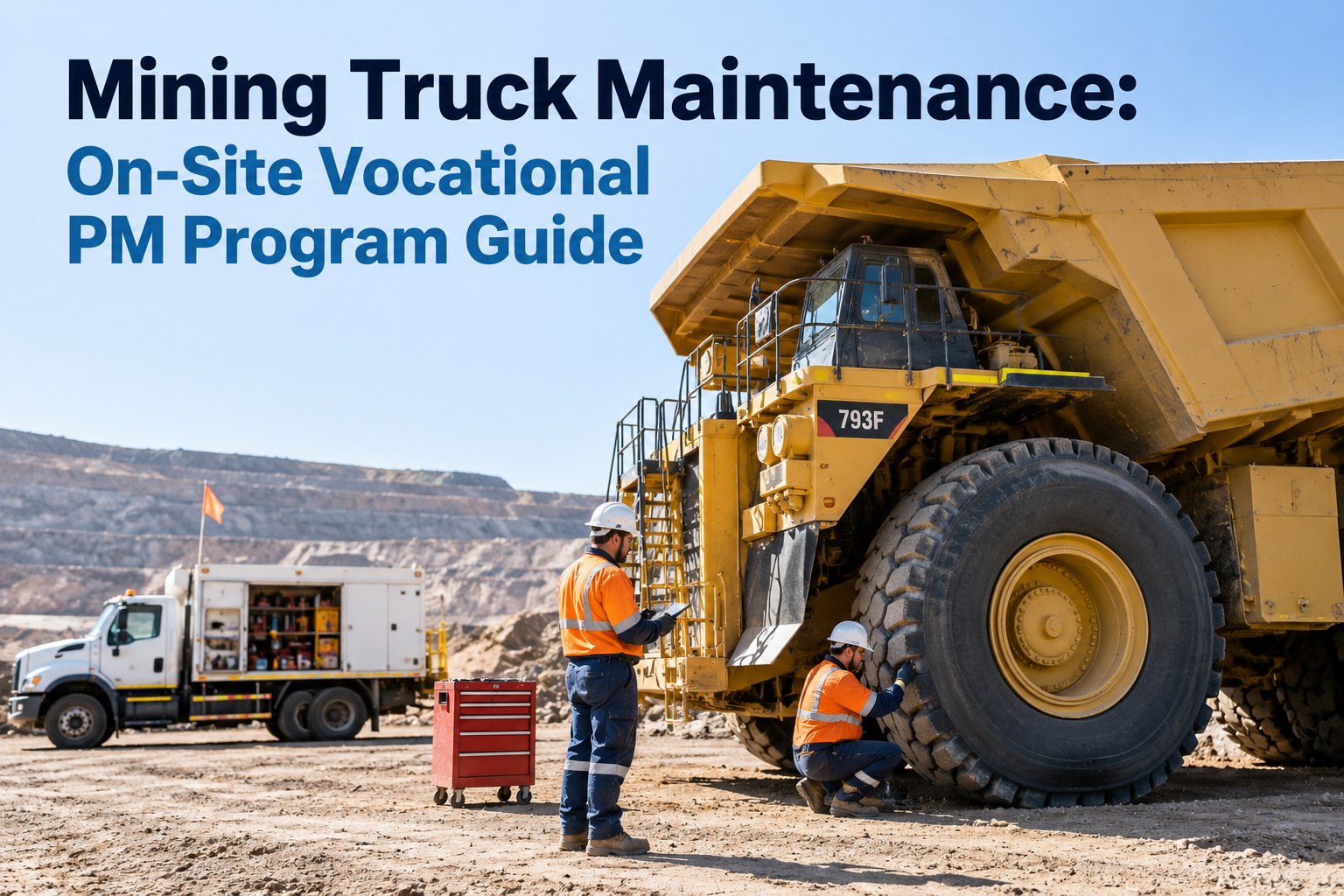
A mining haul truck doesn't live by the same clock as a highway truck. It runs 5,000 to 7,000 hours a year — two to three times a construction machine — at constant maximum payload, through abrasive dust, extreme heat, and continuous vibration, around the clock. Every one of those conditions accelerates component wear 20 to 40% beyond the rates OEM service intervals were baselined against. Then comes the second problem: the truck is parked at a remote pit, hours from the nearest dealer, where a technician can't just swing by and cell signal may not reach. Severe duty on one side, limited service access on the other — that's the vise a mining PM program has to work inside. Follow the OEM calendar to the letter and you'll under-serve the machine; wait for it to break and a single downed 200-tonne truck can bottleneck an entire shift at $5,000–$10,000 an hour in lost haulage. This guide covers the on-site vocational PM program that mining fleets actually run to hit their reliability and uptime targets. Truck Inspection & Maintenance gives dispatch, drivers, and the shop one system for inspections, hours-based PM, and repair tracking — even where the signal doesn't reach — start a free trial or contact our team.
Mining Truck Maintenance: The On-Site Vocational PM Program Guide
Severe duty that wears 20–40% faster. Service access that's hours away. The PM program that wins runs on hours, not the calendar — and lives where the signal doesn't.
Why Mining Breaks a Standard PM Schedule
Three numbers explain why an off-the-shelf calendar program under-serves a mining fleet — and why the cost of getting it wrong is so steep:
Mining equipment runs two to three times the hours of a construction machine. Calendar time between services compresses dramatically — a "quarterly" PM can come due in weeks, not months.
Constant max payload, abrasive dust, high heat, and continuous vibration push wear well past OEM-baseline rates. Dust alone forces air-filter changes up to 50% more often. Standard intervals are simply too long.
Unplanned downtime on a large haul truck runs $5,000–$10,000 per hour in lost haulage, idle crew, and production impact — and a single hydraulic failure can cost $50,000–$200,000 in parts and lost output.
Usage-based PM that keeps pace with real mining hours. Start a free trial and see your whole fleet's PM compliance on one screen.
The Foundation — Hours-Based PM, Not Calendar-Based
The single biggest upgrade a mine site can make is moving off calendar PM and onto usage-based scheduling. A truck running 600 hours a month wears differently than one running 300 — a paper calendar treats them identically, and that's how service windows quietly slip past:
The Severe-Duty Interval Adjustment
Duty cycle isn't subjective — it maps to a multiplier you apply to the OEM base schedule. Mining sits at the heavy end, where intervals get cut hard:
Light Duty
Stockpile loading, material yards — 60–70% engine load, low shock, minimal dust. Follow the OEM manual as written.
Medium Duty
Construction, truck loading, mixed materials — 70–80% load, moderate shock, some dust. Reduce all PM intervals by 25%.
Severe Duty — Mining
Quarry face-loading, mining, rock handling — 80–100% load, heavy shock, extreme dust. Cut all PM intervals in half. A 1,000-hour service becomes 500. This is where haul trucks live.
The Reality That Makes On-Site PM Non-Negotiable — The Failure Trail Almost Always Leads Back to a Missed Inspection
When a hydraulic system fails on a 200-tonne haul truck, the repair can run $50,000–$200,000 in parts and lost production — and in many cases the failure trail leads back to a missed inspection that was never flagged because nobody was tracking it in real time. Every missed PM interval accelerates wear on the next component in line: a skipped filter change becomes a fuel-system failure, a missed brake inspection becomes a brake failure at the worst possible moment. On a remote site with paper logs and whiteboard schedules, that miss is invisible until it's a production stop. Book a demo and see how on-site digital PM closes the gap that reactive maintenance can't.
The On-Site Program in Four Pillars
A working mining PM program isn't one practice — it's four, each built around the twin constraints of severe duty and remote access:
Legally required pre-shift checks move off paper and onto mobile checklists with photo verification. Every defect syncs straight to the maintenance planner and triggers a work order — no lost binder, no delayed defect. This is the front line where problems get caught before the truck loads.
When a truck hits its severe-duty-adjusted interval (250h, 500h, 1000h), the system generates the work order, reserves the parts, and alerts the planner automatically. No spreadsheet, no forgotten hour-meter read — the schedule holds itself consistent across every truck and every tech.
Remote sites can't wait 3–5 days for a part. Track critical-spare consumption, set automated reorder thresholds, and stage inventory so a scheduled PM never stalls waiting on delivery. Overstocking ties up capital; understocking idles a machine — the system finds the line.
Crews complete inspections and update work orders offline; data syncs the moment connectivity returns. Across multiple pits and quarries, maintenance KPIs roll up to one dashboard with site-specific views — so headquarters can see asset health everywhere at once.
Built to run where cell signal doesn't. Book a demo to see offline mode and hours-based scheduling in action.
Every engine hour tracked, every PM fired on real wear, every defect routed to a work order — even where the signal doesn't reach.
Dispatch, drivers, and the shop work from one system for inspections, preventive maintenance, and repair tracking — so no defect, PM, or compliance record ever slips. Start a free trial or contact our team.
KPI Dashboard — 5 Mining PM Metrics
Five numbers tell you whether the on-site program is holding — and give you the reliability data to defend the maintenance budget:
Share of hours-based PMs completed on schedule. Usage-based scheduling routinely pushes this above 95%; calendar programs stall well below.
The reduction mining fleets target by moving from reactive to predictive, on-schedule maintenance. Every hour recovered is haulage back on the road.
Rising MTBF is the clearest proof PM is working — components reaching their design life instead of failing early under severe duty.
From a pre-shift defect to an open, assigned work order. On a remote site, speed here is the difference between a fix and a failure.
Digital pre-shift checks with timestamps and photos — the audit standard for MSHA. Paper logs leave gaps that surface at exactly the wrong moment.
Track all five automatically across every pit — start a free trial in minutes.
The 5 Mining PM Mistakes That Cost Fleets Most
Five patterns show up again and again in mining fleets fighting recurring, expensive failures:
Following OEM Intervals in Severe Duty
Pattern: The manual says 1,000 hours, so the truck runs 1,000 hours — in dust and max payload the OEM never assumed. Components are chronically under-served and fail early. The fix is the 0.5× severe-duty multiplier.
Calendar PM on a Multi-Shift Fleet
Pattern: Every truck serviced on the same date regardless of hours. The hardest-worked haul truck is weeks overdue on wear while an idle one gets a bay it doesn't need.
Paper Logs at a Remote Site
Pattern: A supervisor tracks intervals on a whiteboard, a tech forgets to radio in the hour reading, and a PM window quietly passes. When MSHA arrives, the record has holes.
Understocking Critical Spares On-Site
Pattern: A scheduled PM stalls 3–5 days waiting on a part that has to ship to an isolated quarry. The truck sits, the wear clock keeps running on the rest of the fleet covering its load.
Ignoring the Early Warning Signals
Pattern: Oil temperature, particle counts, and vibration drift from baseline weeks before a gear-train or bearing failure — but nobody's trending them. The catastrophic failure was preventable and telegraphed.
Frequently Asked Questions
Why can't mining fleets just follow OEM maintenance intervals?
Because OEM intervals are baselined against gentler conditions. Constant max payload, abrasive dust, heat, and vibration accelerate wear 20–40%, and mining equipment runs 5,000–7,000 hours a year. Following the manual to the letter leaves components under-served in real mining duty.
How much should I reduce PM intervals for mining duty?
Map duty cycle to a multiplier: light duty stays at 1.0× the OEM base, medium duty at 0.75× (a 25% reduction), and severe mining duty at 0.5× — cut every interval in half. A 1,000-hour service becomes 500 hours. Always fine-tune with oil analysis and inspection findings.
Why is hours-based scheduling better than calendar-based for mining?
A haul truck running 600 hours a month wears twice as fast as one running 300, but a calendar treats them the same. Scheduling PM off engine hours or meter data services each machine on its real wear curve — and pushes compliance above 95%.
How does maintenance software work at remote mine sites with no signal?
Offline-capable systems let crews complete inspections and update work orders without connectivity; data syncs automatically once signal returns. That's essential for isolated pits and quarries where a cloud-only, always-online tool simply won't function.
What are the key mining PM compliance requirements?
MSHA requires legally mandated pre-shift inspections and maintenance records that demonstrate systematic care, with quarterly (surface) to at-least-four-times-yearly (underground) inspections. Digital documentation with timestamps and photos is the accepted audit standard.
How does Truck Inspection & Maintenance fit a mining fleet?
It gives dispatch, drivers, and the shop one system for hours-based PM, digital pre-shift inspections, on-site parts control, and repair tracking — with offline sync for remote sites and audit-ready records — so no defect, PM, or compliance record ever slips. Start a free trial or contact our team.
Severe duty on one side, remote access on the other. The mining PM program that wins runs on hours, lives on-site, and never lets a service window slip.
Hours-based PM auto-scheduling, mobile pre-shift inspections with photo proof, on-site parts control, and offline sync that works where cell signal doesn't — all in one system dispatch, drivers, and the shop share.