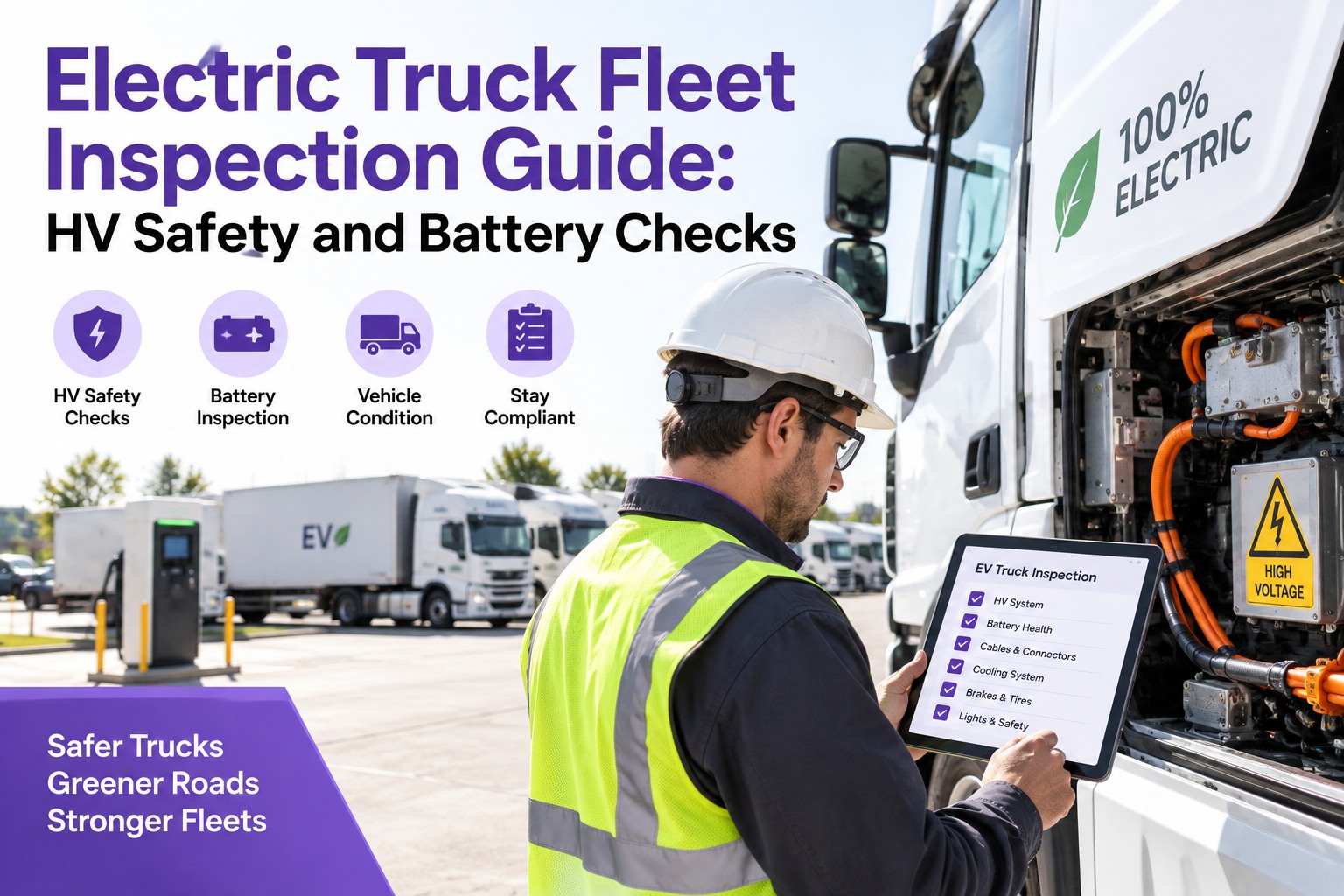
An electric truck is a Class 8 tractor with 600+ volts of DC bus under the frame, a 500 kWh battery pack, and a regenerative brake system doing 70% of the stopping. Every diesel-era inspection item still applies — tires, lights, coupling, structure — but there's a whole second inspection layer sitting on top of it that most fleets are still figuring out how to run. HV safety before anyone touches the truck. Battery state-of-health and thermal balance. Regen brake calibration. Charging equipment. Get any of those wrong and the failure mode isn't "truck down" — it's a fire, a shock hazard, or a $80,000 battery pack ending its life at 40% capacity. This is what the added inspection layer needs to cover. Start free and put an EV-ready inspection on every truck.
Electric Trucks · HV Safety · Battery Health · DVIR
Electric Truck Inspections That Cover the 600-Volt Layer Diesel Never Had
Every diesel-era DVIR item still applies — but an EV adds high-voltage safety, battery state-of-health, thermal management, regen brake calibration, and charging equipment on top. Truck Inspection & Maintenance Management Software runs an EV-specific inspection path with the HV lockout, battery, and charging checks that keep your fleet safe and your battery packs healthy.
600+ V DCbus voltage on Class 8 EVs — lethal at contact
~$80Kbattery pack replacement cost on a Class 8
NFPA 70Ethe electrical safety standard the shop needs
What EVs Add to the Inspection Layer
The base DVIR doesn't go away — brakes, tires, coupling, lights, cab, and trailer inspection are all still required by §396.11. What changes is what sits on top: five inspection categories that don't exist on a diesel truck at all, and that most fleets are training into their inspection program for the first time.
⚡
01
High-voltage safety
HV cables, orange conduit, service disconnect, insulation resistance. Any exposed HV is a fatal-shock and arc-flash risk.
🔋
02
Battery health & balance
State-of-charge, state-of-health, cell balance, capacity fade over baseline. The pack degrades if not watched.
🌡️
03
Thermal management
Battery coolant loop, radiator, pump, temperature at cell level. Thermal runaway starts here.
🛑
04
Regenerative braking
Regen calibration, friction-brake wear (much slower than diesel), pedal-feel consistency.
🔌
05
Charging equipment
Charge port condition, cable, seal integrity, CCS/NACS connector wear, on-board charger status.
The safety layer comes first No EV inspection starts without HV verification. NFPA 70E and OSHA 1910.269 govern electrical work, and while a driver walkaround isn't "work on energized equipment," anything that opens covers, disconnects the pack, or touches HV components requires trained personnel and PPE. The driver inspection catches visual issues; the shop inspection catches everything else — and the two need different templates.
HV Safety — What the Driver Actually Checks
The driver's HV inspection is visual only. They confirm the system is intact and there are no visible warning signs — nothing more, nothing less. Anything wrong here means the truck doesn't move until a qualified technician clears it.
DRIVER-LEVEL HV WALKAROUND
~2 min
Orange HV cables intact
No visible cuts, abrasion, exposed conductor. Orange conduit is the universal HV marker — anything showing bare wire is a stop.
Service disconnect present & sealed
The manual service disconnect (MSD) is locked in its operating position, tamper-seal intact.
HV covers & panels closed
Battery pack covers, motor housing, junction box covers all latched. No panel that's supposed to be closed is open.
Dash HV warnings clear
No HV isolation fault, no "service HV system" light. Any dash HV warning grounds the truck.
No smoke, odor, or heat
Around the battery pack area — sweet chemical smell or unusual heat is thermal runaway starting. Evacuate the truck, call 911.
Charge port clean & dry
No debris, no moisture, no corroded pins. A wet or dirty port fails a charge session and stresses the on-board charger.
Battery Health — The Metrics That Matter
Battery packs don't fail in the way diesel engines do — they degrade, gradually, over hundreds of cycles. The inspection isn't a pass/fail; it's a trend. Four metrics that tell you how a pack is aging and when to act on it.
State of Charge
SOC
Where the pack sits right now. Baseline check at shift start; drivers report against the range they need for the route.
Typical target:
80–90% at dispatch
State of Health
SOH
Current usable capacity vs. original rated capacity. The lifetime KPI — a pack at 80% SOH has lost 20% of its range permanently.
Warranty threshold:
Often 70–80% at 8 years
Cell balance
ΔmV
Voltage variance across cells or modules. Widening imbalance means one module is aging faster — the pack's weakest link determines the whole pack's usable capacity.
Healthy range:
< 30 mV between cells
Cycle count
n
Total charge/discharge cycles logged. Batteries are cycle-rated more than calendar-rated. A truck at 800 cycles has hit real degradation territory.
Typical rating:
2,000–3,000 cycles
Thermal Management — Where the Big Risk Lives
The single most important non-obvious inspection on an EV is thermal. Battery packs are stable in a narrow temperature band; drift outside it and the pack degrades faster in the short run and risks thermal runaway in the long run. Coolant loop and cell-level thermal checks are what keeps that from happening.
💧
Battery coolant loop
Reservoir level, no leaks, coolant color/clarity. Battery coolant is a specific formulation — never top with regular engine coolant.
🌡️
Cell-level temperature
Pack temp sensors report per-module. Any module 5°C+ hotter than the pack average is a red flag; more than 10°C is a stop.
🔄
Coolant pump & radiator
Pump runs on demand from the BMS; radiator clear of debris, fans functional at test. A stuck pump is silent until the pack overheats.
⚠️
Thermal event indicators
BMS logs any thermal alarm even if it self-cleared. Recurring warns are a pattern; investigate before it becomes an event.
EV Inspection Path — Purpose-Built, Not Retrofitted
Truck Inspection & Maintenance Management Software runs an EV-specific inspection path alongside your diesel DVIR — HV walkaround for drivers, battery/thermal/charging checks for the shop, integration with major EV telematics (Ford Pro Intelligence, Freightliner eCascadia diagnostics, Volvo VNR Electric) for SOC/SOH/cell-balance data. One platform covers both diesel and electric assets as your fleet transitions.
Regenerative Braking — Different Wear, Different Checks
Regen does 60-70% of the braking on an electric truck. The friction brakes still exist, still get inspected per §393.47, and still need pushrod stroke checks — but they wear at a fraction of the rate. New failure modes appear: regen calibration drift, pedal-feel inconsistency, regen-to-friction transition delay. All of them matter for driver safety.
DIESEL BRAKES
What you inspect
- Pushrod stroke (Type-30 ≤ 2.00")
- Lining thickness (¼")
- Slack adjuster travel
- Air-brake test sequence
- Drum & disc wear
Wear rate: pads replaced every 50–100K miles
EV BRAKES
What you inspect (added)
- All diesel checks above (still required)
- Regen calibration (pedal % engages what regen level)
- Regen-to-friction transition smoothness
- Pedal feel consistency across SOC range
- Motor-controller fault codes tied to regen
Wear rate: pads may last 200–300K+ miles due to regen
Charging Equipment — The Fourth Wall of Inspection
An EV inspection isn't complete at the truck — the depot's charging infrastructure is inspection scope too. A truck with a healthy battery pack and a broken charger doesn't roll tomorrow. Four items that live at the charger, not the truck.
01
Charge cable & connector
No damage to insulation, connector pins clean, seal ring intact. A damaged cable is a shock hazard and a session-fail waiting to happen.
02
Charger status & error logs
Any error codes since last check. Recurring communication errors between charger and truck are usually a connector problem, not a truck problem.
03
Cabinet cooling & airflow
DC fast chargers generate heat; blocked intakes or failed fans throttle output. A "slow charging" complaint is usually a cooling issue.
04
Grounding & GFCI
Ground fault protection functional; equipment ground continuity verified per NEC. Non-negotiable; retest quarterly.
Common EV Inspection Mistakes
Fleets moving into EV usually make the same five mistakes in the first year. Each one is fixable, and each one is safer to fix before it teaches you the hard way.
✕
Treating the EV like a diesel with a battery
The base DVIR isn't enough. HV, battery, thermal, and charging need their own inspection layer — retrofitting a diesel template misses everything that actually matters on the EV.
✕
Untrained technicians touching HV
NFPA 70E training is not optional for anyone opening HV covers. Shock and arc-flash injuries at 600V DC are almost always fatal. Diesel-experienced mechanics need EV-specific certification.
✕
Ignoring SOH trend
Battery packs die of neglect. If nobody's tracking state-of-health quarterly, you'll discover a truck has lost 20% range only when a driver complains they can't finish a route.
✕
No charger inspection
Depot chargers are treated as infrastructure and never inspected until they fail. Then the whole EV fleet is grounded until the vendor sends a tech.
✕
Assuming regen means "no brake work"
Pads still wear, drums still need pushrod checks per §393.47, air-brake test sequences on trucks with air systems still apply. Regen extends brake life; it doesn't eliminate brake inspection.
Frequently Asked Questions
Does an electric truck still need an FMCSA DVIR and §396.17 annual inspection?
Yes — every rule that applies to a diesel Class 8 also applies to an electric one. The DVIR under §396.11, annual inspection under §396.17, driver signature chain per §396.13, roadside inspection scope under CVSA — all identical. What's added is the EV-specific inspection layer that lives alongside the FMCSA-required items, not instead of them. FMCSA hasn't published EV-specific inspection rules yet, so the practical answer is: comply fully with everything diesel-era, add HV/battery/charging on top as good practice.
Start free with combined FMCSA + EV inspection paths
Who's qualified to inspect HV components on an EV?
NFPA 70E defines the electrical safety standard for anyone working on or near energized equipment; OSHA 1910.269 covers the same ground for shop workers. Most OEMs additionally require their own certification (Freightliner, Volvo, Ford Pro, Tesla Semi, etc.) before a technician can perform warranty-covered work. Drivers do the visual walkaround; anything requiring opening HV covers or disconnecting the pack needs a certified technician with the right PPE — arc-rated clothing, insulated gloves, face shield, and a documented safe-work procedure. Our software lets you flag inspections that require HV-qualified technicians so untrained staff can't accidentally open a work order on an HV issue.
Contact us to build your HV-qualified workflow
How often should we check battery state-of-health?
Daily via telematics for state of charge (SOC); weekly for cell balance; quarterly for state of health (SOH). SOH doesn't move day-to-day — it drifts over hundreds of cycles — so a weekly check is noise. Cell balance can shift enough over a week to matter; if the module-to-module ΔmV widens by more than 20 mV in a month, something's aging asymmetrically. Our software pulls SOC/SOH/cell balance from major EV telematics feeds automatically so you're not entering numbers manually.
Start free with automated battery health tracking
Do reefer trailers work differently behind an electric tractor?
The reefer unit still runs on its own diesel or its own electric power (some newer reefers can pull from the tractor's HV bus, but most are still independently powered). What changes is inspection coordination — the tractor has its EV inspection, the reefer has its own, and both need to be current before dispatch. All-electric refrigerated combinations exist and add a second HV system to inspect. Our software runs multi-asset inspection paths so a driver picking up an electric tractor + reefer trailer combo gets both templates loaded in sequence.
Contact us to build multi-asset EV workflows
HV Safety · Battery Health · Thermal · Regen · Charging
Every Layer of an EV Inspection, on One Platform
Truck Inspection & Maintenance Management Software runs the FMCSA-required DVIR alongside the EV-specific inspection layer — HV walkaround for drivers, battery/thermal/charging deep-dive for the shop, telematics integration with major EV OEMs for automatic SOC/SOH/cell-balance sync, and charger inspection cadences at your depot. Fleets transitioning into electric use it to run both diesel and EV inspections on one platform, keep certified technicians in the right work orders, and prevent the $80,000 battery failures that come from missed thermal warnings.
No credit card required. Free for up to 3 trucks. Built for FMCSA-compliant fleets.