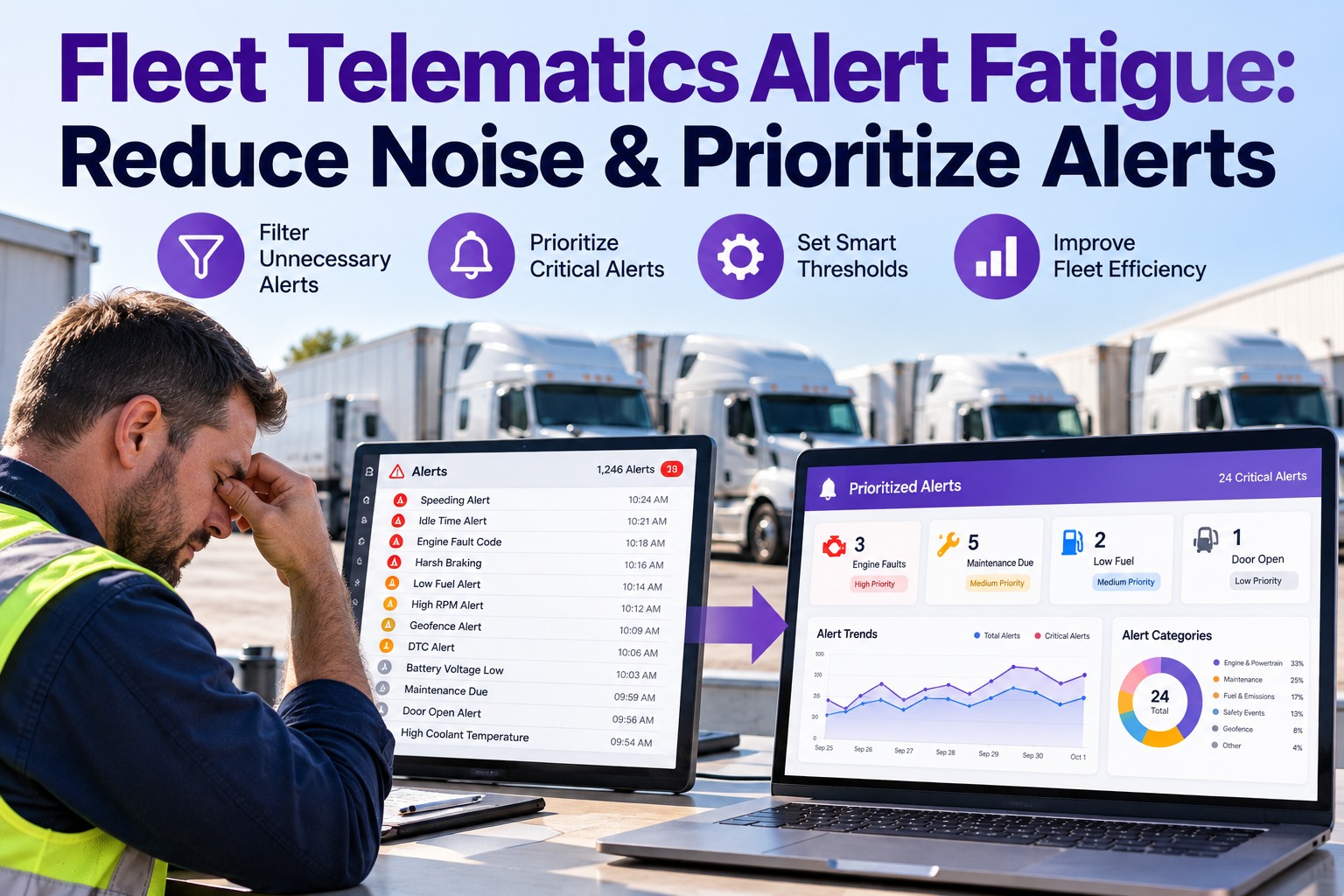
Three hundred and eighty alerts in one day, from one dispatcher's queue, in an otherwise ordinary fleet — hard-braking pings, idle-time warnings, geofence exits, all firing at factory-default thresholds. By alert two hundred, nobody's reading them anymore. That's not a dispatcher failing at their job; that's a system designed to be ignored, and the critical alert buried in there has exactly the same odds of being missed as the noise around it. Start free and cut your alert volume down to what actually needs action.
Severity Tiers · Threshold Tuning · Alert-to-Action Tracking
Fleet Telematics Alert Fatigue: Reduce Noise & Prioritize Alerts
Most fleets don't have a visibility problem; they have a signal-to-noise problem. Truck Inspection & Maintenance Management Software tiers every incoming alert by real severity, tracks which ones actually lead to action, and quietly retires the ones that don't — so a dispatcher's queue stays something people actually check instead of something they've learned to mute.
What "Tuned" Actually Looks Like, Side by Side
Untuned System
~380
alerts / dispatcher / day
Median time to channel gets muted by its first dispatcher: days, not months
Tuned System
5–15
alerts / dispatcher / day
The band where alerts actually get opened and acted on
Four Reasons Alert Fatigue Builds Up Without Anyone Deciding It Should
Everything Looks Equally UrgentA minor threshold breach and a serious brake fault arrive as the same badge, same sound, same inbox
Default Thresholds Never Get TunedSpeeding set five mph over the limit on a highway lane fires constantly and teaches people to ignore the channel
No Owner, No ClosureAn alert that's escalated but never acknowledged trains the person who escalated it to stop bothering next time
Duplicate Alerts, Same IncidentOne faulted sensor firing every 30 seconds can swamp a queue with dozens of alerts for a single event
Build a Severity Pyramid, Not a Single Inbox
Not every alert deserves the same channel, the same sound, or the same response time. A working system sorts incoming events into three tiers before they ever reach a human.
CriticalActive brake fault, DPF derate, safety-system failure — immediate notification, every channel
WarningApproaching maintenance threshold, moderate harsh-braking pattern — queued for same-day review
InformationalMinor idle time, routine geofence entry — logged silently, surfaced only in weekly reports
The 60% rule Track how often each alert type actually leads to a real action — a repair, a driver coaching conversation, a route change. If an alert type's action rate drops below roughly 60%, that's the signal to raise its threshold or retire it entirely. A low action rate isn't proof the alert is important and being missed; it's usually proof the alert isn't calibrated to this fleet.
Tuning Isn't a One-Time Setup — It's a Quarterly Habit
Alert firesLogged with full context — not just a number crossing a line
Action trackedDid it lead to a repair, a conversation, or nothing at all?
False positives flaggedTreated as tuning data, not as failures to shrug off
Threshold adjustedReviewed on a regular cadence, not left on factory defaults indefinitely
A Queue Worth Checking Again
Our Truck Inspection & Maintenance Management Software tiers every alert by real severity, tracks action rates per alert type, and surfaces the ones quietly training your team to ignore the channel — so critical faults stop hiding in a pile of noise nobody opens anymore.
Frequently Asked Questions
How many alerts per day is actually healthy for one dispatcher to manage?
Is alert fatigue a driver or dispatcher discipline problem?
Generally no — it's a system configuration problem. A person who ignores a warning light after the tenth false alarm that week isn't failing at their job; they've been trained by the system itself that most alerts aren't worth acting on, and that training is hard to undo even once a real one comes through.
Should every fleet use the same alert thresholds?
No. A threshold that makes sense for one fleet's routes, vehicle ages, and duty cycles can generate constant false positives for another. Thresholds calibrated against a fleet's own historical data consistently perform better than factory defaults applied uniformly.
What's the fastest way to start fixing an already-noisy alert system?
Start by measuring the action rate on your existing alert types rather than adding more rules — the alert types with the lowest follow-through are almost always the biggest source of fatigue, and raising or retiring just those thresholds often cuts volume dramatically on its own.
Contact us to run an alert audit on your current setup.
Tiered Severity · Tracked Action Rate · Quarterly Tuning
Turn Your Alert Channel Back Into Something People Actually Check
Our Truck Inspection & Maintenance Management Software tiers alerts by real severity, tracks which ones lead to action, and helps you retire the noise — so critical events stop competing with routine pings for the same five seconds of attention.
No credit card required. Free for up to 3 trucks.