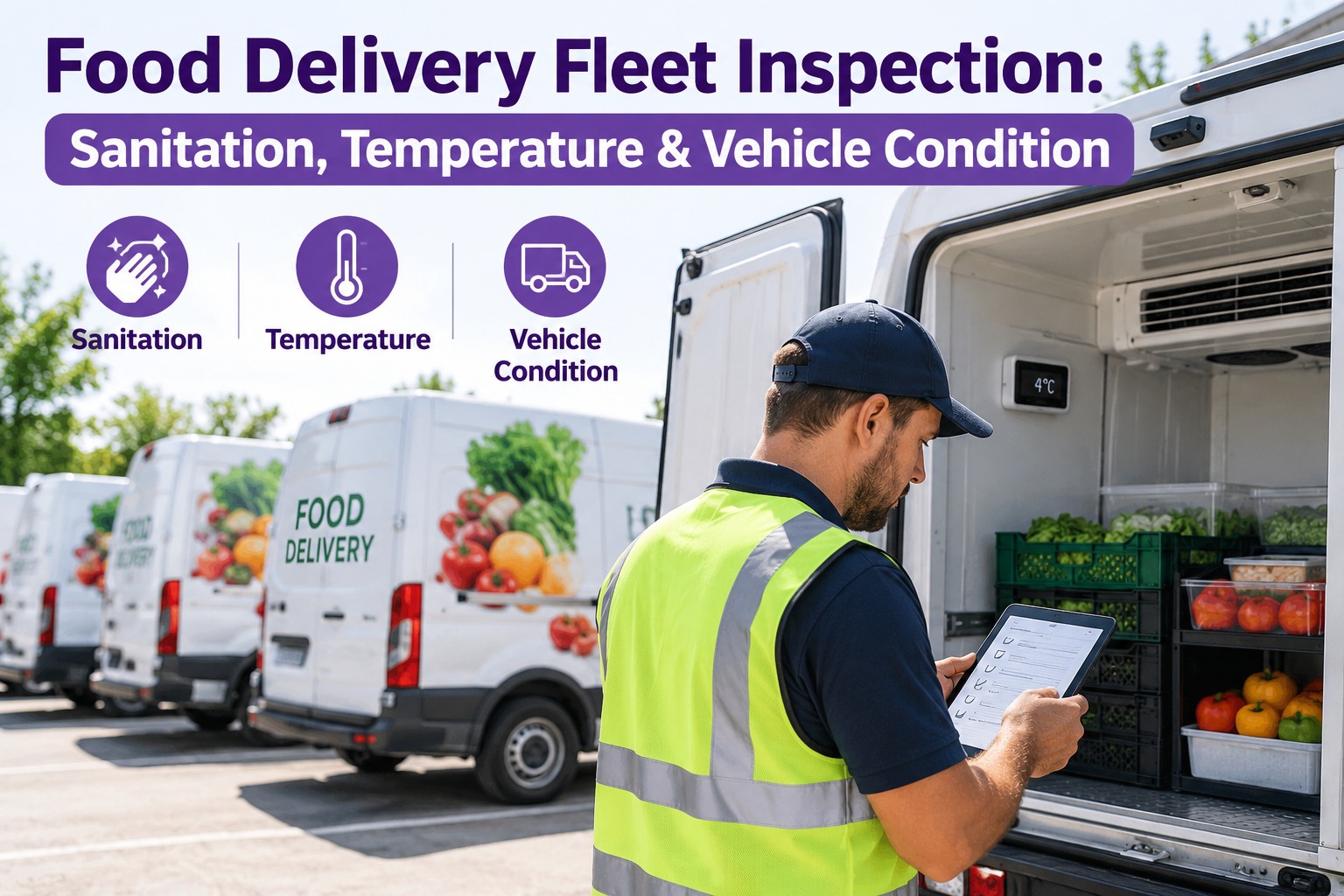
Food Delivery Fleet Inspection: Sanitation, Temperature & Vehicle Condition
By Sarah Johnson on October 16, 2026
A food delivery vehicle fails differently from an ordinary truck. A dead brake light is a violation; a warm reefer, a dirty load bay, or a door left open on a multi-stop run is spoiled product, a failed audit, and a customer who gets sick. Food transport is governed by three things at once — how clean the vehicle is, how cold it stays, and whether it's mechanically sound — and a lapse in any one ruins the load. This guide walks all three pillars and how to keep each one provable, trip after trip. Start free and run every food-fleet check on TIM.
TIM · Food Delivery Fleet Inspection
Food Delivery Fleet Inspection: Sanitation, Temperature & Vehicle Condition
Clean, cold, and roadworthy — a food delivery vehicle has to be all three, every trip, and the product pays for any one that slips. A warm compartment, a residue from the last load, or a breakdown mid-route turns a delivery into a write-off and a compliance problem. What you want is each pillar checked and logged before the wheels turn. That's the loop Truck Inspection & Maintenance Management Software (TIM) runs for you — the inspection flags each issue, it becomes a graded work order, the repair is tracked to a verified close, and sanitation and temperature checks stay on record.
Clean · cold · roadworthyEvery vehicle cleared on all three pillars and logged before dispatch — so a lapse never leaves with the load.
Every food delivery inspection comes down to three questions, each with its own failure mode and its own record. Miss one and the other two don't save you.
01
SanitationIs the load space clean, odor-free, and clear of residue or allergens from the last cargo?
Fails as: cross-contact & contamination
02
TemperatureIs the compartment pre-cooled, holding its set point, and monitored the whole route?
Fails as: a broken cold chain
03
Vehicle ConditionIs the truck — and its refrigeration unit — mechanically sound and road-legal?
Fails as: a breakdown mid-route
Under the federal Sanitary Transportation of Food rule, the vehicle, its temperature control, and the records behind both are all in scope — so these three pillars aren't just good practice, they're what an inspection looks for. Contact our team to map the three pillars to your fleet.
Pillar 01
Sanitation — Keep the Load Space Clean
The compartment that carried raw protein yesterday carries produce today. Residue, spills, odors, and allergens from the last load are the contamination risk, and the rule expects the vehicle to be designed and kept cleanable so prior cargo can't reach the next one. Clean on a schedule, and prove it.
6 checksSanitation checklist21 CFR 1.906
Pillar 02
Temperature — Protect the Cold Chain
The cold chain doesn't break at the set point on the controller — it breaks in the load, at the moments between. Pre-cool before loading, keep air moving through the cargo, mind the doors on multi-stop runs, and monitor a spot that represents the product, not the air by the evaporator. These are the break points to watch.
◷Loaded before pre-coolWarm box at load time means the product never reaches temperature.
≋Blocked airflowPallets against the walls stop cold air circulating through the load.
⊟Doors open on stopsEach multi-stop opening lets warm air in and the set point drift.
◎Sensor by the coilA probe next to the evaporator reads cold while the cargo warms.
6 checksTemperature checklist21 CFR 1.908
Pillar 03
Vehicle Condition — Keep It Running & Road-Legal
A breakdown doesn't just delay a food load — it strands it warming by the roadside. The standard roadworthiness checks matter double here, because the refrigeration unit is a second engine with its own fuel, belts, and failure modes, and the truck has to make every stop on schedule.
6 checksVehicle condition checklistpre-trip
Three Pillars, One Record, Every Trip
Clean, cold, and roadworthy only protect the load if all three are checked and logged together. TIM keeps the sanitation check, the temperature log, and the vehicle inspection on one record per unit — turning any failed item into a work order and keeping the proof an auditor or a receiver may ask for.
The Sanitary Transportation of Food rule spreads the duties across everyone who touches the load. Knowing which role carries which task keeps a gap from opening between them.
ShipperSpecifies the operating temperature and any pre-cooling requirement, in writing.
LoaderVerifies the compartment is prepared and pre-cooled before temperature-controlled food goes in.
CarrierPre-cools, holds the agreed conditions, follows written procedures, and can show evidence on request.
ReceiverChecks on arrival whether the food saw significant temperature abuse before accepting it.
A food fleet carries a risk an ordinary fleet doesn't — the load itself can go bad between the depot and the door. TIM keeps all three pillars on one record so a clean, cold, roadworthy vehicle is provable, not assumed.
Three checks, one recordSanitation, temperature, and vehicle condition live together per unit, per trip.
Defect becomes a work orderA failed item — dirty bay, reefer fault, worn brake — turns into a tracked repair.
Cleaning & temp logs keptWho cleaned it and the trip's temperature history stay retrievable for an audit.
Nothing dispatches failingA unit with an open critical issue on any pillar is flagged until it's fixed.
Reefer on a PM cadenceSchedule refrigeration service alongside the truck so neither engine is a surprise.
Proof for receiversShow the clean-and-cold record on delivery, so a load isn't refused on doubt.
Three things, together. Sanitation — the load space clean, odor-free, and clear of residue or allergens from the last cargo. Temperature — the compartment pre-cooled, holding the product's set point, and monitored the whole route. And vehicle condition — the truck and its refrigeration unit mechanically sound and road-legal. An ordinary pre-trip covers only the third; a food fleet has to clear all three before every run, because a lapse in any one can spoil the load or fail an audit.
What is the FSMA Sanitary Transportation of Food rule?
It's the federal rule (21 CFR Part 1, Subpart O) that governs how food is carried by motor and rail. It sets expectations for the vehicles and equipment — that they're designed and kept cleanable and able to protect food — for temperature control where food needs it for safety, for training of personnel with sanitary duties, and for records. It spreads responsibilities across shippers, loaders, carriers, and receivers, usually fixed by written agreement. The rule doesn't set one universal fridge temperature; each product's operating temperature comes from a documented, product-specific basis.
Where does the cold chain usually break?
Rarely at the controller — almost always in the load, between the obvious steps. The common break points are loading before the compartment is fully pre-cooled, pallets blocking the airflow so cold can't circulate, doors left open too long on multi-stop routes, and a temperature sensor placed next to the evaporator coil, which reads cold while the cargo warms. Refrigeration faults in areas with weak cell coverage can also stop remote alerts. The fix is to check the things between the steps, and to monitor a spot that represents the product, not the air by the coil.
How long do I keep food transport records?
Under the rule, written procedures and agreements are kept for 12 months beyond when they're in use or the agreement ends, and training records are retained as well. Records kept off-site have to be retrievable and available at the facility within 24 hours of a request. The practical takeaway is that your sanitation logs, temperature histories, and the written agreements that assign duties all need to be findable fast — scattered across paper and separate apps, they're the gap an audit finds. Keeping them on one record per vehicle is what makes them producible on demand.
Does refrigeration maintenance count as vehicle inspection?
It should be treated as part of it. The refrigeration unit is effectively a second engine — it has its own fuel or power source, belts, hoses, refrigerant, and failure modes — and it's the one that protects the cargo. A food fleet inspection that checks the truck's brakes and tires but skips the reefer's condition is only two-thirds done. Fold the refrigeration unit into the vehicle-condition pillar, put it on its own preventive-maintenance cadence, and a cooling failure stops being the surprise that spoils a full load mid-route. Start free and track reefer PM alongside the truck with TIM.
Sanitation · Temperature · Vehicle Condition
Clean, Cold, and Roadworthy — Proven Before Every Run
A food delivery fleet carries a load that can spoil, so the inspection has to cover more than the truck — the clean compartment, the held cold chain, and the sound vehicle, each checked and logged. Run the three pillars, turn every failed item into a repair, and let TIM keep the record a receiver or an auditor can ask for. It's free to start on your first three vehicles.