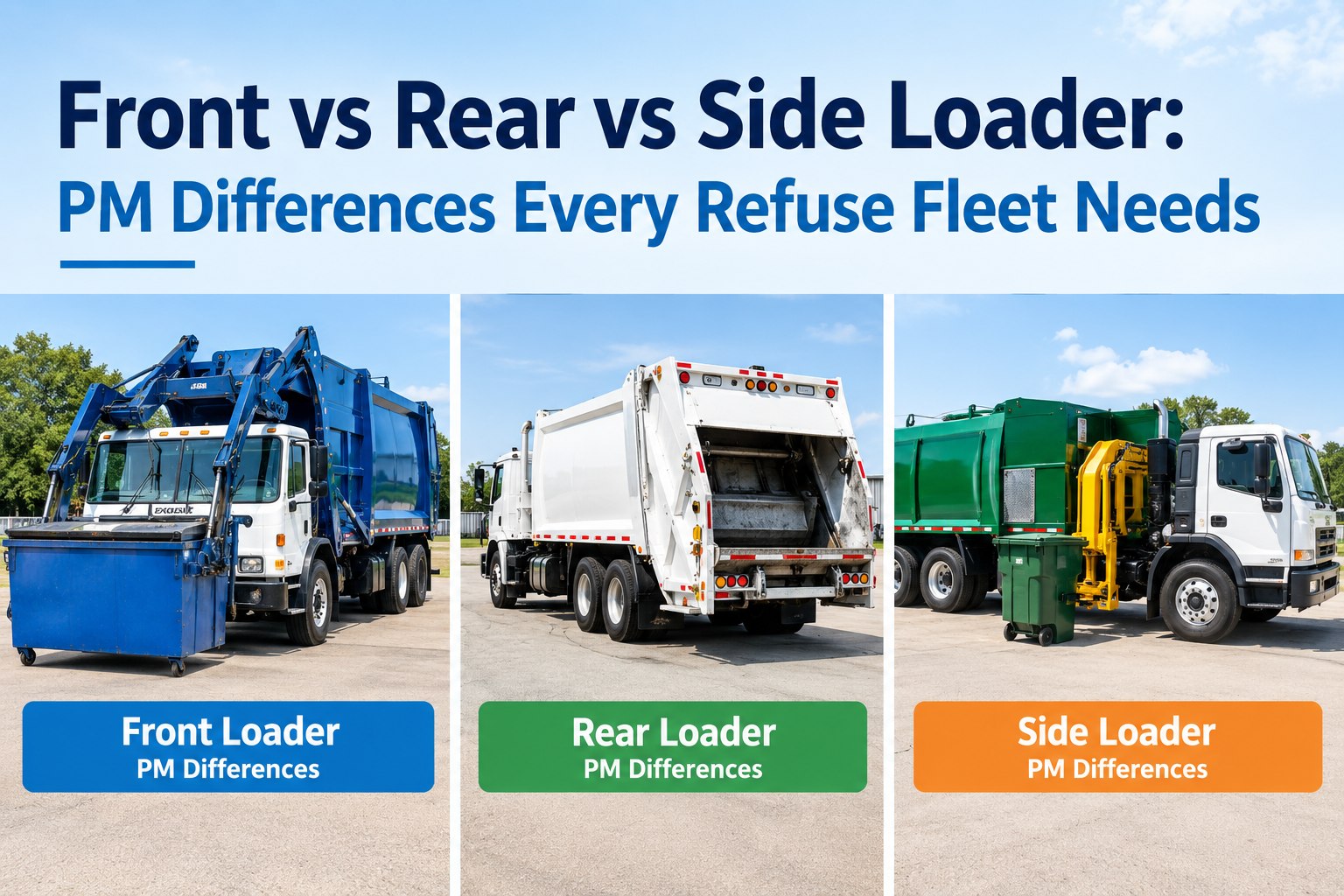
Front loaders, rear loaders, and automated side loaders share the same chassis vendor list and the same DOT rules, but that's where the similarity ends. Front loaders lift 8,000-lb commercial containers overhead multiple times per stop. Rear loaders take manual toss-in loading with an operator standing at the hopper. Automated side loaders swing an articulating arm to grab curbside carts hundreds of times per shift. Each body type stresses different subsystems, wears different parts on different cadences, and needs body-type-specific PM checklists and operator training. Running the same PM checklist across all three body types is one of the most common ways refuse fleets under-schedule maintenance on their most cycle-heavy trucks. This article breaks down what's actually different — where PM cadence diverges, which subsystems dominate each body type, and how to structure PM programs that match the equipment. Truck Inspection & Maintenance supports body-type-specific PM checklists on driver phones — sign up free or contact our team.
Front Loader vs Rear Loader vs Side Loader — PM Differences Every Refuse Fleet Needs
Same chassis. Same DOT rules. Three completely different PM programs.
Why Body Type Drives the PM Program
Three numbers frame why a one-checklist-fits-all approach fails on refuse fleets:
Running one PM checklist across all three body types under-schedules the cycle-heavy trucks by 40-60%. ASL and rear loaders wear hydraulic + brake components 3-6x faster than front loaders.
Cycle-count difference between front loader (80-150 lifts) and ASL (800-1,200 arm cycles) per shift. Same age vehicle, radically different wear on hydraulic seals, hoses, pumps.
Each body type needs body-specific pre-trip training. A rear loader operator can't safely check a front loader; an ASL operator faces failure modes neither of the others sees.
One PM checklist for all three body types = under-scheduling the cycle-heavy trucks. Start a free account and set body-type templates today.
Body Type Comparison Matrix — Head-to-Head
Direct comparison across the 6 dimensions that drive PM program design. Read across each row to see what varies by body type:
Want the full 6-dimension body-type comparison matrix as a printable shop card? Contact our team and we'll send one, free.
Front Loader — PM Program Highlights
Front loader PM is dominated by high-load hydraulic events at moderate cycle count. Fewer stops, but each stop stresses the biggest cylinders on the truck:
Fork Tips + Frame Weld Inspection
Fork tips take direct container contact every lift. PM-A: tip wear + crack check. PM-B: frame weld inspection at high-cycle joints. Fork replacement window at PM-D (100K miles or 20K lifts).
Lift Arm Bushings + Cylinders
Arm bushings wear from angular articulation under load. PM-B: bushing play check with dial indicator, cylinder rod condition. PM-C: bushing replacement window at 8-12K lifts.
Frame Stress at Fork Mounting Points
Front-of-chassis takes the load moment when forks lift overhead. PM-C: full frame inspection at fork mounting points for stress cracks. Overloaded containers (over 8K lbs) accelerate this — enforce weight limits.
Large-Bore Cylinders + High-Pressure Lines
Front loader hydraulic system runs highest peak pressure among body types. PM-B: fluid pressure test under load, hose condition at flex points. Fluid analysis at PM-C.
Rear Loader — PM Program Highlights
Rear loader PM is dominated by high-cycle packing operations at variable load. High operator exposure at hopper drives safety-critical pre-trip items:
Packer Blade + Slide Rail Wear
400-700 pack cycles per shift is the highest packer stress of any body type. PM-A: blade condition + slide rail wear. PM-B: cylinder rod inspection. Blade replacement window PM-D or when material passes packer.
Tailgate Seal + Latch + Safety Prop
Constantly opened for load pack + dump. PM-A: seal condition (leachate leaks = customer complaints), latch positive engagement, safety prop deployment. Tailgate safety failures = fatality risk.
Hopper Safety Controls + Rear Camera
Operator stands at hopper during loading — highest injury risk position in refuse. PM-A: rear camera working, backup alarm audible, hopper emergency stop functional, body-up drive interlock verified. No shortcuts.
Brake Wear from Residential Route
Residential rear loader routes hit 400-700 brake applications per shift. PM-B: brake linings measured, drum condition, slack adjuster stroke. Brake service window compressed vs OTR by 2-3x.
Automated Side Loader — PM Program Highlights
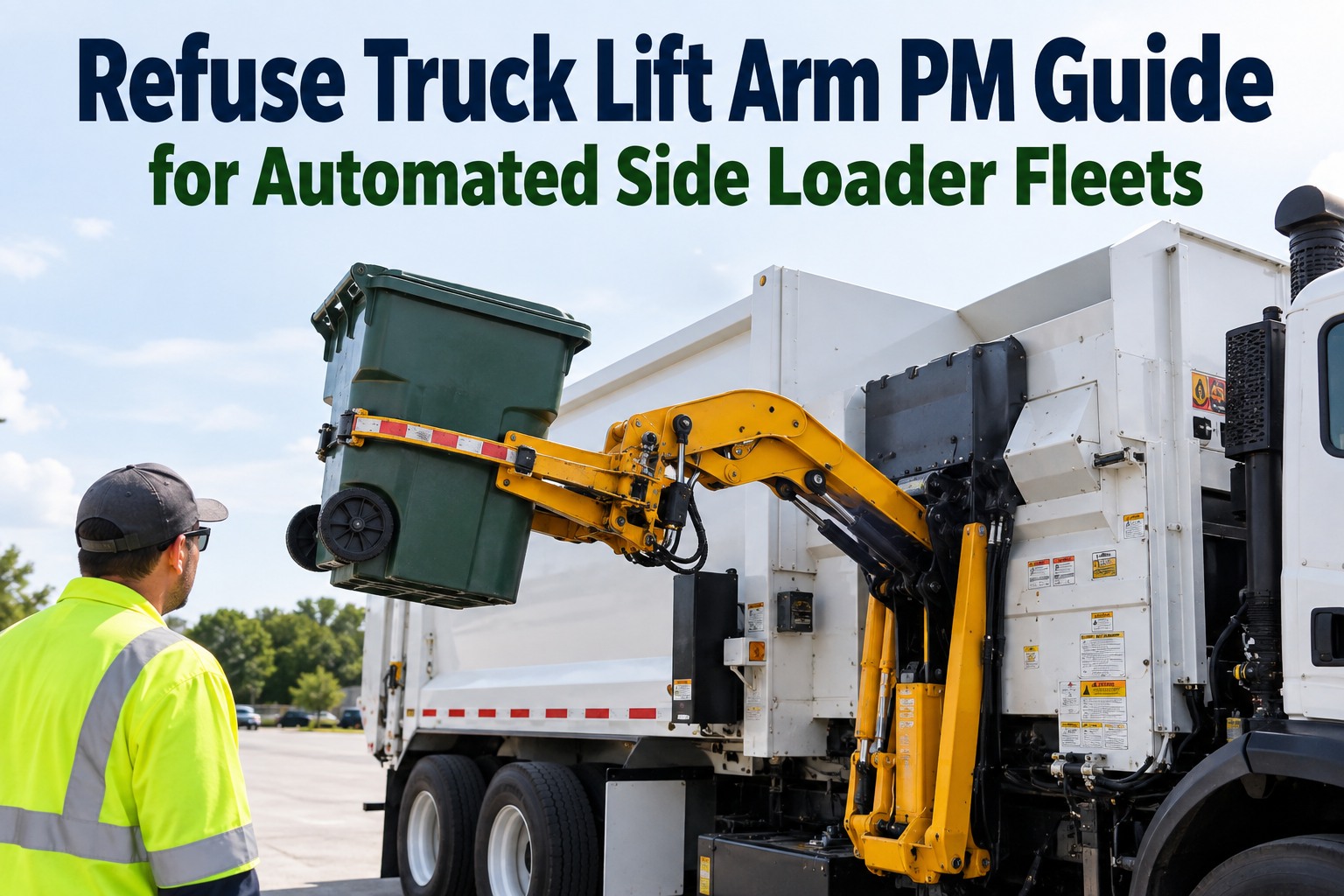
ASL PM is dominated by the automated arm at extreme cycle counts. The arm is the whole game — most ASL failures trace to arm wear ignored between PMs:
Slew Bearing + Arm Cylinders
800-1,200 arm cycles per shift is the highest cycle rate of any refuse subsystem. PM-B: slew bearing play (5-min dial indicator check), cylinder rod condition, seal weep inspection. Slew bearing replacement window PM-D — cheap check, expensive failure ($12K+).
Grabber Wear Plates + Contact Surfaces
Grabber makes contact with 800-1,200 carts per shift. PM-A: wear plate thickness measured, grabber cylinder condition. Grabber wear plates are consumable — swap on schedule, not on failure.
Arm Hydraulic Hoses at Flex Points
Arm hoses flex every cycle at 3-4 joint points. PM-A: hose condition at each flex point, no chafing against arm structure. Hose failure mid-shift = arm inoperative + potential hydraulic fluid loss.
Packer Runs Behind Arm Cycles
ASL packer cycles more often than rear loader relative to route load (each grab feeds hopper immediately). PM-B: same packer inspection as rear loader body, plus arm-to-hopper interlock verification.
Auto-load the matching PM template based on each truck's body type flag — sign up free and configure body-type PM in under 20 minutes.
The One Configuration That Fixes Mixed-Fleet Scheduling — Body-Type PM Templates, Not One-Size Checklists
The most common mixed-refuse-fleet mistake: one PM-B checklist used for all trucks regardless of body type. The front loader techs check the fork bushings but skip packer items that don't apply. The ASL techs try to interpret packer items when the arm is the real wear driver. Result: front loader over-inspected on things that don't wear fast, ASL under-inspected on the arm that's spinning 1,000x per day. Fix: build three separate PM checklist templates — one per body type — each auto-loaded for the truck based on body type flag in the fleet record. Same 4-tier PM cadence structure, but the actual items inside each tier match the equipment. Fleets that switch from unified to body-type-specific checklists typically catch 30-40% more actionable defects per PM within one quarter. Start a free account and set up body-type-specific PM checklists per truck today.
Body-Type-Specific Pre-Trip Items
Beyond the standard chassis pre-trip, each body type has 3-5 items unique to it that must be included in the operator's daily walk-around:
Need help mapping the 3 body-type pre-trips to your driver phones? Get in touch for a free 15-minute setup review.
Front, rear, and ASL trucks each get their own PM checklist template — auto-loaded by body type flag.
3 body-type PM templates, per-truck body flag drives which checklist loads, body-specific pre-trip on driver phones. Free forever for up to 3 vehicles — create your free account or talk to our team.
KPI Dashboard — 6 Body-Type-Aware Metrics
Six numbers that surface whether the body-type-specific PM program is working. Track separately by body type — fleet averages hide the pattern:
Every truck's PM checklist matches its body type flag. Below 100% = wrong checklists loaded, wrong items inspected.
Body-type-specific pre-trip items completed daily. Track per body type — ASL rate below 95% predicts arm failures.
Body-system failures per 100 shifts, tracked per body type. Above 3 for any type = that body's PM program under-scheduling.
Rear loader hopper safety interlocks bypassed or non-functional. Zero tolerance — fatality risk.
ASL slew bearing play growth vs baseline. Above 5% = bearing wear approaching failure window.
Body-type-specific parts (fork tips, packer blades, arm grabbers) in stock when needed for PM. Below 95% = PM slippage.
Catch 30-40% more actionable defects per PM within one quarter with body-type templates — create your free account in 10 minutes.
5 Body-Type-Mixing Mistakes to Avoid
Five patterns that show up on fleets running multiple refuse body types with one PM program:
One PM Checklist for All Body Types
Pattern: Shop uses generic "refuse PM-B" checklist for front, rear, and ASL. Front loader items check things that don't apply to ASL, ASL arm items missing entirely. Result: arm slew bearing goes ignored for 2 years, fails at $12K+.
Cross-Trained Techs Not Body-Specific Certified
Pattern: Tech trained on front loader hydraulics gets asked to service ASL arm. Missing torque specs, missing tolerance data for slew bearing. Body-specific certification prevents this — techs certified per body type they can service.
Operator Assigned to Wrong Body Type
Pattern: Rear loader operator temporarily assigned to ASL. Doesn't know arm pre-trip items. Skips hose flex-point check. Hose fails mid-shift, arm inoperative. Body-type-specific operator training + assignment discipline prevents.
Fleet KPIs Averaged Across Body Types
Pattern: Fleet reports 88% PM compliance overall. What's hidden: front loaders at 95%, rear loaders at 88%, ASL at 78%. The ASL failure rate is invisible in the fleet average. Report KPIs per body type, always.
Parts Inventory Not Body-Type Segmented
Pattern: Shop stocks "refuse packer parts" generally. Not enough front loader fork tips because they're stocked with ASL grabber plates. Body-type segmentation in parts inventory prevents PM slippage from parts stockouts.
Frequently Asked Questions
What's the biggest PM difference between front, rear, and side loaders?
Cycle count. Front loader does 80-150 lifts per shift, rear loader does 400-700 packer cycles, ASL does 800-1,200 arm cycles. The high-cycle body types wear hydraulic, arm, and brake components 3-6x faster than front loaders.
Can one PM checklist cover all three body types?
No. Front loader inspects fork bushings and frame stress. Rear loader focuses on packer blade + hopper safety. ASL focuses on arm slew bearing + hoses. Three separate checklists, one per body type, loaded automatically based on the truck's body type flag.
Which body type has the highest safety risk?
Rear loader. Operator stands at the hopper during loading — direct proximity to packer, tailgate, and moving traffic. Front loader and ASL operators stay in cab during load cycles. Hopper safety controls (rear camera, backup alarm, E-stop, body-up interlock) are non-negotiable on rear loaders.
What's the ASL slew bearing check and why does it matter?
5-minute dial indicator check at PM-B — measures arm-to-tower slew bearing play against baseline. Above 5% growth = bearing wear approaching failure. Bearing replacement costs $12K+ if it fails on route vs a few hundred dollars if caught at PM.
Should chassis PM cadence differ by body type?
Chassis PM tiers are the same across body types, but cycle-based triggers should shift. ASL and rear loaders hit brake wear triggers faster than front loaders because they brake 400-1,200x per shift vs 80-150. Cycle-based triggers alongside miles catch this — mileage-only triggers do not.
How does Truck Inspection & Maintenance handle mixed refuse fleets?
Body-type flag per truck in fleet record loads the matching PM checklist automatically. Three separate PM templates (front loader, rear loader, ASL) with body-specific items pre-configured. Body-specific pre-trip on driver phones, KPIs tracked per body type. Free forever for up to 3 vehicles — sign up in 10 minutes or contact us.
Same chassis. Same DOT rules. Three completely different PM programs — because the equipment is different.
Body-type-specific PM templates per truck, body-specific pre-trip on driver phones, KPIs tracked per body type. Free forever for up to 3 vehicles — no hardware, no contract, no credit card.