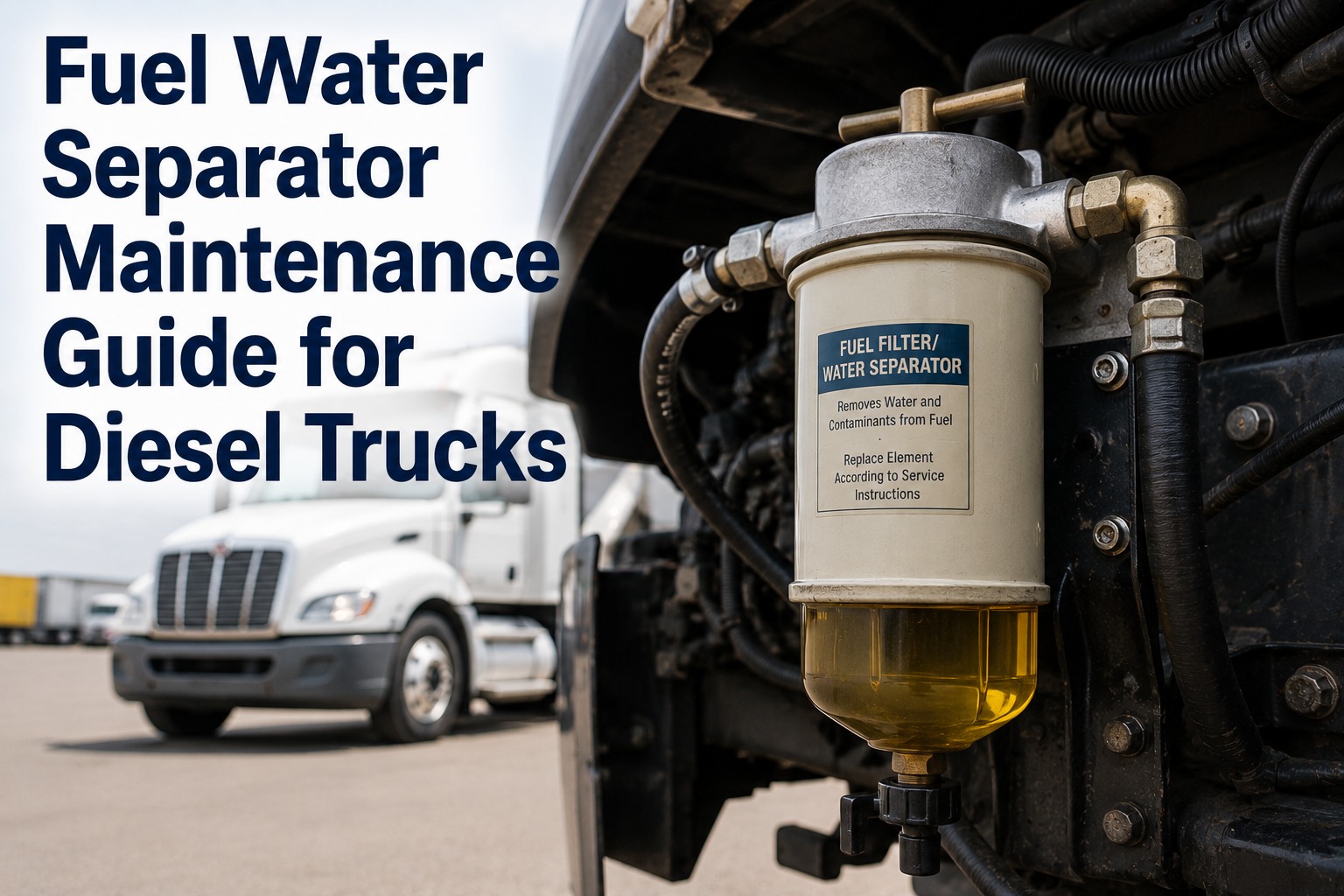
Diesel fuel and water are enemies. Even 500 parts per million of water contamination — a trace amount you can barely see in a jar — is enough to destroy modern high-pressure common-rail injectors that operate at 30,000 PSI and cost $600–$1,200 each to replace. The fuel-water separator is the small filter housing that stands between condensation in your tank and catastrophic injector failure. It works by slowing fuel flow so water droplets (denser than diesel) settle to a collection bowl at the bottom, while a coalescing filter media captures anything the settling stage missed. Neglect the separator and water eventually breaks through, taking out fuel pumps, injectors, and cylinder walls in that order — a single passed-through water event can total $8,000–$15,000 in damage on a modern diesel. This guide walks through how the separator works, the drain-and-service schedule that keeps it doing its job, the contamination symptoms that flag a problem, the replacement intervals per component, and the shop-floor procedure for a proper service. Automate separator drain-and-service tracking across your fleet on our fleet maintenance platform, or reach out to our support team for a walkthrough.
Fuel Water Separator Maintenance Guide for Diesel Trucks
500 PPM of water kills a $1,200 injector. The complete field service guide for the fuel-water separator that stands between your tank and catastrophic engine damage.
How a Fuel-Water Separator Actually Works
Two stages, one job. Understanding both is what makes the maintenance decisions make sense — and it's why tracking separator health per vehicle pays off across a fleet.
Where Does the Water Come From?
Water contamination isn't rare — it's constant. Every diesel tank on every truck accumulates water through six primary paths. Knowing the sources helps you predict when a separator will need extra attention.
Tank Condensation
Warm humid air enters a partially empty tank. Overnight temperature drops cause condensation on tank walls. This is the largest single source — and why "always park with a full tank" is real advice.
Contaminated Bulk Fuel
Fuel from a supplier whose storage tank has its own water problem. Truck stops, remote fueling, and non-major supplier deliveries all raise this risk. Contamination arrives with the load.
Rain & Wash Water
Damaged fill caps, cracked seals, or high-pressure washing near the fill point. Small quantities but very direct — one bad wash can put more water in the tank than months of condensation.
Fuel Additives & Biodiesel
B20 and higher biodiesel blends are hygroscopic — they attract and absorb water from the air. Modern renewable diesel and additive packages can compound this.
Storage Duration
Fuel sitting in a tank for extended periods — spare tractors, seasonal equipment, standby generators. Longer storage means more time for condensation to accumulate and microbial growth to start.
Fuel Cap & Vent Failure
Missing or damaged cap gaskets, plugged tank vents that force pressure changes and moisture intake. Small hardware failures with outsized fuel-quality consequences.
The Damage Chain: What Happens When Water Gets Through
Water contamination doesn't fail one part — it fails a sequence of parts in a specific order. Understanding the sequence is why the separator is worth caring about.
The 6 Symptoms of Water Contamination
Water breakthrough rarely announces itself. These are the six early warning signs — catch any one of them and drain the separator immediately before doing anything else.
Catch water contamination before it costs $15,000
Digital DVIR with photo-capture of separator bowl at every pre-trip. Auto-alerts on Water-in-Fuel codes from ECM. Fleet-wide filter cadence tracked automatically.
Maintenance Cadence: What to Do When
Separator care isn't one task — it's four distinct maintenance actions on different schedules. Get all four on cadence and injector-related failures become rare events, not routine ones.
The Field Service Procedure
Here's the exact shop-floor procedure for a proper primary filter change. Deviation from this sequence is how techs contaminate the fuel system while trying to protect it.
Common Mistakes That Turn a Service Into a Failure
The service procedure is simple — but four mistakes account for most fuel-system problems that follow a "routine" separator change.
Choosing Filters: OEM vs Aftermarket
Filter choice matters more here than in most fleet applications. A cheap aftermarket separator filter that saves $8 upfront can cost $8,000 downstream when the media doesn't perform to spec.
- Validated efficiency at rated flow
- Media matched to engine spec
- Warranty coverage retained
- Correct micron rating for the pump
- Named-brand filters (Baldwin, Donaldson, Fleetguard, WIX)
- Comparable spec to OEM
- Independent lab-tested media
- Reasonable cost savings
- Basic media, variable quality
- Often untested at rated flow
- Micron ratings sometimes overstated
- Risk of media failure under pressure
Frequently Asked Questions
Do a visual bowl check daily at pre-trip, and a full drain into a clear container weekly regardless of what the bowl appears to show. When the water-in-fuel warning light comes on, drain immediately before continuing operation. Track daily drain checks alongside DVIR on our fleet platform.
Typical replacement interval is every 15,000 miles for the primary separator filter, extending to 25,000 miles in favorable conditions. Applications running heavy loads, dusty environments, or fueling from less-controlled sources should shorten the interval. Fleet-wide filter tracking eliminates guesswork — talk to our team about auto-triggered PM cadence.
Six primary symptoms: rough idle or misfires, hard starting after overnight rest, loss of power under load, the water-in-fuel warning light, white smoke at startup, and frequent fuel filter restriction alarms. If any of these appear, drain the separator immediately before doing anything else.
Yes — severely. Water breakthrough sequentially damages the fuel pump ($800–$2,500), then the injectors ($600–$1,200 each), then cylinder walls and combustion components ($3,000–$8,000+). A single major water event typically causes $8,000–$15,000 in combined damage on a modern common-rail diesel. Prevention is far cheaper — monitor at scale with our maintenance software.
No. Pre-filling the new filter bypasses the filter media on that first pass and can push contamination directly toward injectors. Install the filter dry and prime the system through the vehicle's factory hand primer or ignition-on prime function. This is the single most common shop-floor mistake.
Often yes, especially for high-value assets under warranty. Premium aftermarket brands (Baldwin, Donaldson, Fleetguard, WIX) are lab-tested and comparable — those are safe fleet choices. Cheap generic filters at $8–$16 are where risk enters: a media failure under 30,000 PSI can be catastrophic. Not a place to save money on fleet-critical assets.
Turn fuel-water separator care into a repeatable process
Daily bowl-check reminders in the DVIR workflow. Auto-triggered 15,000-mile filter change alerts. Water-in-fuel ECM code capture with instant technician notification. Filter part-number and cost tracking per vehicle. Fleet-wide compliance archive. Everything a maintenance program needs to prevent $15,000 damage events — one platform.