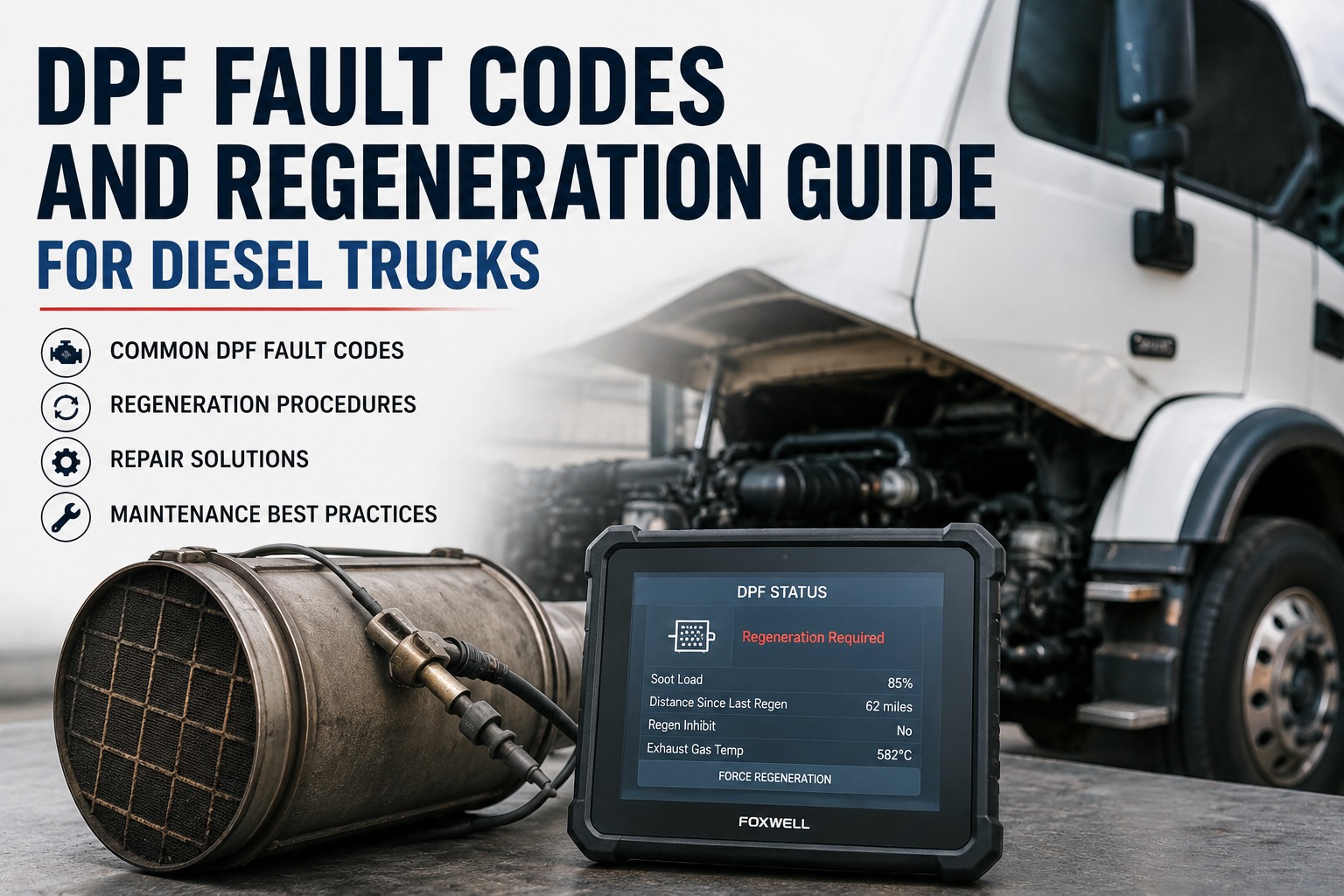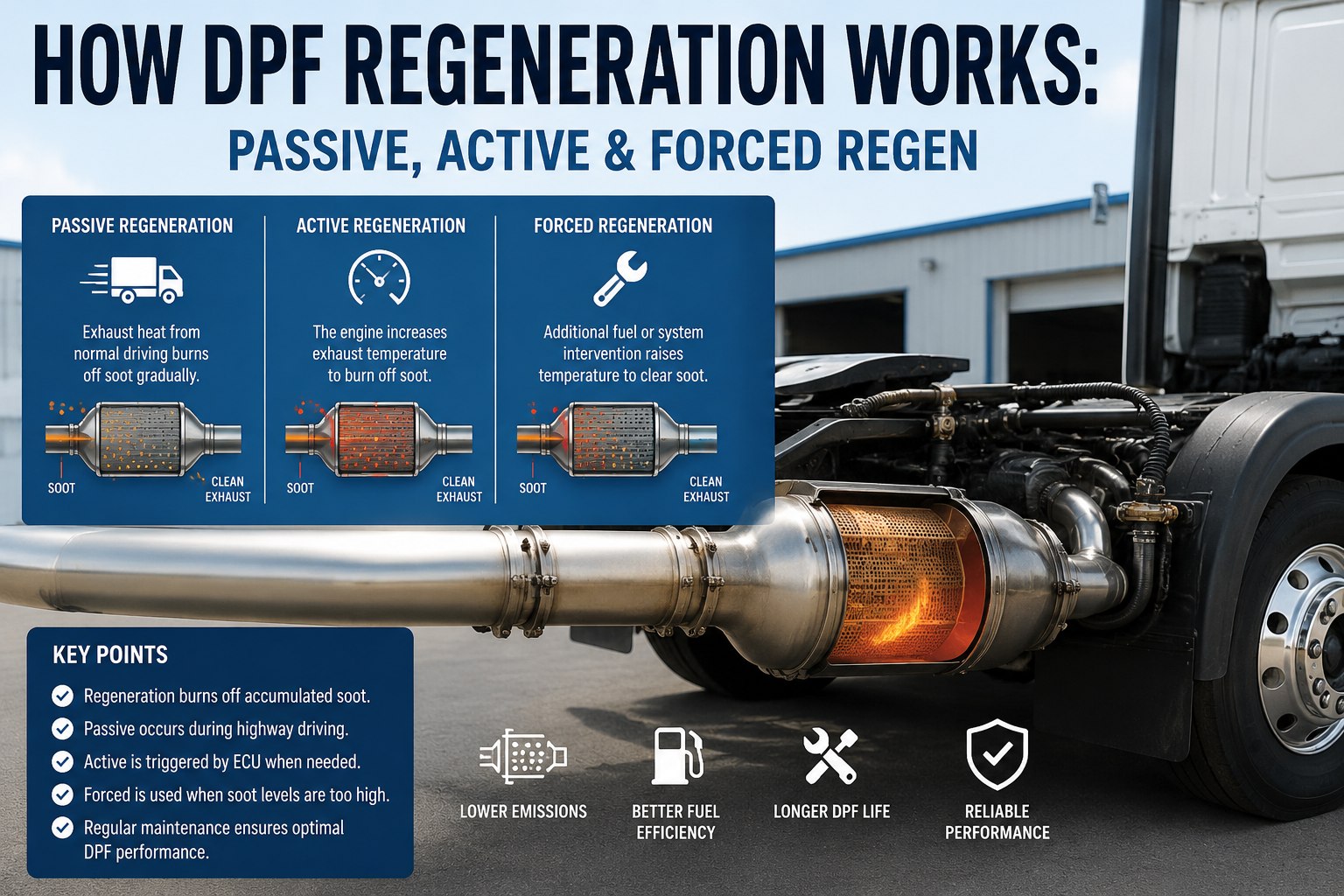
The diesel particulate filter is the single most misunderstood component in a modern diesel truck — and the most expensive one to replace when it fails. Sitting quietly in the exhaust system, the DPF traps up to 99% of the soot leaving the engine before it reaches the tailpipe, a legal requirement since the EPA's 2007 diesel emissions rule cut allowable particulate matter by 90% (from 0.10 g/bhp-hr down to 0.01 g/bhp-hr). To keep working, the DPF has to periodically burn off that trapped soot through a process called regeneration — and it happens in three distinct modes: passive (during highway driving), active (triggered automatically by the ECU), and forced (initiated manually in a workshop). Miss the warning signs and a $200 problem becomes a $3,000 replacement, or worse — a limp-mode roadside breakdown at 2 AM. This guide walks through exactly how DPF regeneration works, what happens when it doesn't, the warning signs every fleet needs to catch early, and how Truck Inspection & Maintenance tracks DPF status alongside DVIRs so early symptoms become defects, not breakdowns.
How DPF Regeneration Works: Passive, Active & Forced
The self-cleaning process that keeps your diesel legal — and what happens when it fails.
What a DPF Actually Does
Before you can understand regeneration, understand what's actually happening inside the filter. The DPF is a ceramic honeycomb structure that sits in the exhaust after the diesel oxidation catalyst (DOC). Exhaust gases enter one side, but soot particles get physically trapped in porous ceramic walls while clean gas exits the other side. The problem: soot has to go somewhere, and that's where regeneration comes in:
The 3 Types of DPF Regeneration
Regeneration is the process of burning trapped soot at high temperatures so it turns into CO2 and exits the tailpipe as gas instead of building up as solid buildup. There are three distinct regeneration modes — every diesel driver, mechanic, and fleet manager needs to know which one is happening and when:
Passive Regeneration
Happens automatically during highway driving
Active Regeneration
Triggered by the ECU when soot load hits 40–45%
Forced Regeneration
Manual — initiated by a technician with a scan tool
Soot vs Ash — The Difference That Matters
Here's the concept most drivers miss: regeneration only clears one type of buildup. Understanding the difference is the difference between a $200 forced regen and a $3,000 filter replacement:
Combustible buildup
Non-combustible buildup
Warning Signs — Catch It Early or Pay Late
DPF problems escalate in a predictable pattern. Catch them at Stage 1 and the fix is free — just a highway drive. Catch them at Stage 3 and you're looking at a tow bill plus filter replacement. Every driver needs to recognize these six warning signs:
DPF Warning Light
Amber light on dashboard — first and easiest sign. Take a 20-minute highway run at steady 60+ mph. Passive regen usually clears it. Ignore it and the next stages arrive fast.
Frequent Regen Cycles
Active regens more often than every 300 miles. Something is producing extra soot — worn injectors, bad EGR, poor fuel quality, or excessive idling. Get it diagnosed before the pattern accelerates.
Reduced Power & Fuel Economy
Sluggish acceleration, harder-working engine at highway speeds, MPG drop of 5–15%. Increased exhaust backpressure forcing the engine to work harder. Time for professional inspection.
Rough Idle & Vibration
Truck shakes at stoplights, almost stalls at idle. Restricted exhaust flow is disrupting normal combustion. Often accompanied by black smoke on acceleration.
Limp Mode / Engine Derate
ECU cuts power to protect the emissions system — max 30–45 mph. This is the truck saying "stop now." Continuing to drive risks turbocharger damage and complete filter failure.
Failed Regen / Persistent Codes
Forced regens no longer clear the codes. Ash saturation or physical filter damage. Only options now are professional cleaning or full DPF replacement — $2K–$5K.
Every DPF warning belongs on your daily DVIR
A DPF light that disappears when the truck restarts is the same DPF light that triggers limp mode 400 miles later — and no one remembers to mention it. Truck Inspection & Maintenance turns every warning light, regen frequency observation, and power complaint into a documented defect routed straight to your shop. GPS-tagged, timestamped, audit-ready. Sign up free for up to 3 vehicles.
What Causes Premature DPF Clogging
DPF failure is almost never random. Six root causes account for the vast majority of premature clogs — and every one is preventable if you know what to look for. Here's the diagnostic checklist mechanics work through:
Short-Trip / Low-Speed Driving
The #1 cause. Trips under 15 minutes never let exhaust temperatures reach the 350°C+ needed for passive regen. Common in urban delivery, local buses, short-haul.
Excessive Idling
Idling produces soot without generating regen heat. Long idle sessions at truck stops, drive-throughs, and yard operations load the filter without a way to clear it.
Wrong Engine Oil
High-ash oil accelerates permanent ash buildup. Use only low-SAPS oil rated for DPF-equipped engines. Check owner's manual — the wrong oil can cut DPF life in half.
Failed EGR or Injectors
Worn injectors dump excess fuel into the exhaust. Coked EGR valves recirculate contaminants. Both overload the DPF far faster than designed for.
Sensor Failures
The differential pressure sensor and exhaust temp sensors tell the ECU when to regen. Dirty or failing sensors mean regens don't trigger — the filter loads up silently.
Poor-Quality Diesel
Low-quality fuel or the wrong sulfur grade produces more soot per gallon. Always use ULSD (ultra-low sulfur diesel) — anything else compromises the entire aftertreatment system.
DPF Maintenance Best Practices
The good news: DPF life is largely under your control. Fleets that follow these five practices consistently see DPFs go 250K+ miles between professional cleanings — while fleets that don't often replace filters at 100K:
Highway Runs Weekly
At least one 30-minute run at 55+ mph per week for every truck. Keeps passive regen working. Schedule urban-focused trucks for weekly highway loops if needed.
Never Interrupt a Regen
Once active regen starts, let it finish. Shutting off mid-cycle leaves partial soot and forces the next regen sooner. Train every driver to recognize active-regen indicators.
Correct Oil Only
Low-SAPS oil rated for DPF-equipped engines. Any deviation accelerates ash buildup permanently. Verify oil spec at every service — don't trust the label alone.
Limit Idling
Every idle hour adds soot without clearing it. Enforce anti-idle policies. Use auxiliary power units where drivers need cab climate. Track idle time via ELD or telematics.
Schedule Ash Cleaning
Plan professional DPF cleaning at manufacturer-recommended intervals — typically 150K–250K miles. Cleaning at $500 beats replacement at $3,000. Track it as a scheduled service.
Log Every Warning
Every DPF warning light and regen frequency change goes on the DVIR. A pattern building over 2 weeks is invisible to any one driver but obvious in the log — and catchable early.
Frequently Asked Questions
How often should DPF regeneration happen?
Passive regeneration happens continuously during highway driving whenever exhaust temps stay above 350°C. Active regeneration typically triggers every 300 miles or when soot load reaches 40–45%. Forced regeneration should only be needed rarely — if it becomes routine, something else is failing (short-trip patterns, bad injectors, or sensor problems).
Can I ignore the DPF warning light?
Not for long. The first amber DPF light is your truck asking for a 20-minute highway run to complete a passive regen. Ignore it and the sequence escalates: reduced power, rough idle, limp mode, and eventually a filter that can't be regenerated at all. What starts as a free highway drive becomes a $500 professional cleaning — or a $3,000 replacement.
What's the difference between DPF cleaning and regeneration?
Regeneration burns off soot — the combustible buildup — through high exhaust temperatures. Cleaning removes ash — the non-combustible byproduct of engine oil and fuel additives that regen cannot touch. Regeneration happens automatically every few hundred miles; professional cleaning happens every 150K–250K miles at a shop with hydraulic or thermal equipment.
Is it safe to keep driving during active regeneration?
Yes — in fact, it's better than stopping. Highway driving during active regen provides the airflow and load that helps the cycle complete. What you must not do is shut off the engine mid-regen — interrupted cycles leave partial soot and force the next regen sooner, accelerating the cycle. Let it finish before parking. Talk to our team about driver training on regen recognition.
How much does a DPF cleaning or replacement cost?
Professional DPF cleaning: typically $300–$700 depending on equipment used (hydraulic cleaning is often the most effective). Full DPF replacement: $2,000–$5,000 for the filter alone, more with labor. The math favors preventive cleaning at recommended intervals — one skipped cleaning often costs 5–10× more than the cleaning itself would have.
How does Truck Inspection & Maintenance help with DPF issues?
Every DPF warning light, unusual regen frequency, power complaint, and idle-time observation belongs on the daily DVIR — captured, timestamped, GPS-tagged, and routed straight to your shop as a defect work order. Truck Inspection & Maintenance turns invisible patterns (three warnings over 10 days) into obvious defects your maintenance team acts on before limp mode. Sign up free to see the workflow.
A $200 DPF problem becomes a $3,000 one when nobody's logging the warnings.
Every DPF warning light, regen frequency change, and idle-time spike is a data point. Truck Inspection & Maintenance captures them on every DVIR — GPS-tagged, timestamped, routed to your shop as a defect work order before the filter reaches ash saturation. Free for up to 3 vehicles with no hardware and no contracts. Set it up in 10 minutes and stop paying for problems you saw coming.