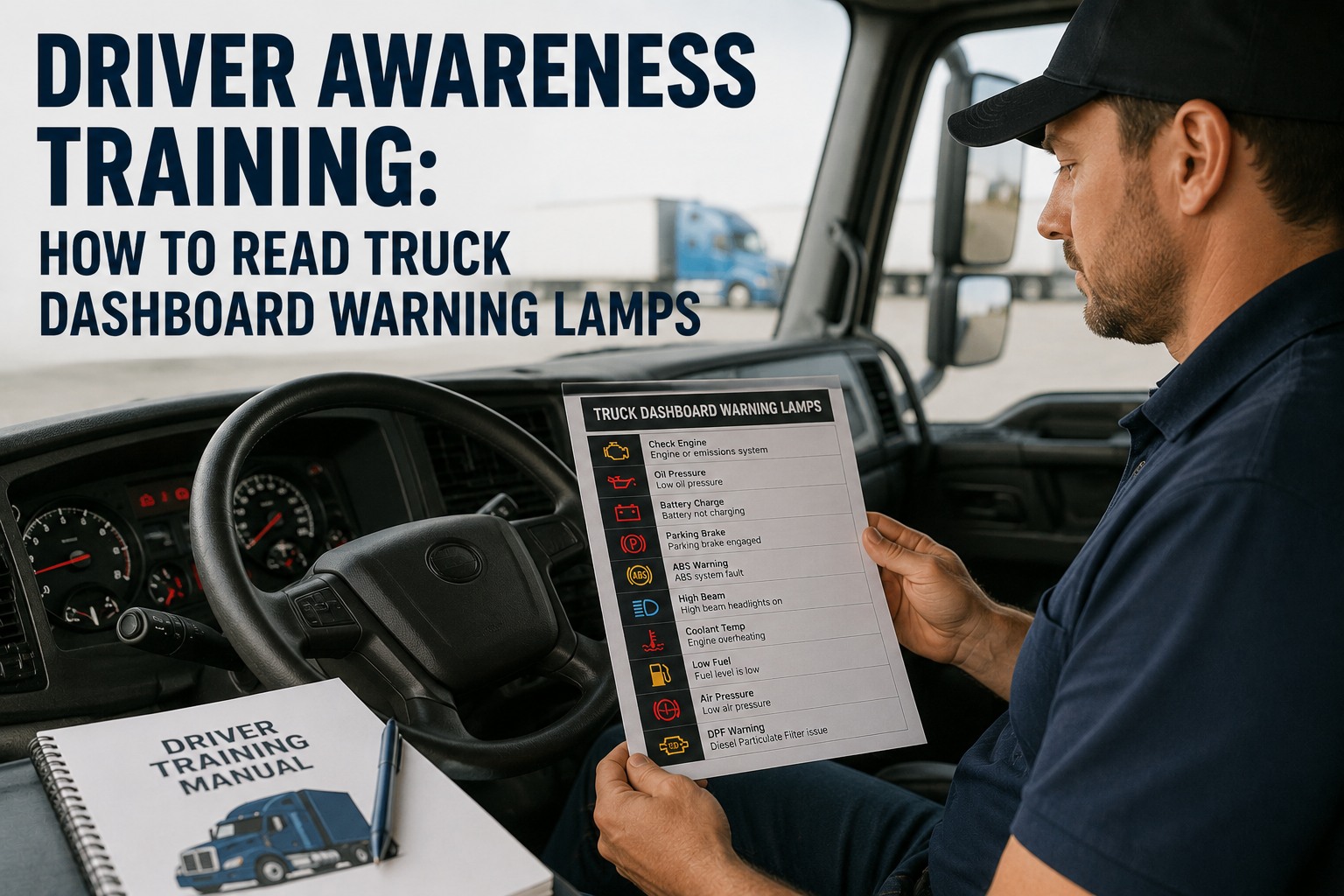
Ask any group of veteran truck drivers what a flashing amber lamp shaped like an engine block means, and you'll get five different answers — most confident, most wrong, and one or two that would have saved a truck from a $12,000 tow if the driver in the seat had known them last Tuesday. Dashboard warning lamps are the single most under-taught skill in the trucking industry. Every fleet requires pre-trip inspections, every fleet requires DVIRs, and almost none of them formally train drivers on what the dashboard is actually telling them once they're rolling. The result is predictable: drivers keep going when they should have pulled over, pull over unnecessarily when they should have kept going, and file DVIRs that describe "some kind of light" instead of the specific fault the technician needs to hear. This article gives you a proven 20-minute training session — the exact color logic, the seven lamps every commercial driver must know cold, and the pull-over-or-keep-going decision rules — plus how Truck Inspection & Maintenance turns a lamp event into a defect record that reaches the shop before the truck does. Start a free trial to run this training with the DVIR platform drivers will use in the field.
Driver Awareness Training: How to Read Truck Dashboard Warning Lamps
A 20-minute training session that closes the dangerous knowledge gap most drivers were never formally taught — color logic, the seven lamps every commercial driver must know cold, and the pull-over-or-keep-going decision rules that prevent expensive breakdowns and unnecessary downtime.
Why This Training Matters More Than You Think
Most drivers picked up their dashboard knowledge on the job — from another driver, from a mechanic in a moment of frustration, or from figuring it out mid-breakdown on the shoulder of I-40. That's not training; it's folklore. And it produces four predictable, expensive failure modes month after month.
Driver keeps going with a red oil-pressure lamp because "it's been on before." Engine ruined. Truck totaled.
Driver pulls onto the shoulder for an amber check-engine lamp that could have made it to the next service point safely.
"Some light came on, I don't remember which one." Tech spends 90 minutes figuring out what the driver actually saw.
Intermittent lamps that would have flagged an emerging failure never get reported because "it went away."
The Color Logic: One Rule, Universal Application
Every commercial truck OEM uses the same color logic. Learn it once, apply it to every vehicle in the fleet, every year, forever. This is the single most important slide in the whole training.
A red lamp is telling you the truck is at risk of catastrophic damage or an immediate safety hazard. Keep driving and the failure gets exponentially worse — often within minutes.
An amber lamp is a warning, not an emergency. Something needs attention, but the truck is generally safe to complete the run — provided the lamp doesn't escalate to red or start flashing.
Green and blue lamps are not warnings. They confirm a system is on and working — high beams, cruise, PTO, exhaust brake, retarder. Absence of them can matter more than presence.
The Seven Lamps Every Commercial Driver Must Know Cold
Every commercial driver — new hire on day one, twenty-year veteran on the last mile of their last run — must be able to identify these seven lamps on sight and state the correct response without hesitation.
What it means: Engine oil pressure has dropped below safe operating level.
What to do: Pull over immediately and shut down. Continued operation destroys the engine in minutes — no exceptions.
What it means: Engine is overheating past the safe threshold.
What to do: Reduce load, downshift, get to safe pull-over. Do not open the radiator cap. Shut down and cool naturally.
What it means: Low air pressure, low brake fluid, or parking brake still engaged. Any is safety-critical.
What to do: Bring truck to controlled stop. Confirm parking brake released; check air pressure gauge. Do not release brakes if air is below spec.
What it means: Critical engine fault detected. Some ECMs will auto-shut down within a set window.
What to do: Pull over and shut down at the first safe location. Do not attempt to restart until diagnosed.
What it means: Engine or emissions fault detected. Severity varies enormously — could be a loose fuel cap or a failing injector.
What to do: Complete run if steady, monitor for flashing or escalation to red. Specific DVIR entry at end of day.
What it means: Diesel particulate filter is loading up and needs a regeneration cycle.
What to do: Continue driving at highway speed to allow auto-regen. If lamp escalates, plan for manual parked regen — don't wait for derate.
What it means: Anti-lock braking system fault. Standard brakes still work; ABS assist is disabled.
What to do: Drive to next service point with awareness that anti-lock function is off. Report specifically on DVIR — do not confuse with red brake lamp.
From Lamp Sighting to Work Order — In Under a Minute
Truck Inspection & Maintenance turns a dashboard lamp into a specific, photographed, GPS-stamped defect entry on the driver's phone in under a minute — routing automatically to the shop as a work order before the truck even reaches the yard. Training teaches drivers what to see; the platform captures what they saw with the specificity technicians need.
The Pull Over / Keep Going Decision Tree
When a lamp illuminates, the driver has seconds — not minutes — to make a decision. This is the exact logic to teach in the classroom and print for every cab, so the decision becomes reflex rather than debate.
Identify the color first. Do not read the icon before you have identified the color. Color drives urgency.
Reduce speed. Find the nearest safe pull-over within 1–2 miles. Shut down the engine if the lamp is oil pressure, coolant temp, or stop-engine. Call dispatch.
Is it steady or flashing? Steady: continue with monitoring. Flashing: reduce load, exit at nearest ramp, plan service — flashing amber often means derate coming.
Not a warning. Confirm the system it represents is one you want on right now. If a green you expect to be lit is missing, that's a silent failure — investigate.
Which lamp. What color. Steady or flashing. When it appeared. Whether it went away. A vague "warning light came on" is worthless to the tech.
The 20-Minute Training Session Outline
Ninety percent of the value of this training lives in the first twenty minutes. Extend beyond that and drivers glaze over. This is the exact structure that works. Sign up free and use the platform to run the DVIR-writing exercise on real tablets.
Open with a real breakdown story from your fleet — a $12,000 tow that a correctly-read lamp would have prevented. Story, not lecture.
Traffic-light rule. Red / Amber / Green-Blue. The steady vs. flashing distinction on amber. That's the whole rule set.
Walk through each. Show the icon, name the color, state the action. Six minutes for all seven — 45 seconds each. Do not linger.
Hand out three lamp scenarios. Drivers write the DVIR entry each would trigger. Compare answers, sharpen the specificity.
Two minutes of questions, then digital sign-off. Attendance and understanding logged for the training record.
The Common Mistakes to Warn Drivers About
Bad habits kill more trucks than bad luck. Name each of these explicitly in training so drivers recognize the pattern in themselves.
Frequently Asked Questions
Partially, and unevenly. CDL curricula include basic vehicle systems, but formal dashboard-lamp interpretation is not a required, tested skill in most jurisdictions. Most drivers pick it up on the job, which produces the folklore-not-training problem this session solves. A 20-minute in-house session — repeated at hire, then annually — closes the gap in a way CDL training doesn't. Start free to schedule and log the training on the same platform drivers use for DVIRs.
At hire, and once annually as a refresher. Additionally: any time your fleet adds a new truck OEM with different lamp iconography, or after any incident where a driver ignored or misread a lamp. Twenty minutes at hire and twenty minutes a year is 40 minutes per driver per year — nothing compared to the cost of one totaled engine or one preventable roadside breakdown.
The color logic is universal across all major OEMs — red-amber-green means the same thing on every truck. The icon shapes vary slightly (a check-engine icon on a Volvo looks a bit different from one on a Peterbilt), but the meaning and response are identical. Teach the color rule first, universally. Then show icon variations for whichever OEMs are in your fleet — usually a supplementary handout, not a separate session.
Depends on fleet policy, but generally no. Reading and interpreting DTCs is a technician skill; drivers are trained to identify the lamp, respond appropriately, and file a specific DVIR. Adding "and pull the DTC" to the driver's responsibility widens the training scope enormously without adding safety value. Let the driver report the lamp; let the tech pull the code. See how our platform links driver reports to technician diagnostics.
Red means stop, amber means inspect soon, flashing amber means escalate. If a driver remembers nothing else from the training, remembering that saves the most trucks. Every other lamp-specific detail is optimization on top of that foundation — but that foundation, applied consistently, prevents the vast majority of the expensive failures a dashboard-illiterate driver eventually causes.
Give Drivers Both the Knowledge and the Tool
Truck Inspection & Maintenance is the mobile-first fleet maintenance platform that turns trained driver awareness into action — DVIRs with photo capture, PM scheduling, work orders that route straight to the shop, and compliance records that stay audit-ready. Train the drivers this week; give them the platform to prove the training worked.