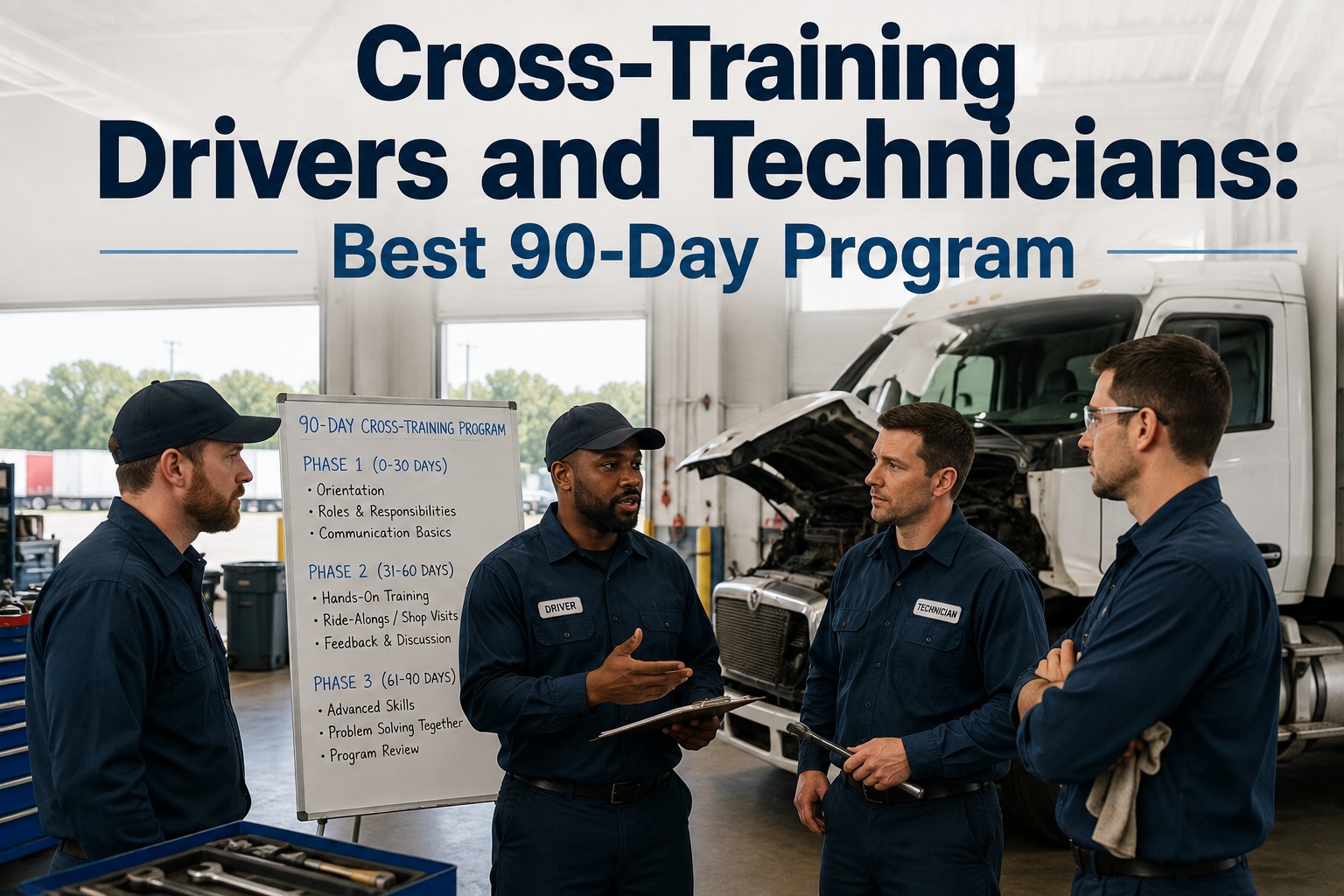
"Brakes feel weird." That's the DVIR entry. The technician picks it up two hours later, walks around the truck for twenty minutes trying to figure out which brake, whether it's pull, drag, delay, or noise, and eventually pings the driver — who's now 400 miles down the road and can't remember. Multiply that by 40 trucks a day and you have the real cost of the driver-technician communication gap: not missed defects, but slow ones, expensive ones, and vague ones that get re-inspected three times before anyone actually fixes them. Cross-training closes that gap. When drivers understand what technicians need to hear and technicians understand what drivers actually feel on the road, DVIRs get sharper, repairs get faster, and the same defect stops coming back on three different units. This article walks through a proven 90-day cross-training program — objectives, weekly cadence, sign-off milestones — plus how Truck Inspection & Maintenance closes the loop so no defect ever gets lost in translation. Start a free trial to give your team the shared platform this training runs on.
Cross-Training Drivers and Technicians: The Best 90-Day Program
A field-tested 90-day cross-training program that closes the communication gap between the cab and the shop — with weekly objectives, sign-off milestones, and KPIs that prove DVIRs got sharper, repairs got faster, and defects stopped coming back.
"Brakes feel weird"
"Right steer, soft pedal after long descent, no pull. Photo attached."
The Cost of the Communication Gap
Most fleets treat drivers and technicians as two separate departments — because org charts say they are. But every defect that reaches the shop is a handoff between them, and every handoff has friction. That friction has a measurable dollar cost that shows up in five places every month.
Vague DVIRs force techs to reproduce the symptom. What should be a 15-minute triage becomes a 2-hour hunt.
The wrong part gets replaced because the real symptom was never captured. Truck returns in a week for the same fault.
Trucks sit in the shop waiting for clarification calls. Load is reassigned, revenue is lost, customer notes the delay.
Defects that felt "not urgent" to the driver were actually CSA-cited items. Inspector finds what the shop should have.
Drivers get frustrated when maintenance feels adversarial. Techs get frustrated when reports feel careless. Both leave.
What "Cross-Training" Actually Means
This is not asking drivers to change brake pads or asking mechanics to log 300 highway miles. It's building enough shared vocabulary that a DVIR entry means the same thing to both sides — and enough mutual respect that flagging a "weird noise" gets taken seriously instead of dismissed.
- How a technician reads a fault code and what descriptors help
- What "brake fade," "wheel hop," "coolant loss" mean mechanically
- Why a photo of a defect saves 30 minutes in the shop
- How the DVIR they file becomes a work order downstream
- The difference between a comeback and a fresh defect
- What a 12-hour shift feels like — the noise, vibration, fatigue drivers describe
- How pre-trip inspections get squeezed by dispatch pressure
- The vocabulary drivers actually use for symptoms — and what they mean
- What a defect "not urgent enough to write up" costs on the road
- How to write repair notes drivers can understand at the next handoff
The 90-Day Program Structure
Ninety days is the right length: long enough to change habits, short enough to keep momentum. The program splits into three 30-day phases, each with a clear objective, weekly touch-points, and a sign-off milestone that unlocks the next phase.
Objective: Both sides speak the same language when describing defects.
Objective: Every defect handoff follows a predictable, evidence-rich format.
Objective: The new communication pattern becomes the default, not the exception.
One Platform Both Sides Actually Use
Truck Inspection & Maintenance replaces paper DVIRs and PM spreadsheets with a single mobile system drivers file into and technicians pull from — with automated work orders, photo attachments, GPS stamps, and real-time compliance dashboards that push PM compliance above 95% and keep the fleet DOT-ready year-round.
The Ride-Along and Shop-Tour Ritual
The two exercises that punch above their weight in this program are the driver shop tour and the technician ride-along. Neither takes more than half a shift. Both consistently produce the "I never realized" moments that permanently change how each side communicates.
Duration: Half day, in small groups of 3–5 drivers
What they see: A live diagnostic in progress. What a fault code readout actually looks like. A tech pulling apart a component to find the failed part. The physical evidence of a "vague DVIR" costing time.
What changes: Drivers file sharper DVIRs the following week — often unprompted — because they've now seen the downstream cost of vagueness with their own eyes.
Duration: One full shift, one-on-one with an experienced driver
What they see: The vibration through the seat on a rough road. Wind noise that makes engine noise hard to hear. The pressure to make a delivery window with a soft brake pedal.
What changes: Techs stop dismissing "feels weird" reports. They start writing repair notes drivers can actually understand. Respect flows both directions.
The KPIs That Prove It Worked
A cross-training program without measurement is a team-building exercise. These five metrics — baselined before the program and re-measured at day 90 — separate real behavior change from a nice week of sessions.
Time from work order open to root fault identified. Sharper DVIRs cut this by 40–60% in most fleets.
% of repairs where the truck returns within 30 days for the same fault. Direct signal that root cause was found the first time.
Sample audit: % of DVIR entries with location, severity, and photo evidence. Track weekly, publish monthly.
% of scheduled preventive maintenance completed on time. Cross-trained shops routinely lift this above 95%.
CSA vehicle-maintenance BASIC violations per inspection. Sharper DVIRs and faster repairs both drive this down.
Sustaining the Cadence After Day 90
The failure mode of a good 90-day program is finishing it. On day 91 the pressure of ordinary operations returns, the weekly standup gets skipped once, then twice, and by month five the shared vocabulary is drifting. These three light-touch rituals keep the gain compounding after the formal program ends. Sign up free and use the platform to make them stick.
One recurring calendar slot. Review three defect handoffs from the month — one that went smoothly, one that didn't, one edge case worth remembering.
Every new hire on either side goes through the ritual within their first 30 days. Existing staff rotate through once a year to keep the empathy fresh.
The five KPIs go on a shared dashboard both drivers and techs can see. Trend lines say more than any lecture ever will.
Frequently Asked Questions
The total time investment across 90 days is about 12–15 hours per person — less than one full shift spread over three months. The payoff shows up in the metrics fast: fleets that run this program consistently report diagnosis times cut nearly in half and comeback rates falling by a third within the first quarter. It pays back the time on the very first month it runs. Start free to baseline your metrics before you start.
Common for regional fleets. Two adjustments work: schedule ride-alongs and shop tours to coincide with drivers' scheduled return-to-terminal days, and run the joint sessions over video with the shared platform showing real DVIRs and work orders on screen. The photo-and-location standard becomes even more important when face-to-face isn't an option — the DVIR itself has to carry the communication load.
In-house is the norm and often better — the lessons stick harder when the shop foreman and a senior driver lead the sessions rather than an outside consultant. The one exception is Week 1's kickoff and Week 12's close, where an outside voice sometimes lifts perceived importance. Everything in between is best delivered by the people the team will keep working with after day 90.
Almost always melts on the first ride-along or shop tour. A technician with 20 years in the shop watches a driver skip their break to make a delivery window with a soft pedal — and reframes every "careless DVIR" they've ever complained about. Same in reverse: a 25-year driver watches a tech spend two hours triangulating "brakes feel weird" and rewrites every DVIR they file that month. Skip the persuasion, run the ritual.
The training changes the behavior; the platform captures the evidence that proves it changed. Truck Inspection & Maintenance is the shared surface both sides work in — mobile DVIRs from the cab, work orders in the shop, photos and GPS as standard, PM schedules that drive proactive touchpoints — so the KPIs you baseline in Week 1 are the same KPIs you re-measure in Week 12, without a spreadsheet in sight. See how the platform supports the program.
Give Your Drivers and Technicians One System to Meet In
Truck Inspection & Maintenance turns the driver-technician handoff into a single digital thread — mobile DVIRs with photos and GPS, automated work orders, PM schedules that drive proactive touchpoints, and real-time dashboards that push PM compliance above 95%. The cross-training builds the habit; our platform makes it durable.