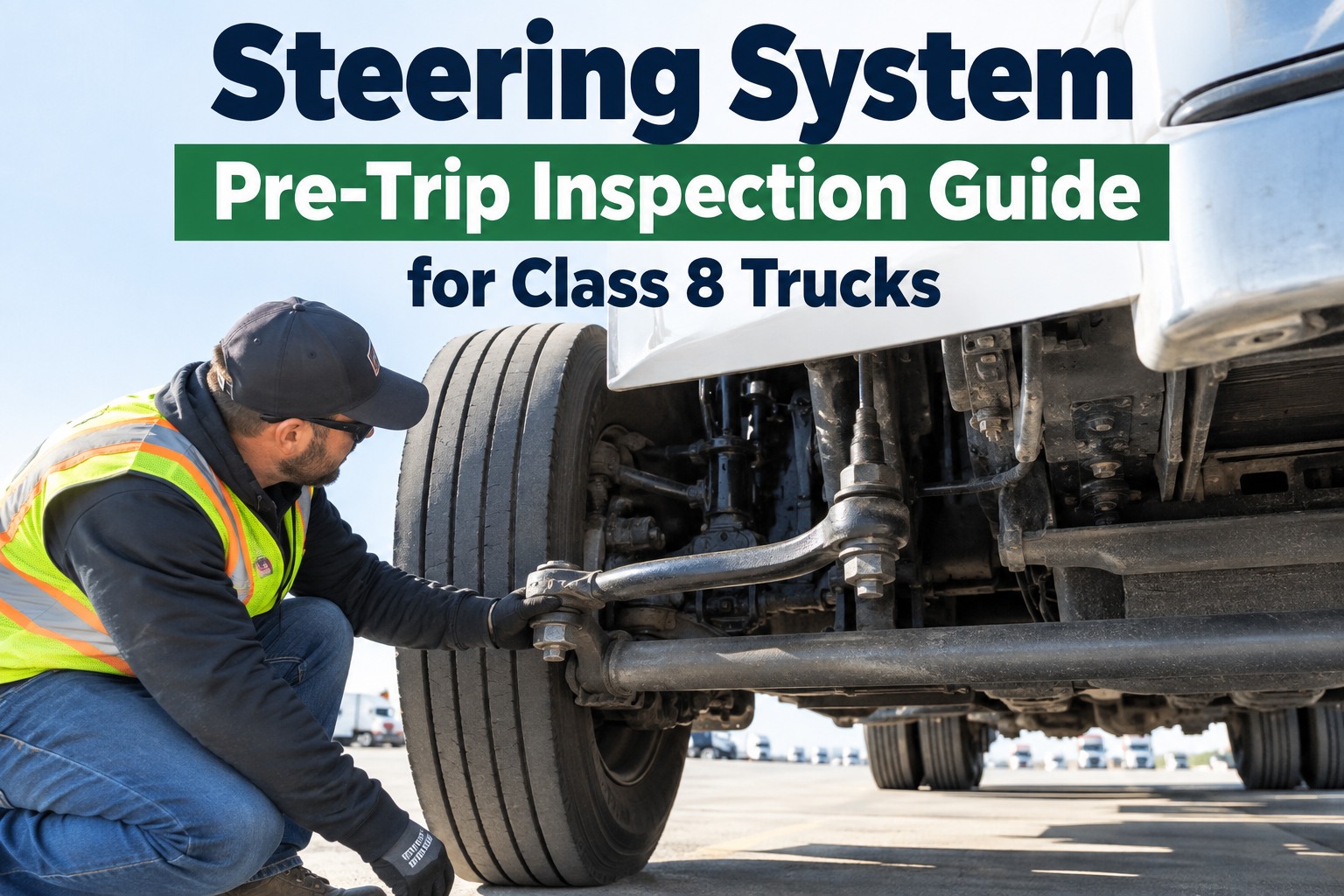
Steering defects are rare — about 2% of out-of-service orders — which is exactly why they get missed. But when brakes fail, a truck stops slowly; when a tie rod end separates or a pitman arm fractures, it stops sideways, at highway speed, usually without warning. And steering almost never fails suddenly: boots tear, joints develop play, and grease dries out over months while the parts sit buried under the hood and behind the wheels. This guide walks the Class 8 steering pre-trip that catches it early — lash, pitman arm, drag link, tie rod ends, and power steering leaks — with the federal limits that decide pass or fail. Our truck inspection and maintenance management software captures each check in a mobile DVIR and routes any defect straight to a work order.Start a free trial and give the front end its own measured inspection record.
The Class 8 Steering Pre-Trip Inspection Guide
Steering is ~2% of out-of-service orders and the #1 catastrophic failure mode. Here's the component-by-component pre-trip for lash, pitman arm, drag link, tie rod ends, and power steering leaks — with the federal limits that decide pass or fail.
Follow the Force: How Your Input Reaches the Road
A steering pre-trip makes the most sense when you follow the path your hands take to the pavement. Driver input runs through the wheel and column into the gear box, out through the pitman arm, along the drag link, into the tie rod and its ends, and finally to the steer wheels. Every joint in that chain is a wear point — and a separation anywhere breaks the connection between the driver and the road.
The Five Steering Checks That Matter Most
The whole chain matters, but five checks catch the vast majority of defects — and two of them, power steering leaks and worn tie rod ends, are the most-cited steering violations in CVSA data.Start free and build all five into a guided steering checklist.
With the engine running, turn the wheel until a front wheel just moves. Excess lash means worn gear or linkage. Federal limit is diameter-based — 2½ inches on a 20-inch power-steering wheel — or 30° angular rotation for power systems, 14° for manual.
The pitman arm must be tight on the gear-box output shaft — any looseness on the splines is a violation. Check gear-box mounting bolts for tightness and the housing for cracks or leaks. A gear box that shifts on its bracket under steering input goes out of service.
Inspect the drag link for straightness — a bent link signals impact damage. Check both ball-and-socket ends for play while a helper rocks the wheel, and confirm jam nuts are tight and cotter pins present. A separated drag link means total loss of directional control.
The zero-tolerance joint. A healthy end rotates freely in its socket with no measurable play; any detectable movement means replace. A seized end binds the steering; a torn boot lets grit in and destroys the socket. Both of the fleet's most-cited defects live here.
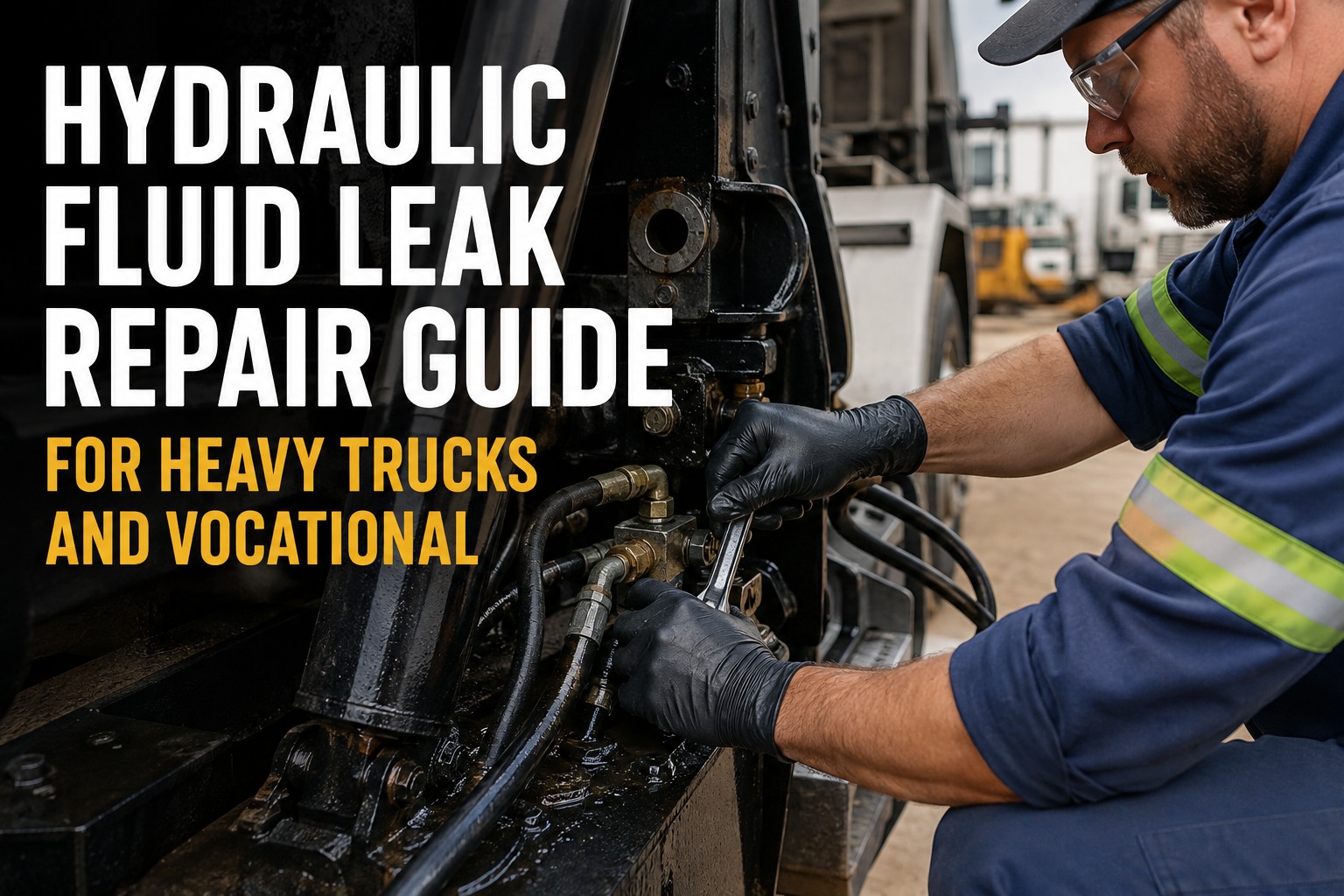
Check fluid level and condition — clean and red, not dark or burnt. Inspect the pump, hoses, reservoir, and gear box for leaks. Any leak severe enough to impair assist, or a reservoir below minimum, is an out-of-service condition. Dark fluid signals overheating.
The Federal Lash Table (49 CFR 393.209)
Steering wheel lash is the one steering check with a precise, wheel-diameter-based federal limit — and inspectors measure it with a ruler. Confirm your wheel diameter and system type, then measure against these thresholds.Contact our team to build these thresholds into your PM checklist.
| Steering wheel diameter | Manual max lash | Power max lash |
|---|---|---|
| 16 in or less | 2 in | 4¼ in |
| 18 in | 2¼ in | 4¾ in |
| 19 in | 2⅜ in | 5 in |
| 20 in | 2½ in | 5¼ in |
| 21 in | 2⅝ in | 5½ in |
| 22 in | 2¾ in | 5¾ in |
| Not listed | 14° rotation | 30° rotation |
Why "Stops Sideways" Isn't a Metaphor
Steering fails through slow, progressive deterioration — and every stage of that decline is catchable in a pre-trip. The problem isn't that the failures are invisible; it's that they're quiet, and quiet defects lose to loud ones for shop attention.
Close the Loop from Driver Flag to Repair Sign-Off
Our truck inspection and maintenance management software replaces paper DVIRs and PM spreadsheets with mobile inspection capture, instant defect routing, PM scheduling, and DOT recordkeeping in one place. A driver's steering complaint becomes a work order the same shift, lash and linkage checks stay on schedule, and every repair is signed off and audit-ready — so fleet managers stop chasing paperwork and start driving uptime.
What Puts a Class 8 Steer Axle Out of Service
Federal rules at 49 CFR 393.209 set the floor, and CVSA criteria decide roadside. These are the conditions that ground the truck.
Frequently Asked Questions
Catch Steering Defects in the Bay, Not on the Shoulder
Our truck inspection and maintenance management software gives fleets one platform for the whole inspection-to-repair loop — mobile DVIR capture, instant defect routing, PM scheduling, and DOT recordkeeping. Lash and linkage checks stay on schedule, driver flags become same-shift work orders, and every repair is signed off and audit-ready year-round. Leading fleets use it to cut breakdowns, pass DOT audits, and give drivers a maintenance system they'll actually use.