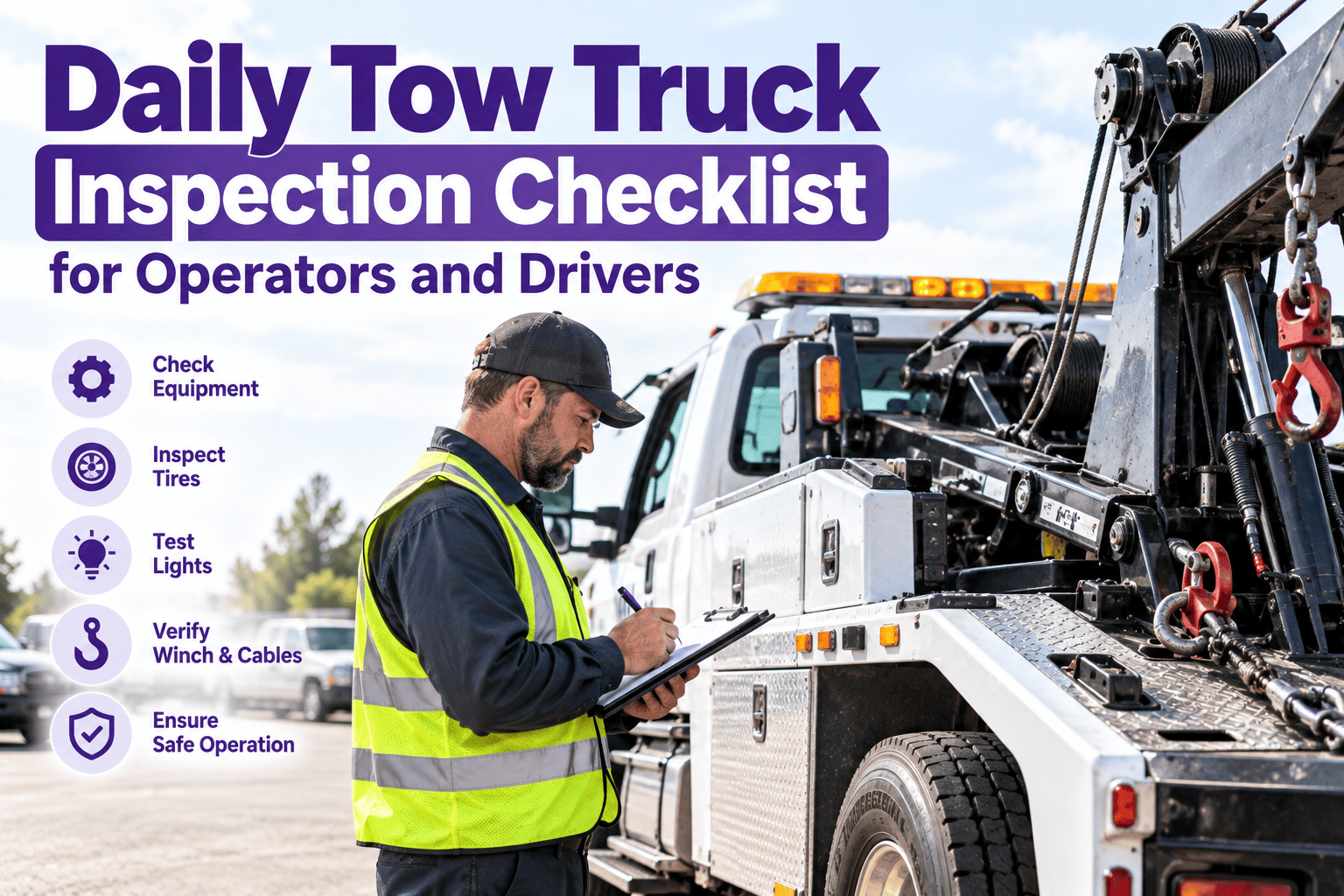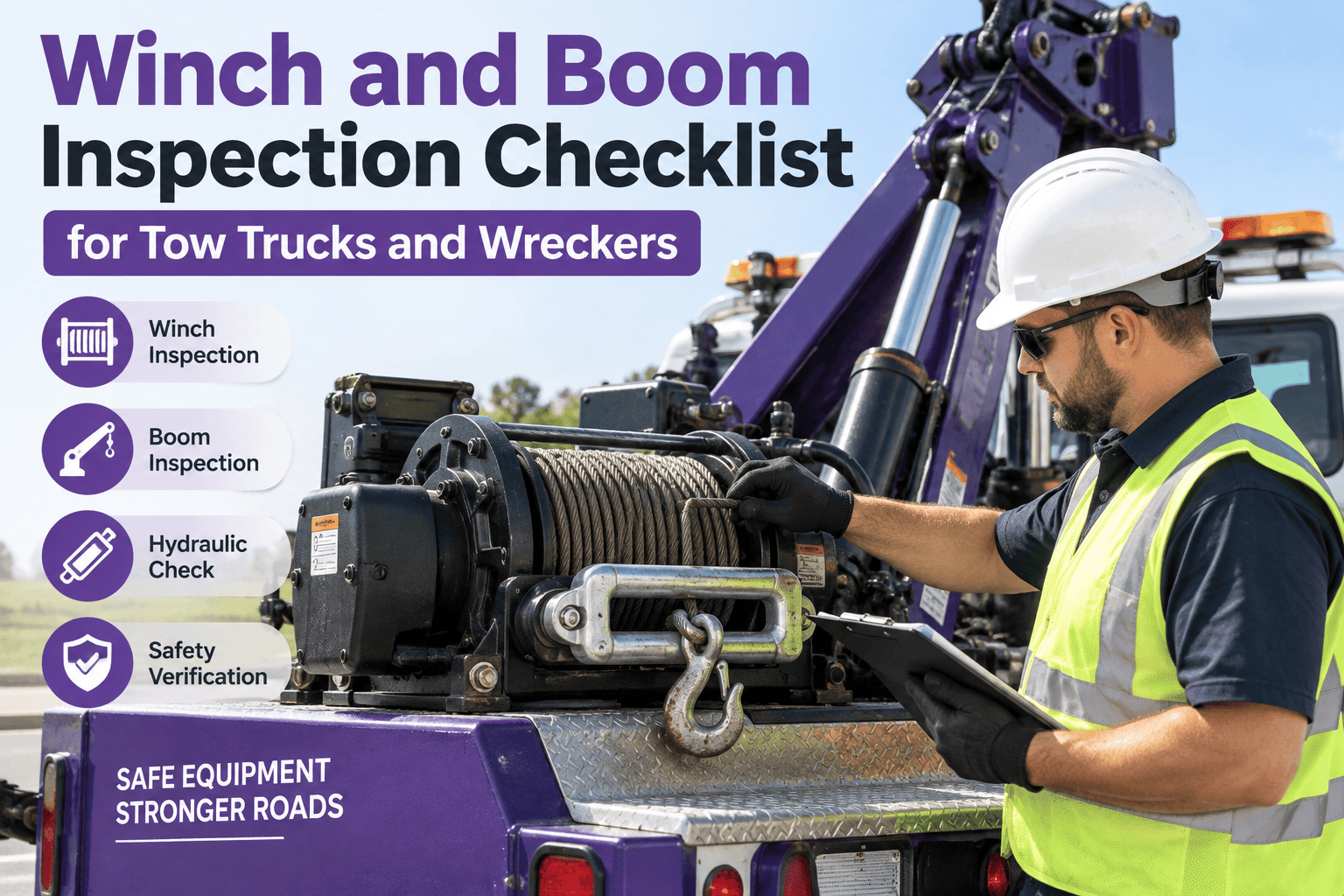
A tow truck's winch and boom are the only two components whose failure can kill the operator or a bystander in the same second. A snapped cable under 20,000 lb of pull doesn't warn you. That's why ASME B30.5 treats winch inspection as a daily job with monthly documented deep-dives. Truck Inspection & Maintenance Management Software puts the checklist on the driver's phone, grades each finding at log-time, and opens a work order the moment a retirement criterion is hit. Start free and run your first digital winch & boom check.
Every Recovery Starts With a Cable You Trusted Yesterday
Six broken wires per lay length is the ASME B30.5 retirement threshold — and by the time you can hear a strand pop under load, the truck is already in the road. Our software runs the loop end-to-end: guided winch & boom checklist → auto-graded findings → out-of-service work order at the exact retirement criterion → signed record for the audit.
Two Subsystems, Two Failure Modes
Winch and boom fail from different physics. A checklist that treats them as one thing will miss half of each — so our software splits them into two guided walkthroughs.
- Wire rope condition and diameter
- Drum spooling and layer count
- Hook, latch, and end fittings
- Motor, gear housing, brake
- Cable anchor and dead-end
- Weldments and stress-riser cracks
- Pin joints, bushings, clevises
- Cylinders and rod condition
- Hoses, fittings, seals
- Controls and operator station
The ASME B30.5 Retirement Criteria
ASME B30.5 defines exactly when a winch cable is finished — in numbers you can measure with a pen and a caliper. Our software builds each threshold into the checklist so the operator answers yes/no.
Diameter Reduction — What the Caliper Tells You
Internal fatigue shows up as a shrinking rope diameter. Below the threshold for its size, the rope is retired even with no visible broken wires.
| Nominal diameter | Max reduction | What it looks like |
|---|---|---|
| ≤ 5/16" | 1/64" (~0.4 mm) | A hair's-thickness undersize on the caliper |
| > 5/16" to 1/2" | 1/32" (~0.8 mm) | Visible thinning against a new-rope sample |
| > 1/2" to 3/4" | 3/64" (~1.2 mm) | Rope loose in a bushing that fit tightly new |
| > 3/4" to 1-1/8" | 1/16" (~1.6 mm) | Obvious step at loaded vs unloaded section |
The Winch Walkaround — 8 Points, In Order
Outboard-to-inboard, so nothing is missed while attention is fresh. Our software presents them in this order with the pass/fail spec on each screen.
The Boom Walkaround — Structure · Hydraulics · Controls
A defect in any half is enough to fail the truck. Group the checks by system so a hydraulic weep doesn't get lost in a structural walkaround.
- Weldments — no cracks at heat-affected zones or gusset toes
- Boom sections — no deformation, dents, or wear-pad grooves
- Pin joints — no pin-bore elongation; retention hardware in place
- Bushings — no play under a bar test
- Chassis mount — sub-frame bolts tight, no cracked welds
- Cylinder rods — no scoring, pitting, or plating loss
- Seals — dry rod under static pressure; no drift under load
- Hoses — no cracks, blistering, or SAE J517 age-out (5–7 yr)
- Fittings — no weep at swivels or JIC connections
- Reservoir — fluid clear amber; no water haze or sparkle
- Levers — return-to-neutral without sticking
- Dead-man / e-stop — cuts hydraulic power immediately
- Load-moment indicator — live and calibrated (if fitted)
- Overload cutout — trips at rated capacity, resets cleanly
- Operator station — outrigger interlocks functional
Every Retirement Criterion, Turned Into a Yes/No Answer
Our software puts each ASME B30.5 threshold on the operator's phone as a single tap. A finding at the threshold auto-opens an out-of-service work order and locks dispatch until the shop clears it.
The Hydraulic-Seal Decision Path
A wet cylinder isn't automatically out of service — the question is passing weep vs failing seal. Our software asks the same questions the shop foreman would, in order.
Frequently Asked Questions
Turn Every Pre-Use Check Into a Signed, Audit-Ready Record
Our software gives operators the ASME B30.5 winch and boom checklist on their phone, grades findings at log-time, and opens a work order the moment a retirement criterion is met — so the truck that rolls to the recovery is the truck you know is safe.