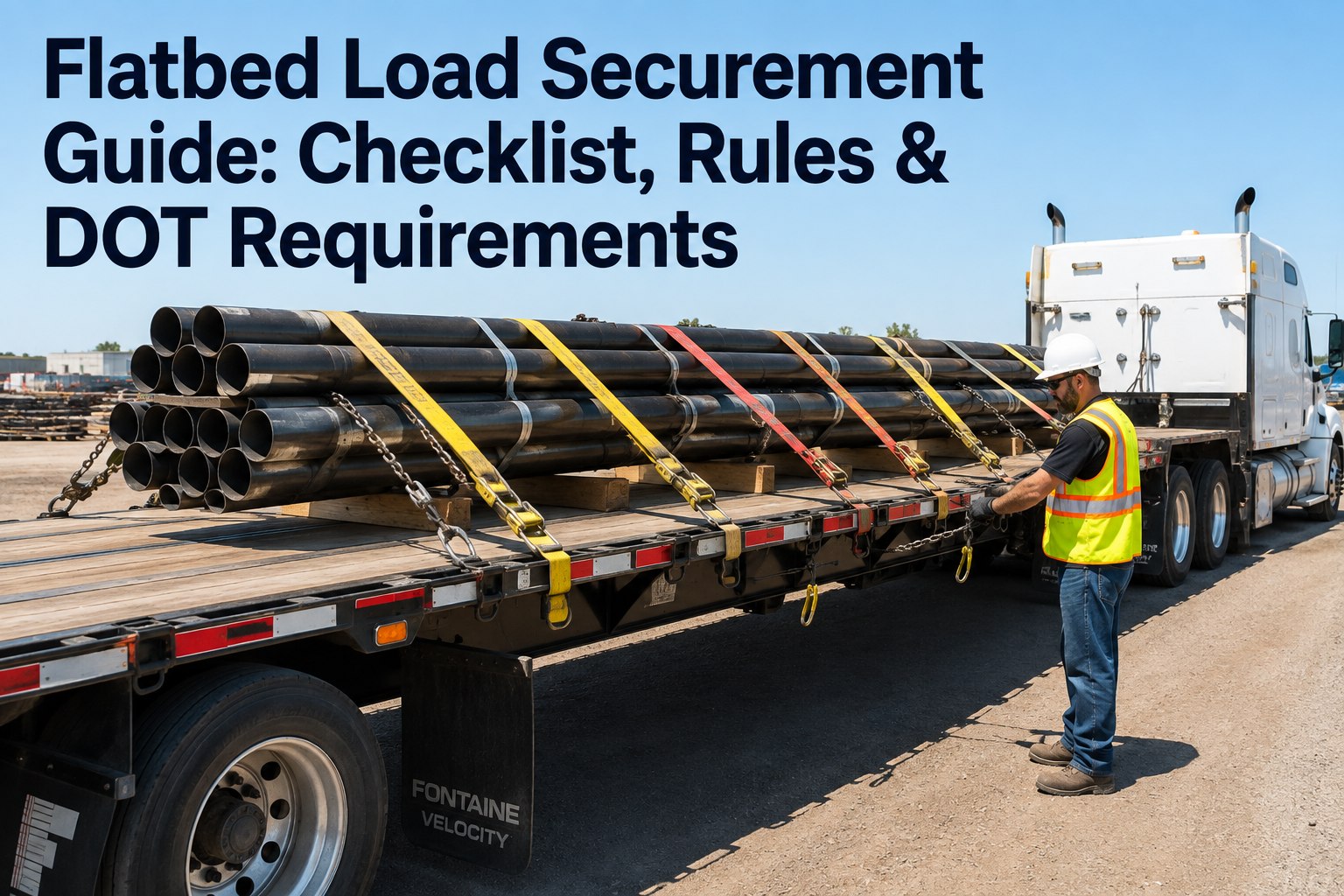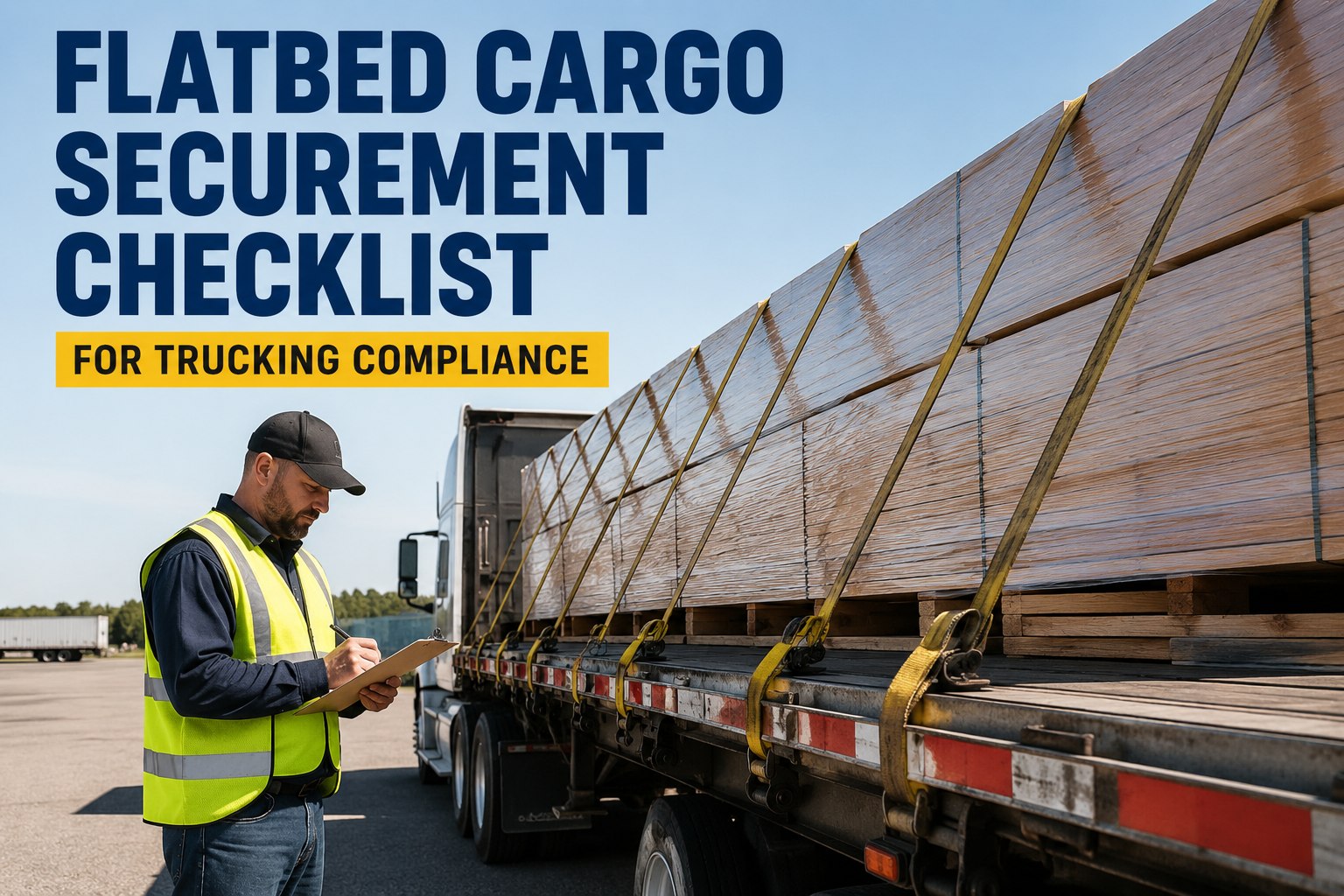
A flatbed load that looked perfect at the shipper can shift 30 miles down the highway straps stretch, cargo settles, dunnage compresses, and the 40,000-lb piece of steel behind the cab starts moving relative to the deck. Load shift is behind roughly 20% of commercial vehicle loss-of-control crashes, and FMCSA writes the rules with no gray area: aggregate WLL at least 50% of cargo weight, no shift over 0.5" in any direction, and mandatory re-checks at 50 miles and every 150 miles after. Truck Inspection & Maintenance Management Software runs the pre-trip securement check and the mid-trip verification as sequenced workflows on the driver's phone — every strap counted, WLL math done, photo-verified, filed to §393.100 spec. Start free and run flatbed load-shift prevention on TIM.
Load Shift Is Preventable — TIM Sequences the Check the Federal Rule Requires
The rules don't leave room for guesswork: two independent tests every legal flatbed load must pass, plus mandatory re-checks at 50 miles and every 150 miles or 3 hours. Truck Inspection & Maintenance Management Software runs both — pre-trip WLL calculator, tie-down count validator, edge-protection photo capture, and a mid-trip verification workflow the driver can't skip.
The Three Numbers Every Flatbed Driver Must Know Cold
Almost every load-shift violation traces to one of three miscalculations. The rules apply simultaneously — passing two out of three is still a citation. Below is the math triangle TIM has built into the pre-trip securement calculator.
The combined working load limit of every tie-down on an item must equal at least 50% of the item's total weight. A 40,000-lb piece of steel needs at least 20,000 lb of aggregate WLL across every strap and chain.
49 CFR §393.106Cargo ≤5 ft & ≤1,100 lb: 1 tie-down. Cargo 5–10 ft: 2. Over 10 ft: 2 for the first 10 ft plus 1 more for every additional 10 ft or fraction thereof. Heavy vehicles ≥5,000 lb need 4 minimum.
49 CFR §393.110Cargo cannot shift more than half an inch in any direction under normal conditions — including 0.8g braking, 0.5g rearward, and 0.5g lateral acceleration. Anything more is a securement failure by definition.
49 CFR §393.102The Tie-Down Count Matrix — Straps by Cargo Length
The matrix below is the working reference the TIM pre-trip loads by cargo length automatically. Drivers see the required minimum count the moment they log the cargo dimensions — no mental math, no rounding down.
| Cargo length | Cargo weight | Min tie-downs | Rule reference |
|---|---|---|---|
| ≤ 5 ft | ≤ 1,100 lb | 1 | §393.110(b)(1) |
| ≤ 5 ft | > 1,100 lb | 2 | §393.110(b)(2) |
| 5 ft to 10 ft | Any weight | 2 | §393.110(b)(3) |
| 10 ft to 20 ft | Any weight | 3 | §393.110(b)(4) |
| 20 ft to 30 ft | Any weight | 4 | §393.110(b)(4) |
| 30 ft to 40 ft | Any weight | 5 | §393.110(b)(4) |
| 40 ft to 50 ft | Any weight | 6 | §393.110(b)(4) |
| Any vehicle / heavy equipment | ≥ 5,000 lb | 4 minimum · direct tie | §393.130 |
The Mid-Trip Verification Cadence — When TIM Prompts the Driver
The pre-trip check is only half the rule. FMCSA §393.100 requires the driver to re-inspect the securement at three separate points during the trip — and a driver who can't demonstrate compliance can be cited even if the cargo is perfectly secure at the scale. Truck Inspection & Maintenance Management Software prompts the driver at each interval and captures the re-check with a photo and a signature.
Pre-Trip Math + Mid-Trip Prompts + Photo Evidence — All in TIM
Truck Inspection & Maintenance Management Software runs the whole flatbed securement workflow on the driver's phone. WLL calculator opens with cargo weight and dimensions. Tie-down count validated automatically. Mid-trip re-check reminders fire at 50 mi and every 150 mi. Every check photo-verified and filed against the load record — audit-ready the moment a DOT officer asks.
Four Shift-Causing Failures the Pre-Trip Has to Catch
Most on-road shifts don't happen because the driver ignored the rules — they happen because one of these four failures wasn't caught at the yard. TIM's securement template asks about each explicitly.
Strap contacts a cargo edge with less than 0.5" radius. Sharp edge abrades or cuts the strap in transit — securement fails without warning. Corner protectors are 30 seconds; not optional.
Cargo can slide fore-aft or side-to-side on the deck. Wooden blocks, chocks, or friction mats have to fill the gap. Tie-downs alone don't prevent shift — they hold cargo down, not in place.
Driver counted straps by breaking strength or by manufacturer's "rated capacity" instead of the marked WLL. A 4" strap is typically 5,400 lb WLL; a 3/8" Grade 70 chain is 6,600 lb. Use the label, not memory.
Commodity-specific rules under §393.116–§393.136 govern logs, metal coils, paper rolls, concrete pipe, vehicles, and hazmat. Applying general §393.106 to a metal coil is one of the most common Subpart I violations.
Frequently Asked Questions
Every Flatbed Load Legal at the Shipper — and Still Legal 150 Miles Later
Pre-trip WLL math in TIM, count validator per cargo length, edge-protection photo, mid-trip prompts, mandatory recheck logs. Load shift stops being the reason a rig ends up on its side.