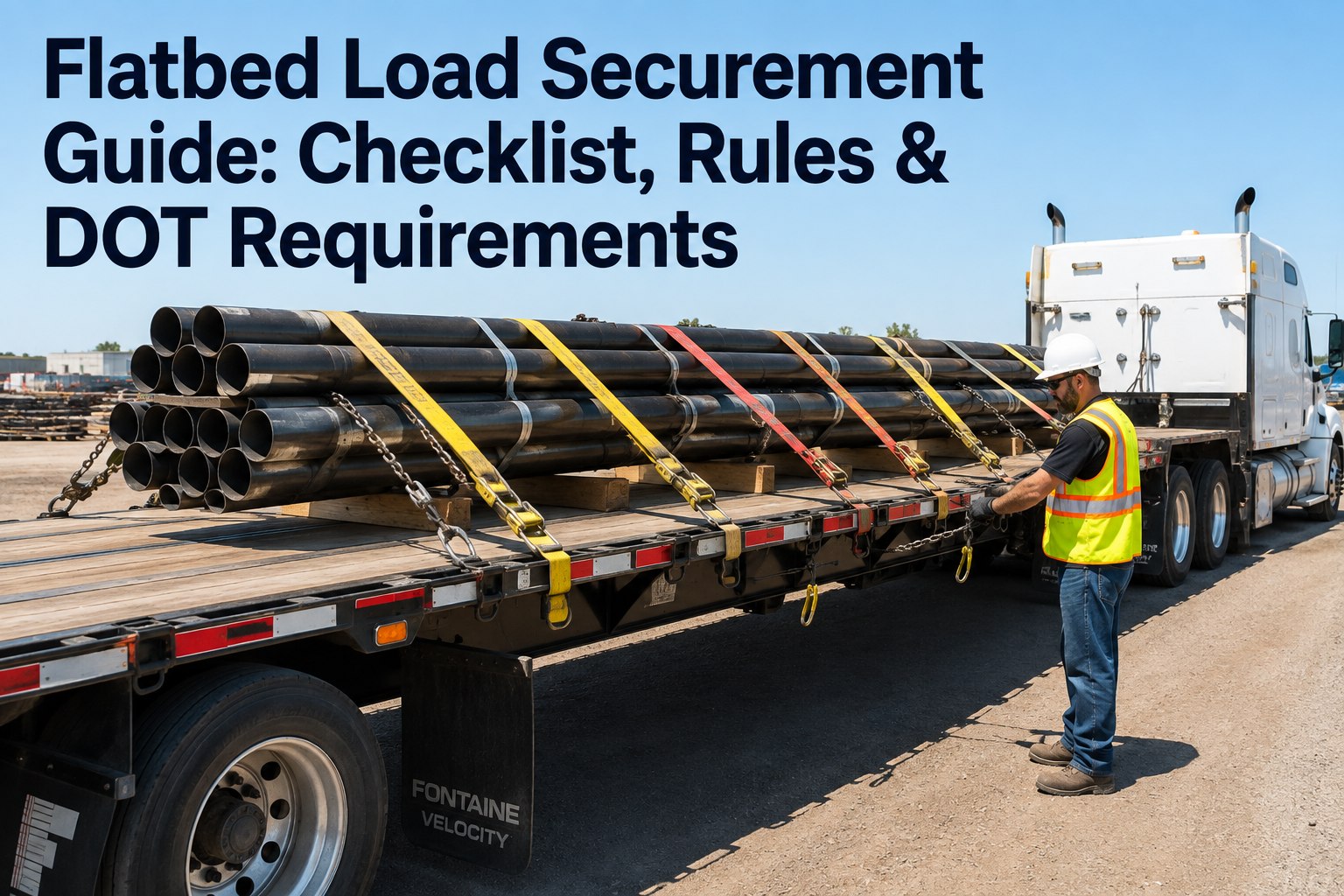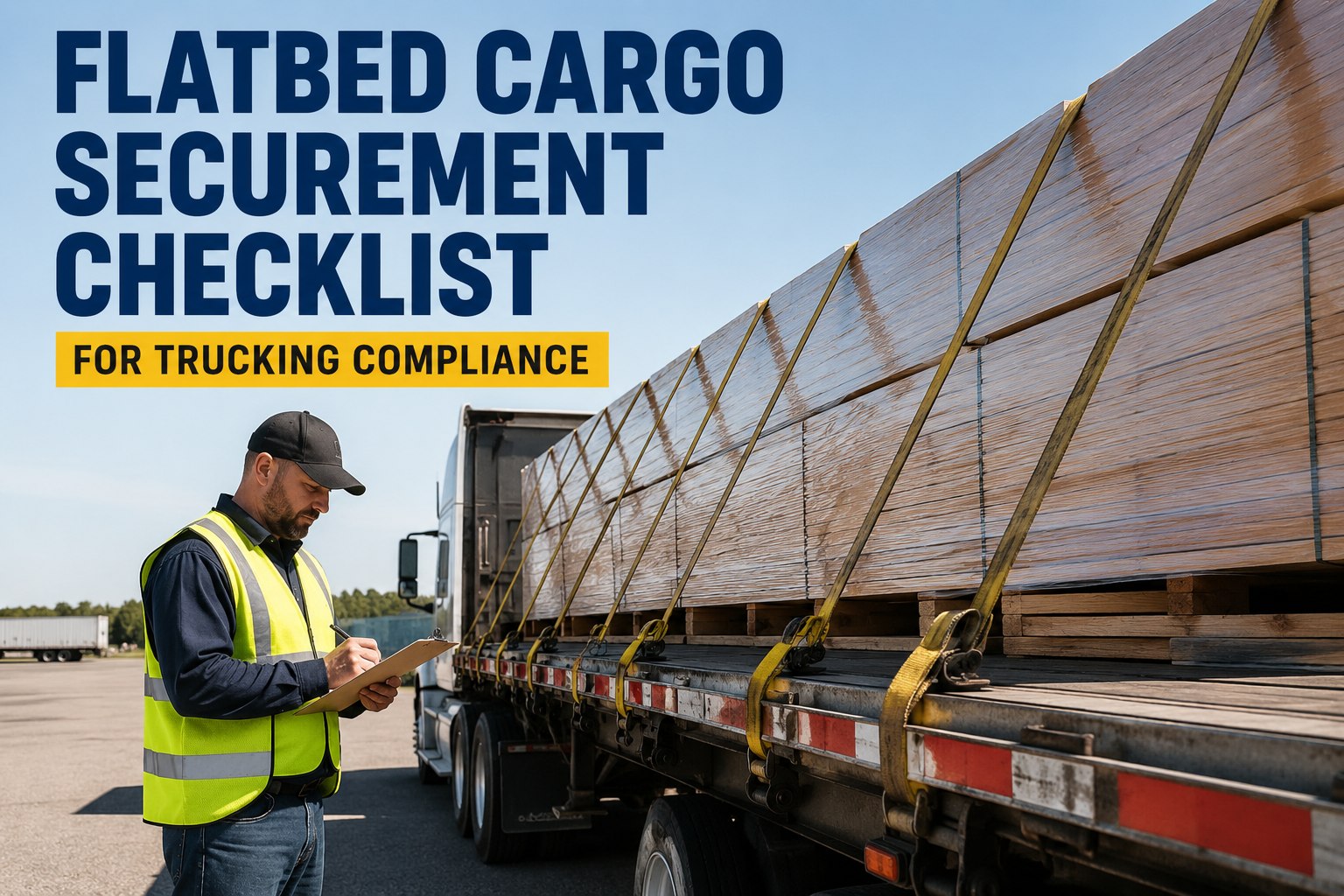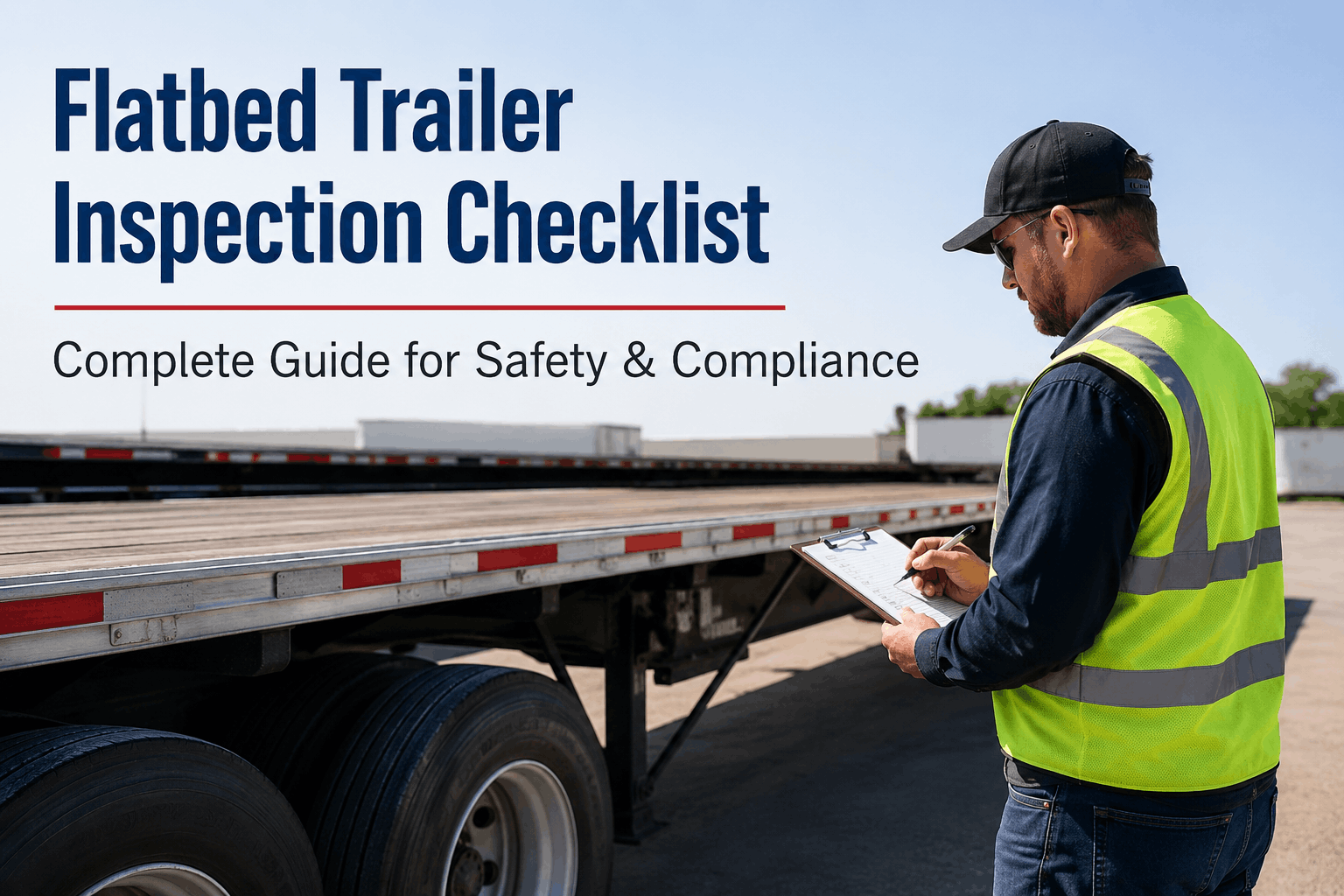
A flatbed trailer hides nothing. Unlike a dry van, every defect and every securement mistake is in plain view — which is exactly why DOT inspectors scrutinize flatbeds so hard and why a missed check can cost you a load on the highway, literally. Cargo securement violations carry fines up to $16,000 per occurrence, out-of-service orders, and CSA points that drive up insurance, and a shifted or fallen load on an open deck endangers everyone around it. The defense is a disciplined inspection routine that covers both the trailer itself and the load riding on it. This guide gives you a complete flatbed inspection checklist — structure, decking, tires, brakes, lights, and the FMCSA securement math under 49 CFR Part 393 — so your trailers pass roadside and your freight stays put. Truck Inspection & Maintenance turns it into a digital DVIR your drivers finish in minutes. Talk to our team to roll it out.
Flatbed Trailer Inspection Checklist
Trailer condition + load securement — everything before the wheels turn.
Two Inspections in One
A flatbed inspection is really two checks stacked together, and skipping either one fails you at roadside. First, the trailer itself must be mechanically sound and roadworthy. Second — and uniquely for flatbeds — the load securement has to meet FMCSA's exacting standards under 49 CFR Part 393. An inspector evaluates both, and a perfect trailer with one under-rated strap is still an out-of-service order. Work them in this order, every time.
Part 1 — Trailer Condition
Structure, decking, tires, brakes, lights, kingpin, and landing gear. The mechanical roadworthiness that any DVIR demands.
Part 2 — Load Securement
Tie-down count, working load limits, edge protection, and the 50-mile re-check. The flatbed-specific compliance that inspectors hit hardest.
Part 1 — The Trailer Walk-Around
Open decks take a beating — sun, rain, road salt, and heavy point-loads all attack the structure. Work the trailer in the same order every time so nothing slips. Start a free account to put this exact walk-around on every driver's phone.
Frame & Decking
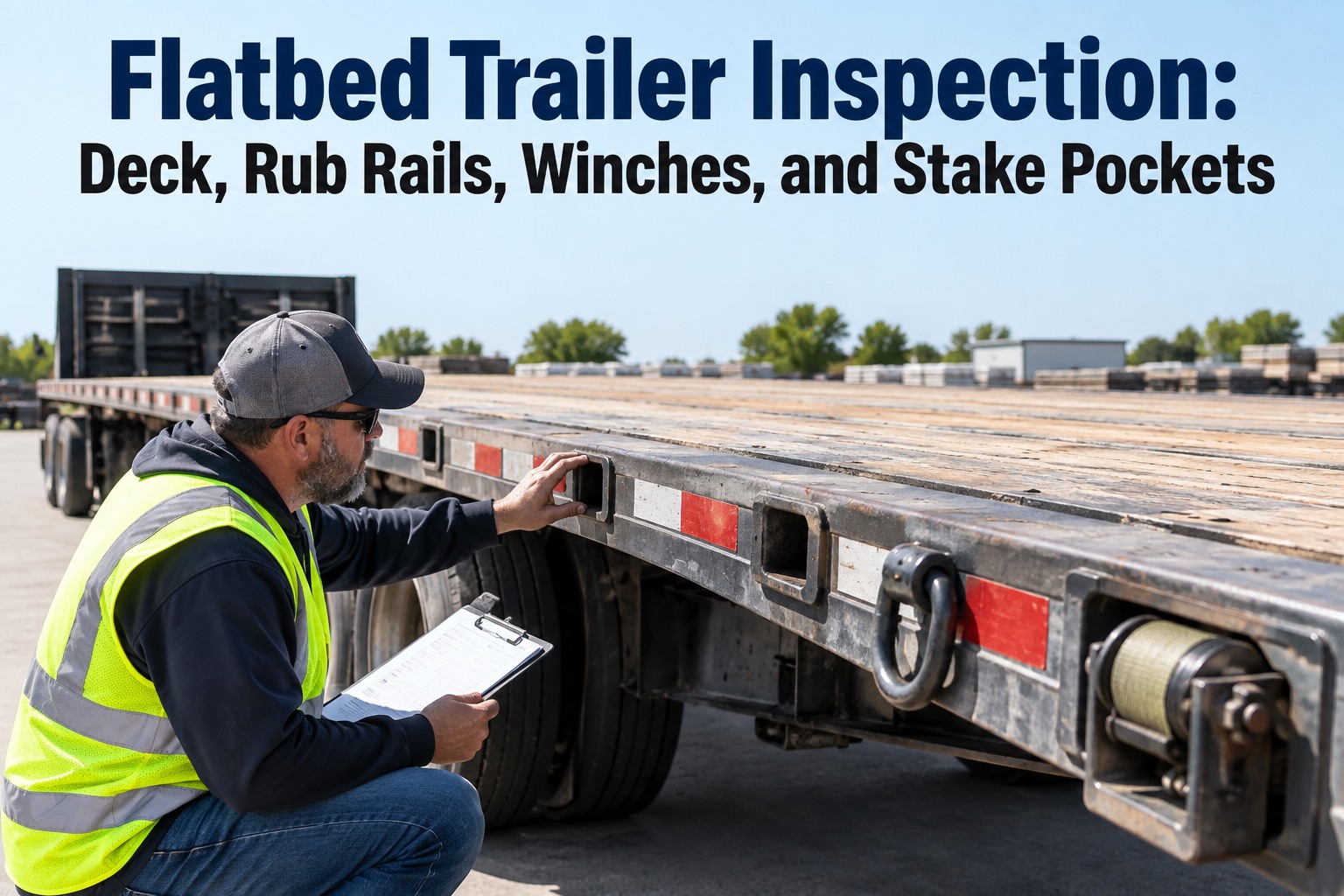
- No cracks, bends, or rust-through in main rails
- Deck boards/planks solid, no rot or holes
- Rub rails and stake pockets intact
- Welds at crossmembers undamaged
Tires & Wheels
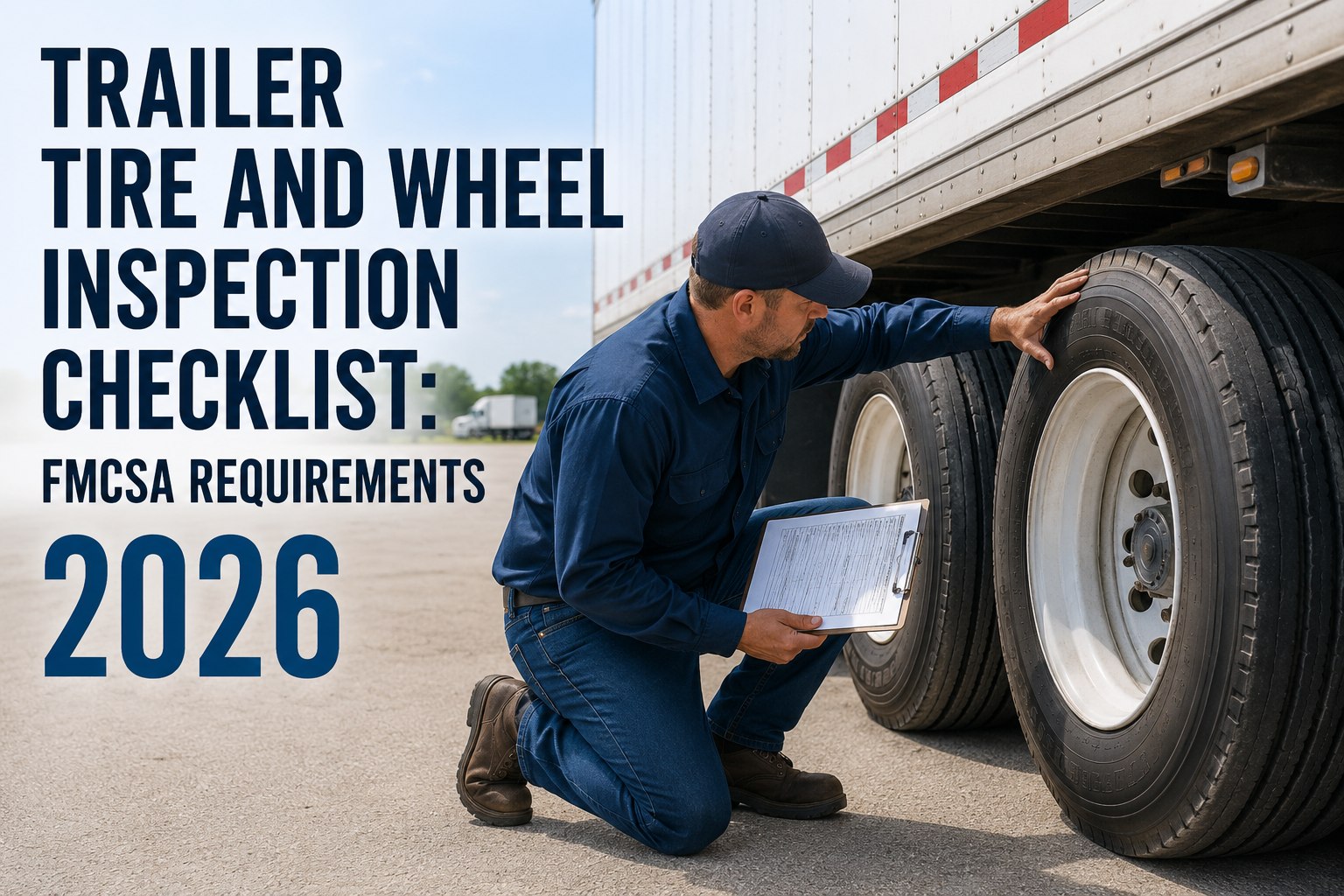
- Tread depth measured, no cuts or bulges
- Correct pressure on all positions
- Lug nuts tight, no rust trails
- Duals not touching, rims undamaged
Brakes & Air
- Slack adjuster travel within limits
- Air lines free of leaks and chafing
- Brake chambers and drums sound
- ABS light cycles correctly
Lights & Reflectors
- Stop, tail & turn signals all working
- Clearance and marker lights functional
- Conspicuity tape clean and intact
- 7-way connection secure
Kingpin & Coupling
- Kingpin undamaged, no excessive wear
- Upper coupler plate flat and greased
- Locking jaws engage fully
- Apron free of cracks
Landing Gear & Suspension
- Landing gear cranks smoothly, legs sound
- Springs/airbags intact, no leaks
- U-bolts and hangers tight
- Mud flaps present and secure
A digital DVIR built for flatbeds
Truck Inspection & Maintenance turns this whole checklist into a mobile pre-trip — photo capture, auto out-of-service tagging, instant work orders, and audit-ready records for every trailer and every load. No hardware, no contracts. Sign up free and digitize your fleet today.
Part 2 — Load Securement Math
This is where flatbeds get cited most, and where the rules are pure arithmetic. FMCSA's core principle under 49 CFR Part 393 is simple: cargo must be immovable under all braking, turning, and road conditions. Get the three numbers below right and you pass. Reach our team to build load-type securement checklists for your freight.
The WLL rule
The combined Working Load Limit of all tie-downs must equal at least half the cargo weight. Hauling 30,000 lbs? You need at least 15,000 lbs of combined WLL.
The count rule
At least four tie-downs for loads over 10 feet, plus one tie-down for every additional 10 feet or part thereof. Whichever rule needs more, that's your minimum.
The short-load rule
Cargo 5 feet or shorter but over 1,100 lbs still needs at least two tie-downs. Small doesn't mean exempt.
Securement inspection checklist
- Combined tie-down WLL ≥ ½ cargo weight, verified
- Correct tie-down count for load length
- Chains (Grade 70) on heavy/sharp steel; straps on lumber & palletized goods
- Edge protectors on every sharp corner — straps cut on metal edges
- Heavy equipment over 10,000 lbs: four independent corner tie-downs (§393.130)
- Binders rated, chains and straps free of cuts, cracks, or wear
- Weight distributed evenly — no jackknifing or tipping risk
- Re-check securement within first 50 miles, then every 150 mi / 3 hrs
Chains vs Straps — Pick Right
Matching the tie-down to the cargo isn't preference, it's compliance. The wrong choice fails — a strap cut by a sharp steel edge is a loose-cargo violation waiting to happen, and an inspector who can flex a strap by hand will write it up. Here's the quick decision.
- Heavy machinery, steel beams & coils
- Concrete barriers and hard-surface loads
- Higher WLL; won't cut on sharp metal edges
- Required for many commodity-specific loads
- Lumber, palletized & manufactured goods
- Lighter machinery
- Faster to apply, lighter to handle
- Use edge protectors; degrades in UV over time
Frequently Asked Questions
How many tie-downs does a flatbed load need?
Two rules, and you use whichever demands more. By count: at least four tie-downs for loads over 10 feet, plus one for every additional 10 feet or part thereof. By weight: the combined Working Load Limit of all tie-downs must equal at least half the cargo weight. Even short cargo (5 feet or less) over 1,100 lbs needs at least two. Start a free account to build securement checks into every pre-trip.
What's the Working Load Limit rule?
The combined WLL of all securement devices must equal at least 50% of the cargo's weight — this ensures the system holds even under emergency braking. Example: a 10,000 lb machine needs at least 5,000 lbs of combined WLL across its tie-downs. Every chain, strap, and binder is rated and marked; use those ratings to do the math before you roll.
When do I have to re-check the load?
FMCSA requires drivers to stop and inspect securement within the first 50 miles of a trip — this is not optional, and inspectors will ask when and where you did it. After that, re-check every 150 miles or 3 hours, whichever comes first. Failing to demonstrate the 50-mile check can earn a violation even if the cargo is properly secured at inspection. Talk to our team about logging re-checks.
Should I use chains or straps?
It depends on the load. Grade 70 transport chains are required for heavy, hard-surface, or sharp loads — steel coils, beams, concrete, heavy machinery — because they have a higher WLL and won't cut on metal edges. Four-inch polyester straps suit lumber, palletized freight, and lighter machinery: faster and lighter, but they cut on sharp edges (use edge protectors) and degrade in UV. Match the tool to the cargo.
What happens if my securement fails inspection?
Cargo securement violations carry fines up to $16,000 per occurrence, out-of-service orders that shut your truck down, and CSA points that raise your insurance. If an inspector can flex a strap by hand or sees any load movement, that's a loose-cargo violation — even if you think it's tight. Edge protection, correct WLL, and the right tie-down count are what keep you rolling. Sign up free to standardize securement checks.
Can my driver do the full inspection?
Yes. A trained driver completes the trailer walk-around and the load securement check in about five minutes before each trip, and handles the required 50-mile and en-route re-checks. Mechanical repairs go to a qualified technician. The key is making defect reporting one tap so a problem spotted in the yard reaches the shop instead of becoming a roadside failure — and so your securement inspection is documented if an officer asks.
Make every trip start with a passed inspection.
Truck Inspection & Maintenance turns this flatbed checklist into a digital DVIR — trailer and securement checks, photo capture, auto out-of-service tagging, instant work orders, and audit-ready records. Free for up to 3 vehicles, no hardware, no contracts.