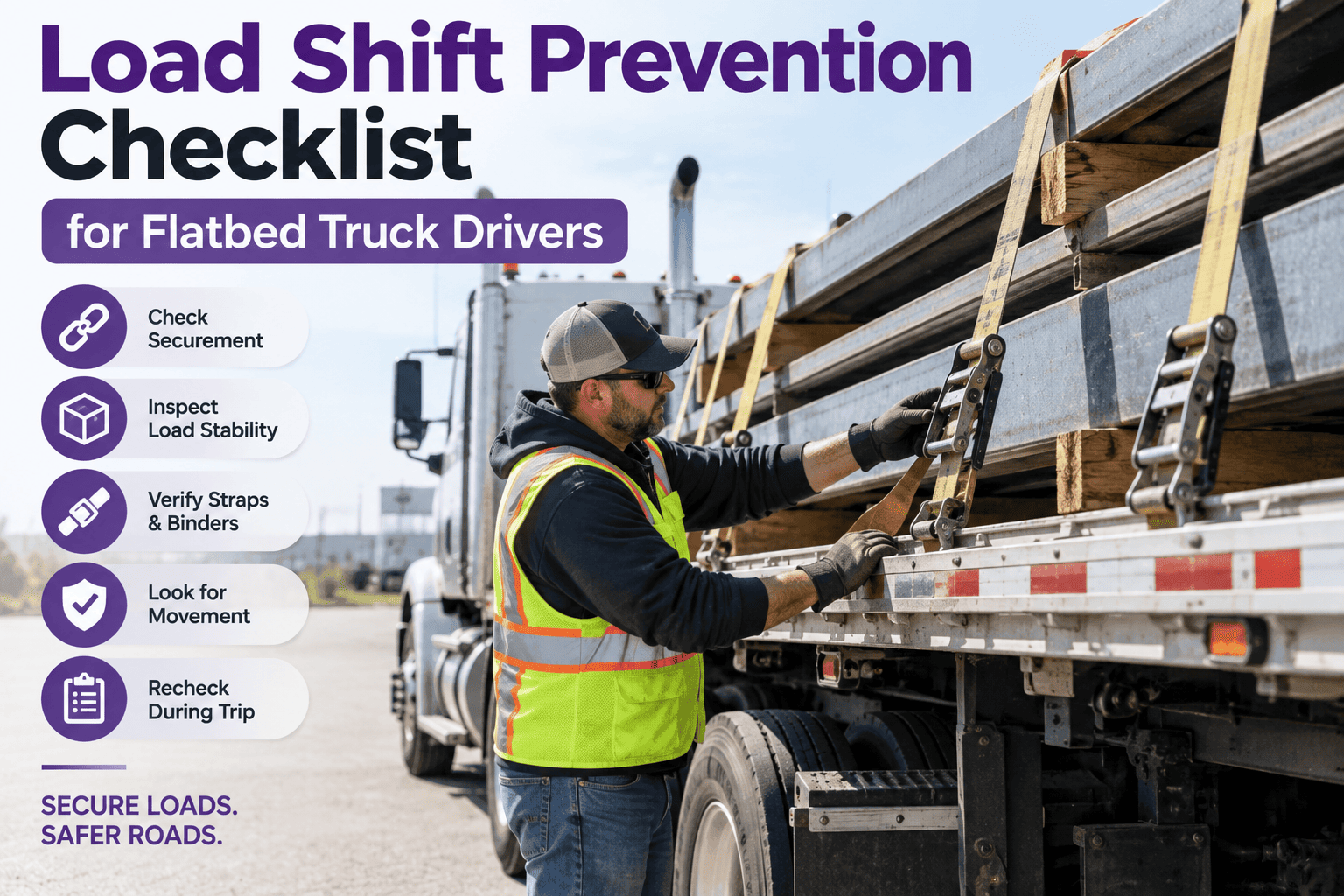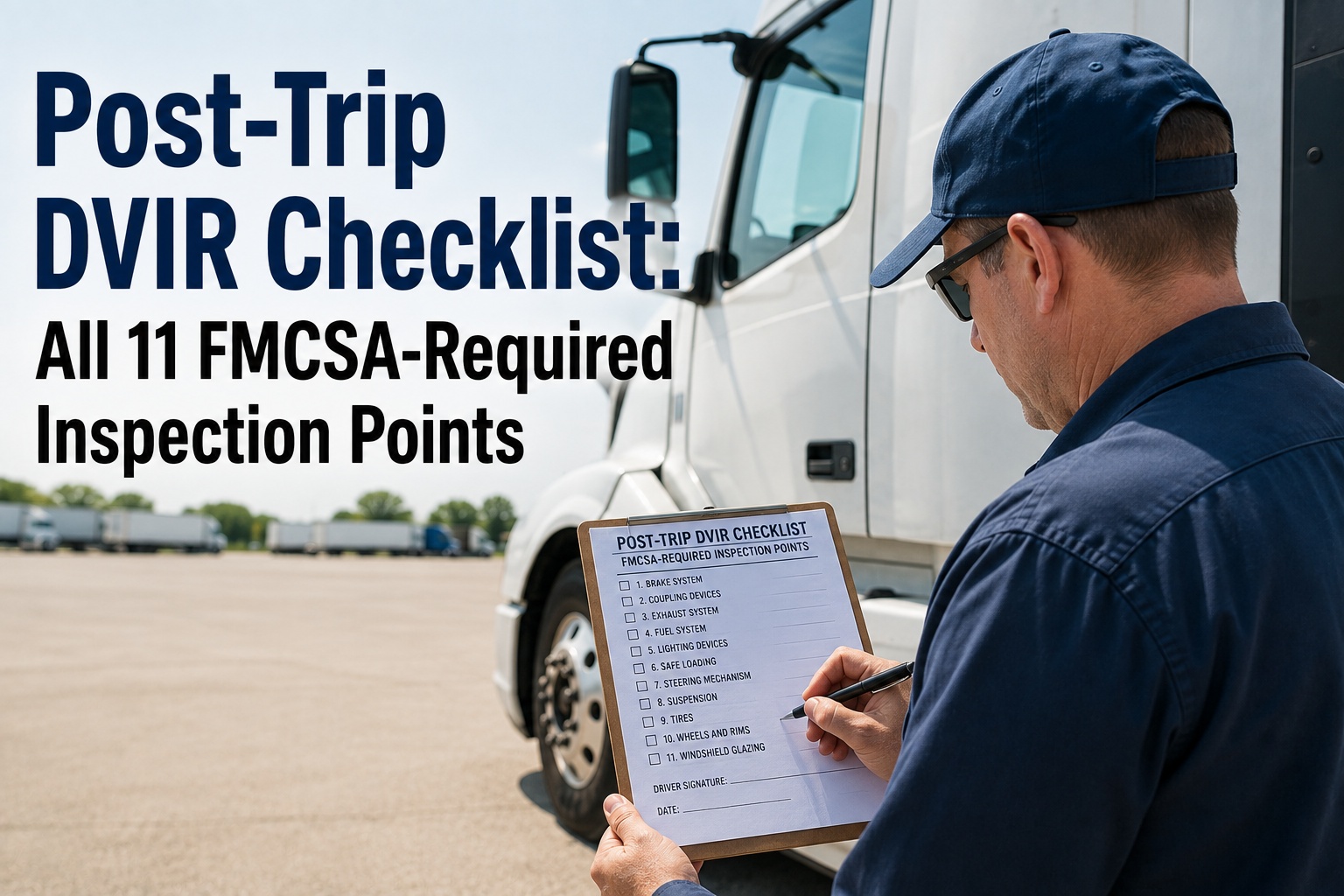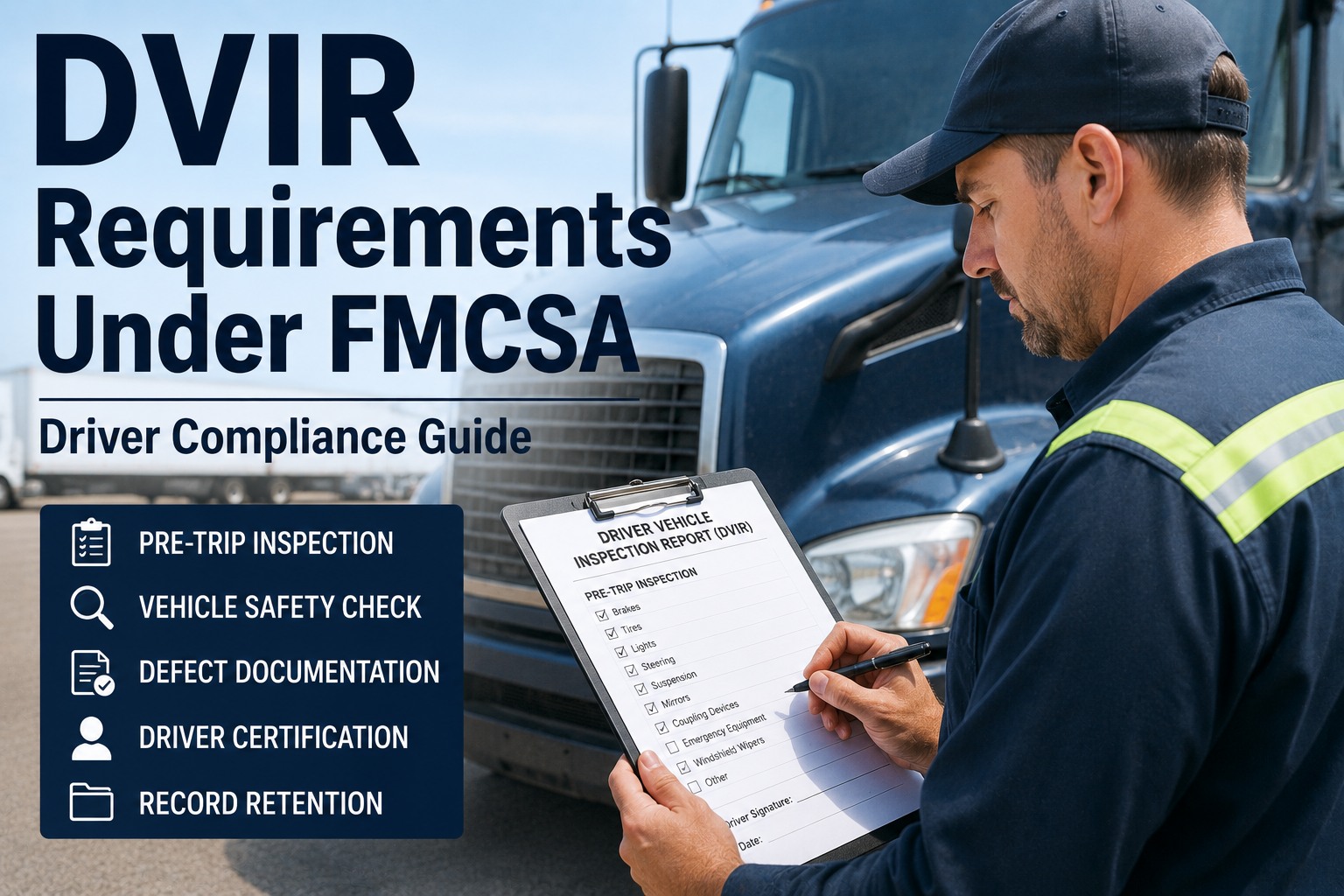
A single unsecured pallet at highway speed becomes a 2-ton projectile. That's why the Federal Motor Carrier Safety Administration built 49 CFR Part 393 Subpart I — the cargo securement standard that governs every piece of freight moving on a US flatbed. The rules aren't complicated once you break them down: enough tie-downs (per length-and-weight table), enough combined strength (50% of cargo weight in Working Load Limit), and everything above condition to pass a Level I inspection. Miss any of these and you're looking at fines up to $19,246 per violation, or $23,048 if the load triggers an out-of-service order — with each separate finding cited independently on the same stop. This guide walks through the WLL math, the length-and-weight tie-down formula, commodity-specific rules for lumber, coils, and heavy equipment, the required 50-mile and 150-mile re-check cadence, and the full pre-trip flatbed securement checklist. Track every load and inspection on our fleet software, or reach out to our support team for a walkthrough.
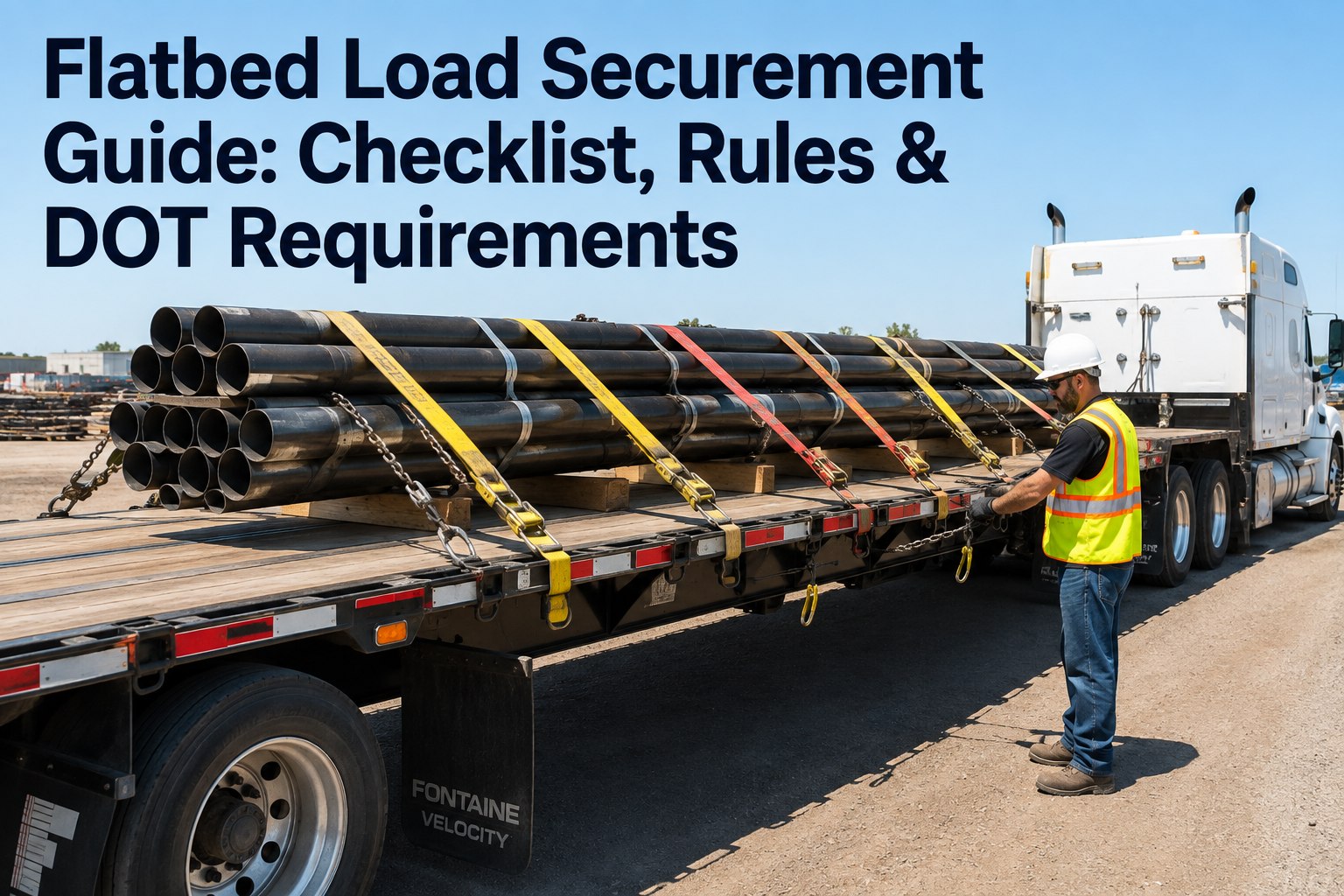
Flatbed Load Securement Guide: Checklist, Rules & DOT Requirements
The complete driver-facing playbook: tie-down math, WLL rules, commodity-specific requirements, and the audit-ready checklist that keeps you compliant on every load.
The 4 Core Rules That Govern Every Load
The entire cargo securement regulation reduces down to four foundational rules. Every commodity-specific requirement builds from these. Know these cold and you understand the framework.
Applicability
Rules apply to all CMVs in interstate commerce. Cargo must be firmly immobilized or secured to prevent shifting, falling, blowing off, or spilling. Both driver and carrier bear joint responsibility.
Performance Criteria
Securement must withstand 0.8g forward, 0.5g rearward, and 0.5g lateral deceleration without cargo shifting. These are the physics the tie-down math is built to satisfy.
Minimum Tie-Down Count
Aggregate WLL must be at least 50% of cargo weight. Minimum number of tie-downs determined by cargo length and weight, per the tie-down table (detailed below).
WLL & Marking
Every tie-down assembly must be permanently marked with its Working Load Limit by the manufacturer. Missing, worn, or illegible markings render the tie-down non-compliant — inspector cannot count it.
The Tie-Down Count Table (Section 393.106)
This is the table every flatbed driver should have committed to memory. It defines the minimum count — you still need enough aggregate WLL, so more tie-downs may be required.
The 50% Aggregate WLL Rule — Explained
The Working Load Limit rule is the most-cited flatbed violation for a reason: it's misunderstood. Here's the plain-English version with two worked examples.
Add up the WLL rating of every tie-down securing the article. That number must equal or exceed half the article's total weight. It's that simple — and that non-negotiable.
Straps vs Chains: What Goes on What Load
Different commodities demand different tie-down types. Getting this wrong isn't just a violation — it's how loads shift and drivers get hurt.
Commodity-Specific Rules You Cannot Miss
Beyond the general rules, FMCSA has specific requirements for high-risk commodities. Getting these wrong is a fast track to a violation regardless of how much aggregate WLL you have.
The Edge Protection Rule
The single most-missed detail on flatbed inspection. Any sharp corner that touches a strap or chain requires edge protection — no exceptions.
When Edge Protectors Are Mandatory
Turn securement compliance into a repeatable process
Digital pre-trip checklist, in-trip re-check reminders, photo evidence per load. Everything a DOT auditor could ask for — logged, timestamped, VIN-linked.
The Required Re-Check Cadence (§392.9)
Securement isn't a "set it and forget it" task. FMCSA mandates specific re-check intervals during the trip. Missing these is a violation independent of whether the load actually shifted.
Pre-Trip Flatbed Securement Checklist
Print this. Every flatbed load, every driver, every trip. Compliance is muscle memory — this checklist builds it.
Violation & Penalty Reference
Cargo securement violations don't come alone — inspectors write each separately. A single stop can generate multiple citations on the same truck.
Frequently Asked Questions
The combined Working Load Limit of all tie-downs securing an article of cargo must equal at least 50% of that article's weight. So a 40,000 lb excavator needs tie-downs totaling at least 20,000 lbs of WLL. This applies on top of the minimum tie-down count from §393.106 — you need both, not either.
Per §393.106: 1 tie-down for cargo 5 ft or shorter and 1,100 lbs or less; 2 tie-downs for cargo 5 ft or shorter but over 1,100 lbs OR longer than 5 ft up to 10 ft; and 2 tie-downs for the first 10 ft plus 1 additional tie-down for every 10 ft beyond that. Heavy equipment over 10,000 lbs requires a minimum of 4 direct tie-downs.
Under §392.9: within the first 50 miles of the trip, then every 3 hours or 150 miles (whichever comes first), and after every change of duty status. Missing any of these intervals is a violation independent of whether the cargo actually shifted.
A direct tie-down connects the load directly to the trailer (chain from equipment D-ring to trailer frame) — only 50% of its WLL counts because tension is on a single line. An indirect tie-down goes over the top of the load (strap loops over lumber and back to trailer) — full 100% of WLL counts. This changes the math significantly on heavy equipment.
Whenever wire rope, chain, or synthetic webbing passes over any edge that could cut or abrade the tie-down. Most commonly this applies to steel plates, coil edges, and heavy equipment corners. Missing edge protection is a citable violation and can trigger an out-of-service order if the condition is serious.
FMCSA civil penalties for cargo securement violations range up to $19,246 per general violation and up to $23,048 per violation that triggers an out-of-service order. Multiple violations on a single truck during one inspection are cited separately, meaning a single stop can generate five-figure fines.
Make cargo securement audit-ready across every load
Digital pre-trip securement checklist. Photo evidence per load. Automatic re-check reminders at 50-mile and 150-mile intervals. Full compliance archive by driver and VIN. Everything you need to defend a Level I inspection — one platform, one workflow.