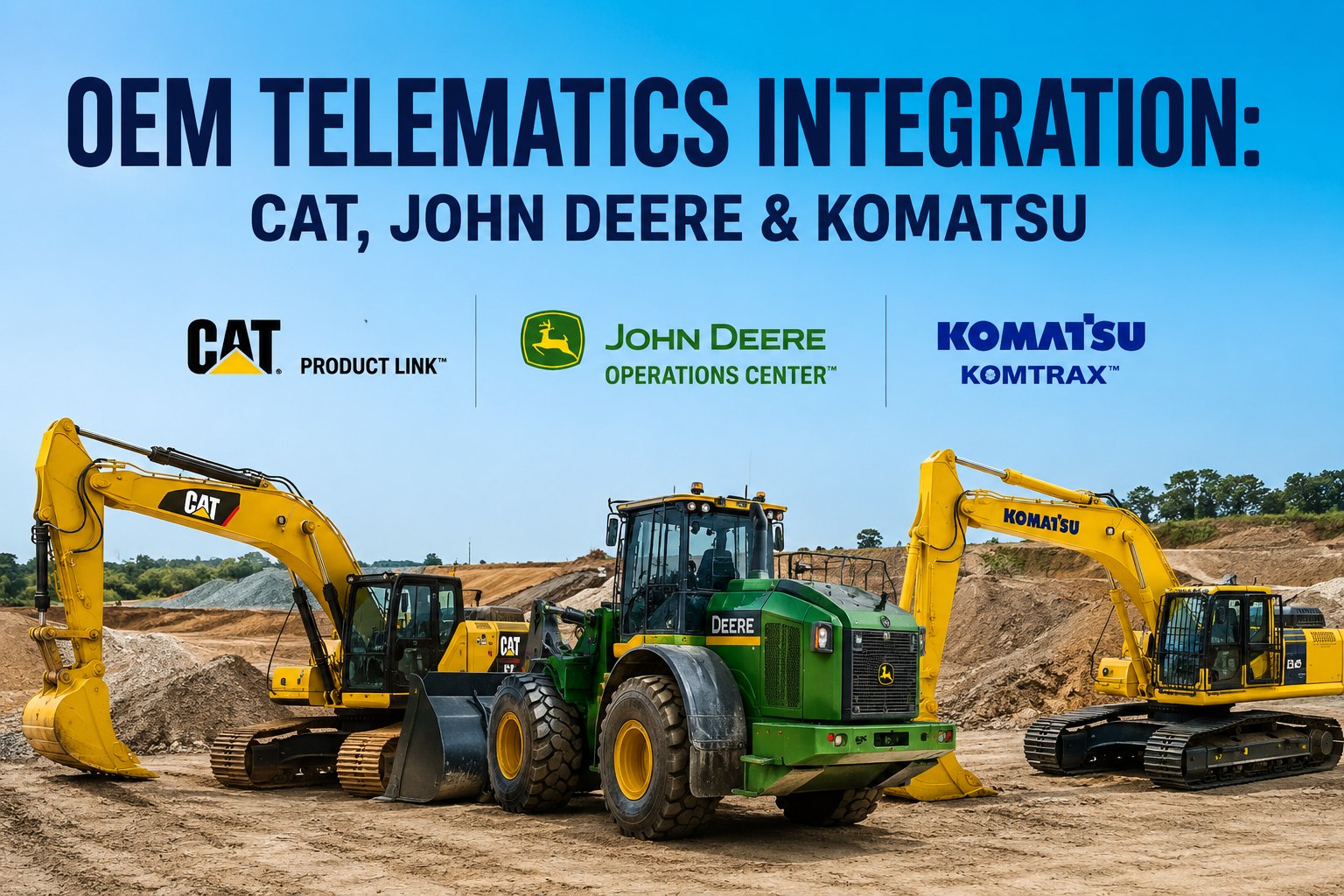
A typical mid-size contractor runs equipment from five to eight different manufacturers — a Cat excavator, John Deere dozers, a Komatsu loader, maybe a Volvo hauler — and every one of them ships with sophisticated factory telematics already installed. The problem isn't a lack of data. It's that each brand locks its data in its own portal: John Deere Operations Center, Cat Product Link, Komatsu KOMTRAX, Volvo ActiveCare Direct. None of them talk to each other natively, so a fleet manager ends up logging into four dashboards to answer one question about utilization. OEM telematics integration solves this by pulling every manufacturer's feed into one platform through a shared standard — no aftermarket hardware, no warranty worries, just the sensors already in your machines. This guide explains how it works, what data flows, and how Truck fleet management software turns a mixed OEM fleet into one maintenance and utilization dashboard.
Integration Guide · Heavy Equipment · 2026
OEM Telematics Integration: CAT, John Deere, Komatsu & More
Unify factory telematics from every manufacturer into one platform through the ISO 15143-3 standard — automating maintenance, diagnostics, utilization tracking, and inspections across a mixed fleet.
5-8
OEM brands on a typical mid-size fleet
ISO
15143-3 — the one standard that unifies them
~20
Standardized data points every OEM feed shares
Zero
New hardware — factory sensors already onboard
The Four-Portal Problem
Every OEM built its telematics as a walled garden. Individually they're capable — but a mixed fleet turns that strength into a daily headache of context-switching, inconsistent metrics, and no single source of truth for utilization or maintenance.
Portal by portal
Log into 4+ dashboards to see one fleet
Each OEM defines its metrics differently
Utilization compared by hand, brand to brand
Maintenance data trapped per manufacturer
One unified platform
Every brand on a single screen
Common definitions across all OEMs
Utilization compared apples-to-apples
Maintenance and diagnostics in one record
The Standard That Makes It Work: ISO 15143-3
The key that unlocks mixed-fleet integration is a single international standard. ISO 15143-3:2020 — formerly known as AEMP 2.0 — defines a common schema and transport so telematics from any compliant manufacturer arrive in the same consistent format. It's the reason one platform can read Cat, Deere, and Komatsu without a custom build per brand.
Common schema
Location, hours, fuel, faults, and payload defined identically across every OEM — no per-brand translation.
Vendor-neutral
Maintained by the industry (JCMA), not one manufacturer — so it stays fair to mixed fleets.
Snapshot & time series
Pull the latest value per machine, or a full history over a period — for trending and equipment records.
Each OEM's front door: the standard is the same, but you authorize each brand once. Cat issues an ISO 15143-3 Client ID and Secret via your dealer or Cat Digital; John Deere sets up access through the Operations Center; Komatsu exposes KOMTRAX data. A capable platform holds all those connections behind one login.
What Data Flows From Each Machine
Once authorized, roughly 20 standardized data points stream from each connected asset (exact availability varies by machine and subscription tier). These are the ones that drive maintenance and utilization:
Equipment identity
OEM name, model, serial/PIN, and your own equipment ID — the backbone of a unified asset record.
Location
Timestamped latitude/longitude and latest position — for geofencing, security, and time-on-site.
Operating & idle hours
Cumulative run and idle hours — the true meter that drives usage-based PM and utilization scoring.
Fuel & DEF
Fuel usage and DEF levels — cost visibility and an early signal of a developing mechanical issue.
Fault codes
Diagnostic fault codes surfaced from the machine — the trigger for a proactive work order.
Distance & payload
Odometer distance and load/payload counts where the machine supports them — productivity insight.
Free · Up to 3 Assets
One dashboard for every brand you run
Truck fleet management software connects your Cat, John Deere, Komatsu, and Volvo telematics through the ISO 15143-3 standard — pulling hours, fuel, fault codes, and location into one platform that auto-schedules PM, flags faults as work orders, and tracks utilization across the whole mixed fleet. No new hardware. Sign up free for up to 3 assets and unify your OEM feeds today.
What the Integration Automates
Once the OEM feeds land in one platform, the workflows that used to mean juggling four portals start running themselves — with every brand held to the same logic:
Hours-based PM scheduling
Service triggers off real cumulative operating hours from each machine, so a Cat and a Deere both get serviced by actual use, not a guessed calendar.
Fault-code work orders
A diagnostic fault from any OEM auto-generates a work order, catching a developing issue before it halts a machine mid-jobsite.
Utilization tracking
Operating-vs-idle hours across every brand reveal which high-value assets are underused — and which to redeploy or rent out.
Digital inspections & records
Field inspections and maintenance history sit beside the OEM data, giving each machine one complete, audit-ready record.
What to Know Before You Connect
Mixed-fleet integration is powerful, but a few realities shape what you'll get. Knowing them up front sets the right expectations:
Data varies by machine
Identity and location are broadly available; hours, fuel, DEF, distance, and payload depend on the specific machine's capability and your subscription tier.
Refresh rates differ
OEMs cache data — John Deere recommends polling no more than hourly, for example — so many fleets run 1-4 hour cadences rather than expecting second-by-second updates.
Coverage isn't universal
Not every OEM exposes the same fields, and smaller manufacturers may not support the standard at all — so the best platforms also handle older and non-standard assets.
Frequently Asked Questions
What is OEM telematics integration?
It's connecting the factory-installed telematics on your equipment — Cat Product Link, John Deere Operations Center/JDLink, Komatsu KOMTRAX, Volvo ActiveCare Direct — into a single fleet platform. Instead of logging into each manufacturer's portal separately, all their data flows into one dashboard where it drives maintenance scheduling, fault alerts, and utilization tracking across your whole mixed fleet.
What is ISO 15143-3 (AEMP 2.0)?
It's the international standard that makes mixed-fleet integration possible. Formerly called AEMP 2.0, ISO 15143-3:2020 defines a common schema and transport for machine telematics, so data from any compliant OEM arrives in the same consistent format — location, hours, fuel, fault codes, and more. It's the reason one platform can read Cat, Deere, and Komatsu without a custom build for each brand. Contact our team to see it unify your fleet.
Do I need to install any new hardware?
No — that's the biggest advantage. Your equipment already has sophisticated factory-installed sensors and telematics modules built by the manufacturer. Integration connects directly to the OEM's platform through secure APIs, so there's zero aftermarket hardware, no installation cost, no extra cellular plans, and no concern about devices affecting your machine warranties.
How do I authorize each manufacturer?
Each OEM has its own front door, but the process is similar: Cat issues an ISO 15143-3 Client ID and Secret through your dealer or Cat Digital; John Deere sets up access via the Operations Center and an app profile; Komatsu exposes KOMTRAX data. A good platform stores all those credentials and holds every connection behind a single login.
Will every machine send the same data?
Not exactly. Identity and location are broadly available across brands, but richer fields — operating hours, fuel, DEF, distance, and payload — depend on the machine's capability and your subscription tier. Refresh rates also vary, since OEMs cache data and recommend polling intervals (often hourly). The standard sets a common format; what each machine populates within it can differ.
What about older equipment or brands that don't support the standard?
Smaller manufacturers and older machines may not expose an ISO 15143-3 feed. The strongest mixed-fleet platforms plan for this — combining OEM feeds where available with aftermarket tracking or manual records for the rest, so you still get one complete view instead of a partial one. Sign up free to bring your whole fleet together.
Every Brand, One Screen
Stop juggling four OEM portals.
Truck fleet management software unifies Cat, John Deere, Komatsu, Volvo, and more through the ISO 15143-3 standard — automating hours-based PM, fault-code work orders, utilization tracking, and inspections across your entire mixed fleet. Free for up to 3 assets. No new hardware, no warranty risk, no contracts.