The most expensive 10 minutes of the fleet's day are the ones between shifts. The inbound driver hangs up the keys, the outbound driver grabs them, and one DVIR passes through the invisible middle where 60% of missed defects live. The shop foreman never hears about the pull to the left. The outbound driver never sees the note about the loose air line clamp. Three days later the truck is on the shoulder — not because the defect was undetectable, but because the shift-change handoff was a conversation nobody had. A structured 10-minute ritual — inbound driver, outbound driver, shop foreman, at the truck, every day — closes this gap. Not a meeting. A triangle: three people, one DVIR, three sets of eyes on the same physical truck at the same time. Fleets that adopt it report 40% reductions in in-service defects escaping to the road. This guide walks the exact ritual — who says what, in what order, and how the DVIR moves through the handoff intact. Sign up free for Truck Inspection & Maintenance today — no credit card required to run the ritual with the DVIR displayed on every phone at the same time, or contact our team for a shift-change process audit configured to your fleet size and operating hours.
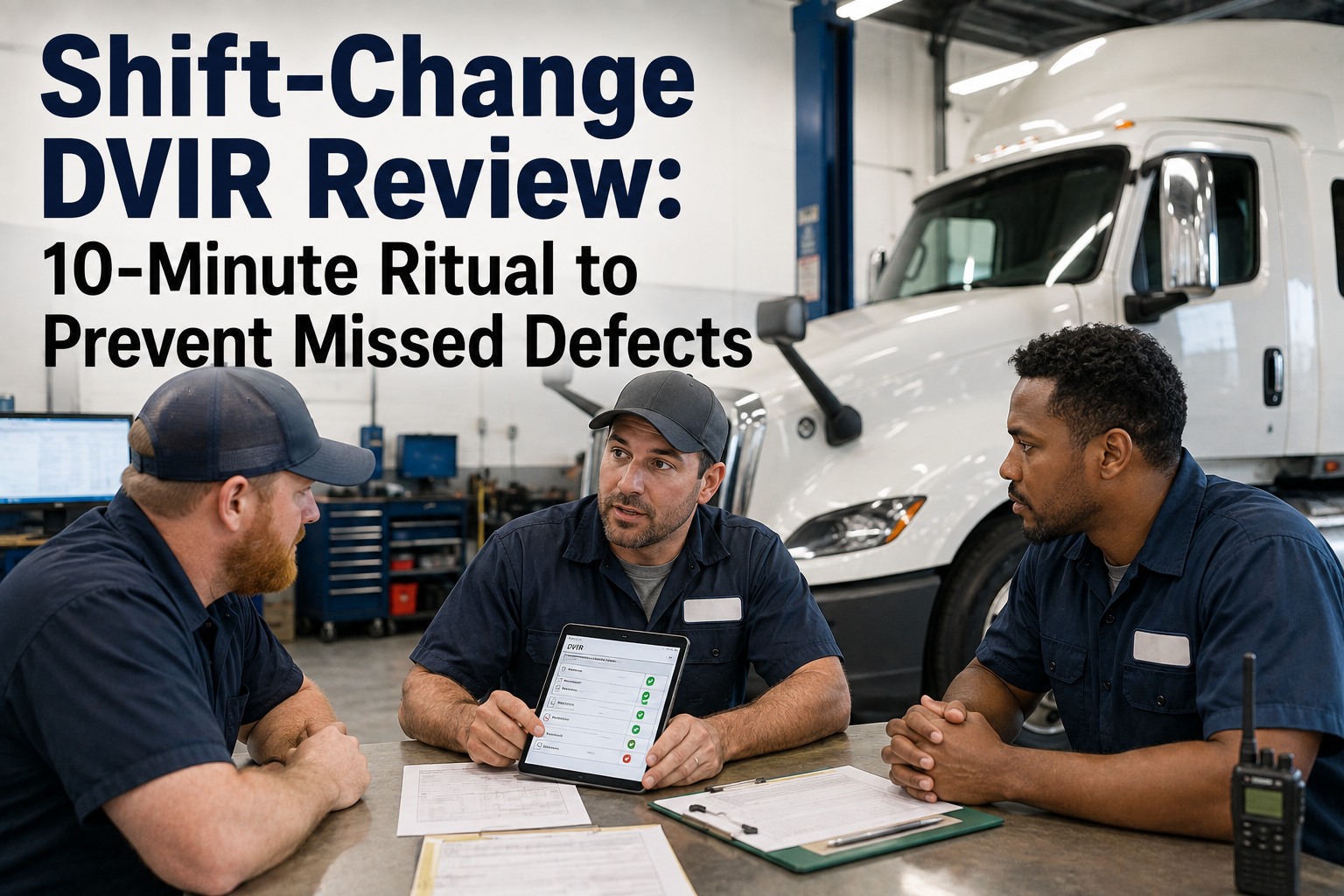
Shift-Change DVIR Review: 10-Minute Ritual to Prevent Missed Defects
The window between shifts is where 60% of missed defects live. A structured 10-minute triangle — inbound, outbound, shop — closes the gap most fleets don't know they have.
The Shift-Change Gap — Why the DVIR Goes Cold
The DVIR is legally complete when Driver A signs, mechanic certifies, Driver B acknowledges. The regulatory chain works. But between the signature and the wheels turning, there's an operational gap most fleets don't measure — and it's where preventable defects escape into service.
The Triangle — Three People, One Truck, One DVIR
The ritual is simple to describe and easy to enforce: three people meet at the truck at shift change, all looking at the same DVIR at the same time. What makes it work is that each role brings a specific angle the other two don't have.
The 10-Minute Timeline — Who Does What, In What Order
The ritual runs the same every day. Ten minutes, five phases, three people. The order matters because each phase depends on information from the previous one.
What the Ritual Prevents vs What a Normal Handoff Misses
The value of the ritual is in the comparison — the same defect, discovered at the same time, going through two different processes. The outcomes diverge sharply.
Run the triangle with the same DVIR on every phone — simultaneously
Real-time DVIR sync across inbound driver, outbound driver, and shop foreman devices. Photo evidence viewable by all three. Work order opens with one tap. §396.13 acknowledgment captured with full context.
The 5 Failure Modes That Kill Shift-Change Rituals
Every fleet that tries this ritual and abandons it fails in one of five predictable ways. Knowing the failure modes in advance is the fastest way to prevent them.
Adapting the Ritual to Your Operation
The 10-minute triangle is the base pattern. Different fleet types need different tweaks — here's how to adapt without breaking the core loop.
Frequently Asked Questions
A structured 10-minute meeting at every shift-change between the inbound driver, outbound driver, and shop foreman — physically at the truck, with the DVIR displayed on all three phones. It closes the operational gap between the FMCSA-required DVIR signatures and the moment the truck actually rolls. The signature chain (§396.11 driver, §396.11(c) mechanic, §396.13 next driver) is legally complete when captured, but the practical understanding of what's wrong, what's been fixed, and what to watch for often doesn't transfer. The ritual makes that transfer explicit: inbound briefs defects in plain language while pointing at the truck, foreman triages fix-now vs defer vs monitor, outbound signs with full context instead of as a checkbox. Fleets report ~40% reductions in defects escaping to the road after adopting it.
Because it turns cheap in-yard repairs into expensive roadside repairs. A defect caught in the yard takes 20-45 minutes and costs $200-400. The same defect caught 50 miles into a route takes 4-6 hours, costs $1,500+ with tow and mobile mechanic fees, delays or loses the load, and can trigger a roadside violation adding CSA points for two years. On a 100-truck fleet with even a 5% shift-change miss rate, that's $80,000-100,000 annually in avoidable emergency spend before CSA and load-loss costs. The gap exists because the FMCSA signature chain doesn't require the three people involved to meet — only that their signatures appear in sequence. The ritual adds the coordination the signatures alone don't produce.
Because triage happens in 60 seconds when the foreman can see the truck and hear the driver's description at the same time — versus 45 minutes of guessing when the same info arrives as a DVIR entry hours later. Hearing "pulls left when I brake from 45+ MPH, worst after 4-5 stops" while standing at the drive axle lets the foreman name the likely cause, decide priority, open the work order, and brief the outbound driver — all in one 3-minute window. Take the foreman out of the ritual and every step becomes a separate handoff with its own delay and translation loss. If the primary foreman genuinely can't attend, an assistant foreman with triage authority should. Try the platform free to see the triangle sync in action.
Yes — about 10 minutes per driver per shift-change plus 10 minutes of foreman time per truck. On a 50-truck fleet with daily shift-changes, that's roughly 8-10 hours of foreman time per week. The offset: fleets adopting the ritual typically report 40% reductions in in-service defect escape, cutting roadside repairs, emergency dispatches, CSA violations, and on-time load failures. The math almost always favors the ritual within the first quarter. The bigger hidden cost isn't the ritual itself — it's the dispatch coordination required to build a 15-minute overlap window into shift schedules so inbound and outbound actually meet. Skip that step and the ritual happens half the time, which is worse than never doing it because it creates false confidence.
Signing a DVIR is a legal acknowledgment — the outbound driver certifies they've reviewed the previous report. The ritual is an operational transfer — the outbound driver develops actual working knowledge of the truck's condition through direct conversation with the inbound driver and shop foreman. A signature can be captured in 5 seconds on a clean DVIR. The ritual takes 10 minutes because it involves conversation, physical inspection, and triage decisions. Both are needed: the signature satisfies the regulation, the ritual satisfies the operation. "Signed and rolled" is not the same as "understood and rolled." The ritual eliminates the gap by requiring three people to look at the same DVIR at the same truck at the same time.
Partially — but a digital DVIR platform makes the ritual dramatically more effective. Three advantages matter: real-time sync so the same DVIR appears on all three phones at once, photo evidence viewable by everyone (the inbound driver's brake chamber photo becomes the foreman's diagnostic input immediately), and one-tap work order creation so the fix is queued before the outbound driver leaves the yard. Paper DVIRs can support the ritual concept, but practical friction usually compresses it from 10 minutes to 3 and kills its effectiveness. The February 2026 FMCSA final rule (Docket FMCSA-2025-0115) explicitly authorized eDVIRs and photo evidence in §396.11 and §396.13 — regulatory direction is toward digital, and the ritual works best on the same infrastructure. Contact our team for a ritual implementation template.
The ritual has to happen every shift-change or it dies. The failure mode is predictable: after two weeks of clean DVIRs, someone suggests skipping "just this once" and within a month the ritual is abandoned. The prevention is treating it as fixed process, not conditional — it runs every shift-change regardless of DVIR content. A clean-DVIR ritual takes 3 minutes instead of 10, but still happens: three people at the truck, quick walk of the DVIR's clean status, outbound signs, keys change hands. This preserves the muscle memory for the days when the DVIR isn't clean — which is when the ritual actually saves the fleet money. Fleets that run it as "when needed" always end up not running it when it's needed, because by the time the value is visible the defect has already escaped.
Turn the 10-minute shift-change window into the fleet's highest-value coordination point
Real-time DVIR sync across all three phones. Photo evidence viewable by everyone. One-tap work order creation from the ritual. §396.13 acknowledgment captured with full operational context. Built for fleets that want defects caught in the yard, not on the road.