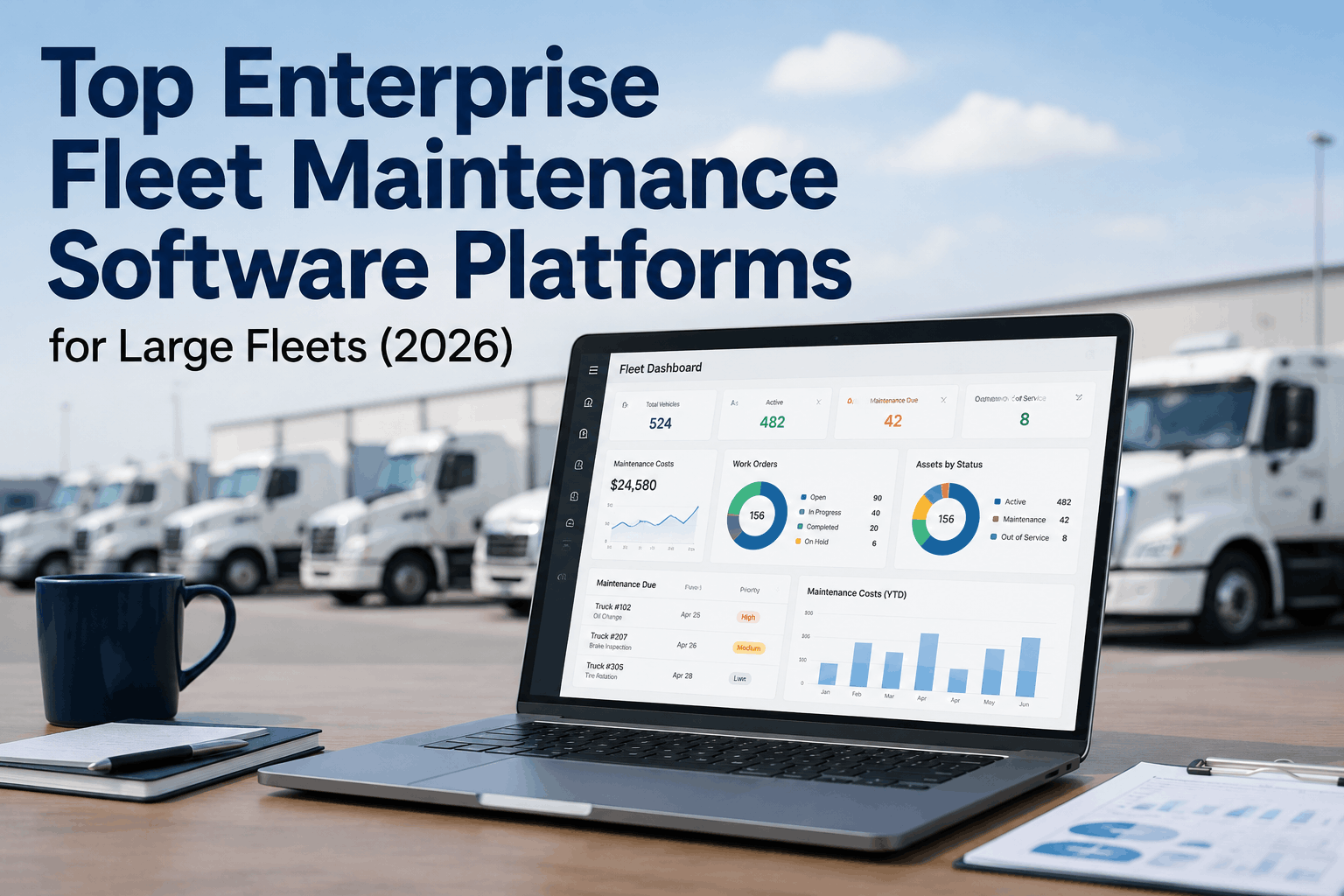
When you're running hundreds or thousands of vehicles across multiple depots, regions, and jurisdictions, a maintenance platform isn't a convenience — it's the difference between a fleet that compounds efficiency and one that quietly bleeds money through downtime, missed compliance, and disconnected data. The enterprise fleet maintenance market is now projected to surpass $30 billion in 2026, growing at a 16.9% CAGR, and with over 300 products on the market the hard part isn't finding software — it's evaluating it against the criteria that actually matter at scale. This guide lays out the five enterprise-grade evaluation pillars, the total-cost-of-ownership math that vendor sticker prices hide, the multi-location and integration requirements large operations can't skip, and how Truck Inspection & Maintenance measures up for fleets that need to scale without scaling their headaches. Talk to our enterprise team for a tailored evaluation.
Top Enterprise Fleet Maintenance Software Platforms
The evaluation framework for fleets measured in hundreds, not dozens.
Why Enterprise Fleets Need Different Software
Large delivery and transportation operations face a maintenance challenge smaller fleets simply don't. At ten vans, a spreadsheet is annoying. At hundreds of vehicles across multiple states, a disconnected system doesn't just slow you down — it actively costs money every single day through gaps you can't even see. Enterprise-grade platforms exist to unify fleet health, work orders, compliance records, parts inventory, and analytics into one scalable system, where "light" maintenance apps lack the depth needed for true cost-per-mile analysis and multi-site control. The question for a fleet executive isn't whether to invest — it's can you afford the cost of not having a system in place.
Built for simplicity
- Basic service record keeping
- Single-location assumptions
- Limited automation & scalability
- Few or no ERP integrations
- Per-user pricing that punishes growth
Built for scale
- Multi-trigger PM automation across thousands of assets
- Multi-location, multi-region, mixed-power fleets
- API maturity — SAP, Oracle, fuel, telematics
- Audit-ready compliance documentation
- Cost-per-mile & lifecycle analytics
The 5 Enterprise Evaluation Pillars
Industry analysts score enterprise fleet platforms on a weighted matrix — and these five pillars are where large fleets win or lose. Use them as your scorecard; a platform strong in three but weak in two will cost you at scale. Start a free account to test these capabilities against your own fleet before committing.
Predictive Accuracy
30%Can it use telematics data to forecast mechanical failure before the breakdown? The single biggest driver of uptime at scale.
API Maturity
25%Seamless data exchange with external ERPs (SAP, Oracle), fuel cards, and telematics. Brittle integrations multiply cost every year.
Technical Scalability
25%Support for mixed-power fleets (ICE, EV, hydrogen) across multi-regional jurisdictions, from hundreds to thousands of assets.
Compliance Depth
20%Audit-ready documentation, ELD/HOS support, and DVIR automation that holds up under DOT scrutiny across every terminal.
The Tie-Breaker: TCO
∑When two platforms score evenly on capability, total cost of ownership decides. And that's where the sticker price lies to you.
The TCO Trap — What Vendor Pricing Hides
Here's the number that sinks enterprise software budgets: most organizations underestimate total cost of ownership by 40–60% because they evaluate on license price alone. For enterprise platforms, software licensing is only 25–35% of total spend. The rest hides in implementation, integration, data migration, training, and ongoing operations. A reliable planning heuristic for mid-market cloud platforms: your 3-year total runs roughly 3x the first-year license cost. Reach our team for a transparent TCO breakdown with no hidden line items.
Illustrative breakdown of enterprise fleet-platform TCO. The license you compare on is the smallest slice — Tier-1 ERP-style deployments can push professional services alone into the millions for complex multi-entity rollouts.
The Non-Negotiables for Multi-Location Fleets
Beyond the scorecard, enterprise operations have hard requirements that disqualify a platform outright if missing. These are the capabilities that separate software built for one shop from software built for a national network. Open a free account to verify each one against your operation.
Centralized multi-site control
One dashboard across every depot, region, and state — with role-based access so each location sees what it needs and HQ sees everything.
Multi-trigger PM scheduling
Schedule by mileage, engine hours, calendar, or real-time condition data. Most competitors support only two trigger types.
Telematics & ERP integration
API connections that feed DTC codes, mileage, and engine hours in — and push maintenance events out to SAP, Oracle, and fuel systems.
Parts inventory with auto-reorder
Cross-location parts visibility and automatic reordering so a stockout at one depot doesn't ground a truck for days.
Cost-per-mile & lifecycle analytics
True per-asset cost tracking and CapEx forecasting — turning maintenance from a cost center into a planning advantage.
Audit-ready compliance
DVIRs, HOS support, and document retention that produce records in minutes across every vehicle under your DOT number.
Enterprise depth without enterprise lock-in
Truck Inspection & Maintenance delivers multi-trigger PM, multi-location dashboards, telematics & ERP integration, and audit-ready compliance — without the per-user pricing that punishes you for adding technicians. Sign up free and run a real pilot on your own assets.
How the Platform Categories Compare
The enterprise market sorts into four broad categories, each optimized for a different priority. Picking the wrong category — not the wrong vendor — is the most expensive mistake an enterprise buyer makes. Here's where each wins and where it leaves gaps.
| Category | Best At | The Gap | Fits |
|---|---|---|---|
| Telematics-first suites | GPS, driver behavior, routing | Maintenance depth bolted on | Logistics prioritizing tracking |
| Legacy FMIS | Deep PM, public-sector audit trails | Region-locked, custom pricing | Transit & municipal fleets |
| Tier-1 ERP modules | Total enterprise integration | $2M–$5M services, slow rollout | Fortune 500 with IT teams |
| Unified fleet CMMS | PM + compliance + analytics in one | Must verify true enterprise scale | Multi-location commercial fleets |
Truck Inspection & Maintenance sits in the unified fleet CMMS category — combining multi-trigger PM, compliance automation, and analytics in one subscription, built to scale across locations without ERP-tier implementation cost.
The Payoff at Enterprise Scale
The business case compounds with fleet size. Every percentage point of downtime reduction multiplies across hundreds of assets, and the same telemetry that prevents breakdowns also strengthens your compliance posture. Here's what enterprise fleets running unified platforms report in 2026.
Frequently Asked Questions
What makes a platform "enterprise-grade" versus a basic fleet app?
Enterprise-grade means depth and scale: multi-trigger PM automation across thousands of assets, multi-location and multi-region control, mature API integrations with ERPs and telematics, audit-ready compliance, and cost-per-mile analytics. Light apps handle service records for a single shop but lack the automation, integration, and scalability large fleets depend on. Start a free account to test enterprise features on your fleet.
How should we evaluate total cost of ownership?
Never on license price alone — it's only 25–35% of true cost. Factor in implementation, integrations, data migration, training, and ongoing operations. A useful heuristic: 3-year TCO runs about 3x first-year license cost for mid-market cloud platforms, and far more for Tier-1 ERP deployments where services alone can hit millions. Always get the full equation in writing. Talk to our team for a transparent breakdown.
Do we have to replace our telematics or ERP to adopt a new platform?
Not with an API-mature platform. Modern fleet CMMS connects to existing telematics and ERP systems via standardized APIs — ingesting DTC codes, mileage, and engine hours, and writing maintenance events back to SAP or Oracle without ripping out hardware or contracts. API maturity is exactly why it's weighted so heavily in enterprise evaluations.
Can one platform handle a mixed ICE, EV, and hydrogen fleet?
The best enterprise platforms are built for it — technical scalability across mixed-power fleets and multi-regional jurisdictions is a core analyst criterion in 2026. As fleets electrify in phases, the maintenance system has to track different powertrains, service intervals, and battery health side by side under one roof. Sign up free to see how mixed-fleet management works.
How long does enterprise implementation take?
It varies enormously by category. Tier-1 ERP-style rollouts can run months and require systems integrators. Unified cloud CMMS platforms deploy far faster — asset lists, PM schedules, and historical work orders migrate during onboarding, often with guided support at no extra cost. The faster the rollout, the sooner the downtime savings start compounding.
Is per-user pricing a problem at enterprise scale?
It can be a hidden tax. Platforms that charge per user effectively penalize you for adding technicians and dispatchers — exactly what growth requires. Look for pricing that scales on assets or a flat enterprise model instead, so expanding your team doesn't inflate your bill. Contact us for pricing that doesn't punish growth.
Score us against any platform on your shortlist.
Truck Inspection & Maintenance brings multi-trigger PM, multi-location control, telematics & ERP integration, and audit-ready compliance into one subscription — enterprise depth without ERP-tier cost. Run a free pilot and put us through the five-pillar scorecard yourself.