The clipboard sits in a dispatcher's tray. The dispatcher hands it to the shop foreman at noon. The foreman creates a work order on Tuesday. Parts get ordered Wednesday. Repair starts Thursday afternoon. Truck returns to service Friday at 4 PM — four days after the defect was identified, when the actual wrench-time was six hours. Every fleet manager has lived this story. The fleets operating at world-class levels — 95%+ PM compliance, sub-2% unplanned downtime, MTTR under 4 hours — don't have better technicians or fancier shops. They have a structured fleet work order management system that automates every handoff paper systems lose. A fleet work order management system is the software platform that handles a maintenance request from the moment a defect is identified through final repair certification and audit-ready close-out. Industry data from 2026 deployments shows 40% reduction in repair cycle time, 15-25% improvement in technician productivity within 90 days, and defect-to-repair compression from 2.5 days down to under 4 hours. Truck Inspection & Maintenance is the integrated work order platform — DVIR defects auto-create work orders, parts auto-deduct from inventory, technicians work from mobile devices, and repair certification closes the FMCSA 49 CFR 396.11(a)(3) compliance loop. This guide walks through exactly what a work order system is, what makes a good one, and how to evaluate any platform. Talk to our team for a work order walkthrough.
What Is a Fleet Work Order Management System?
Defect to repair to close-out — automated. Truck Inspection & Maintenance handles every handoff.
The Work Order Definition — What It Actually Is
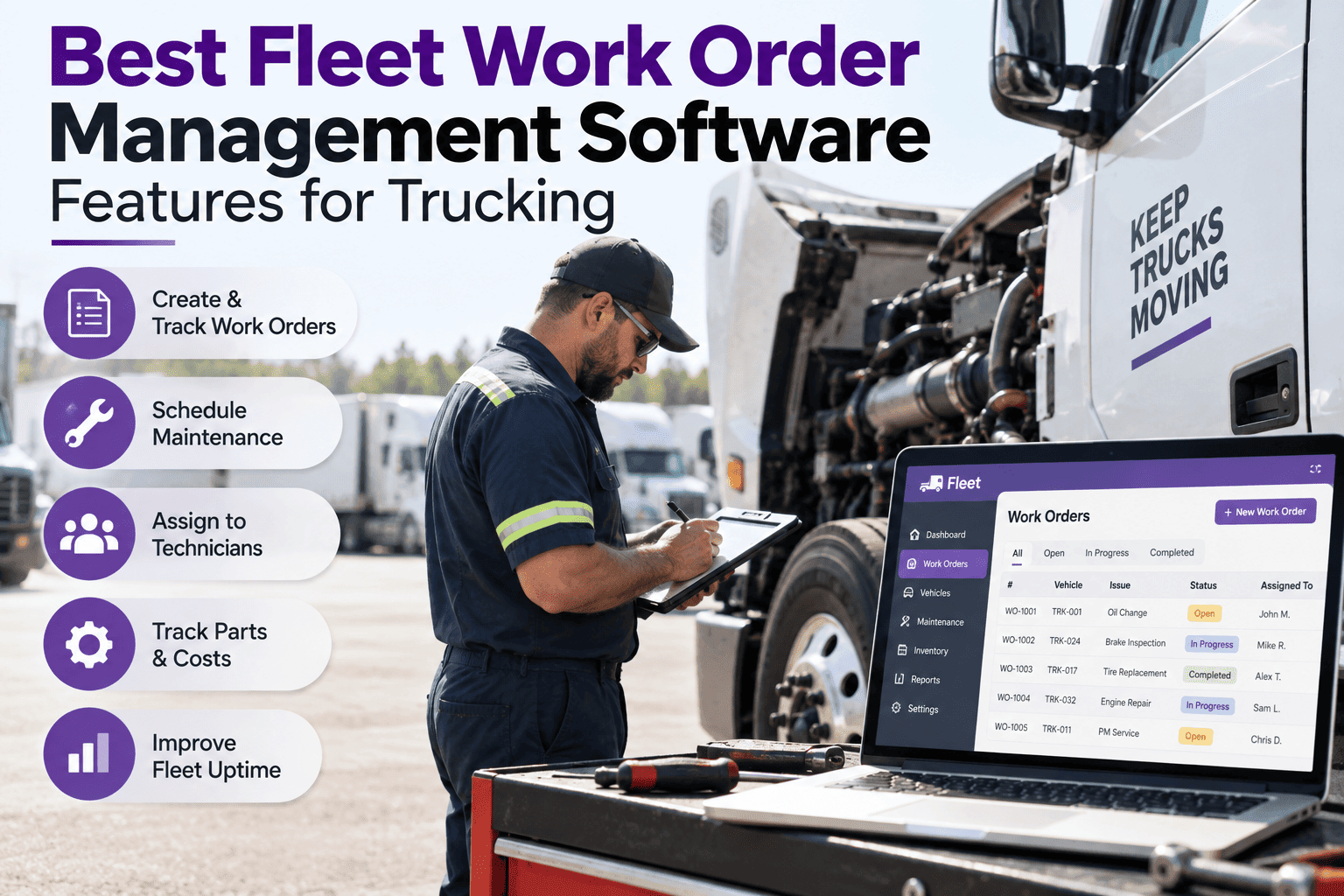
A fleet work order is the structured digital record that tracks every maintenance event from request through completion. A work order management system is the software that creates, routes, executes, and closes those records — replacing paper, spreadsheets, and disconnected tools. Truck Inspection & Maintenance handles all four functions in one platform:
The 5-Stage Work Order Workflow
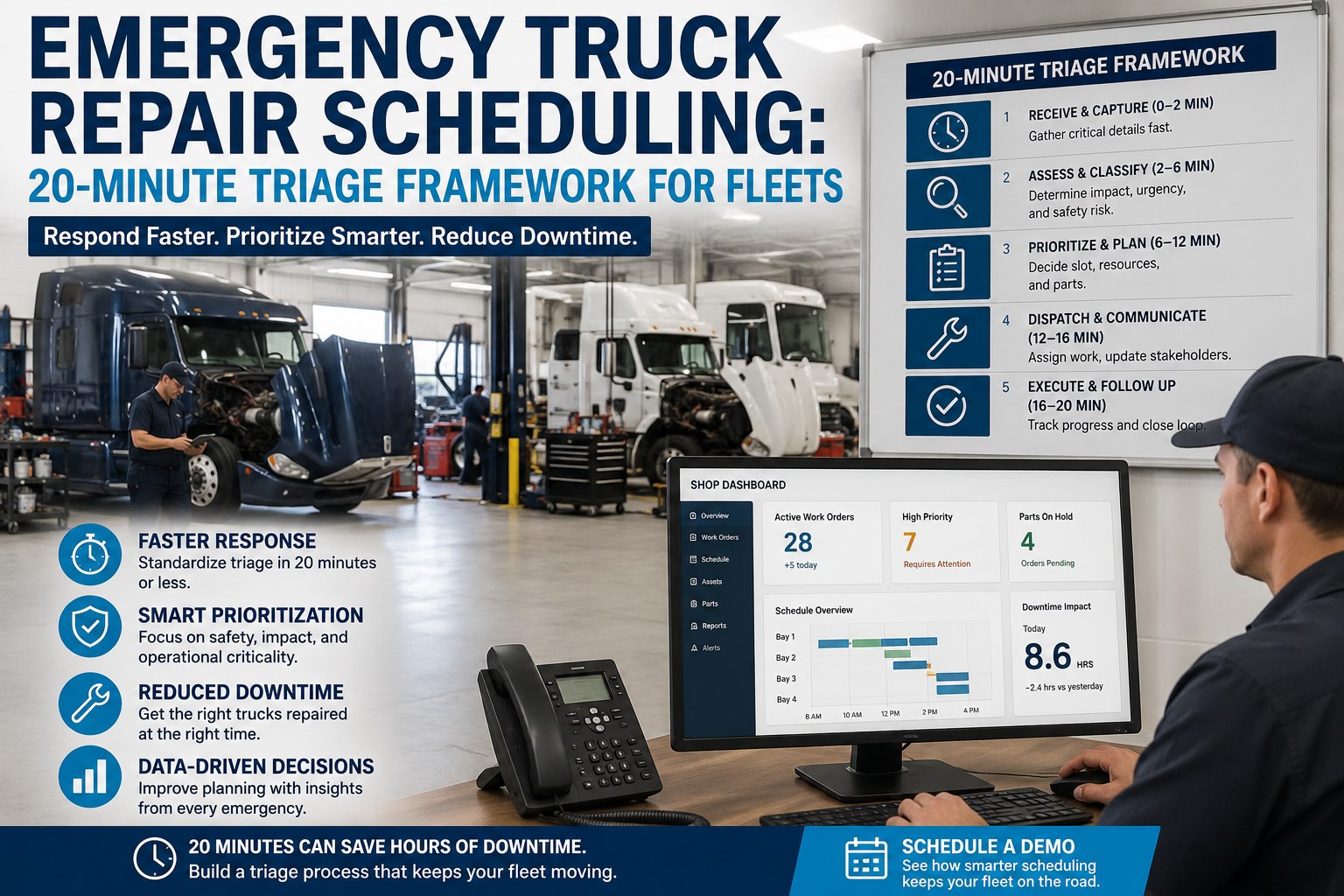
Every work order moves through five stages — and every fleet has friction points at each stage. Truck Inspection & Maintenance eliminates the friction by automating the handoffs:
Request Capture
Source identified. Driver DVIR defect, PM trigger, telematics fault code, or manual request. Captured in mobile or desktop — never on paper. Our platform consolidates all sources into one queue.
Triage & Approval
Severity classification. Critical (vehicle grounded immediately), scheduled (next PM window), monitor (next service). Approval routing based on cost thresholds. Truck Inspection & Maintenance handles this in seconds, not days.
Parts & Technician Staging
Resources allocated. Parts pulled from inventory or auto-ordered. Technician assigned by skill match and shop availability. Repair window scheduled. Pre-staging eliminates "waiting for parts" delays.
Wrench-Time Execution
The repair happens. Technician opens work order on tablet — sees defect photos, root cause, parts list, torque specs. World-class fleets target MTTR under 4 hours. Time captured per work order automatically.
Close-Out & Audit Trail
Loop closes. Repair certified on original DVIR (49 CFR 396.11(a)(3) compliance). Inventory deducted. Vehicle history updated. Cost data flows to dashboards. Audit trail intact for FMCSA review.
What Triggers a Work Order
A modern work order system pulls from multiple sources. Truck Inspection & Maintenance ingests all five — manual ticketing alone is a 2015 workflow:
The 8 Essential Features of a Work Order System
Not every "work order app" is a work order management system. The features below are what separate basic ticketing from real fleet maintenance management. Truck Inspection & Maintenance delivers all eight:
Auto-Creation from Multiple Sources
DVIR, PM, telematics, manual, roadside — all flow into one queue. No re-entry, no lost requests. Severity classification fires automatically.
Smart Technician Assignment
Routes by skill, workload, location, parts availability. Brake job to brake-certified tech. Diesel work to diesel-trained tech. Not just first-available.
Parts Inventory Integration
Parts auto-deduct from inventory when technician scans usage. Stock alerts fire when below minimum. PO auto-generation for critical items.
Mobile Technician App
Tech works from tablet or phone. Sees defect photos, parts list, repair procedures, torque specs. Logs hours and photos directly. No paperwork.
Labor & Cost Capture
Clock in/out per work order. Loaded labor rate auto-applied. Parts costs pull from supplier invoices. Total cost calculates at close.
Photo Documentation
Before/during/after photos attach to every work order. Visual evidence for warranty claims, insurance documentation, and customer disputes.
Compliance Auto-Logging
Repair certification flows back to the original DVIR — closing the 49 CFR 396.11(a)(3) loop. One action satisfies two regulatory requirements.
Vehicle History Integration
Every work order joins the vehicle file. Searchable by date, technician, component, cost. Critical for resale value and replacement decisions.
The Planned-vs-Reactive Work Order Split
Every work order is either planned (PM, inspection-generated, scheduled repair) or reactive (breakdown, roadside, emergency). The ratio tells you the financial maturity of your maintenance program. Truck Inspection & Maintenance categorizes automatically:
The Profitable Category
The Cost-Multiplier Category
Stop running work orders on paper, email, and tribal knowledge
Truck Inspection & Maintenance is the integrated work order platform — DVIR-triggered creation, smart technician assignment, parts inventory integration, mobile tech app, compliance auto-logging. Sign up free on your first 3 vehicles in 10 minutes.
What Data a Work Order Captures
A work order is more than a repair ticket — it's the data record that feeds every fleet KPI. Truck Inspection & Maintenance captures every dimension automatically:
VIN, vehicle ID, mileage, engine hours, current location, vehicle type, year/make/model
Description, severity, component category, photos, source (DVIR/PM/telematics)
Technician assigned, clock in/out times, loaded labor rate, wrench-time, total hours
Items used, quantities, supplier costs, in-house vs outside, warranty status
Vendor name, scope, cost, invoice number, warranty terms, completion date
Driver pre-trip, mechanic repair certification, next-driver acknowledgment
Created, approved, started, completed, closed. Cycle time auto-calculated.
Regulation cited (49 CFR 396.11(a)(3)), retention schedule applied, audit flag
The 6 KPIs Work Orders Generate
The data captured in work orders feeds the fleet KPIs that drive decisions. Truck Inspection & Maintenance calculates all six in real-time dashboards:
The Cost of a Manual Work Order Process
Most fleets underestimate the cost of running work orders manually. The friction at each handoff compounds. Truck Inspection & Maintenance eliminates each cost category:
How to Choose a Fleet Work Order System
Buying decisions for work order software come down to eight evaluation criteria. Truck Inspection & Maintenance is designed around all eight:
Frequently Asked Questions
A CMMS (Computerized Maintenance Management System) is the broader platform that includes work order management as one component, alongside PM scheduling, parts inventory, inspection management, and compliance tracking. A standalone work order app captures repair tickets but doesn't integrate the rest. Truck Inspection & Maintenance is a complete CMMS — work orders, DVIRs, PM, parts, and compliance in one platform. Contact our specialists for the architecture difference walkthrough.
Industry benchmark: under 4 hours for safety-critical defects, under 48 hours for moderate. Manual workflows typically run 2.5 days. The gap is automation: integrated platforms auto-create work orders the moment defects are flagged, while paper-based fleets lose tickets in dispatcher inboxes. Truck Inspection & Maintenance closes the 2.5-day to 4-hour gap by eliminating every manual handoff.
Six sources should all flow into one work order queue: driver DVIR defects, PM schedule triggers (mileage/hours/calendar), telematics fault codes from ECM, manual technician requests, roadside inspection citations, and predictive maintenance alerts. If a platform only supports manual creation, it's not a real work order management system. Truck Inspection & Maintenance ingests all six with auto-severity routing.
When a technician scans parts at the work order, inventory auto-deducts in real time. Stock alerts fire when below minimum thresholds. PO auto-generation kicks in for critical items. End-of-month inventory counts become unnecessary because the system tracks consumption continuously. Truck Inspection & Maintenance includes parts management as a native module, not a bolt-on. Sign up free to see parts integration in action.
Industry benchmark: 65%+ planned spending. Best-in-class fleets achieve 80/20 (80% planned, 20% reactive). The reason this metric matters: reactive repairs cost 3-9x more than planned work due to emergency premiums on labor and parts. Every 10% shift toward planned saves real money. Truck Inspection & Maintenance tracks this ratio automatically and surfaces the trend month-over-month.
49 CFR 396.11(a)(3) requires that when a DVIR identifies a defect, the carrier certifies the repair on the original DVIR before the vehicle returns to service. Manual processes break this linkage routinely — the repair happens, but the certification doesn't flow back to the original record. Truck Inspection & Maintenance auto-logs repair certification on the original DVIR when the work order closes — making compliance structural, not procedural. Talk to our team for a compliance review.
Every work order tracked. Every handoff automated. Every audit defensible.
Truck Inspection & Maintenance is the integrated work order platform — DVIR-triggered creation, smart technician assignment, parts inventory integration, mobile tech app, compliance auto-logging, real-time dashboards. Free for up to 3 vehicles. 40% repair cycle reduction benchmark.