A diesel engine breathes a huge volume of air, and every bit of it has to be clean. Let dust past a leaking filter housing and it sandblasts the turbo and scores the engine from the inside; let a boost hose split and the engine loses power and smokes while the turbo works itself to death. The air intake is a simple system that fails expensively, and almost every failure is a clamp, a seal, or a cracked hose you could have caught. This checklist walks the whole path, air-in to cylinder. Start free and inspect the intake path against its own limits.
Keep Dirt Out · Keep Boost In
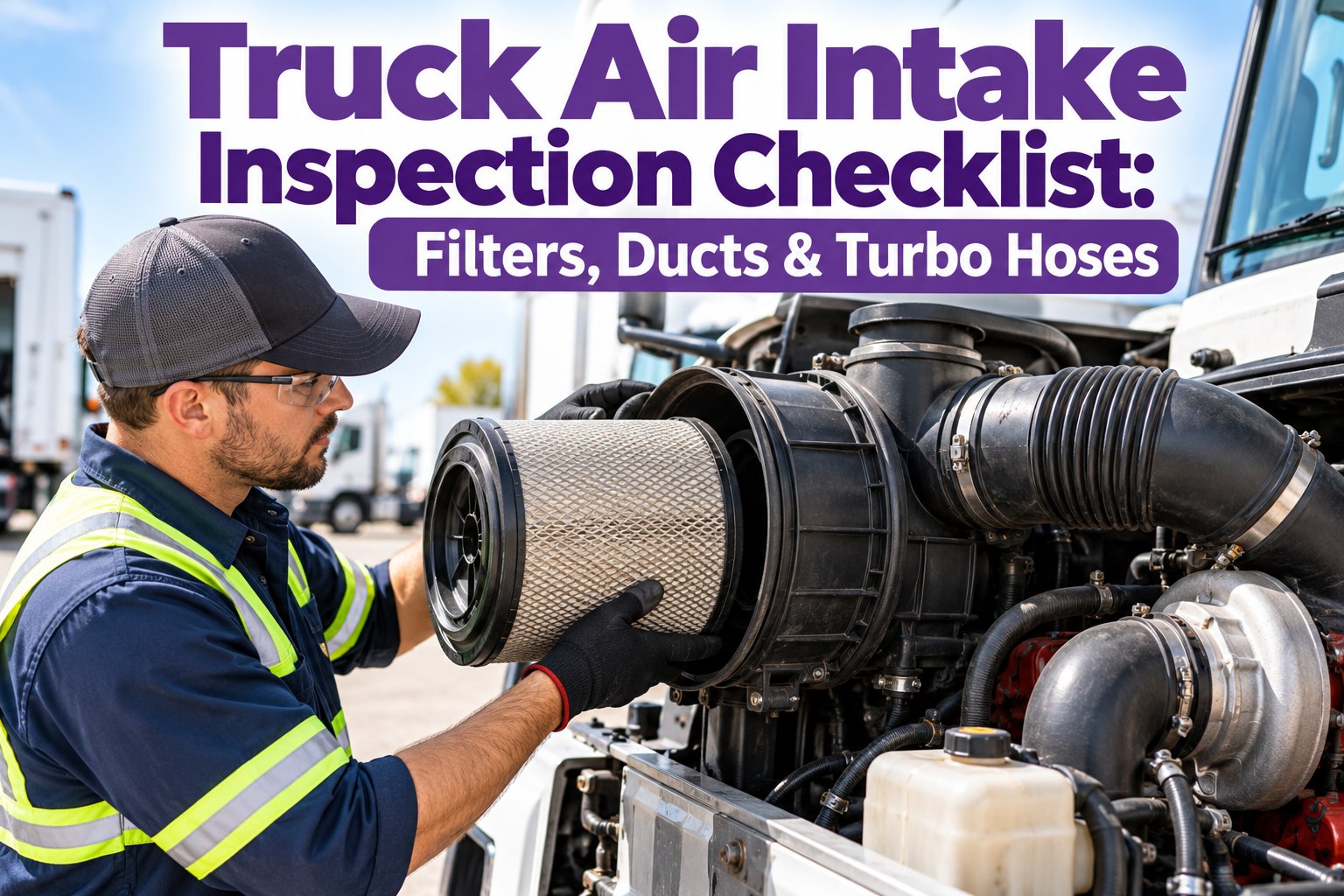
Truck Air Intake Inspection Checklist: Filters, Ducts & Turbo Hoses
The intake has one job — deliver clean air under boost with nothing leaking in or out. Truck Inspection & Maintenance Management Software puts each stage, from pre-cleaner to intake manifold, on the inspection with its own pass/fail check, and turns a tripped restriction gauge or a soot-ringed clamp into a dated work order before dust reaches the turbo.
20–25"water column — typical max filter restriction, under load
Clean sideany dust past the filter means the housing is leaking
2 risksdust wears the turbo; boost leaks sap power and fuel
The Air Path — and the Two Things That Go Wrong
Air travels one route to the cylinder, and only two kinds of failure happen along it: something lets dirt in before the filter can stop it, or something lets boost out after the turbo makes it. Every check below is really asking one of those two questions.
1Pre-cleaner / snorkelFirst line against bulk dust
→
2Air filter & housingRestriction & seal
→
3Ducts & clampsLeak points in & out
→
4Turbo & boost hosesCompressor & charge air
→
5CAC & intake manifoldCooler & final run
INDirt getting in
Before the filter, or past a leaking housing or duct, unfiltered air carries grit straight to the turbo and cylinders. The tell is dust on the clean side of the element — proof the housing sealed badly or a hose after the filter is leaking.
Sands compressor blades, scores the bore and charge air cooler
OUTBoost getting out
After the turbo, a split hose or loose clamp lets pressurized air escape before it reaches the cylinders. The tells are a whistle under boost, soot at the joint, and low manifold pressure versus commanded boost.
Low power, black smoke, higher fuel burn, overworked turbo
Checklist 1 — Filter, Housing & Restriction
Start where the air does. The filter only protects the engine if the housing seals and the restriction is in range — a clean-looking element in a leaking box is worse than useless, because it lets dirt through while looking fine.
Checklist 2 — Ducts, Clamps & Turbo Plumbing
This is where most intake leaks live. Walk every joint from the filter outlet to the intake manifold, feeling hoses as well as looking — a collapsed inner liner or a split bellows can only be found by hand.
Software Built to Run This Checklist for You
Helping with exactly this is the job. Truck Inspection & Maintenance Management Software puts every item above on the tech's device with its own limit attached — restriction in inches of water, the clean-side dust check, the boost-side whistle and MAP shortfall. A reading or finding that fails flags the component, and a failed component opens a dated work order routed to the shop with the detail and a photo on it. The dust leak that quietly kills a turbo and the boost leak that quietly burns fuel both get caught on a schedule instead of at a rebuild.
Trace the Dust — Where the Dirt Got In
If you find dust where it shouldn't be, its location tells you exactly where the leak is. This is the fastest way to turn "there's dirt in the intake" into a specific repair.
Dust on the clean side of the element
→Housing leaked — bad seal, cracked box, or unlatched lid
Dirt only at the compressor inlet, box sealed
→A hose or joint after the filter is leaking — trace that run
Whistle under boost, little smoke, soot at a joint
→Pressurized-side leak after the turbo — split hose or loose clamp
Low power, black smoke, high restriction reading
→Filter restriction starving the compressor — service the filter
Frequently Asked Questions
How do I know when a truck's air filter needs replacing?
Go by restriction, not by looks or by miles alone. A diesel air filter is due when intake restriction reaches its limit — typically around 20–25 inches of water column, measured under load rather than at idle, which is what the restriction gauge or filter minder is reading. A clean-looking element can still be at its limit, and a filthy-looking one can still be in range, so the gauge is the real signal. One caution: snow, ice, or water can trip a minder on a visually clean filter, so check the snorkel and airbox before assuming the element is the problem, and only reset a tripped indicator after you've found the cause.
What are the symptoms of a boost or intake leak?
On the pressurized side, after the turbo, the classic signs are a whistle under boost, a soot ring at the leaking joint, low manifold pressure compared with the boost the engine commanded, and — if fueling stays high — black smoke and lost power. Leaks before the turbo behave differently: they tend to whistle at idle or cruise with little smoke, and the real danger there isn't lost boost but unfiltered dust. Either way the engine is working harder for less, which shows up as reduced power and higher fuel burn well before anything fails outright.
Why is dust on the clean side of the filter such a serious finding?
Because it means unfiltered air is reaching the engine, and intake dust is one of the most destructive things a diesel can ingest. Grit that gets past the filter sands the turbo's compressor blades, scores the cylinder bores, and coats or scores the charge air cooler — wear that doesn't announce itself until compression and power have already fallen. Dust on the clean side of the element proves the housing sealed badly, a hose after the filter is leaking, or the box is cracked. It's worth tracing to its source immediately rather than just wiping it out and refitting the filter.
Contact us to build the clean-side dust check into your intake inspection.
Can I seal a cracked air cleaner housing instead of replacing it?
No — a cracked housing should be replaced, not patched with RTV or tape. The air cleaner housing is a sealed boundary between dirty and clean air, and any repair that doesn't fully restore that seal lets unfiltered dust bypass the filter, which defeats the entire point of the intake system. The same logic applies to the duct work and clamps: the goal is an airtight path from the filter outlet to the intake manifold, so a "good enough" seal on any part of it is the kind of shortcut that ends up costing a turbo or an engine.
Clean · Sealed · In Range
Keep the Dirt Out and the Boost In
Truck Inspection & Maintenance Management Software turns this checklist into a live inspection on your tech's device — every filter, duct, hose, and cooler item carrying its own limit, every failed point opening a tracked work order with a photo. Fleets run it to protect the turbo from dust and the fuel bill from leaks.
No credit card required. Free for up to 3 trucks. Built for FMCSA-compliant fleets.