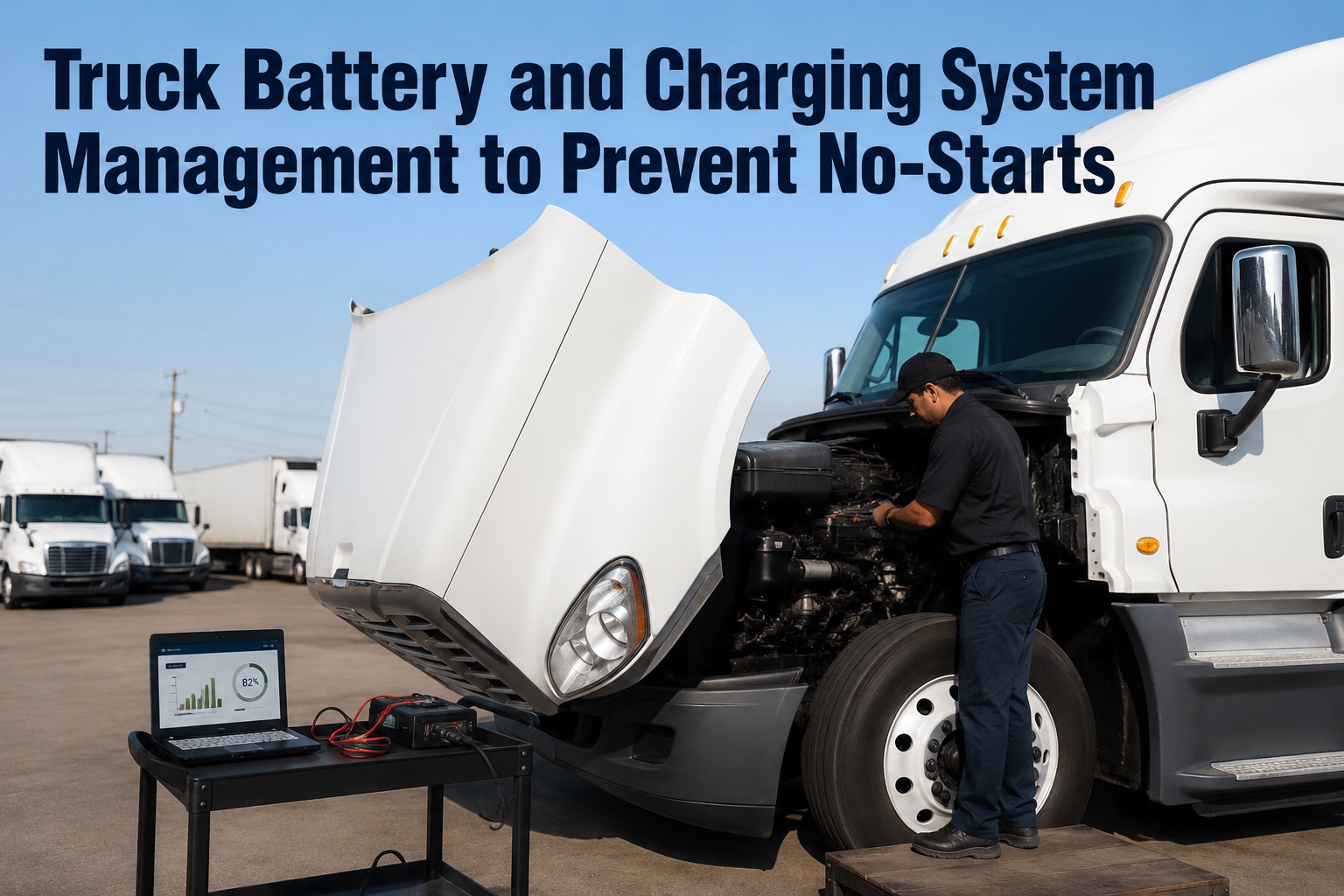
A truck that won't start at 5 AM doesn't just delay a load — it cascades into missed delivery windows, $400-$1,500 in daily downtime cost, jump-start service calls, and a driver standing in a yard with nothing to do. Battery failure is the second most common cause of fleet vehicle no-starts, and what makes it brutal is that a battery losing 15% of its rated CCA capacity is statistically 80% likely to fail within 30 days — yet still cranks the engine normally on a warm morning, giving zero visible warning. Truck Inspection & Maintenance solves this by logging every voltage reading, tracking battery age and replacement history, scheduling charging-system PMs, and flagging the trucks heading for trouble — turning no-starts from emergencies into routine maintenance tasks. Start your free trial and put your fleet on a no-no-start track.
Truck Battery and Charging System Management
The CMMS that catches battery failure 21 days before it strands a load.
The Real Cost of One No-Start — And What Truck Inspection & Maintenance Prevents
The repair bill is the smallest line on the invoice. The damage is in the ripple — every no-start triggers a sequence of costs that the maintenance budget never captures, but the P&L always feels. Our platform tracks every dollar this list represents:
Logged automatically in our service history so repeat offenders surface in dashboards.
One day of missed loads per truck — our downtime tracking quantifies it for ROI reporting.
Driver-status logs feed into platform reports so payroll burn is visible, not buried.
Our PM scheduler converts emergency replacements into planned, low-cost swaps.
The Voltage Rulebook — Now Logged Automatically
A multimeter is the cheapest diagnostic tool in any fleet shop, and most fleets still misread it. Truck Inspection & Maintenance builds these voltage zones directly into the inspection workflow — drivers and technicians enter readings, the platform flags the zone, and trends surface in fleet dashboards. No more guesswork:
The 5 Hidden Killers — And How Our Software Catches Each One
Battery age gets the blame for almost every dead battery. Wrong. Most batteries die years before their rated life because of conditions the fleet never tracks. Truck Inspection & Maintenance is built specifically to track every one of these killers in the daily inspection workflow:
Parasitic Draw from Aftermarket Loads
Liftgates, inverters, dash cams, telematics modules, and bunk loads pull amps with the key off. Repeated deep discharge is what truly kills starting batteries — and most fleets never measure it.
Corroded Cables & Bad Grounds
A green-fuzzed terminal or a rusted frame ground adds voltage drop the alternator fights. The truck keeps starting — until one cold morning, it doesn't.
Short-Run Duty Cycles
Local delivery trucks and yard hostlers rarely run long enough for the alternator to replenish what cranking drained. The bank drifts to chronically undercharged across normal operation.
Heat — The Silent Capacity Thief
Under-hood summer temperatures accelerate grid corrosion and water loss. A flooded battery in a poorly ventilated bay can lose 50% of its rated life in one hot season.
Slipping or Glazed Drive Belts
A belt that looks fine but slips under load means the alternator never spins fast enough for rated output. A chronically half-charged bank shortens life for every battery in the fleet.
Mismatched Bank Replacement
Adding one new battery to a bank of old ones drags it down to the same level within months. Mixed ages and CCA ratings create current imbalances that shorten every battery's life.
The 14-21 Day Predictive Window — Built Into the Platform
Battery failure isn't random — it's a signal that gets louder over weeks. Truck Inspection & Maintenance captures voltage and load-test data at every inspection, then plots the trend across asset history. Here's the warning window our customers actually see in their dashboards:
First Drift
CCA drops 5-10%. Our voltage-trend chart shows the dip; asset moves from green to yellow on the fleet dashboard.
Capacity Loss
CCA drops 15%+. Failure probability hits 80%. Platform auto-creates a "Replace Battery" work order during planned downtime.
Slow Crank
Drivers log "longer cranking" in the pre-trip. Defect routes to maintenance with the full voltage history attached.
No-Start
Where fleets without our platform end up. With Truck Inspection & Maintenance, this day never arrives.
Turn battery failures into PM tasks.
Truck Inspection & Maintenance logs every voltage reading, tracks battery age, schedules charging-system PMs, and flags trucks heading for trouble. Free for up to 3 vehicles. Contact support to plan your rollout.
The Charging System Trinity — All Three Tracked in One Platform
"The battery is dead" is the most common misdiagnosis in fleet maintenance. The charging system is a chain of three components, and a weak link in any one drags the other two down. Truck Inspection & Maintenance tracks all three in a single asset record — so technicians diagnose the system, not the symptom:
Battery Bank
Stores energy, supplies cranking current. Our platform logs rest voltage, load tests, and install dates per battery.
Alternator + Regulator
Generates AC, rectifies to DC, regulates voltage. Software tracks output history so drift over months becomes visible.
Cables + Grounds
Carries current both ways. Our inspection checklists include voltage-drop and ground-strap checks every PM.
Seasonal Charging-System Calendar — Auto-Scheduled by Our Platform
Most fleets test batteries only when one fails. The best fleets run a four-touch annual schedule. Truck Inspection & Maintenance ships with the seasonal cycle pre-configured — every PM hits the shop floor on time without anyone tracking a spreadsheet:
Post-Winter Audit
Platform auto-generates load-test work orders fleet-wide. Terminal inspections, ground straps, and CCA logs feed straight into asset history.
Heat-Damage Check
Inspection template covers ventilation, electrolyte, and alternator-under-load tests. All findings stored against the asset record.
Pre-Winter Readiness
Our most-used inspection template of the year. Load test, voltage drop, parasitic draw, drive belt — one checklist, full audit trail.
Cold-Start Monitoring
Weekly cranking-time and rest-voltage logs feed the dashboard. Marginal units flag automatically before the first hard freeze.
Frequently Asked Questions
How does Truck Inspection & Maintenance track battery health?
Every inspection captures rest voltage, load-test results, install date, CCA rating, and visible defects against the specific battery — not just the truck. Our platform plots the trend, flags marginal units, and auto-generates replacement work orders 14-21 days before predicted failure. No spreadsheets, no missed cycles.
What voltage means my battery needs replacement?
Rest voltage below 12.4V combined with a load test showing under 80% of rated CCA means replacement. Our system applies this rule automatically — when a technician logs the readings, the asset gets the right color code and the right next-step. Sign up free to log voltage and load-test history across your entire fleet.
Can a bad alternator look like a bad battery?
Yes — and this is the most common misdiagnosis in fleet shops. A weak alternator slowly undercharges the battery, which then fails on a cold morning. Truck Inspection & Maintenance separates alternator output, battery voltage, and connection health into three tracked components per asset, so technicians see exactly which link in the chain is the problem.
How long should a properly maintained truck battery last?
Good charging practices can extend battery life from roughly 2 years to 4 or more. The difference is almost entirely about avoiding repeated deep discharge, maintaining clean connections, and matching battery capacity to actual electrical load. Our platform's PM scheduler and asset history make all three doable for fleets of any size.
How does the platform handle parasitic draw testing?
We ship a parasitic-draw inspection template as a standard PM. Technicians measure with an ammeter on the negative cable, log the reading, and the platform flags anything above 50 mA. Repeat-offender assets surface in the dashboard so the underlying aftermarket loads can be diagnosed before they kill another battery.
Why use Truck Inspection & Maintenance instead of a spreadsheet?
Battery management is exactly the kind of repeating, predictable, scheduling-heavy task software handles better than spreadsheets. Install dates, CCA history, voltage trends, replacement cycles, and seasonal PMs across 10+ vehicles fall apart in Excel. Talk to our team about putting your charging-system data on autopilot.
Catch battery failure 21 days before it strands a load.
Truck Inspection & Maintenance logs voltage, CCA, alternator output, and connection health on every PM — and flags the trucks heading for trouble. Free for up to 3 vehicles. No hardware. No contracts.