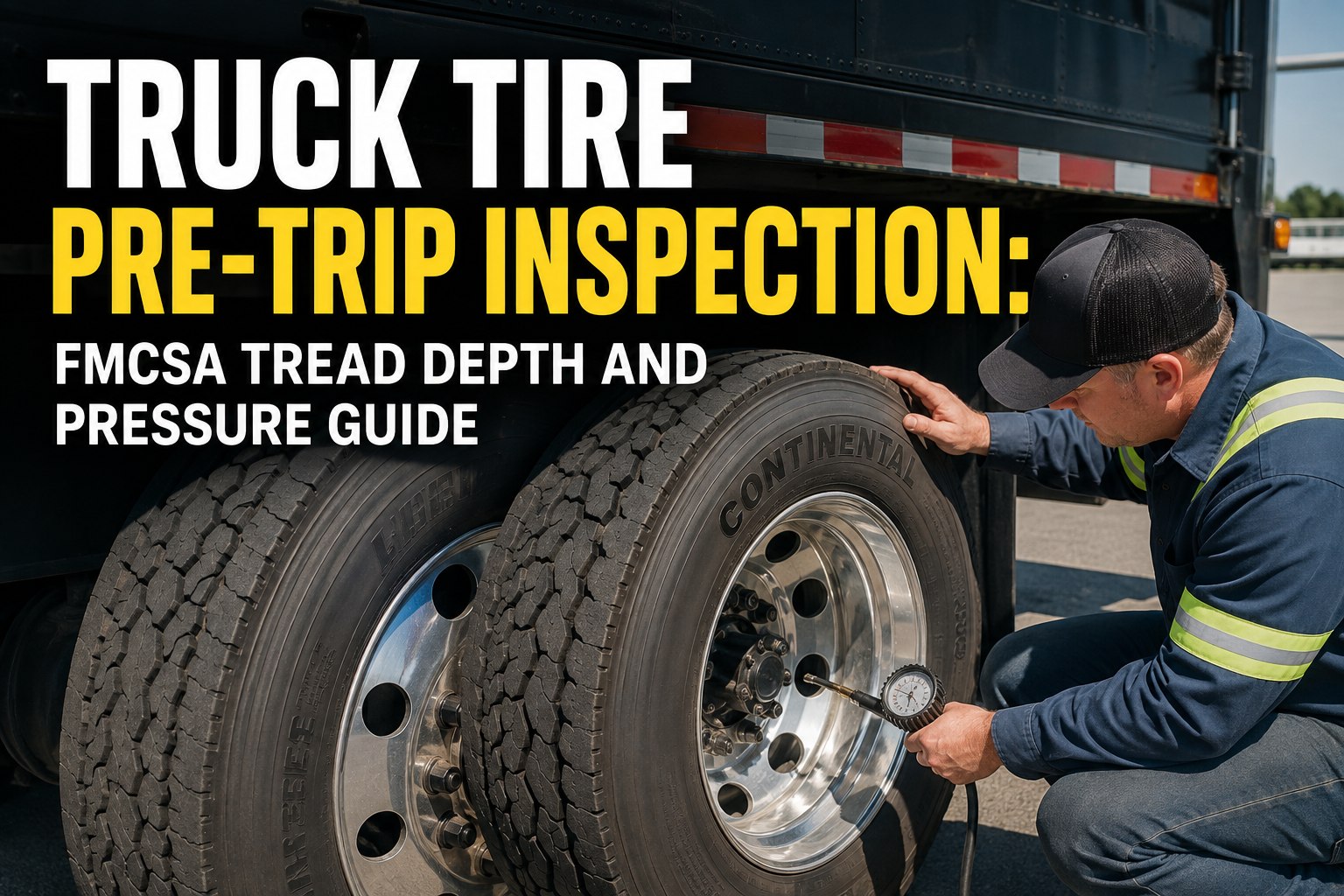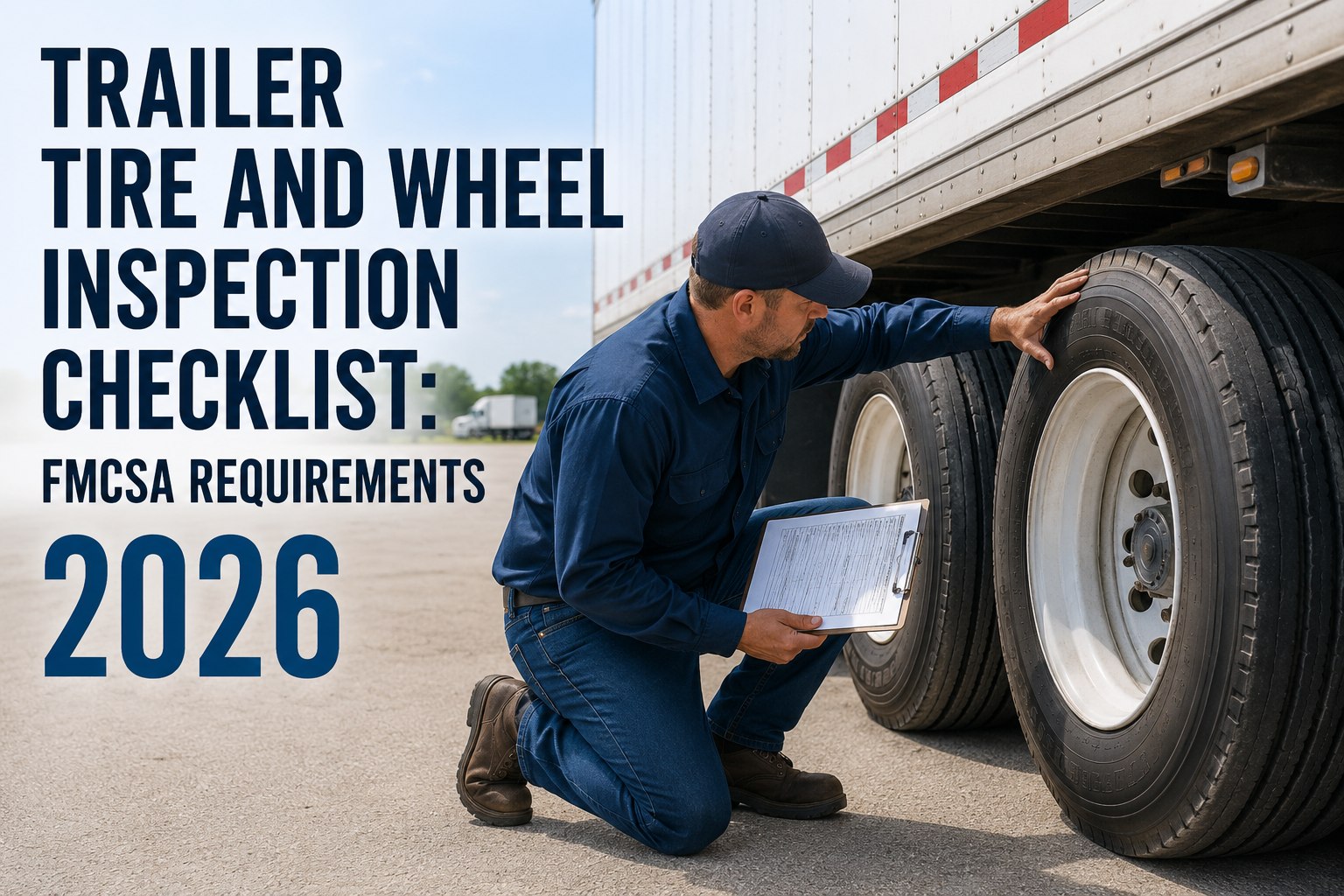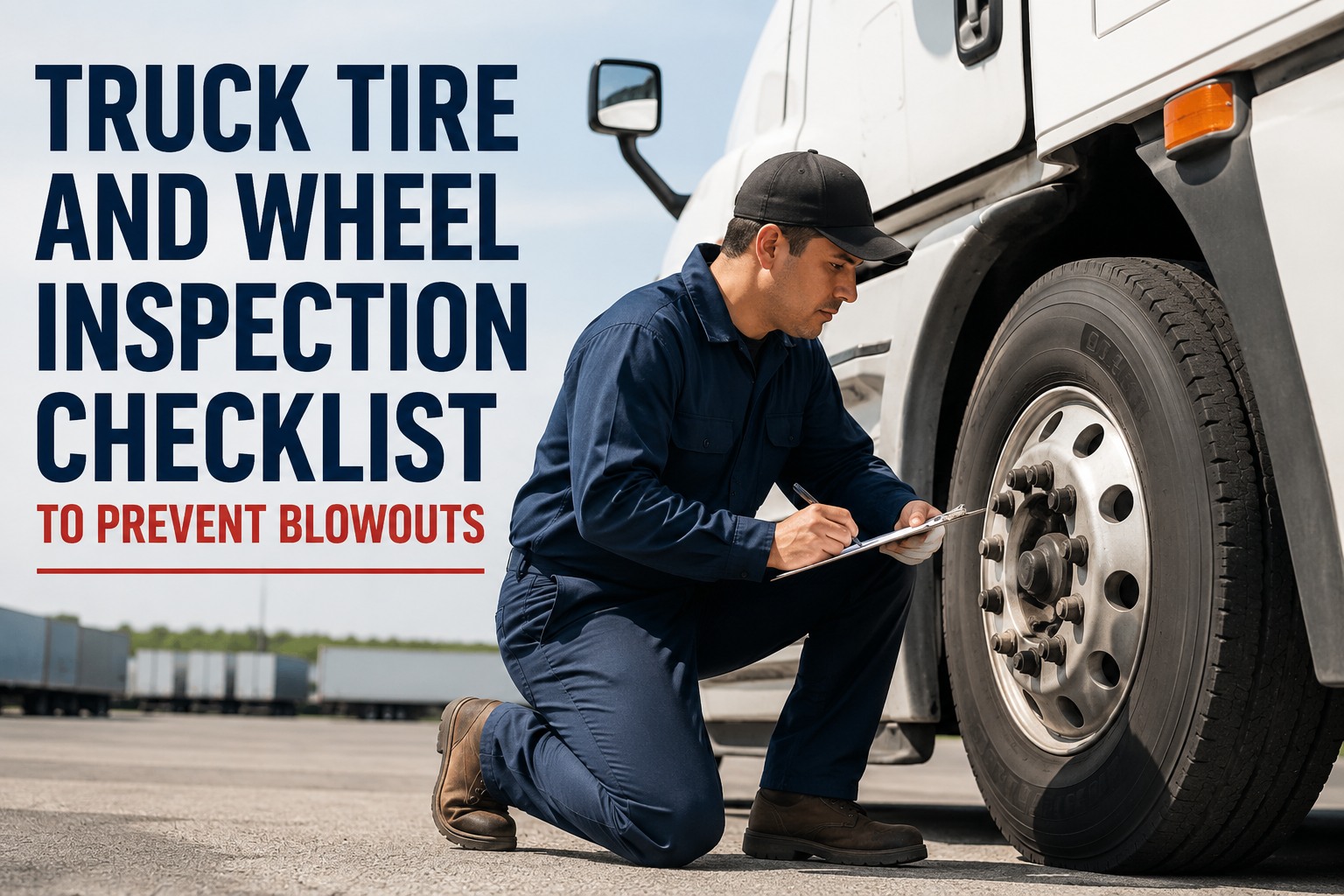
A steer tire sitting at 3/32 inch of tread looks perfectly fine. It has visible grooves, it holds air, and nothing about it says "grounded." It's also already illegal — because federal law holds steer axles to 4/32 inch while every other position on the truck can legally run down to 2/32. That gap between what a tire looks like and what a gauge says is the single biggest reason tire violations get written, and it's why visual estimation isn't a tire inspection. Tires remain one of the leading causes of out-of-service orders, and most of the failures trace back to two things: a measurement nobody actually took, and inflation nobody checked cold. This guide covers the position-dependent tread minimums, the two-tier threshold most fleets don't realize exists, the conditions that ground a truck regardless of tread, and how truck maintenance software turns tire readings into a trend you can act on before a tire reaches its limit.
Fleet Safety Guide · Truck Tire Inspection · 2026
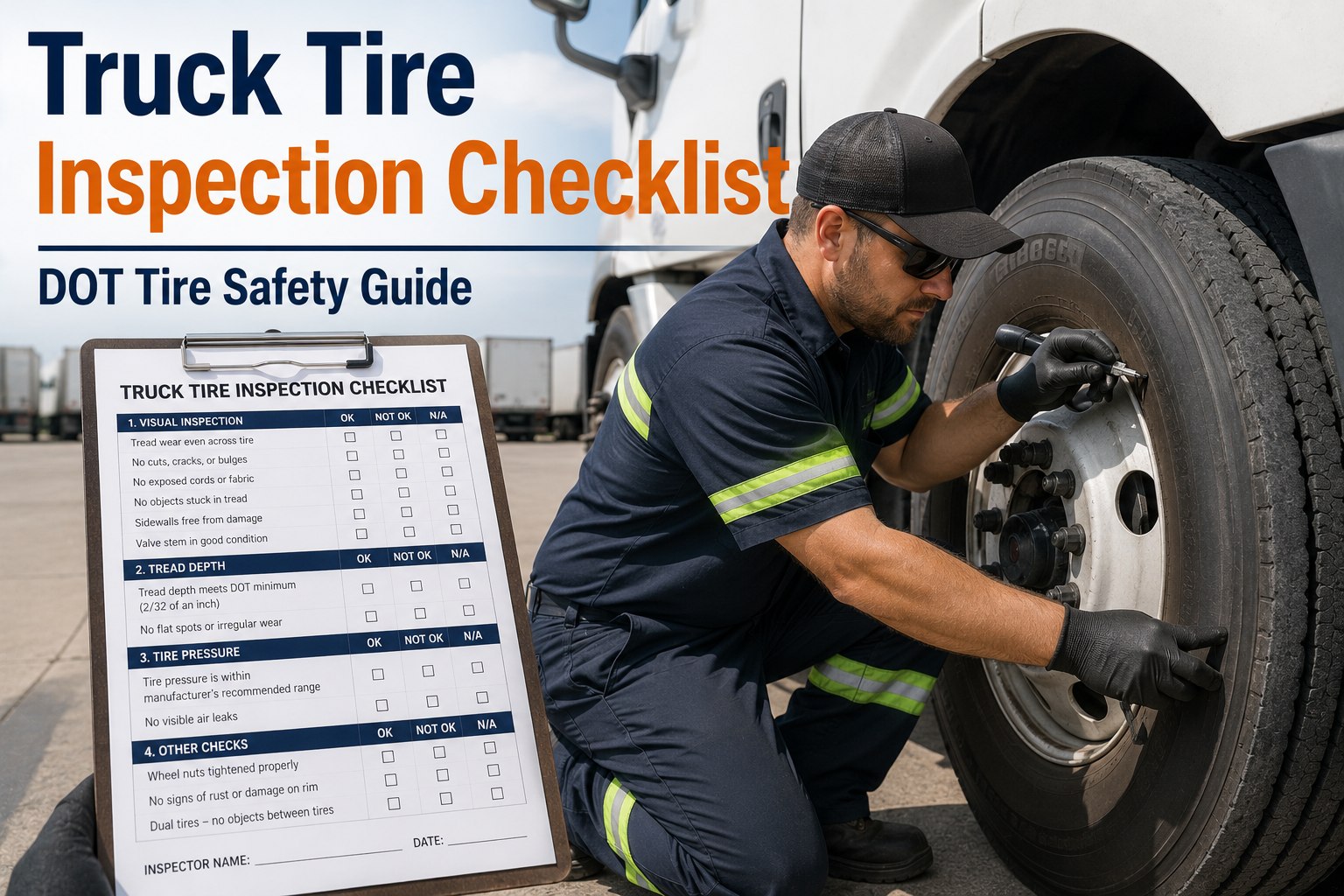
Truck Tire Inspection Checklist
The tread minimums that change by axle position, the out-of-service conditions that ignore tread entirely, and the inflation discipline behind both.
4/32"
Minimum tread depth on any steering axle
2/32"
Minimum on drive, tag and trailer positions
50%
Below half max pressure is automatic OOS
Lowest
The shallowest reading on the tire governs
Position Determines the Limit
This is the rule that catches people. Under 49 CFR 393.75, the legal minimum tread depth depends entirely on where the tire sits — and a depth that's perfectly legal on a trailer is a violation on the front axle:
4/32 inch
Front axles of trucks, truck tractors, and buses carry the highest standard, because a steer tire failure means a loss of directional control rather than an inconvenience.
2/32 inch
Drive, tag, and trailer positions may legally run to half the steer minimum — though running tires that low is a false economy that invites failures and citations.
Why this trips people up: a tire at 3/32 inch has plenty of visible tread and would pass any casual glance. On a trailer it's legal. Move that same tire to a steer position and it's an immediate violation. Position-specific measurement isn't a technicality — it's the whole compliance question, and it's why every tire needs its own gauged reading rather than a walk-past.
The Two-Tier Threshold Most Fleets Miss
There isn't one tread standard — there are two, and they do different jobs. Knowing where each sits is what keeps a truck from being technically legal and still citable:
Replace here: 5/32" steer, 3/32" drive & trailer
Pulling tires above both legal floors keeps you clear of citations entirely and avoids operating anywhere near an out-of-service threshold.
Legal floor: 4/32" steer, 2/32" all others
The federal operating standard under 393.75. Fall below this and you're in violation — the vehicle is non-compliant even if it isn't grounded on the spot.
Grounded: 2/32" steer, 1/32" all others
The stricter roadside threshold. Reach it and the vehicle cannot move until the tire is replaced — on site or after a tow.
The gap between the tiers is a citation zone: a steer tire between 2/32 and 4/32 inch is below the federal minimum but not yet at the out-of-service line — legal to move, but a written violation on your record. That's the band fleets accidentally live in when they replace based on appearance rather than measurement.
How to Measure Correctly
A tread reading is only as good as where you take it. Three rules govern a valid measurement:
Measure in a major tread groove
Take the reading in a principal groove — never on a tie bar, wear hump, or fillet, which sit higher and produce falsely passing numbers.
The shallowest reading governs
Check multiple points across the tread face. The lowest depth anywhere on the tire determines compliance, not the average and certainly not the best spot.
Use a gauge, not your eyes
Visual estimation is the top reason violations get missed. A proper tread depth gauge gives an exact number that can be recorded and trended.
Out of service regardless of tread depth
A tire can have plenty of tread and still ground the truck. These conditions are immediate out-of-service violations on their own — and the tire that ends a run is often the one with good tread and a sidewall problem nobody logged.
Exposed ply or belt
Any body ply or belt material showing through the tread or the sidewall.
Tread or sidewall separation
Any separation of the tread or sidewall from the tire's structure.
Flat or audible leak
A flat tire, or any leak you can hear at the tire or valve.
Cuts exposing cord
Cuts deep enough to expose the ply or belt material beneath.
Bulges & blisters
Any sidewall bulge or blister, indicating internal structural failure.
Under 50% inflation
A tire running below half its maximum marked pressure is automatically out of service.
Any sidewall leak
A sidewall leak grounds the tire regardless of any automatic inflation system fitted.
"Not for Highway Use"
Tires marked for off-highway use only, or run beyond their speed rating.
Inflation: The Root Cause Behind Most Failures
Under-inflation is the quiet driver of blowouts, irregular wear, and fuel waste. It's also the easiest thing on this page to get right — and the easiest to fake:
Check cold, always
Take readings before the truck moves, or after it's been parked three or more hours. A hot tire reads high and hides an under-inflated tire.
Use the placard, not the sidewall
The sidewall number is the tire's maximum, not your target. Set pressure to the vehicle placard specification for the load and position.
A thumper is not a gauge
Thumping tells you a tire isn't flat. It cannot detect the 15-20 psi shortfall that's quietly destroying tread life. Use a calibrated gauge on every tire.
Watch the temperature
Pressure falls roughly 1-2 psi for every 10°F drop in ambient temperature, which makes cold-weather checks a maintenance requirement, not a nicety.
What under-inflation actually costs: a tire running 20% under-inflated loses roughly 10% of its tread life and raises rolling resistance enough to measurably hurt fuel economy. Since tires and fuel are two of the largest variable costs in the fleet, ignoring a 10 psi drop across a set of tires is a recurring expense, not a minor oversight.
Free · Up to 3 Vehicles
Trend tread depth before it becomes a violation
Truck maintenance software records tread depth and pressure as real numbers per wheel position, so wear becomes a trend line instead of a guess — and a steer tire approaching its limit surfaces as a scheduled replacement rather than a roadside surprise. Every reading is timestamped against the vehicle with full inspection history. Sign up free for up to 3 vehicles and put measurements behind your tire program.
Reading the Wear Pattern
How a tire wears tells you what's wrong elsewhere on the vehicle. Treat an irregular pattern as a diagnostic result, not just a tire problem:
Over-inflation
Excess pressure crowns the tread so the middle carries the load and wears first. Reduce to the placard specification.
Under-inflation
Low pressure flattens the footprint onto both edges. The most common pattern, and the one that costs the most tread life.
Alignment
Wear concentrated on a single shoulder points to alignment or axle issues. Schedule an alignment check rather than just replacing the tire.
Retread & Regroove Restrictions
Where a tire has been rebuilt matters as much as its condition. These position rules are absolute, and getting one wrong is an instant violation:
Bus front wheels
Retreaded, recapped, and regrooved tires are all prohibited on the front steering wheels of buses — no exceptions on the position that steers a load of passengers.
Truck steer positions
Regrooved tires rated at 4,920 pounds or more of load capacity are barred from the steering axle of trucks and truck tractors.
Drive & trailer positions
Retreads are widely used and legal on non-steer positions, subject to load rating requirements — which is why retreading remains a mainstream fleet economy.
The Full Inspection Checklist
A complete tire inspection goes well beyond tread and pressure. Work every position, including the ones you can't see from a walk-past:
Tread & depth
Gauged depth at multiple points, in major grooves
Position-correct minimum applied to each tire
Irregular or uneven wear patterns noted
Nails, screws, and embedded objects removed
Sidewalls & casing
Both sidewalls checked — inner and outer
Cuts, snags, bulges, blisters, and weathering
No exposed cord, ply, or belt material
Heat indicators: discoloration or hot spots
Inflation & duals
Cold pressure gauged on every tire
Dual pairs matched in pressure and diameter
Inner dual inspected — the most-missed defect
Valve stems, caps, and extensions secure
Wheels & fasteners
Rims free of cracks, bends, and damage
Lug nuts tight; no rust streaks or shiny threads
No missing or mismatched fasteners
No signs of hub or seal leakage
Build a cadence, not a habit: a driver visual check on every pre-trip, a cold pressure check with a calibrated gauge weekly, gauged tread depth and a full sidewall inspection at every PM service, and a comprehensive documented inspection annually. Keep the paperwork too — driver inspection reports are retained for three months and annual inspection reports for fourteen.
Frequently Asked Questions
What is the minimum legal tread depth?
Under 49 CFR 393.75 it depends on position: steer tires on trucks, truck tractors, and buses need at least 4/32 inch, while drive, tag, and trailer tires need at least 2/32 inch. Measurements are taken in a major tread groove, and the shallowest reading anywhere on the tire determines compliance. CVSA out-of-service thresholds are lower still — 2/32 inch on steers and 1/32 inch elsewhere.
Why are there two different tread standards?
They serve different purposes. The DOT minimums under 393.75 define the legal operating standard — fall below and you're in violation. The CVSA out-of-service thresholds are the stricter roadside line at which a vehicle is physically grounded and cannot move. A steer tire between 2/32 and 4/32 inch is citable but not yet out of service, which is why best practice is replacing at 5/32 inch steer and 3/32 inch elsewhere. Contact our team about tracking tread across your fleet.
What tire conditions cause immediate out-of-service?
Several, regardless of tread depth: body ply or belt material exposed through the tread or sidewall, tread or sidewall separation, a flat tire or audible air leak, cuts exposing ply or belt, sidewall bulges or blisters, any sidewall leak, inflation below 50% of the tire's maximum marked pressure, and tires labeled "Not for Highway Use" or run beyond their speed rating. A tire with excellent tread can fail on any one of these.
How often should tire pressure be checked?
At minimum during every pre-trip inspection, with a proper gauged cold-pressure check weekly. Readings must be taken cold — before the truck moves or after three-plus hours parked — because a hot tire reads high and masks under-inflation. Compare against the vehicle placard specification rather than the sidewall maximum, and remember pressure drops roughly 1-2 psi for every 10°F fall in ambient temperature.
Can I run retreaded tires on a commercial vehicle?
On most positions, yes — retreads are legal and widely used on drive and trailer axles subject to load rating requirements. But they're prohibited on the front steering wheels of buses, along with recapped and regrooved tires. Regrooved tires rated at 4,920 pounds or more of load capacity are also barred from the steer position of trucks and truck tractors. Position determines legality, so verify before fitting.
What does the wear pattern tell me?
It's a diagnostic. Wear concentrated in the center of the tread indicates over-inflation; wear on both shoulders indicates under-inflation; and wear on one side alone points to an alignment or axle problem that will destroy the replacement tire too. Treating an irregular pattern as a symptom rather than just a worn tire is what stops the same failure repeating. Sign up free to log wear patterns and schedule the follow-up work.
Measured, Not Estimated
Catch the tire before the gauge at roadside does.
Truck maintenance software captures tread depth and cold pressure per wheel position on every inspection, trends the wear so replacements get scheduled instead of discovered, and keeps the documented history that satisfies DOT recordkeeping. The tire that would have grounded a load becomes a planned job in your own shop. Free for up to 3 vehicles. Works with your existing fleet, no contracts.