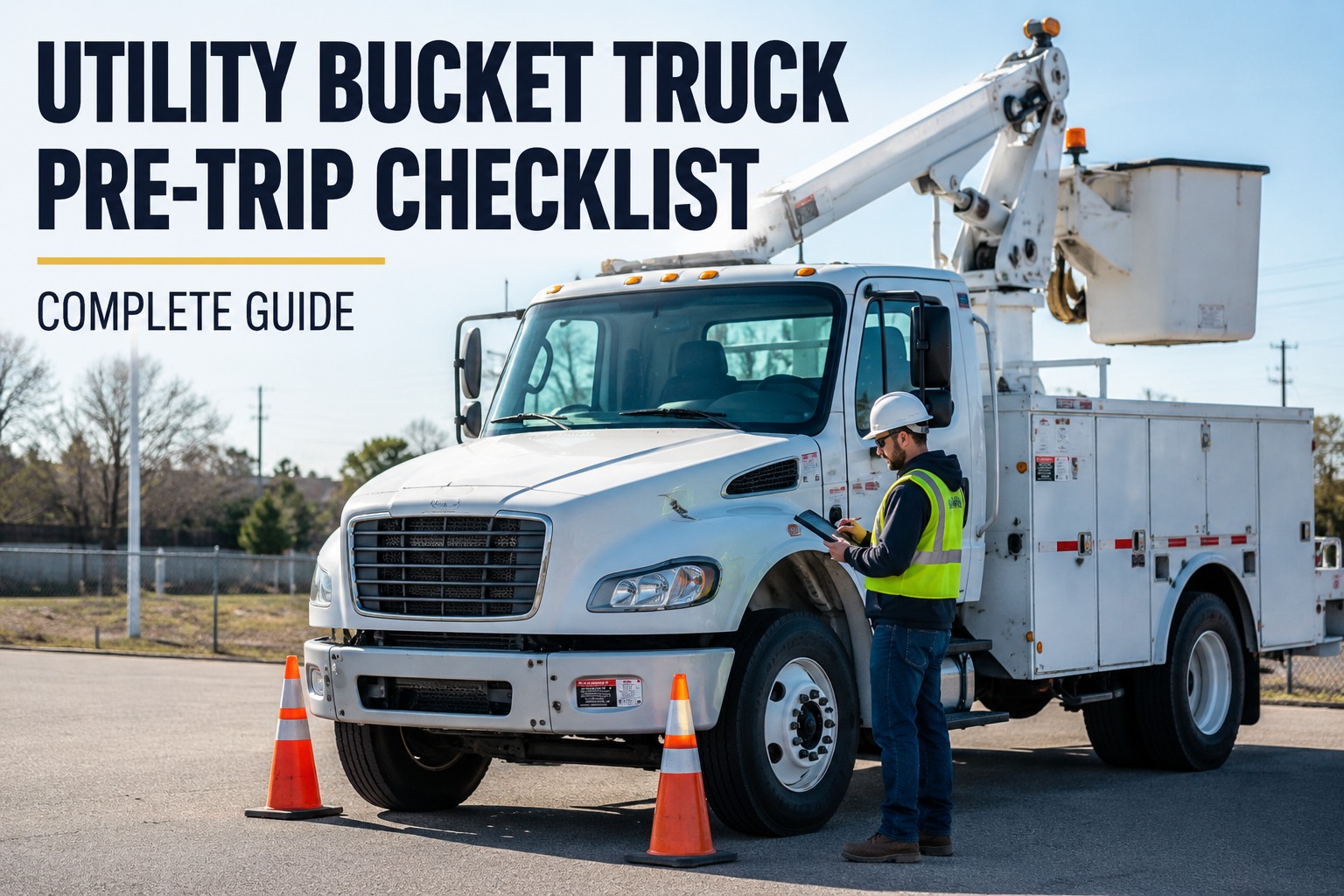
A utility bucket truck pre-trip is not a regular DOT pre-trip with an aerial device bolted on. It's a compound inspection covering a $200K-$400K asset that combines a heavy-duty chassis, an insulated boom (dielectric-tested annually under OSHA 1910.269), hydraulic pumps running 8-12 hours per shift, outriggers that must deploy on all four corners before the boom moves, and high-voltage proximity safety equipment. ANSI A92.2 (now superseded by ANSI A92.20) and OSHA 1910.67 + 1910.269 set the inspection bar — and a generic FMCSA DVIR misses most of what actually grounds a bucket truck. This guide is the complete 51-point pre-trip checklist utility lineworkers and fleet managers actually run. Every section maps to a real failure mode seen on Altec, Versalift, Terex, and other utility bucket trucks. Print it for paper use, or run it as a clickable digital DVIR with photo capture per defect — the same workflow the FMCSA's March 2026 eDVIR final rule explicitly authorizes. Start your free trial and run bucket truck inspections on software built for utility fleets.
Utility Bucket Truck Pre-Trip Checklist
Complete 8-section, 51-point pre-trip inspection covering boom, hydraulics, outriggers, dielectric, and chassis items.
Why Bucket Trucks Need a Specialized Pre-Trip Inspection
A standard FMCSA DVIR covers brakes, lights, tires, and frame — the mechanical baseline. A bucket truck pre-trip adds the aerial device items mandated by ANSI A92.20 and OSHA 1910.269: boom condition, hydraulic system, outrigger integrity, insulated boom dielectric, platform/bucket safety. Both are required when running utility line work. Skipping either side creates safety and compliance exposure:
Mechanical Items Only
DOT + ANSI + OSHA Items
The Complete 51-Point Bucket Truck Pre-Trip Checklist
Here's the full pre-trip inspection. Print it for paper use or tap through it digitally — every checkbox below is interactive. Sections marked CRITICAL are immediate lockout if any item fails. Don't deploy the boom until every CRITICAL item passes:
Hydraulic Boom System
Outriggers & Stability
Bucket / Platform & Controls
Dielectric & Insulation
Chassis & Drivetrain
Lighting & Visibility
Safety & Emergency Equipment
Documentation & PPE
Critical Lockout Items — Don't Deploy the Boom
Six items below are non-negotiable lockout failures. If any one fails the inspection, the truck is grounded until repair completes and re-inspection passes. These are the items that cause real injuries or fatalities when ignored:
Outrigger Interlock Failure
If the boom can move without all four outriggers fully deployed, the entire stability system is compromised. Single-point failure that drops the truck.
Hydraulic Cylinder Drift
Boom slowly lowering under load = internal cylinder seal failure. Operator in bucket can drift into energized conductors. Immediate lockout.
Insulated Boom Damage
Any cut, gouge, or contamination on the dielectric section eliminates the insulation barrier. Operator becomes path-to-ground at the conductor.
Lower-Control Override Fails
If lower controls can't override upper controls, you cannot rescue an incapacitated operator from the bucket. Bottom-to-top safety chain broken.
Lanyard Anchor Compromised
Rusted, cracked, or missing fall protection anchor = no defense against bucket ejection during boom maneuvering. OSHA requires 100% tie-off.
Expired Dielectric Test Sticker
Annual dielectric test required under OSHA 1910.269. Without current sticker, the truck cannot legally perform energized line work.
Run the 51-point pre-trip on software built for it.
Truck Inspection & Maintenance imports the full bucket truck checklist as a guided digital DVIR with photo capture per defect, lockout enforcement on CRITICAL items, dielectric test calendar, and PM scheduling by aerial hours. Free for up to 3 vehicles. Contact support to plan your rollout.
ANSI & OSHA Standards Map — What the Checklist Covers
The 51 points map directly to the federal and industry standards governing bucket truck operations. Each checklist section satisfies one or more of the standards below:
Paper Checklist vs Digital DVIR — Which to Use
The 51-point checklist works on paper. It works dramatically better digital — especially when the same lineworker is logging dielectric test dates, defect photos, and lockout enforcement across multiple trucks. Compare the two:
Paper Checklist
Digital DVIR
The Utility Fleet ROI — 15 Bucket Trucks, Year 1
Utility fleets running 10-25 bucket trucks see measurable ROI from digital pre-trips. The math below is for a 15-truck regional electric or telecom operation:
Frequently Asked Questions
How long should a bucket truck pre-trip take?
7-9 minutes with a guided digital DVIR, 20-25 minutes on paper. The digital workflow is faster because lineworkers tap through items rather than write, photos replace lengthy defect descriptions, and dielectric/PM data auto-populates from prior records. The fastest paper inspection isn't faster than a digital one — it's missing items.
Is a bucket truck pre-trip legally required?
Yes — under multiple frameworks. FMCSA 49 CFR 396 mandates daily DVIRs for any vehicle over 10,000 lb GVWR. ANSI A92.22 and OSHA 1910.67 require pre-shift aerial-device inspection. OSHA 1910.269 adds dielectric and high-voltage proximity requirements for utility work. All three apply simultaneously to a bucket truck doing line work.
What's the most important section of the pre-trip?
Outriggers and hydraulic systems jointly. Outrigger interlock failure means the boom can deploy without four-corner stability — a single-point failure that drops the truck. Hydraulic cylinder drift means the boom can slowly lower while the operator is in the bucket near energized conductors. Both are immediate lockout items in this checklist. Sign up free to enforce lockout digitally.
How often is annual dielectric testing required?
Every 12 months under OSHA 1910.269 for insulated aerial devices used in electric utility work. Records must be retained and shown on demand. The pre-trip checklist's S4 section includes a check for the current dielectric test sticker — without it, the truck cannot legally perform energized line work regardless of how clean the rest of the inspection is.
Does the checklist apply to non-insulated bucket trucks?
Yes — minus the dielectric section. Tree trimming, telecom, and sign maintenance fleets running non-insulated bucket trucks use the same 8-section framework, skipping S4 dielectric items. The remaining 46 points (boom, hydraulics, outriggers, controls, chassis, lighting, safety, documentation) apply universally to any aerial device.
How does the digital DVIR handle CRITICAL fail enforcement?
When a CRITICAL item (outrigger interlock, hydraulic drift, dielectric, lanyard anchor) fails, the digital DVIR auto-flags the truck "do not deploy" and creates a work order that must be closed by a qualified mechanic before re-inspection. The truck physically cannot pass a clean inspection until the issue is resolved and re-checked. Talk to our team for utility-specific lockout configuration.
Run the 51-point pre-trip on software built for it.
Truck Inspection & Maintenance imports the full bucket truck checklist as a guided digital DVIR, enforces CRITICAL lockouts, tracks dielectric test calendars, and produces audit-ready export. Free for up to 3 vehicles. No hardware. No contracts.