A shock absorber almost never fails outright — it fades. The ride gets a little floatier, the front end dips a little harder on a stop, a tire starts wearing in odd patches, and because it happens over tens of thousands of miles, nobody connects the dots until the truck is noticeably worse to drive. This guide shows you how to read the symptoms, test a shock honestly, and know when it's genuinely time to replace. Start free and track every shock against its wear interval.
Symptoms · Testing · Replacement
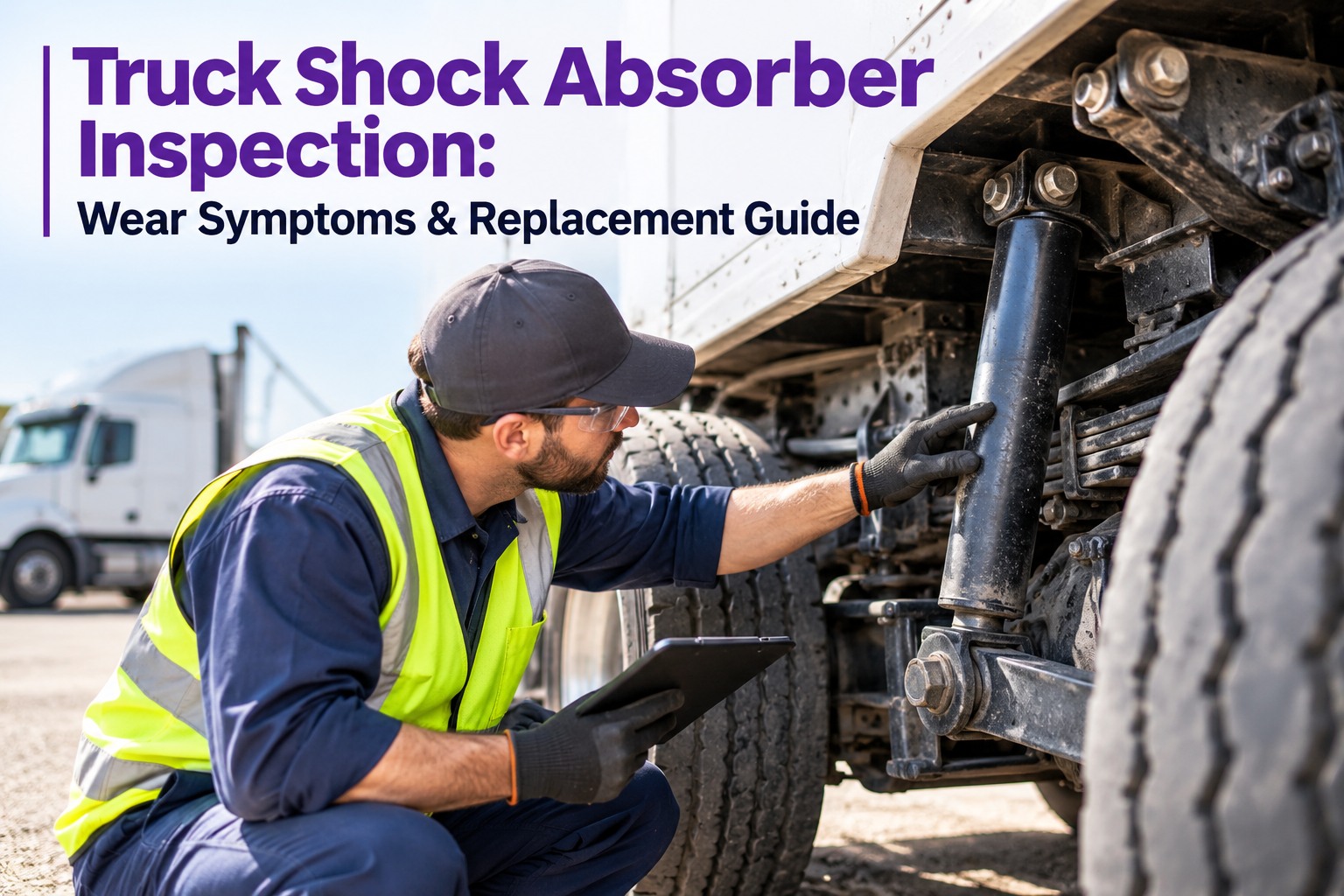
Truck Shock Absorber Inspection: Wear Symptoms & Replacement Guide
Worn shocks don't ground a truck at roadside — they quietly stretch your stopping distance, chew your tires, and load your chassis. Truck Inspection & Maintenance Management Software tracks each shock's mileage and bounce-test history, flags the two-symptom rule, and schedules replacement before the wear shows up in your tires or your brakes.
+20%stopping distance worn shocks can add at highway speed
30–40%tire life already lost by the time cupping shows
2symptoms at once = schedule replacement, any mileage
The Seven Symptoms of a Worn Shock
Shocks talk to you through the ride, the tires, and the brakes long before they leak. Learn to read these seven and you'll catch a fading shock while it's still just a maintenance item — not after it's cost you a set of tires or 20 feet of stopping distance.
01
Nose dive on brakingThe front end dips hard every time you brake — the clearest sign the front shocks have lost their damping.
02
Float and excess bounceThe truck keeps bobbing after a bump or dip instead of settling in one motion. The bounce test confirms it.
03
Cupped or scalloped tiresDiagonal wear patches from the wheel bouncing. By the time you can see cupping, the tire has lost 30–40% of its life.
04
Longer stopping distanceWorn shocks can add up to 20% to stopping distance at highway speed by letting the tires skip on the road.
05
Steering wander or shimmyVagueness or a shimmy above 55 mph, worse in crosswinds, as the tires lose consistent road contact.
06
Body roll in turnsThe truck leans more than it used to through corners and ramps — a real concern on high-profile box trucks.
07
Oil on the shock bodyFluid on the body means the seal has failed. A visibly leaking shock is already past its usable life — replace it.
The Bounce Test — Done Honestly
The bounce test is the fastest field check for damping, but only if you do it loaded. An empty truck's springs mask a tired shock; the same shock gives itself away under cargo. Test each corner, and record the result per corner so you can watch the trend.
1Push down firmly on one corner of the loaded truck, then release.
2Watch how the body settles — count the oscillations before it comes to rest.
3Repeat on all four corners. Record each result so you can compare over time.
Healthy
1–2
oscillations, then still. The shock is doing its job.
Worn
3+
bounces means inadequate damping — trigger a replacement evaluation.
A loaded test matters because an empty bounce test understates degradation on a cargo vehicle — the truck that passes empty can still be badly under-damped at working weight.
When to Replace — Mileage, by How Hard the Truck Works
There's no single replacement number, because a highway tractor and a municipal dump truck wear shocks at completely different rates. Use duty cycle as the guide, and treat these as the point to inspect and expect replacement — not a guarantee the shock lasts that long.
Duty cycleInspect / expect replacement around
Standard commercial / highway~50,000 miles
Heavy payload / off-road routes30,000–40,000 miles
Box trucks, flatbeds, dump trucks30,000–35,000 miles
Municipal / utility, rough terrain25,000–30,000 miles
The Two-Symptom Rule and the Brake Thresholds
Mileage tells you when to look; these decision points tell you when to act. They turn "it feels a bit soft" into a scheduling call you can defend.
Any two symptoms together
Two of the wear signs present at the same time justifies scheduling replacement immediately — regardless of how many miles are on the shock.
Stopping distance +10%
Stopping distance more than 10% above the OEM spec calls for an immediate shock inspection — the damping is measurably affecting braking.
Stopping distance +15%
A 15% or greater increase in a brake benchmark test is diagnostic of shock degradation — the shocks are the suspect, not just the brakes.
Any visible leak
Oil on the body is seal failure. A visibly leaking shock has already passed its usable threshold — no further test needed, replace it.
Software Built to Catch the Fade for You
Helping with exactly this is the job. Truck Inspection & Maintenance Management Software keeps each shock's install mileage, bounce-test results, and symptom history against the specific axle it's on — so it can flag the duty-cycle interval as it approaches and raise the two-symptom rule automatically. A leaking or failed shock opens a dated work order with the finding and a photo attached, and the slow fade that a daily walkaround never notices finally gets a system watching it.
What Worn Shocks Cost You Beyond the Shock
A shock is a cheap part — the expensive part is everything a worn one damages while you wait. This is why catching the fade early pays for itself several times over.
⊘TiresCupping and scalloping scrap tires at 30–40% remaining life.
⊘BrakingUp to 20% longer stopping distance and reduced rear traction on nose-dive.
⊘StabilityShimmy above 55 mph and higher rollover risk on ramps for tall trucks.
⊘ChassisRoad impact transferred into steering linkage, bearings, and frame.
Frequently Asked Questions
How do I know if my truck shocks are worn out?
Watch for seven signs: the front end diving hard on braking, the truck floating or bouncing after a bump, cupped or scalloped tire wear, longer stopping distances, steering wander or shimmy above 55 mph, more body roll in turns, and oil on the shock body. The two most decisive are the leak — oil on the body means the seal has failed and the shock is done — and the bounce test. Any two symptoms present at once is enough to schedule replacement no matter the mileage.
How often should heavy-duty truck shocks be replaced?
It depends heavily on duty cycle. Standard commercial and highway trucks run about 50,000 miles between shocks; heavy-payload and off-road routes cut that to 30,000–40,000; box trucks, flatbeds, and dump trucks to 30,000–35,000; and municipal or utility vehicles on rough terrain to 25,000–30,000. Treat those as the point to inspect and plan replacement rather than a fixed lifespan — a shock on a punishing route can fade well before its mileage, which is why the symptoms and bounce test always override the odometer.
Is a leaking shock absorber an immediate problem?
Yes. Oil on the shock body means the seal has failed, and a visibly leaking shock has already degraded past its usable threshold — it's no longer damping properly even if the truck still drives. There's no measurement to take at that point; a leaking shock is a replacement, not a "monitor" item. The reason it matters is that the shock may have been under-performing for a while before the leak became visible, so the tire and braking effects are often already underway by the time you spot the oil.
Do worn shocks really affect braking and tires?
Significantly. Worn shocks can add up to 20% to stopping distance at highway speed by letting the tires skip rather than stay planted, and they reduce rear-wheel traction during the nose-dive of a hard stop. On tires, inadequate damping causes the wheel to bounce, producing cupped wear that scraps the tire with 30–40% of its tread still left. A shock is one of the cheapest parts on the truck, but a worn one quietly spends money on tires and stretches your braking — which is the whole case for catching the fade early.
Contact us to put shock tracking on your fleet.
Inspect · Test · Replace
Catch the Fade Before It Reaches Your Tires and Brakes
Truck Inspection & Maintenance Management Software tracks every shock's mileage, bounce-test history, and wear symptoms against its axle, flags the duty-cycle interval and the two-symptom rule, and opens a work order the moment one leaks or fails. Fleets run it to replace shocks on the fade — not after the tire bill arrives.
No credit card required. Free for up to 3 trucks. Built for FMCSA-compliant fleets.