Here's the trap with truck emergency equipment: the rule is short, the items are cheap, and the checklist you find online is probably out of date. FMCSA rewrote § 393.95 twice in 2026 — spare fuses are gone, liquid-burning flares are gone — yet most guidance, and the 2024 print CFR, still lists them. A driver can have a flawless logbook, sound brakes, and current medical card and still get placed out of service over an extinguisher gauge drifted into the red. This is the current § 393.95 checklist: exactly what every truck, tractor, and bus must carry in 2026, what changed, and the pre-trip routine that keeps a $30 item from becoming an OOS order. Start a free trial and build the emergency-equipment check into every driver's pre-trip.
FMCSA § 393.95 · Emergency Equipment
The Truck Emergency Equipment Checklist (2026)
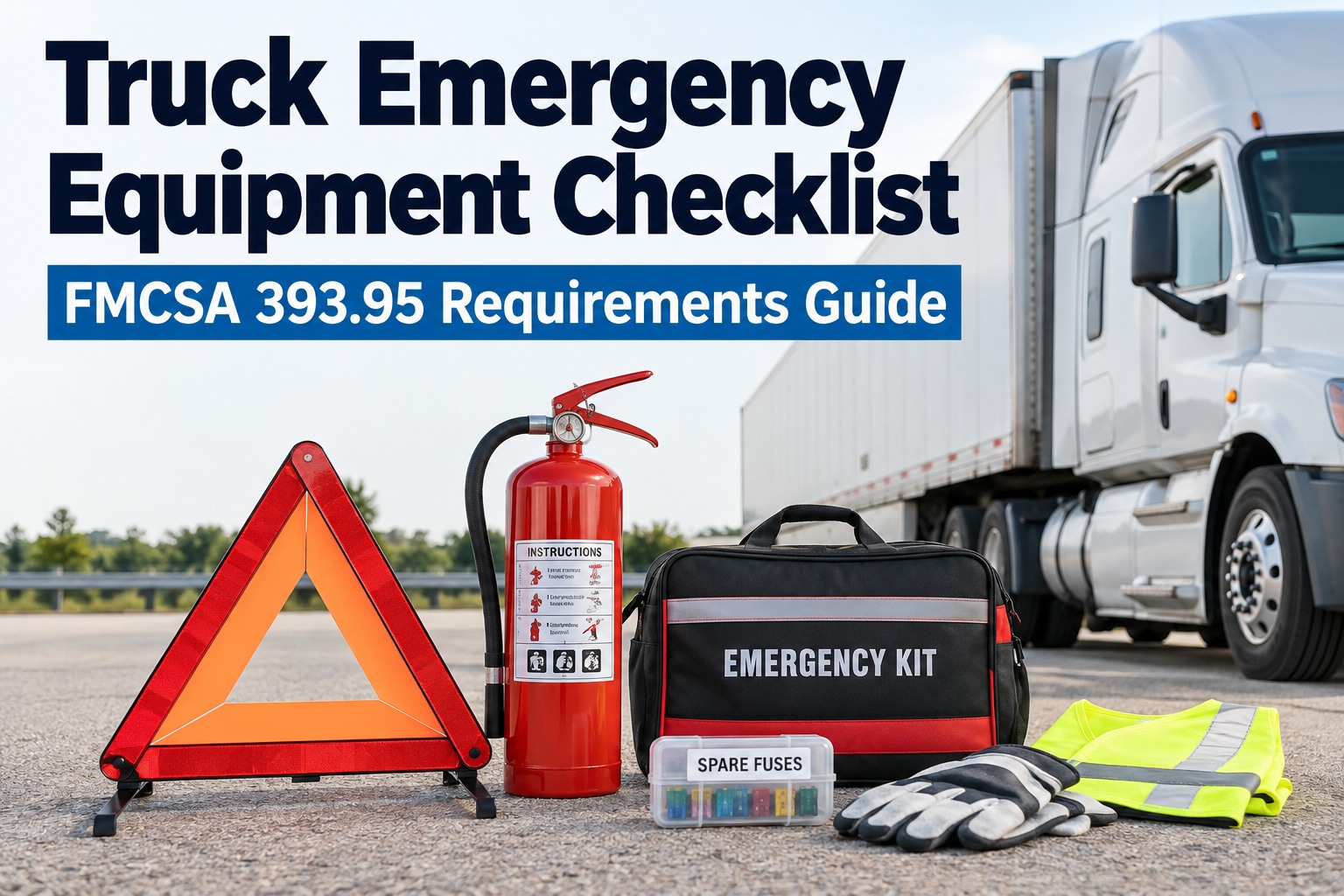
As of 2026, § 393.95 comes down to two things on every power unit: a correctly rated fire extinguisher and warning devices. The list got shorter this year — here's exactly what's required now, and what quietly dropped off.
2required item categories in 2026
5 B:Cmin extinguisher rating (10 B:C hazmat)
3reflective triangles, or 6 fusees
What Every Power Unit Must Carry — The Checklist
Every truck, truck tractor, and bus must carry the items below (the one exception: the driven unit in a driveaway-towaway operation). Two categories, and both are checked the same way every morning.
1
Fire Extinguisher
A UL-rated extinguisher, securely mounted, readily accessible, fully charged, and in good working condition. The agent must not require protection from freezing and must meet EPA SNAP toxicity rules.
StandardOne rated 5 B:C or more — or two each rated 4 B:C or more
HazmatPlacardable load: one rated 10 B:C or more
CheckUL rating label present · gauge in the green · mounted & accessible · no damage
2
Warning Devices for Stopped Vehicles
One of exactly two accepted sets as of 2026. Triangles are the practical default — weatherproof, reusable, and legal on every load, with no flame restrictions.
Option AThree bidirectional reflective triangles meeting FMVSS No. 125
Option BAt least six fusees (plus any additional the § 392.22 placement rules require)
RestrictionFusees/flame devices barred on 1.1–1.3 explosives, flammable cargo tanks, and compressed-gas-fueled CMVs
Don't get caught out A first aid kit is
not a federal § 393.95 requirement — it never was — though OSHA may require one if you have employees, and many state programs reference ANSI/ISEA Z308.1. Carry one because it's smart, not because an inspector will cite its absence under this rule.
Ask how to build your fleet's exact kit list.
What Changed in 2026 — Read This Before You Trust an Old Checklist
FMCSA issued two deregulatory rules in 2026 that shortened § 393.95. If your checklist, wall poster, or the printed CFR still lists these, it's stale. Neither item is required anymore.
✕ Removed
Spare Fuses
The spare-fuse requirement at § 393.95(b) was removed and reserved effective April 20, 2026. It generated roughly 9,000 roadside violations a year on vehicles that have largely moved to circuit breakers. Still permitted and often sensible — just no longer citable.
✕ Removed
Liquid-Burning Flares
Liquid-burning flares were removed as an accepted warning device effective March 23, 2026. Paragraph (f) now lists exactly two options — FMVSS 125 triangles or at least six fusees. Old guidance listing flares as a third choice is out of date.
Why it matters Guidance published before those 2026 dates — including the 2024 annual print CFR — still shows the old text. A driver carrying spare fuses and flares isn't wrong, but a fleet training to a checklist that requires them is drilling on obsolete rules and missing what actually gets inspected: the extinguisher and the triangles.
Put the Current § 393.95 Check in Every Pre-Trip
Truck Inspection & Maintenance connects drivers, mechanics, and managers on one mobile-first platform — the emergency-equipment check lives right in the driver's mobile DVIR, so extinguisher rating, gauge, mounting, and warning-device presence get confirmed with a tap and a photo every morning. A red gauge or a missing triangle routes straight to the shop as a work order, and extinguisher service intervals fire as automatic PM reminders. Turn a cheap-item OOS risk into a repeatable routine.
The Fire Extinguisher: DOT Floor vs. Service Standard
Here's the distinction fleets most often blur — and it's where "technically legal on the road" and "actually maintained" split apart. Passing a roadside check doesn't mean the extinguisher is on schedule for its service intervals.
DOT Floor · § 393.95
What a roadside inspector checks
Correct UL rating for the vehicle (5 / 4×2 / 10 B:C)
Securely mounted & readily accessible
Charged — gauge in the green
Manufacturer UL label present, no damage
Service Standard · NFPA 10
What keeps it actually functional
Monthly quick inspection (gauge, seal, access)
Annual professional maintenance & tag
Six-year internal examination
Twelve-year hydrostatic test
Passing on rating and mounting doesn't mean the internal exam is current — and a missing or outdated service tag is itself a common finding. Treating the DOT floor and the service schedule as one thing is how fleets end up legal on the road but overdue on maintenance.
Start free and track both the daily check and the NFPA service clock in one place.
Frequently Asked Questions
Do I still need to carry spare fuses in 2026?
Not as a requirement. FMCSA removed the spare-fuse mandate from § 393.95(b) effective April 20, 2026, and the paragraph is now reserved — the requirement had been producing roughly 9,000 roadside violations a year, largely on vehicles that use circuit breakers rather than fuses. You can still carry spare fuses, and for a fuse-equipped truck it's often sensible, but their absence is no longer a citable violation. The practical takeaway: don't fail a driver on an internal audit for missing fuses, and update any checklist that still lists them as mandatory.
Start free and run the current, correct list.
What size fire extinguisher does my truck need?
It depends on whether you haul placardable hazmat. A power unit carrying hazardous materials in a quantity requiring placards needs a UL rating of 10 B:C or more. Any other power unit needs either one extinguisher rated 5 B:C or more, or two extinguishers each rated 4 B:C or more. Whichever applies, it must be UL-labeled by the manufacturer, securely mounted, readily accessible, charged with the gauge in the green, and use an agent that doesn't need freeze protection and meets EPA SNAP toxicity rules. The rating is stamped on the label — if you can't read it, an inspector treats it as non-compliant.
Are reflective triangles or fusees better?
Both are legal, but triangles are the practical default for most fleets: they're weatherproof, reusable, carry no flame restrictions, and satisfy § 393.95 on every load. Fusees are single-use and, critically, can't be carried on vehicles hauling Division 1.1–1.3 explosives, on cargo tanks with flammable gas or flammable liquid (loaded or empty), or on any CMV using compressed gas as a motor fuel. Since the 2026 rule removed liquid-burning flares entirely, your only two options now are three FMVSS 125 triangles or at least six fusees — and triangles avoid every restriction fusees carry.
Why do drivers keep failing inspections on emergency equipment?
Because it's small, cheap, and easy to overlook on a rushed pre-trip — exactly the profile of items roadside inspections are won and lost on. An extinguisher gauge drifts into the red over months and nobody notices; a triangle gets used at a breakdown and never replaced; a service tag lapses. None of it feels urgent until it's an out-of-service order. The fix isn't more equipment — it's making the check a required, logged step every morning instead of a glance.
Talk to our team about building emergency-equipment checks into your pre-trip on Truck Inspection & Maintenance.
Two items · Checked daily · Never an OOS
Never Lose a Day to a $30 Item Again
Truck Inspection & Maintenance turns § 393.95 into a routine your drivers actually run — mobile pre-trip checks for extinguisher rating, gauge, and warning devices, instant defect routing when something's missing or expired, automatic NFPA service reminders, and audit-ready records for every unit. Purpose-built for trucking, it connects drivers, mechanics, and managers so a small item never becomes a big violation.
No credit card required. Free for up to 3 trucks. Built for FMCSA-compliant fleets.