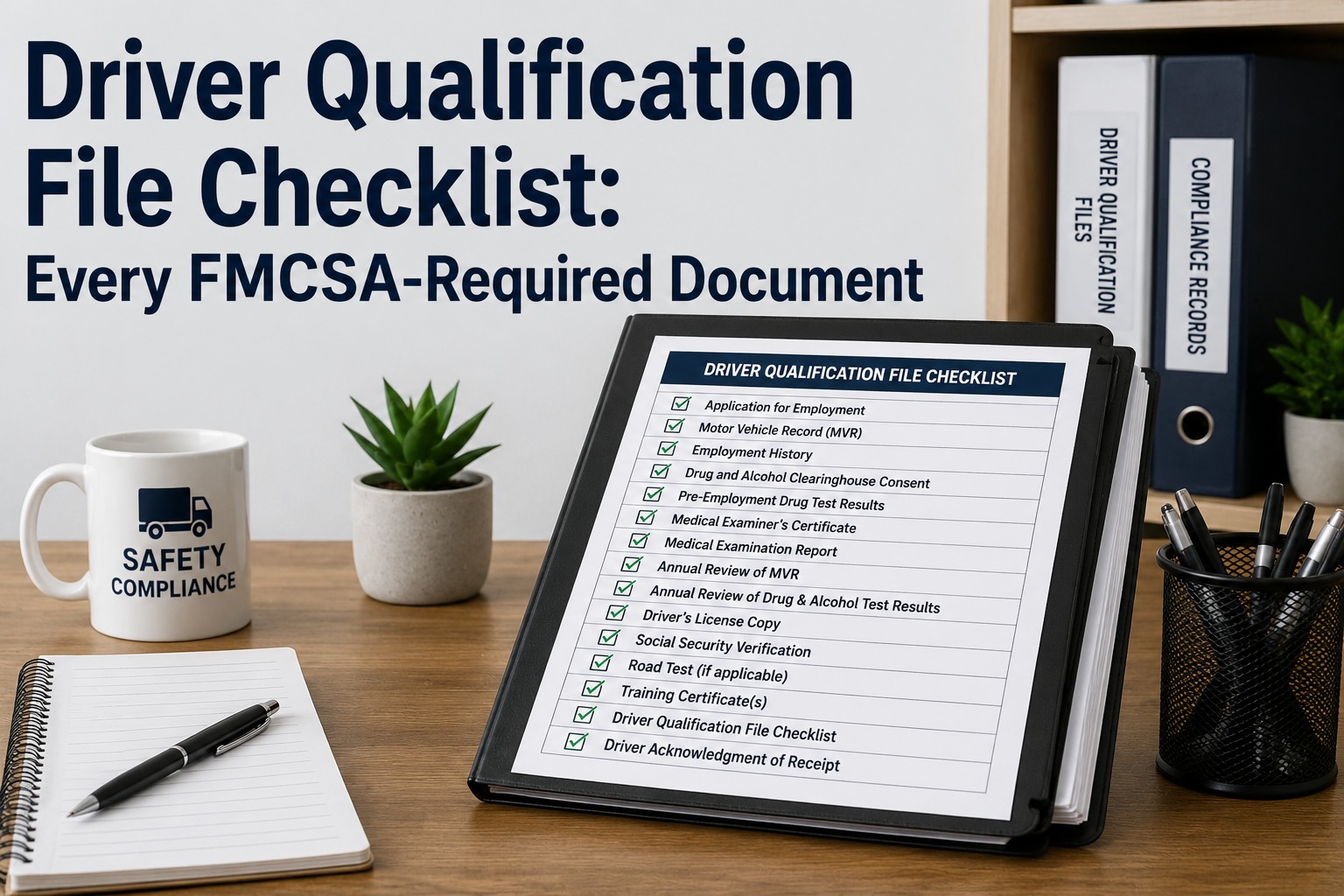
Missing or incomplete driver qualification files are one of the top findings in FMCSA compliance reviews — each documentation gap can trigger civil penalties, elevated Driver Fitness BASIC exposure, insurance surcharges, and broker vetting failures. Under 49 CFR §391.51, every motor carrier must maintain a complete DQ file for every driver from the day of hire through 3 years after separation. This checklist covers all 12 required documents grouped by lifecycle phase (pre-hire, annual/ongoing, conditional), the renewal cadence for each, and the exact retention window that governs when you can purge and when you cannot. Every document is tied to its CFR citation so audit responses take minutes, not days. Truck Inspection & Maintenance tracks DQ files with automated renewal alerts and audit-ready export — sign up free or contact our team.
Driver Qualification File Checklist — Every FMCSA-Required Document
12 documents. 3 lifecycle phases. Employment + 3 years retention. One missing document = one audit finding.
Why DQ File Completeness Is Non-Negotiable
Three numbers frame the audit exposure of a single incomplete DQ file:
Incomplete DQ files rank in the top 5 findings on FMCSA compliance reviews. Each missing document is its own citation, not a bundled one — 3 drivers × 2 gaps each = 6 findings.
DQ files must be retained for the full duration of employment PLUS 3 years after termination. Purging on the termination date is a violation — auditors regularly request files for former employees.
DQ file violations range from acceptable-with-corrective-action up to $15K+ per driver per finding when combined with knowing-violation charges. Insurance surcharge exposure compounds separately.
One missing document = one FMCSA finding. Start a free account and structure every driver's DQ file to §391.51 automatically.
Phase 1 — Pre-Hire Documents (5 Required)
These 5 documents are collected and filed at the time of hire. They stay in the file for the driver's entire employment plus the 3-year retention window:
Want a printable pre-hire DQ intake checklist? Contact our team and we'll send a fill-in template, free.
Phase 2 — Annual & Ongoing Documents (5 Required)
These documents renew on a fixed cadence. Missing a renewal window is the #1 source of DQ audit findings — the calendar drives everything:
Turn on 4-tier renewal alerts (T-45/T-30/T-15/T-1) for every annual document — sign up free and drop DQ findings by 90% in one audit cycle.
Phase 3 — Conditional Documents (Apply to Some Drivers)
These documents are required only for specific driver categories. If the trigger applies, the document is mandatory:
The One Rule That Prevents 90% of DQ Findings — Set Renewal Alerts at T-45, T-30, T-15, T-1 Days
Every finding in Phase 2 (annual MVR, annual review, medical card, National Registry, Clearinghouse) traces to the same root cause: the renewal came and went before anyone noticed. Set four cascading alerts per document per driver: 45 days before expiry (order/schedule), 30 days (chase), 15 days (escalate to supervisor), and 1 day (final safety net). Alerts feed the compliance manager's queue automatically — no spreadsheet chasing, no manual calendar scan, no driver riding on an expired medical card. Fleets that adopt cascading alerts drop DQ findings roughly 90% within one audit cycle. Start a free account and turn on 4-tier renewal alerts for every DQ document today.
Renewal Cadence Matrix — What Refreshes When
Fixed cadences for every recurring DQ document. Plot these against every driver's file and the calendar drives itself:
Need help mapping the cadence matrix to your current driver roster? Get in touch for a free 15-minute compliance review.
Every DQ document renewal tracked with cascading alerts — no driver ever rides on an expired document again.
All 12 DQ documents per driver, 4-tier renewal alerts (T-45/T-30/T-15/T-1), audit-ready export in one click. Free forever for up to 3 vehicles — create your free account or talk to our team.
KPI Dashboard — 6 DQ Compliance Metrics
Six numbers to track monthly on any fleet running DQ compliance as a first-class KPI:
All 12 applicable documents present in every active driver's file. Below 100% = audit-exposed drivers on the road.
Zero drivers dispatched with expired DOT medical cards. Single expired card = OOS + citation + insurance flag.
Every driver's annual MVR pulled within 12 months of prior. Missed pull = §391.25 violation.
Every driver's annual driving record review completed and signed by qualified reviewer within the 12-month window.
Average days of advance warning before document expiry. Below 30 days = reactive renewal cycle.
All former drivers' complete DQ files retained for full 3-year post-termination window. Purging early = citation trap.
The 5 Most Common DQ Audit Findings
Every finding below has been cited in FMCSA compliance reviews thousands of times. All five are preventable with the cadence matrix and 4-tier alerts:
Expired DOT Medical Card in File
Finding: Driver's medical card expired 6 weeks ago; driver still dispatched. §391.43 violation + potential §391.11 disqualification exposure. Cascading alert at T-45/30/15/1 prevents this entirely.
Missing Prior-Employer Safety Performance History
Finding: §391.23(d) investigation not documented or attempted for driver hired 8 months ago. Even a good-faith unsuccessful attempt must be documented — silence is not defensible.
Annual MVR Skipped for One Cycle
Finding: Prior MVR dated 14 months ago instead of within 12-month window. Rolling 12-month calendar from prior pull date beats fixed-date scheduling.
DQ File Purged on Termination Date
Finding: Auditor requests file for driver terminated 18 months ago; company destroyed it on termination date. Retention is termination date + 3 years, not termination date.
Annual Review Present But Unsigned
Finding: MVR pulled and filed on time, but no documented signed review by qualified carrier reviewer. §391.25 requires the review documentation, not just the MVR itself.
Prevent all 5 findings above with cascading alerts and one-click audit export — create your free account in 10 minutes.
Frequently Asked Questions
How many documents are required in a driver qualification file?
Under 49 CFR §391.51, every active driver's DQ file must contain up to 12 documents grouped by lifecycle phase: 5 pre-hire documents (employment application, initial MVR from each state, road test certificate or CDL copy, prior-employer safety performance history, ELDT certificate for post-Feb 2022 CDLs), 5 annual/ongoing documents (annual MVR, annual driving record review, DOT medical certificate, National Registry verification, Clearinghouse query), and 2 conditional documents (medical variance/waiver, LCV training certificate) that apply only to specific driver categories.
How long must DQ files be retained?
DQ files must be kept for the full duration of the driver's employment PLUS 3 years after termination — per §391.51(d). Some individual documents may be removed from the active file after 3 years from date of execution even while the driver is still employed (annual MVRs, annual reviews, medical certificates, National Registry verifications). Purging an entire file on the termination date is a citation trap — auditors regularly request former-driver files during compliance reviews.
How often must an MVR be pulled and reviewed?
Every 12 months, per §391.25. The annual MVR must be pulled from every state where the driver holds a license. The annual review of driving record is a separate requirement — the carrier must document a reviewer's evaluation of the MVR plus accident record plus any citations, with signature, date, and qualification determination. Both items are cited separately when missing, so completing the MVR pull without the signed review still generates a §391.25 finding.
When is the DOT medical card renewal required?
Maximum 24 months, per §391.43 — but the medical examiner may issue a shorter certificate (3, 6, or 12 months) if condition monitoring is warranted. The specific expiry printed on the medical examiner's certificate is what governs, not a flat 2-year rule. A driver may not lawfully operate a CMV with an expired card, so setting cascading renewal alerts at 45, 30, 15, and 1 days before expiry is the standard fleet practice.
What's the most common DQ file audit finding?
Expired DOT medical cards and missed annual MVR pulls are the two most frequent citations. Both fail for the same reason — the renewal cadence went unmonitored. The fix is systematic: cascading alerts at T-45/T-30/T-15/T-1 days before every expiry, tied to a compliance queue rather than a spreadsheet. Fleets that switch from spreadsheet tracking to alert-driven tracking typically drop DQ audit findings by roughly 90% within one audit cycle.
How does Truck Inspection & Maintenance track DQ file compliance?
Truck Inspection & Maintenance ships with the full §391.51 12-document DQ file structure pre-configured per driver. Cascading 4-tier renewal alerts (T-45/T-30/T-15/T-1) fire automatically for every recurring document. Document upload and version history live in the driver record; audit-ready export produces a complete file in one click. Former-driver files auto-retain for the full 3-year post-termination window and only unlock for purge after the retention period expires. Free forever for up to 3 vehicles. Sign up in 10 minutes or contact our team for larger fleets.
One expired medical card is one FMCSA citation and one insurance flag. Cascading alerts prevent the miss.
Full §391.51 DQ file structure per driver, 4-tier renewal alerts on every recurring document, audit-ready one-click export, 3-year retention lock on former-driver files. Free forever for up to 3 vehicles — no hardware, no contract, no credit card.