The moment a new motor carrier's USDOT number activates, the clock starts on an 18-month probation window that will determine whether the company earns permanent operating authority or gets shut down before it ships its first year of freight. Inside that 18-month window sits the FMCSA New Entrant Safety Audit — a mandatory review that has to happen within the first 12 months for property carriers, within 120 days for passenger carriers. This isn't a test of driving skill or dispatch strategy. It's a test of whether the carrier has the safety management controls, records systems, and required programs in place to operate under the Federal Motor Carrier Safety Regulations. Auditors don't grade on a curve. Sixteen bright-line violations under §385.321(b) cause automatic failure of the entire audit regardless of how well the carrier performs in every other area — no discretion, no partial credit, no second chance. Fail the audit, miss the corrective action deadline, and FMCSA revokes the DOT registration. The good news is that passing is a documentation exercise, not a mystery. Every automatic-failure violation, every required record category, every corrective action pathway is published in advance — and the carriers who fail overwhelmingly fail because they didn't know what was actually being reviewed. This guide walks through the exact structure of the New Entrant program: what the 18-month window includes, when the audit happens, what documents are reviewed, the 16 automatic-failure conditions, how the corrective action plan process works, and how Truck Inspection & Maintenance software builds the audit-ready record trail from day one so new carriers can focus on hauling freight instead of scrambling for paperwork. Ready to start compliance-ready from day one? Start a free trial of Truck Inspection & Maintenance, or contact our support team for a walkthrough.
New Entrant Safety Audit: FMCSA Requirements & Compliance Guide
You get one shot at your first 18 months. Pass the audit and earn permanent authority. Miss the corrective action deadline and FMCSA revokes your DOT number. Here's how to land in the first group.
DOT number active
Safety audit
Permanent authority
What the New Entrant Program Actually Is
The New Entrant Safety Assurance Program is FMCSA's 18-month probation window for every newly registered interstate motor carrier. Understanding the program's structure explains why compliance can't be an afterthought.
The New Entrant Journey — 3 Phases
The 18-month probation breaks into three distinct phases, each with its own priorities. Understand where you are, and you know what to focus on.
The 6 Areas Auditors Review
Every New Entrant Safety Audit examines six core compliance areas. Miss the systems in any one and citations follow. Here's what each area actually requires.
The 16 Automatic-Failure Violations
These are the bright-line rules. Any single violation fails the entire audit — no discretion, no partial credit. Verify all 16 before your DOT number even activates.
Onsite vs. Offsite: Two Audit Formats
New Entrant audits now come in two formats. Which one you get depends on FMCSA's determination — but the underlying record requirements are identical.
Build audit-ready records from day one
Digital DVIRs. Driver qualification files. Annual inspection scheduling. ELD support docs. Truck Inspection & Maintenance software builds every required New Entrant record as a byproduct of daily operations — so the audit becomes a filter, not a scramble.
What Happens If You Fail — The Corrective Action Path
Failing the audit isn't automatic revocation. There's a specific pathway back if the carrier acts fast. Understanding it turns a failure into a fixable event.
The Top 5 Reasons New Carriers Fail
The vast majority of New Entrant failures trace back to the same five root causes. Solve these five and passing becomes almost mechanical.
Frequently Asked Questions
The New Entrant Safety Audit is a mandatory compliance review that FMCSA conducts on every newly registered interstate motor carrier within the first 12 months of operation (property carriers) or 120 days (passenger carriers). The audit reviews six core compliance areas: driver qualification, drug and alcohol testing, hours of service, vehicle maintenance, insurance and authority, and accident register plus hazmat if applicable. The audit sits inside a broader 18-month probation window — passing the audit doesn't end scrutiny. FMCSA continues monitoring CSA scores and roadside data until permanent authority is granted at month 18. Truck Inspection & Maintenance software builds these records automatically from your first day of operation.
The audit is conducted within the first 12 months of DOT number activation for property carriers, or 120 days for passenger carriers. Hazmat operations may face shorter windows. Carriers don't choose the date — FMCSA or a state partner sends the notice. Poor early roadside inspection performance can accelerate the audit; a clean roadside record can extend it toward the 12-month deadline. Some carriers are audited as early as month 3 if the operating authority activates quickly and there's activity on the ELD.
FMCSA defines 16 automatic-failure violations under §385.321(b). They cluster into four groups: driver qualification (using a driver without valid CDL, disqualified license, expired medical, or missing Clearinghouse query), drug and alcohol (no testing program, using a driver who refused or tested positive, no pre-employment testing), hours of service (permitting driving beyond HOS limits, no records maintained, falsification), and vehicles/operations (no systematic maintenance program, operating without registration or insurance, using out-of-service vehicles, operating without authority). One violation of any of these fails the entire audit regardless of everything else.
Failure isn't automatic revocation — but the corrective action clock starts immediately. FMCSA sends a written notice detailing every violation. The carrier must submit a Corrective Action Plan (CAP) within the deadline (typically 60 days for property carriers, shorter for passenger and hazmat). The CAP must explain exactly how each violation will be corrected with real actions and dates. If FMCSA accepts the CAP, the carrier continues operating under New Entrant status while implementing corrections. If the CAP is rejected or the deadline is missed, FMCSA revokes operating authority and the carrier goes out of service. Contact our team to see how the software helps prevent failure in the first place.
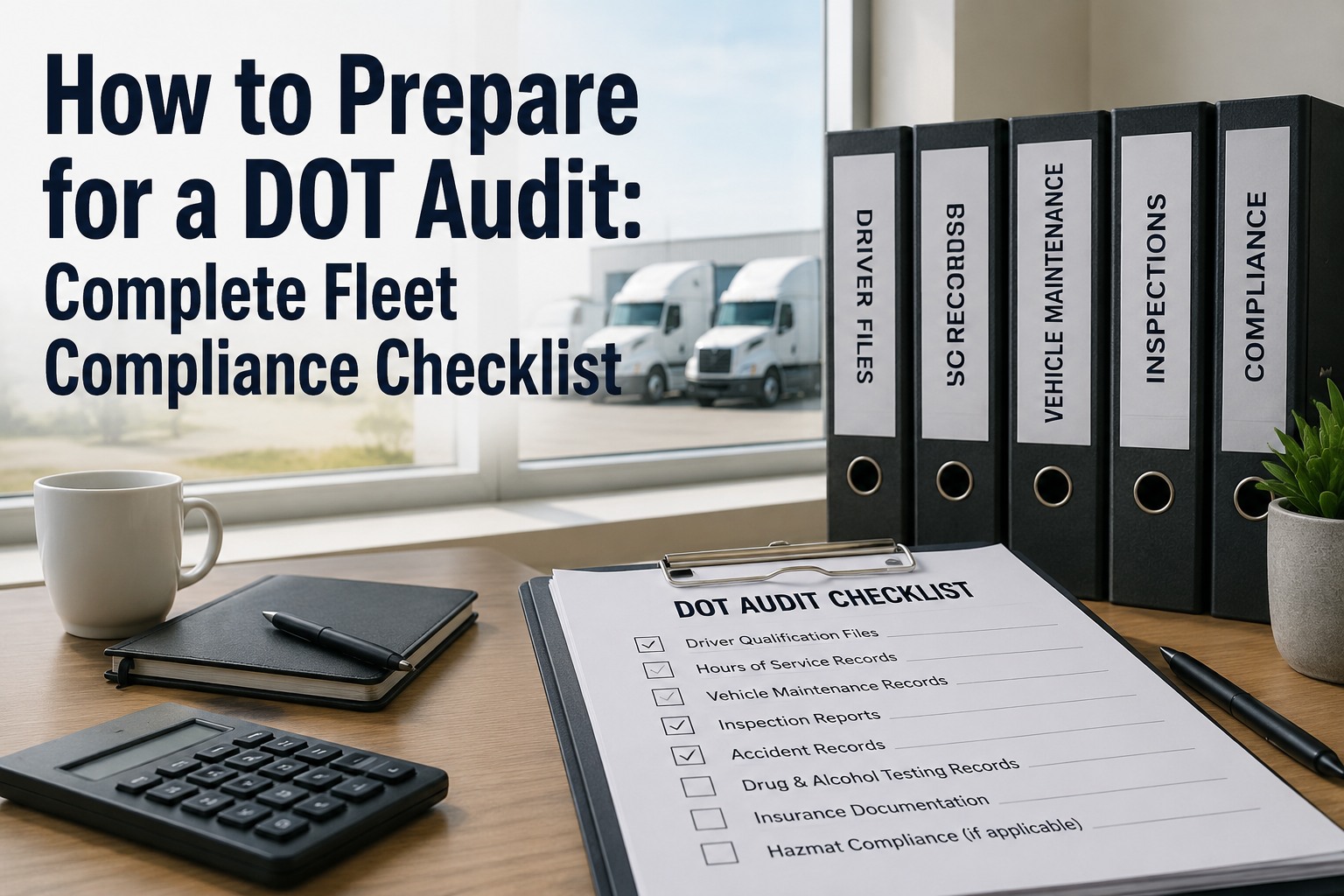
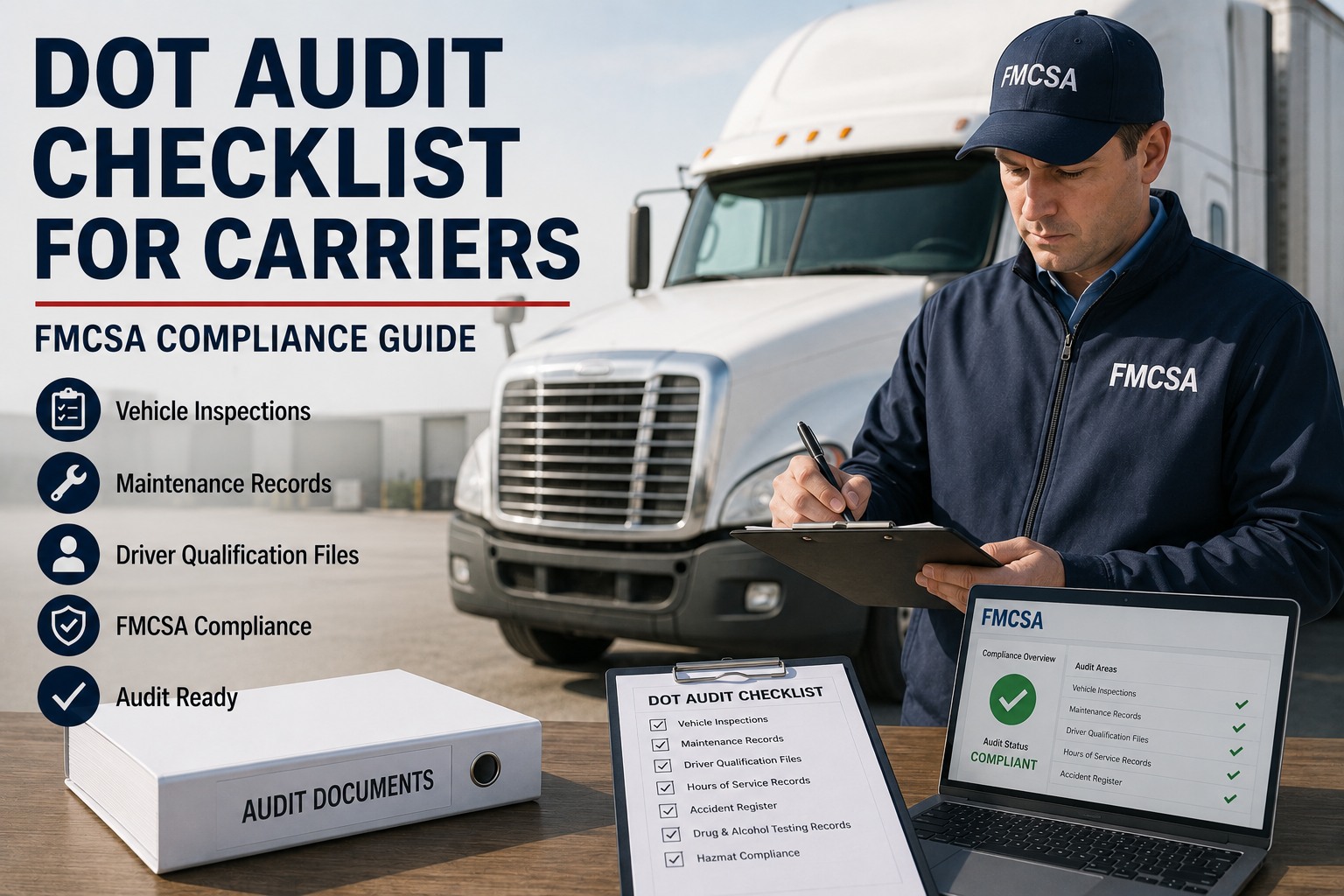
Six document categories are required. Driver Qualification files (application, MVR, medical certificate, CDL copy, Clearinghouse queries) for every driver. Written drug and alcohol testing program with test records and random pool documentation. 6 months of HOS/ELD records with supporting documents. Annual DOT inspection certificates plus 3 months of DVIRs for every CMV. Current certificate of insurance at federal minimums with MCS-90 endorsement. Written accident register plus operating authority documents. Hazmat training records and shipping papers if transporting hazardous materials. All records must be either physically present (onsite audit) or uploadable within 48 hours (offsite audit).
No. Passing the Safety Audit is a required milestone, but the New Entrant probation continues for a full 18 months from DOT number activation. During the remainder of the window, FMCSA continues monitoring roadside inspection performance, CSA scores, crash data, and any subsequent safety issues. Consistent compliance across the entire 18-month period leads to permanent operating authority at month 18. Subsequent safety problems during this monitoring period can still result in revocation. The mindset shift for new carriers: audit prep isn't a one-time event, it's the beginning of a permanent compliance operation. Try free: sign up here.
Truck Inspection & Maintenance software makes New Entrant compliance a byproduct of daily operations
Driver qualification files digital and complete. DVIRs captured at every trip. ELD support documents attached automatically. Annual DOT inspection scheduling and completion records. Random drug test tracking. Accident register logging. Clearinghouse query records. Every category the auditor asks for, built as normal daily work — so New Entrant carriers focus on hauling freight instead of scrambling for paperwork. One platform, one workflow, one source of truth.