A DOT audit is not a roadside inspection — it's a records review, and that changes everything about how you prepare. An investigator isn't looking at your trucks; they're looking at your paperwork, checking whether the safety systems federal law requires actually exist and are actually being used. And in 2025 and 2026 the audit landscape has shifted twice over. First, FMCSA increasingly runs focused audits aimed at specific compliance areas where the data already shows problems, meaning auditors often arrive knowing your weak spots before you say a word. Second, off-site audits have exploded — up roughly 8,485% between 2017 and 2021 — so instead of hosting an investigator you're uploading documents to a federal portal, often on a 48-hour clock. If your records live in filing cabinets and spreadsheets, that clock is where carriers fail. Get audit-ready records free. This guide walks the six factors auditors actually evaluate, the violations that fail you automatically, every document by category, and how long you must keep each one.
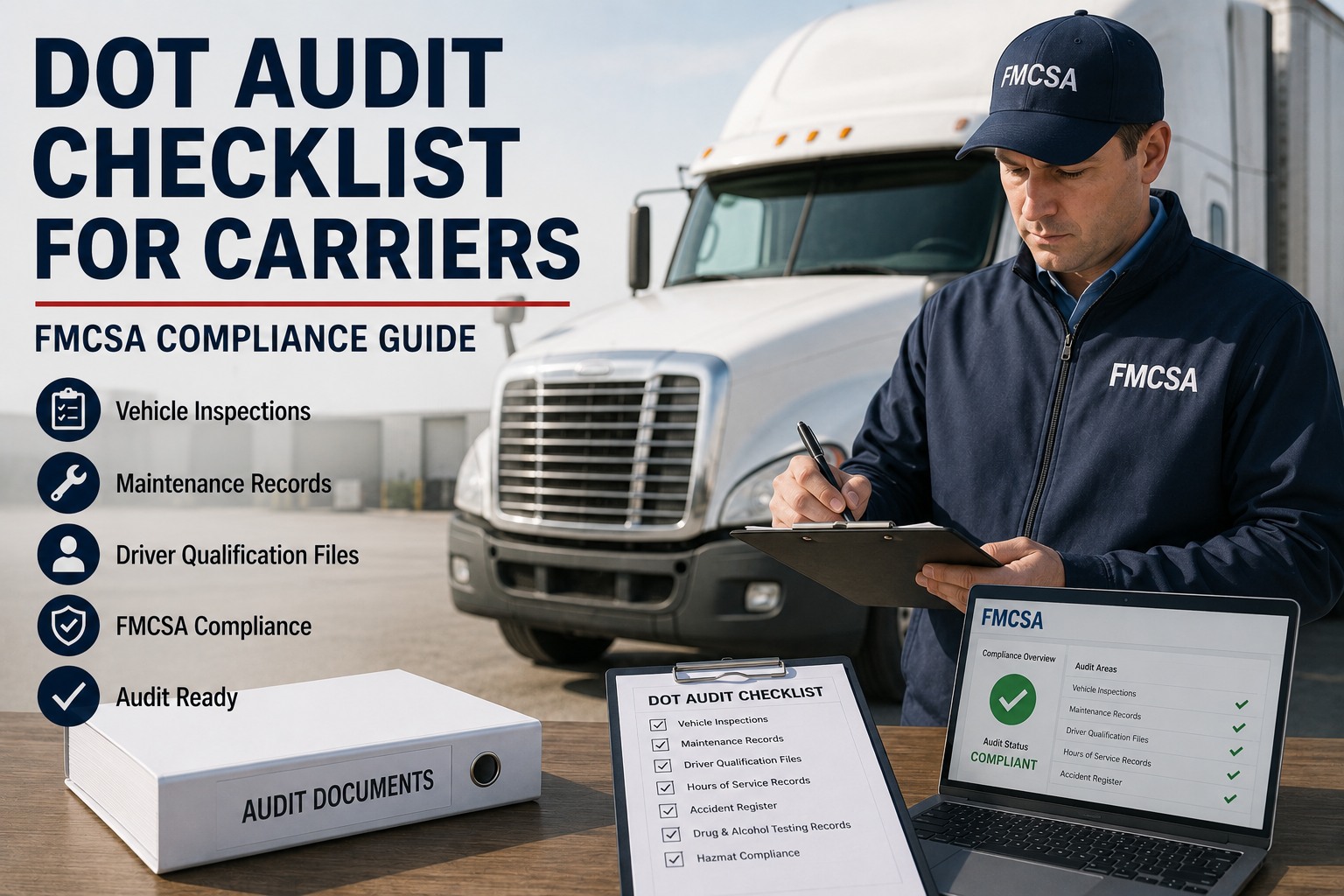
DOT Audit Checklist for Carriers: The FMCSA Compliance Guide
A DOT audit is a records review, not a truck inspection. Here are the six factors investigators evaluate, the sixteen violations that fail you automatically, and every document you need — with the retention clock for each.
What Puts You in the Chair
Audits aren't random misfortune — most are triggered by something specific in your data or history. Knowing the triggers tells you where the investigator's attention will land.
Weak Safety Measurement System scores are the most common trigger, and they tell FMCSA exactly which area to focus on.
High crash rates, a high-profile accident, or a citizen complaint can each put a carrier under review.
Every new carrier gets a safety audit automatically — typically around months 9 to 12, and within the first 18 months of authority.
Some reviews come with no trigger at all, which is why continuous readiness beats scrambling after a notice.
The Six Factors Auditors Evaluate
A DOT audit isn't a freeform hunt — it follows a defined structure of six safety-management factors. Preparing factor by factor is how you cover the whole exam instead of guessing.
Your operating authority, a current certificate of insurance at federal minimums, and an updated MCS-150. The foundational paperwork that proves you're legally operating.
Driver qualification files under 49 CFR Part 391 — applications, MVRs, medical certificates, CDLs, employment verifications, and annual reviews for every driver including owner-operators.
Hours of service compliance — ELD or paper logs with supporting documents, proving drivers ran legal hours and that you monitored them.
Annual DOT inspections, DVIRs, maintenance and repair records for every CMV, plus proof your inspectors and brake technicians are qualified.
If you haul placardable quantities of hazardous materials, the additional federal requirements covering handling, training, and emergency response.
A written accident register of all DOT-reportable accidents — and, critically, the register must exist even if you've had none.
The Violations That Fail You Instantly
Sixteen specific violations under §385.321(b) trigger automatic failure regardless of how well you perform everywhere else. These are non-negotiable — no amount of strength in other factors offsets them.
The Document Checklist by Category
Here's what an auditor asks for, grouped the way you should organize it. Build these files before you need them, because assembling them under a 48-hour deadline is how gaps get discovered.
The Chain Auditors Follow: DVIR to Repair to Release
On the vehicle factor, investigators don't just want to see DVIRs — they follow the thread. A driver reported a defect: is there a repair record showing it was corrected, and proof the vehicle didn't return to service until it was? A broken link in that chain is a violation even when the repair actually happened. Truck Inspection & Maintenance connects every DVIR defect to its work order, repair, and sign-off automatically, so the full chain is intact and provable for every vehicle, every time.
How Long You Must Keep Everything
Every record type has its own clock, and the clocks don't match. Discarding a file too early is its own violation — this is the schedule to build your retention policy around.
What Happens After
An audit ends in a rating, and the rating determines whether you keep operating normally, get flagged, or have to stop. Understanding the outcomes clarifies what's actually at stake.
Minimum requirements met — operate normally. Only about 7% of carriers get through without any violations at all.
Compliance problems must be fixed. A red flag to brokers, shippers, and insurers that follows you commercially.
A Corrective Action Plan is required. Operations may have to cease until the CAP is filed and the rating upgraded — and for new entrants, authority can be revoked.
Frequently Asked Questions
Several things. The most common trigger is poor CSA Safety Measurement System scores, but audits also follow high crash rates, a high-profile accident, citizen complaints, or purely random selection. New entrants are a separate case — every new carrier automatically receives a safety audit, typically around months 9 to 12 after authority goes active and within the first 18 months. Something important has changed recently: in 2025 and 2026 FMCSA increasingly conducts focused audits that target specific compliance areas where the agency's data already shows a problem, which means auditors often arrive already knowing exactly where you're weak. That's a meaningful shift from a general review, and it argues for fixing the areas your own CSA data flags before anyone else looks at them. Start a free trial to close gaps early.
There are sixteen specific violations under §385.321(b) that trigger automatic failure no matter how well you perform in every other category. The most commonly encountered are: having no drug and alcohol testing program, using a driver without a valid CDL, operating without required insurance, using a physically unqualified driver (most often one with an expired medical certificate), and missing 51% or more of required records of duty status. What makes these especially dangerous is that they're binary — strength elsewhere doesn't offset them, and each represents a basic safety system that federal law assumes exists. Notably, most are also entirely preventable through tracking: expired medical certificates in particular are cited as the most common driver-file violation year after year, and they fail carriers who simply lost track of a renewal date. Ask about expiration tracking.
Maintenance records must be kept for one year, and additionally for six months after the vehicle leaves your control — so selling or returning a truck doesn't immediately end your obligation. Other record types run on different clocks, which is where carriers get tripped up: driver qualification files must be retained for the entire length of employment plus three years after the driver leaves, safety performance history follows the same employment-plus-three-years rule, HOS and ELD records are kept for six months, DVIRs for three months, and the accident register for three years. Because these periods differ, a single blanket retention policy either keeps far too much or discards something too early — and discarding a required record early is itself a violation. Building the retention schedule into your recordkeeping system rather than relying on memory is the practical fix. Start free and automate retention.
For the vehicle factor, expect to produce an annual DOT inspection certificate for every commercial motor vehicle, roughly three months of DVIRs per vehicle, the maintenance history for each unit, and proof that the people performing your annual inspections and brake work are qualified under FMCSA standards. The piece carriers most often miss is the repair chain: auditors want repair records showing that every defect flagged on a DVIR was actually corrected before that vehicle returned to service. It isn't enough that the DVIR exists or even that the repair happened — the documented link between the reported defect, the repair, and the release back to service is what satisfies the requirement. A break anywhere in that chain reads as a violation even when the truck was genuinely fixed, which is why connecting inspections to work orders automatically matters so much. Start free and link DVIRs to repairs.
Off-site audits have become the norm rather than the exception — FMCSA increased them by roughly 8,485% between 2017 and 2021. Instead of an investigator visiting your terminal, you're directed to upload documents through an FMCSA portal, and you'll typically need your DOT PIN to access the system. The audit is mostly a records review covering driver qualification, drug and alcohol testing, hours of service, maintenance, insurance, and your accident register. For HOS specifically, auditors commonly request one full month of ELD logs for one driver from within the last six months, transferred from your ELD system using a special code the auditor provides, along with the matching supporting documents for that same month. Many carriers are expected to produce requested records within about 48 hours, which is precisely why digital, searchable, centralized files have become a practical necessity rather than a convenience. Start free and be portal-ready.
Be Audit-Ready Before the Notice Arrives
DOT audits reward carriers who kept their records straight all along and punish the ones assembling files under a 48-hour deadline. Truck Inspection & Maintenance keeps annual inspections, DVIRs, and repair records linked and complete for every vehicle, tracks the expiration dates that cause the most cited violations, enforces retention periods automatically, and produces audit-ready reports in seconds — so a focused audit finds exactly what it's supposed to find.