An FMCSA audit letter is the least fun envelope a fleet manager opens all year — and 93% of fleets that receive one walk away with at least one citation. Some of those citations run into fines of $19,277 per out-of-service violation. The difference between the fleets that pass cleanly and the ones that don't isn't luck, and it isn't fleet size. It's whether the records the auditor asks for can be produced within the 48-hour window that FMCSA typically allows for off-site document submission — and whether those records show a working compliance program, not just a stack of paper. FMCSA auditors check six core record categories: driver qualification files, Hours of Service records with 6 months of supporting documents, drug and alcohol testing records with Clearinghouse queries, vehicle maintenance and annual inspections, DVIRs, and operating authority plus insurance. On top of the six categories, there are 16 bright-line automatic-failure conditions — any one of which fails the entire audit regardless of everything else. This guide walks through exactly what to prepare in the 14–30 days between audit notice and audit date, the record retention rules per category, the automatic-failure list, the audit-day playbook, and how Truck Inspection & Maintenance software builds the audit-ready record trail as a byproduct of normal daily operations. Ready to make audit prep a byproduct of daily work? Start a free trial of Truck Inspection & Maintenance, or contact our support team for a walkthrough.
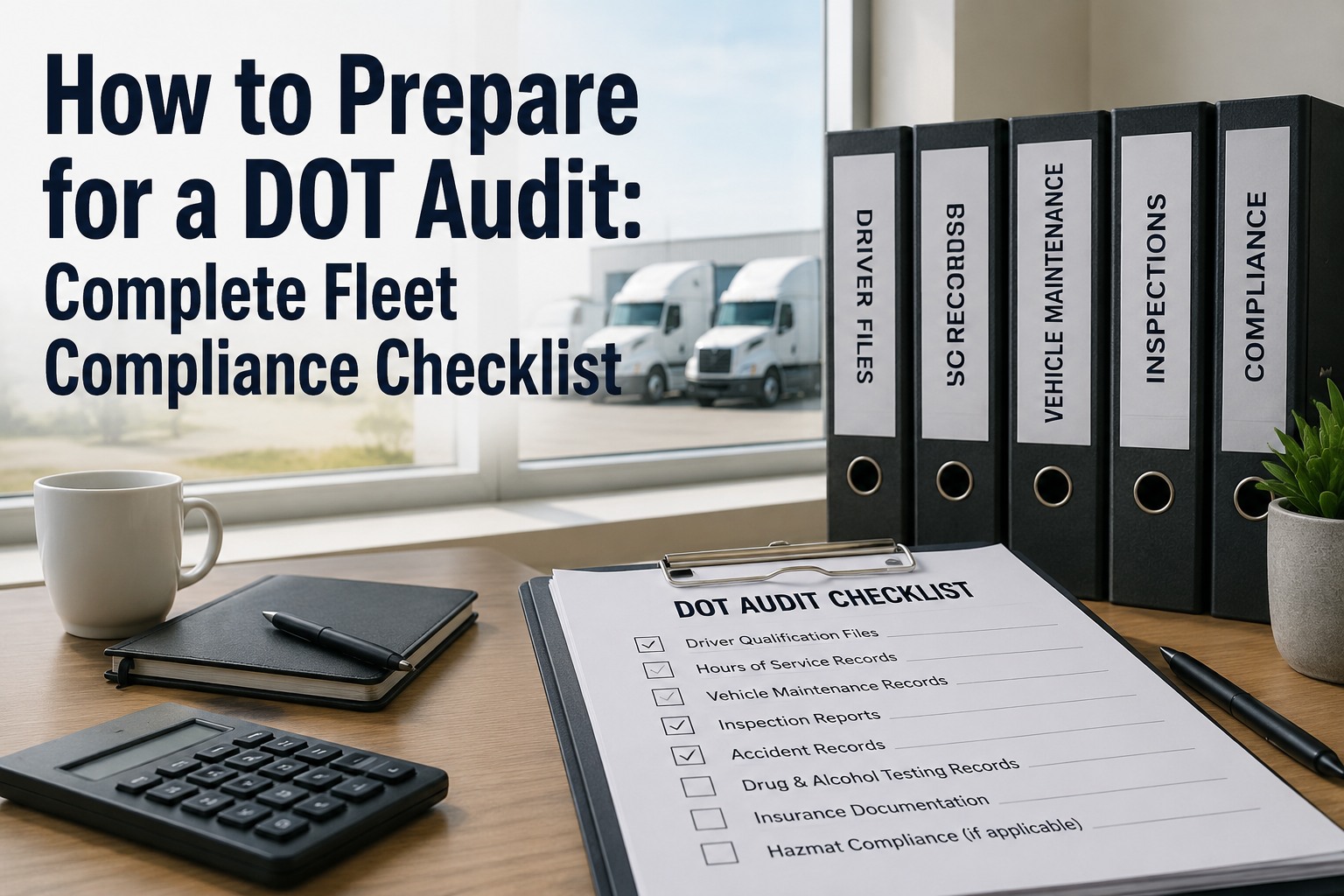
How to Prepare for a DOT Audit: Complete Fleet Compliance Checklist
93% of audited fleets get cited. $19,277 per out-of-service violation. 6 record categories. 16 automatic-failure conditions. Here's how to land in the 7% that walks away clean.
The 4 Types of DOT Audits — What Each One Means
Not every audit is the same. The type of audit you face determines what documents are reviewed, how long it takes, and what happens if you fail. Know which one is on your desk before you start prepping.
The 6 Record Categories Auditors Check First
Every DOT audit hits the same six record categories in roughly the same order. Miss any one and citations follow. Here's what's required in each and how long records must be retained.
The 16 Automatic-Failure Conditions
FMCSA defines 16 bright-line rules under §385.321(b). A single violation of any one fails the entire audit regardless of everything else. Verify all 16 before any other prep work.
The 30-Day Countdown: What to Do When
You typically get 14–30 days between audit notice and audit date. Working backward from the audit, here's the day-by-day countdown that lands well-prepared fleets in the 7%.
Turn audit prep into a byproduct of daily operations
Digital DVIRs. ELD support docs. Maintenance records. Driver files. Annual inspection certificates. Truck Inspection & Maintenance software builds every category the auditor asks for as normal daily work — so audit prep is a filter, not a scramble.
Audit Day Playbook — What Actually Happens
The audit itself is more procedural than adversarial. Here's the exact sequence of what an on-site or off-site auditor typically does, so nothing catches your team off guard.
The Ratings & Consequences You're Playing For
Every full compliance review ends in one of three ratings. Understanding what each one triggers helps you prioritize prep effort correctly.
Frequently Asked Questions
Preparation follows a 30-day countdown. First verify all 16 automatic-failure conditions (valid CDLs, current medicals, active drug/alcohol program, current insurance, systematic maintenance program). Then assemble records across six categories: driver qualification files, 6 months of HOS/ELD data, drug and alcohol program records, maintenance and annual inspection records, 3 months of DVIRs, and operating authority plus insurance documentation. Identify and document gaps — most carriers find 8–15% missing on first review. Finally, assemble the binder or portal folder, brief your team, and confirm delivery method. Truck Inspection & Maintenance software builds these records automatically as a byproduct of daily operations.
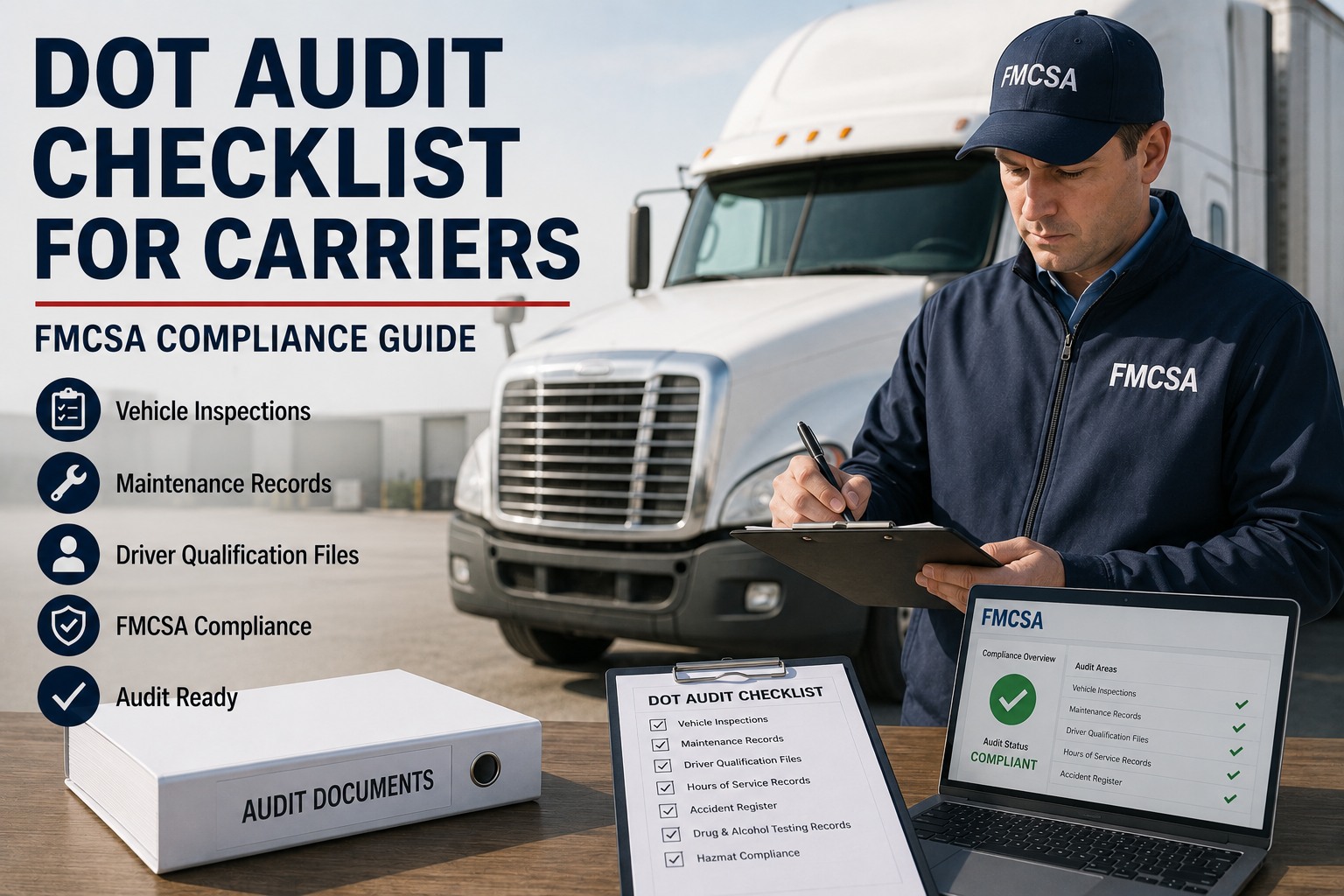
Six core record categories are required. Driver Qualification files under 49 CFR 391 (application, MVR, medical certificate, CDL, Clearinghouse queries). HOS/ELD records under 49 CFR 395.8 (6 months of logs plus supporting documents). Drug and alcohol program under 49 CFR 382 (written policy, test records, random pool documentation, Clearinghouse queries). Vehicle maintenance under 49 CFR 396 (annual DOT inspections, systematic PM records, repair history). DVIRs (3 months minimum). Authority and insurance under 49 CFR 387 (MCS-150, certificate of insurance, MCS-90, accident register for 3 years). All must be retrievable within 48 hours for off-site audits.
FMCSA defines 16 bright-line automatic-failure conditions under §385.321(b). Any single violation fails the entire audit regardless of everything else. They fall into four groups: driver qualification (using a driver without valid CDL, expired medical certificate, or missing Clearinghouse query), drug and alcohol (no testing program, using a driver who refused or tested positive, no pre-employment testing), hours of service (permitting driving beyond HOS limits, no records maintained, falsification), and vehicles/operations (no systematic maintenance program, operating without registration or insurance, using an out-of-service vehicle, operating without authority). Verify all 16 before any other prep work.
You typically get 14–30 days between the audit notice and the audit date. New Entrant Safety Audits are scheduled within the first 12 months of operation. Compliance reviews triggered by CSA scores, crashes, or complaints usually give 2 weeks minimum. Off-site audits require records delivery within 48 hours of the specific document request. The best fleets prepare continuously — records aren't scrambled together in 30 days, they're built as a byproduct of normal operations. Contact our team to see how the software makes audit prep continuous.
Consequences depend on the rating. A Conditional rating means gaps exist but the fleet remains authorized — expect higher insurance costs, lost broker/shipper contracts, and increased CSA monitoring. An Unsatisfactory rating requires a Corrective Action Plan within 45 days; if FMCSA rejects the plan or you don't respond, operating authority can be revoked and the fleet placed out of service. Individual violations carry their own fines — HOS violations can reach $19,277 per infraction. New Entrant audits that fail can lose authority within the first 12 months. Beyond regulatory consequences, brokers and shippers often refuse loads from carriers with Conditional or Unsatisfactory ratings.
Retention varies by record type. HOS/ELD logs: 6 months minimum plus supporting documents. Driver Qualification files: active employment plus 3 years after departure. Drug and alcohol test records: 5 years; program policy indefinitely. Vehicle maintenance records: 1 year while vehicle is in service plus 6 months after. DVIRs: 3 months minimum. Accident register: 3 years. Insurance and operating authority: always current. Missing a retention deadline is itself a violation — records shouldn't be shredded just because "we don't need them anymore." Try free: sign up here.
Truck Inspection & Maintenance software makes DOT audits a filter, not a scramble
DVIR captures at every trip. ELD support documents attached to trip records. Digital driver qualification files. Automatic maintenance and annual inspection scheduling with completion records. Clearinghouse query tracking. Accident register logging. All six FMCSA record categories built as a byproduct of daily operations — retrievable within 48 hours for any off-site audit request, one platform, one workflow, one source of truth.