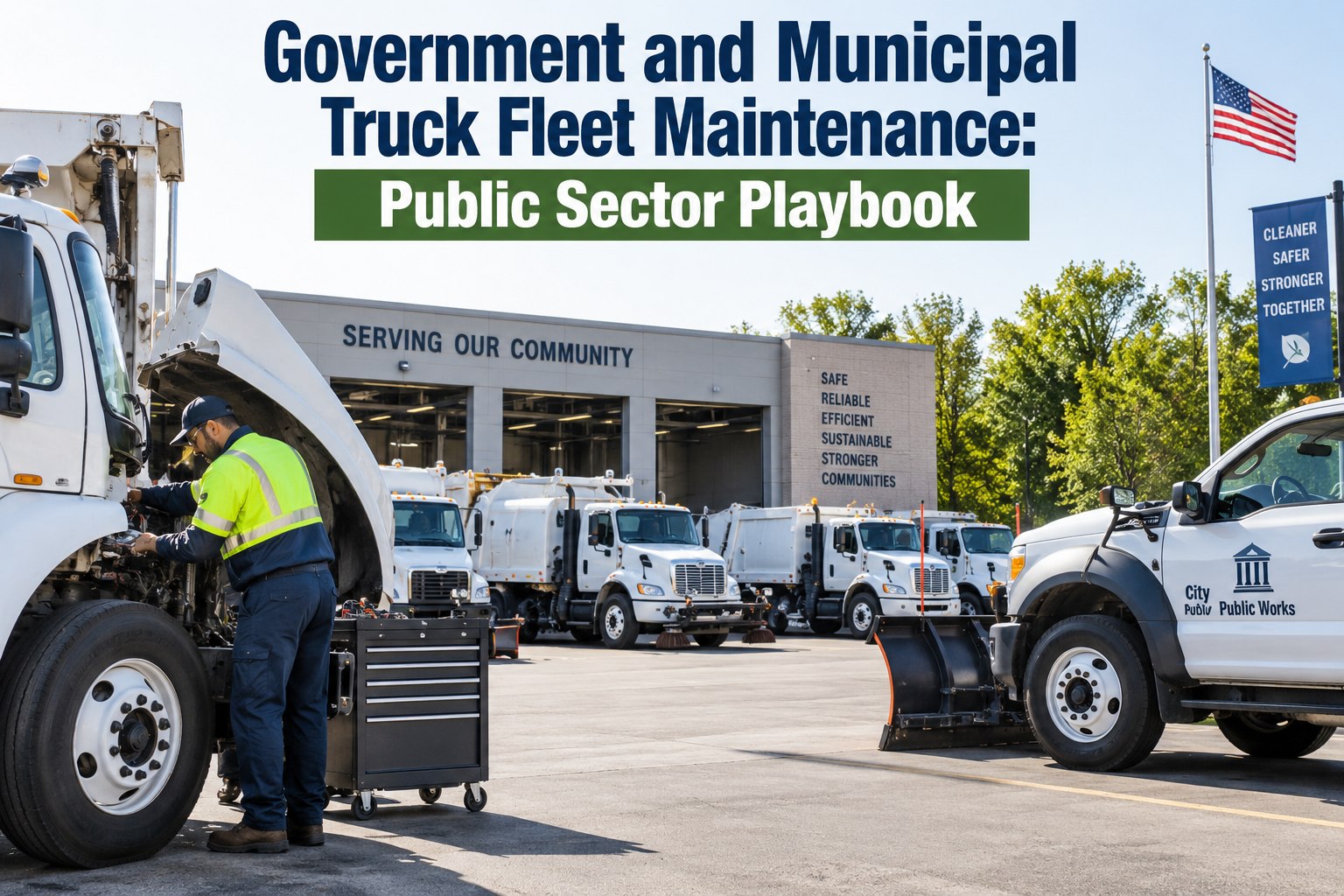
Municipal and government fleet DOT compliance occupies a distinct space in the FMCSA regulatory landscape — one that combines all the obligations of commercial fleet operations with several public sector complications that commercial carriers don't face. Public works, sanitation, water utility, parks, and other government departments operating CDL-required vehicles fall fully under 49 CFR Parts 380-399 with the same DVIR, DQF, maintenance record, drug/alcohol testing, and inspection requirements as any commercial carrier. But government fleets also face additional oversight layers: state DOT audits, internal city or county auditor reviews, performance audits by inspector general offices, and Freedom of Information Act (or state equivalent) requests that can expose compliance records to public scrutiny. The 2025 CVSA International Roadcheck placed 22.6% of inspected vehicles out of service — including significant numbers of municipal fleet vehicles, with brake violations leading at 41% across all categories. Industry data shows only 7% of motor carriers (including government carriers) pass focused FMCSA compliance reviews without violations. Municipal fleet managers carry a particular burden: failures don't just affect operational performance — they become public record, generate news coverage, and trigger political consequences.
The 2026 regulatory environment intensifies municipal fleet compliance importance in three specific ways. The eDVIR Final Rule (effective March 23, 2026) explicitly authorizes electronic DVIRs under §396.11 — formalizing electronic recordkeeping as the regulatory baseline. Paper medical certificates were eliminated January 10, 2026, with all CDL driver medical examiner records flowing through electronic FMCSA systems. The CSA scoring overhaul weights out-of-service violations at 2× severity, splits Vehicle Maintenance into two BASIC categories, adds the "Driver Observed" BASIC for pre-trip walkaround quality, and uses a 24-month violation window. For government fleets, these changes amplify what was already a compliance-heavy environment. The agencies that systematize digital compliance workflow consistently outperform those operating on paper and spreadsheets — fewer violations, faster audit response, better insurance pricing, and stronger defense against the public accountability that government operations require.
This guide is the complete municipal fleet DOT compliance audit checklist for 2026: the 8 categories every audit reviews, the preparation timeline before an audit notice arrives, the most common audit findings affecting government fleets, the regulatory framework citations, and the digital workflow that makes audit defense routine rather than emergency. Start your free trial of our truck inspection and maintenance software to deploy municipal-specific compliance workflow — live in 10 minutes, free for up to 3 trucks.
Municipal Fleet DOT Compliance Audit Checklist: Complete 2026 Guide
Why Municipal Fleet Compliance Is Unique
Government fleet operations face all the regulatory obligations of commercial carriers plus several public sector complications. Understanding these differences explains why generic compliance approaches need adjustment for municipal operations.
Three-Tier Oversight Structure
Mixed Fleet Composition
Public Records Exposure
Budget Constraint Reality
Political Accountability
Procurement & Bidding Constraints
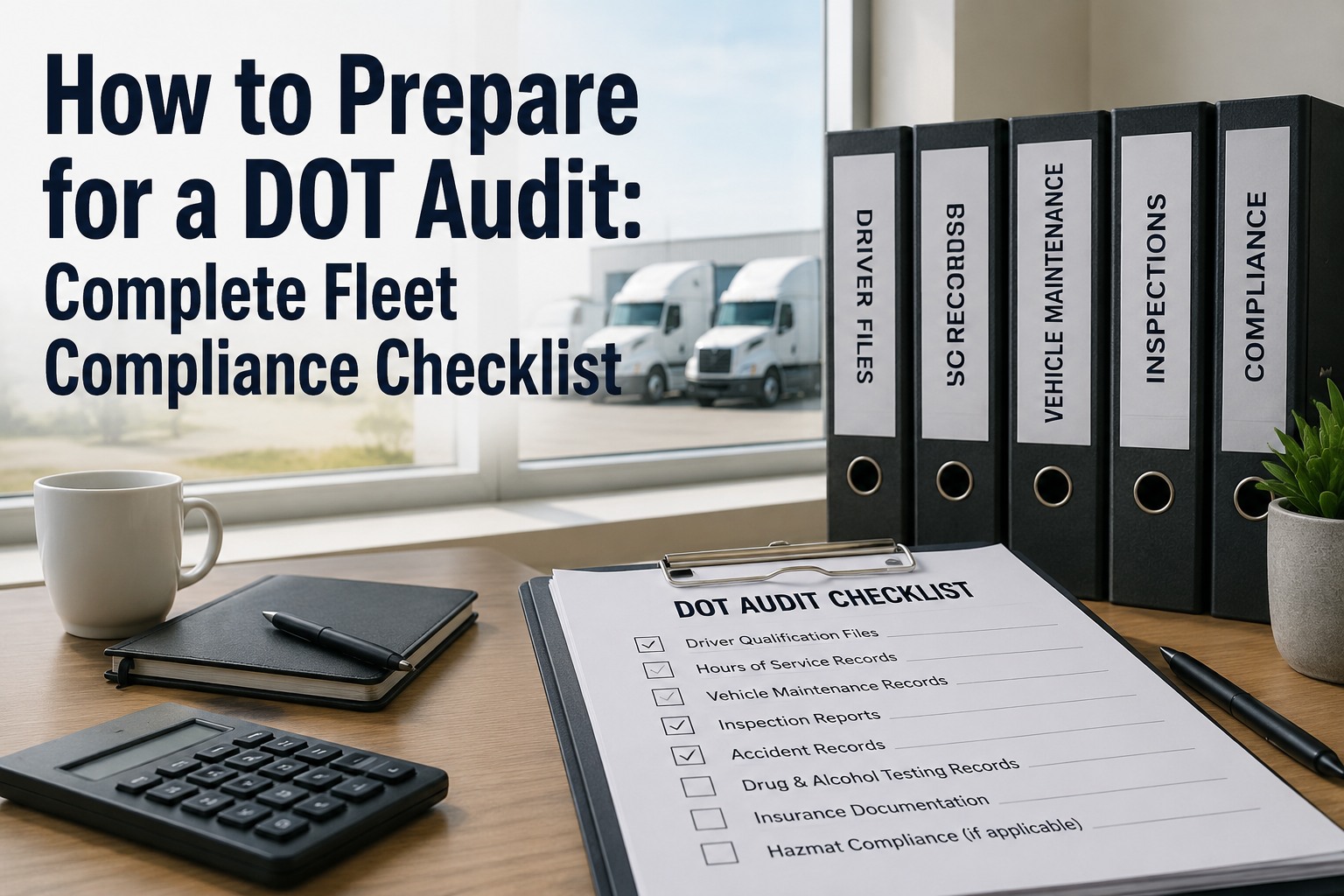
The 8-Category Audit Checklist
Every FMCSA compliance review covers these 8 categories. State and internal audits typically follow similar structure. Prepare for each one continuously rather than scrambling when audit notice arrives. Contact our sales team for help deploying audit-ready documentation workflow.
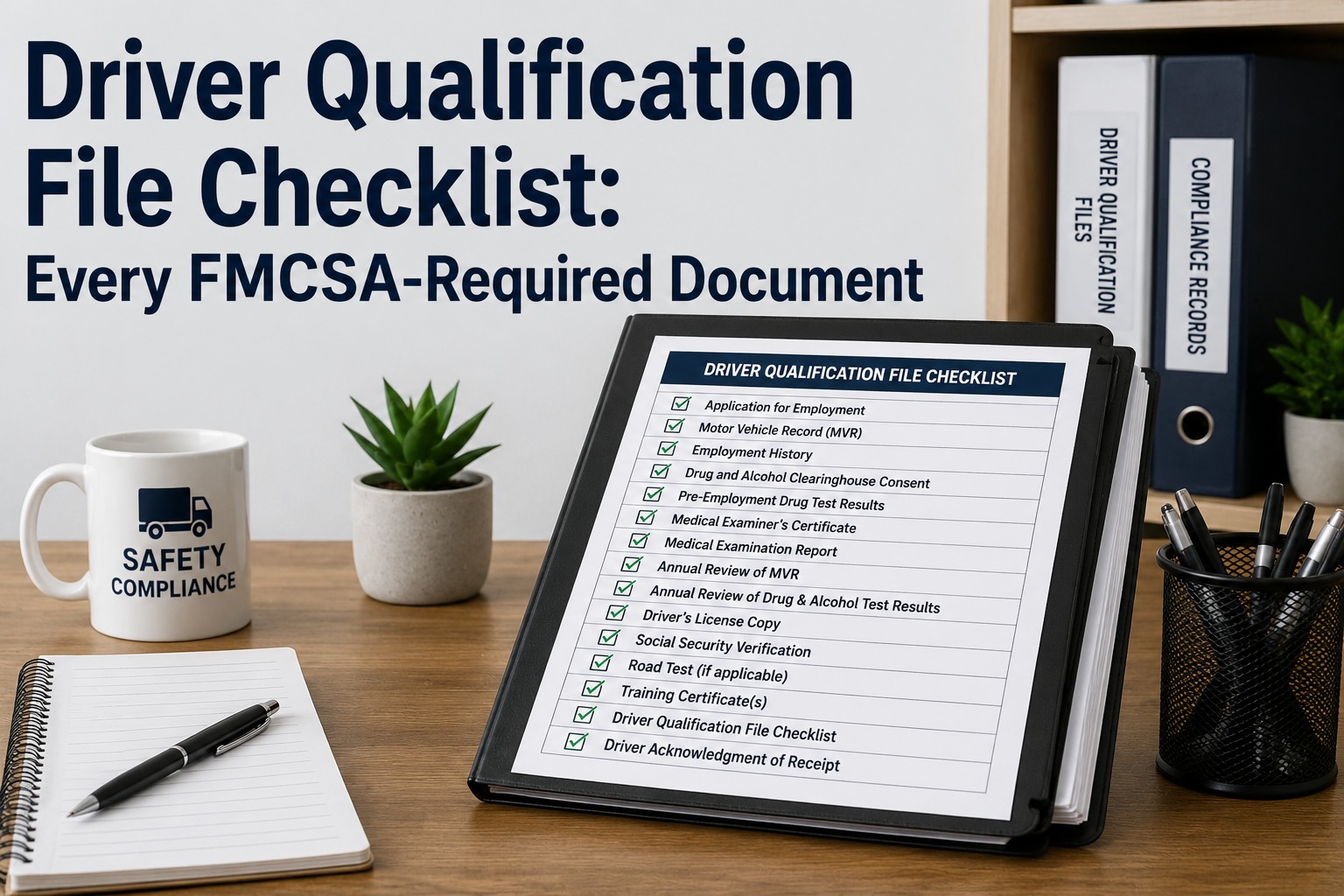
01 CDL Driver Qualification Files
02 DVIR & Pre-Trip Inspections
03 Annual Periodic Inspections
04 Maintenance & Repair Records
05 Drug & Alcohol Testing
06 Hours of Service / ELD
07 Accident Register
08 Vehicle Documentation
The Audit Preparation Timeline
The fleets that pass audits cleanly don't prepare for audits — they maintain continuous compliance that makes audit response routine. Here's the timeline framework for both ongoing discipline and audit-specific response.
| Timeline | Activities |
|---|---|
| Continuous (Daily) | DVIR completion, fault tracking, defect-to-repair workflow, driver communication on inspection findings |
| Continuous (Weekly) | DQF expiration review, MVR renewal scheduling, training record updates, drug testing random selection |
| Continuous (Monthly) | CSA score review, BASIC trending analysis, internal compliance spot-check, maintenance program audit |
| Continuous (Quarterly) | Internal mock audit, drug testing rate verification, accident register review, vehicle documentation audit |
| Audit Notice Received | Document request immediately — typical 48-hour to 30-day response window |
| Day 1-3 Post-Notice | Generate audit packets for requested date range/drivers/vehicles, identify any gaps |
| Day 4-14 | Address documentation gaps, prepare narrative for any anomalies, coordinate with legal counsel |
| Day of Audit | Present documentation, answer auditor questions, maintain professionalism, take detailed notes |
| Post-Audit | Address findings per Corrective Action Response (CAR) requirements, typically 30-60 days |
The single biggest predictor of audit outcomes is whether the fleet maintains continuous compliance discipline or scrambles when audit notice arrives. Continuous-discipline fleets pass audits routinely with minor findings or none. Scrambling fleets find gaps that take weeks to address, often discover they can't fully reconstruct missing records, and incur substantial findings. The 48-hour to 30-day audit response window is not enough time to build documentation that should have been maintained continuously — making the platform decision and ongoing workflow discipline more important than any audit-specific preparation.
Common Municipal Fleet Audit Findings
These five findings appear most frequently in government fleet audits. Address them proactively rather than discovering them during compliance reviews.
Incomplete DQF Documentation
Broken DVIR Chain of Custody
Missing Annual Inspection Records
Drug Testing Documentation Gaps
Undocumented Systematic Maintenance
The Public Sector Compliance Framework
Eight FMCSA citations define municipal fleet compliance obligations. Reference these in policy documents, training materials, and audit response.
Driver Qualification Files
Driver Vehicle Inspection Reports
Annual Periodic Inspection
Systematic Maintenance Program
Drug & Alcohol Testing
Hours of Service / ELD
Accident Register
Public Records Exposure
Frequently Asked Questions
Do FMCSA regulations apply to municipal fleets?
Yes, with specific exemptions. CDL-operated commercial motor vehicles (CMVs) in municipal fleets — public works trucks, sanitation, water utility, parks vehicles operating at 26,001+ pounds GVWR — fall fully under FMCSA regulations including DVIR (§396.11), DQF (Part 391), maintenance records (§396.3), annual inspections (§396.17), drug/alcohol testing (Part 382), and Hours of Service (§395.8). Exemptions exist for specific situations: emergency vehicles during emergency response are exempt from HOS but not from DQF, DVIR, or maintenance; school buses operate under separate regulatory framework (49 CFR Part 380 and other applicable rules); transit buses operate under FTA regulations; military vehicles are exempt entirely; some small-government operations may qualify for limited exemptions. The default assumption should be that FMCSA applies unless specific exemption documented. State DOT regulations often layer additional requirements on top of federal FMCSA rules. Start your free trial for municipal compliance workflow.
How often does FMCSA audit municipal fleets?
FMCSA compliance reviews can be triggered by several factors: poor CSA scores in any BASIC, post-accident review after fatal incidents, complaint-based investigations, random selection from carrier population, or as part of new entrant safety assurance program. Municipal fleets face the same audit triggers as commercial carriers, plus additional state DOT audit programs in many jurisdictions, internal city/county auditor reviews on regular schedules, and inspector general performance audits. Single fleet may face multiple audit types per year — federal compliance review, state safety audit, internal financial audit, performance audit. Audit notification typically arrives via mail or email with document request and response window ranging from 48 hours (focused review) to 30 days (compliance review). The pattern: fleets maintaining continuous compliance discipline pass these audits routinely; fleets scrambling to assemble documentation find significant gaps. Continuous discipline beats emergency preparation. Contact our sales team for ongoing compliance workflow.
Are police and fire vehicles exempt from DOT compliance?
Police and fire vehicles have specific exemptions but not blanket immunity from DOT compliance. True emergency response activities (responding to calls with lights/sirens, fire suppression, active law enforcement) are exempt from many FMCSA requirements including Hours of Service. However, several exemptions are commonly misunderstood: training operations are not emergency response and require compliance; transit/positioning operations (moving vehicles between stations) require compliance; non-emergency support activities require compliance; maintenance of emergency vehicles still requires §396.3 systematic maintenance and §396.17 annual inspection in many jurisdictions. The CDL requirement applies based on vehicle weight and configuration rather than emergency status — a 26,001+ pound fire apparatus typically requires CDL for non-emergency operation. State and local laws may layer additional requirements. The default approach: document exemptions claimed, maintain compliance for non-exempt operations, and don't assume blanket exemption that doesn't exist in regulation. Many police and fire fleets have been cited for compliance failures because they assumed broader exemptions than actually exist.
What software do municipal fleets typically use?
Municipal fleets typically use a mix of platforms reflecting their multi-tier oversight and procurement constraints. Common categories: fleet management platforms (often shared with public works asset management); compliance-specific software for DVIR, DQF, and audit prep; ELD/HOS providers for CDL operations; fuel management systems; accident management platforms; and procurement/cooperative purchasing agreements with state contract vendors. The fragmentation problem: running 4-6 disconnected systems creates data silos, manual reconciliation work, and audit prep that requires assembling documentation from multiple sources. Modern integrated platforms reduce this fragmentation by handling DVIR + DQF + maintenance + compliance on one workflow. Procurement considerations: many municipalities have access to state contract pricing (often more favorable than direct vendor pricing), cooperative purchasing agreements (NASPO, GSA Schedule 70, NCPA), and grants for compliance technology. The selection process: evaluate platforms against the 8 audit categories rather than feature checklists, validate municipal-specific workflow (mixed fleet handling, public records integration), and ensure vendor will work within municipal procurement framework. Sign up free to validate platform fit.
What happens if a municipal fleet fails a DOT audit?
Consequences vary by audit type and severity of findings. Federal FMCSA compliance review findings result in: (1) Corrective Action Response (CAR) requirements within 30-60 days; (2) civil penalties ranging from $1,584/day for missing records to $19,277-$23,048 for out-of-service operation violations; (3) CSA score impact compounding across 24-month violation window; (4) potential conditional safety rating affecting operations and insurance; (5) increased audit attention in future periods. State DOT audit findings often produce similar civil penalties under state regulatory framework. Internal city/county auditor findings produce: administrative consequences, policy changes, sometimes personnel actions, public reporting in audit findings. Public exposure compounds these consequences for municipal fleets — audit findings can become news coverage, FOIA requests pull additional records into public scrutiny, and political accountability falls on elected officials. The cumulative cost of a serious audit failure for municipal fleets commonly runs $100K-$500K+ in penalties, remediation costs, software/training investment, and indirect political/career consequences. Single avoided audit failure typically pays for years of compliance platform across the entire fleet.
How can budget-constrained municipal fleets improve compliance?
Three approaches deliver substantial improvement within municipal budget constraints. First, focus on the highest-leverage compliance gaps — DQF completeness (#1 finding), DVIR chain of custody (#2), and annual inspection tracking. These three address roughly 60-70% of typical audit findings and require modest investment. Second, leverage existing tools rather than buying new — most municipal fleets already have some software; the question is whether it's being used to its compliance potential rather than whether new platforms are needed. Third, explore state contract pricing and cooperative purchasing agreements that often provide significant discounts on compliance software. NASPO ValuePoint, GSA Schedule 70, NCPA, and state-specific contracts commonly offer 20-40% pricing improvements. Free tier platforms (typically free for 1-3 vehicles) allow validation before scaling. Grants for fleet safety technology are increasingly available — check FMCSA Motor Carrier Safety Assistance Program (MCSAP) grants and state-specific safety grants. The pattern: budget-constrained fleets can achieve substantial compliance improvement through focused investment in highest-leverage areas rather than comprehensive platform overhauls. Talk to our sales team for cooperative purchasing options.