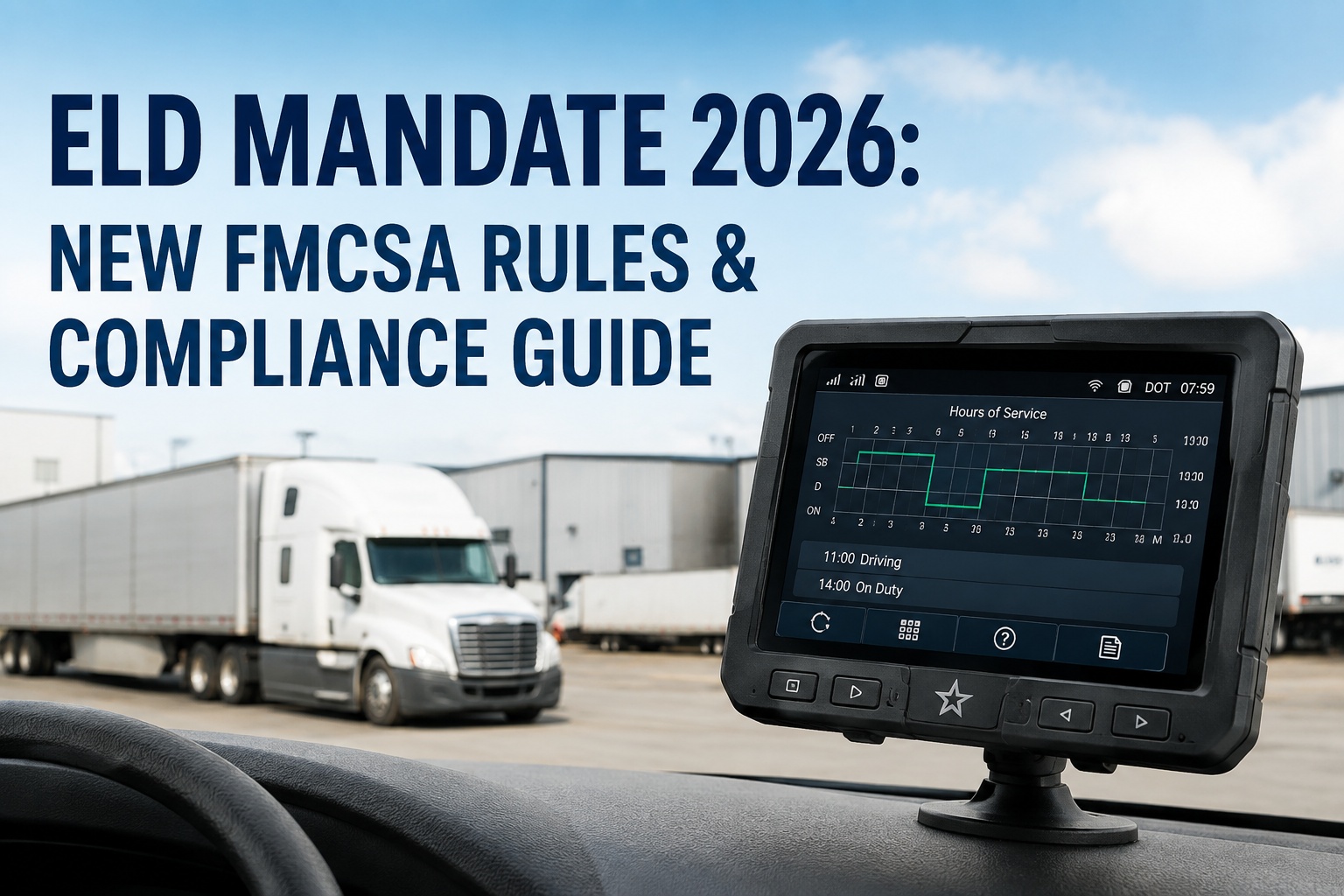
The ELD Mandate itself hasn't changed in 2026 — but the enforcement environment around it has changed dramatically, and fleets treating "we have a device" as compliance are getting caught. FMCSA estimates the ELD mandate prevents 1,844 crashes, 562 injuries, and 26 fatalities every year, and the agency has moved from education mode into strict zero-tolerance enforcement. In January and February 2026 alone, FMCSA revoked multiple popular ELD devices from its registered list, forcing thousands of carriers to scramble for compliant hardware within a strict 60-day replacement window. On February 19, 2026, electronic DVIRs became explicitly and unambiguously legal — GPS-stamped, photo-verified, and audit-ready records replaced years of paper ambiguity. Then on July 22, 2026, FMCSA rescinded the requirement to keep the ELD operator's manual in the cab. This guide walks through the current ELD framework — what's required today, what changed in 2026, revoked-device risk, exemptions, penalties, and how Truck Inspection & Maintenance pairs ELD-driven HOS data with digital DVIRs so your fleet's compliance is one system, one audit trail, one login.
ELD Mandate 2026: New FMCSA Rules & Compliance Guide
The law hasn't changed. The enforcement has. Here's what fleets need to know now.
What Actually Changed in 2026 — The Timeline
There is no brand-new ELD mandate law in 2026. What changed is the enforcement environment and the surrounding compliance ecosystem. Four specific developments in the first half of 2026 reshaped what "ELD compliant" actually means in practice:
Broker Financial Rules Tightened
Effective January 16, brokers must maintain $75,000 in liquid trusts or bonds as "assets readily available" — group trusts eliminated. Direct pressure on carrier payments and downstream compliance capacity.
ELD Zero-Tolerance Enforcement
Effective February 7, carriers using revoked ELDs face immediate out-of-service orders. Multiple popular devices removed from FMCSA's registered list in January and February — thousands of trucks scrambling to replace hardware.
eDVIRs Explicitly Legalized
February 19 final rule removed ambiguity around paper vs digital inspections. Electronic Driver Vehicle Inspection Reports now formally legal — driver and mechanic sign-off both digital, no wet ink required, records must be electronically producible.
ELD Manual No Longer Required in Cab
Effective July 22, FMCSA rescinded 49 CFR 395.22(h) requirement to carry a physical ELD operator's manual. Drivers must still understand ELD operation and carry three other documents. Clean out the glovebox — carefully.
ELD Technical Modifications Proposed
FMCSA scheduled to issue proposed rule November 2026 (RIN 2126-AC50) covering technical modifications to ELD specifications. Not final yet — monitor eld.fmcsa.dot.gov for any changes affecting current device compliance.
The Core ELD Requirements — What Every Fleet Still Owes
Before diving into 2026's enforcement changes, understand the foundational framework that hasn't changed. Under 49 CFR Part 395 Subpart B, most CMV drivers required to keep records of duty status must use a registered ELD to track hours of service. The rules cover six pillars — miss any one and you're non-compliant regardless of technology:
Registered Device
Only ELDs on FMCSA's registered list at eld.fmcsa.dot.gov qualify. Verify your device is still listed — revocations happen without warning.
Automatic Recording
Device must auto-capture engine hours, vehicle motion, miles driven, and location every 60 minutes during driving — no manual entry allowed for these.
Data Transfer Ready
Must support electronic data transfer to authorized safety officials via web services, email, USB2.0, or Bluetooth at roadside inspection.
6-Month RODS Retention
Records of duty status retained for 6 months. Supporting documents also 6 months. Digital storage strongly preferred over paper backup.
8-Day Malfunction Rule
If device malfunctions, driver switches to paper logs immediately. Repair or replace within 8 days. Beyond 8 days, formal extension request to FMCSA required.
Driver Certification
Drivers certify RODS at end of each 24-hour period. Any edits require driver review and re-certification. Unassigned driving time must be resolved.
The Revoked Device Problem — 2026's Biggest Compliance Trap
The single biggest ELD risk in 2026 is not lack of a device — it's using one that's been silently revoked. FMCSA continues removing non-compliant ELDs from its registered list under 49 CFR Part 395, and once a device is revoked, carriers have a strict 60-day window to replace it or face out-of-service orders. Here's what to do about it:
Zero-Tolerance Since February 2026
Carriers using revoked devices face immediate out-of-service orders. HOS violations accumulate the moment a device leaves the registered list — even if the driver had no way to know.
Hours of Service — The Rules the ELD Enforces
The ELD is the enforcement mechanism. The rules being enforced are the Hours of Service regulations under 49 CFR Part 395. Every driver, dispatcher, and safety manager must know these limits cold — because the ELD will not let anyone pretend otherwise:
Your ELD covers HOS. What covers everything else?
ELDs enforce driving hours — they don't handle DVIRs, defect-to-work-order routing, driver qualification files, or the audit trail that ties it all together. Truck Inspection & Maintenance runs digital DVIRs alongside your ELD data, storing everything in one driver file with GPS-tagged, timestamped audit evidence. Sign up free for up to 3 vehicles — no hardware, no contracts.
ELD Exemptions — Who's Not Required
Not every commercial driver falls under the ELD mandate. Understanding exemptions matters because operating an exempt vehicle without exemption documentation is treated as non-compliance. Four categories are recognized under current FMCSA rules:
Pre-2000 Engine Vehicles
Vehicles manufactured before model year 2000 are exempt because the engine control module can't communicate with modern ELDs. Engine model year — not vehicle registration year — is the determining factor.
Short-Haul Under 150-Mile Radius
Drivers who return to their normal work reporting location within 14 hours and operate within a 150 air-mile radius. Must not exceed 11 driving hours. Time cards suffice — no RODS or ELD required.
Driveaway-Towaway Operations
Drivers transporting a vehicle that is itself the commodity being delivered — new truck deliveries, RV dealer transfers, and similar operations. Exempt from ELDs but must still comply with HOS.
8-Days-in-30 Occasional Drivers
Drivers who maintain RODS for no more than 8 days in any 30-day period may use paper logs. Common for occasional drivers, part-time operators, and specialty haulers with intermittent CDL work.
Penalties & Enforcement Reality
ELD enforcement in 2026 is no longer theoretical. FMCSA has published the escalation ladder — and it moves fast when problems accumulate. Here's the real-world cost structure fleets face:
Roadside Violation
Fine per violation, CSA points on carrier record. HOS violations logged directly by ELD data during inspection — no argument possible.
Out-of-Service Order
Truck taken out of service on the spot. Driver held until compliance restored. Immediate revenue loss plus tow/storage fees.
Falsification Charges
Log falsification via ELD data manipulation carries severe carrier penalties and possible criminal charges. Personal driver liability applies.
Compliance Review Trigger
Repeated ELD/HOS violations trigger FMCSA compliance reviews. Sustained pattern leads to unsatisfactory rating and potential authority revocation.
The 2026 ELD Compliance Checklist
Print this. Assign an owner for each row. This is exactly what a DOT auditor will walk through during a compliance review, and it's what a plaintiff attorney will subpoena after a crash. Every checkbox is a documented artifact:
Frequently Asked Questions
Is there a new ELD mandate in 2026?
No. The core ELD mandate has been in full effect since December 2019 and its foundational rules under 49 CFR Part 395 Subpart B remain unchanged. What changed in 2026 is enforcement — FMCSA moved to zero-tolerance for revoked devices, formally legalized electronic DVIRs, rescinded the in-cab operator's manual requirement, and scheduled a proposed rule on technical modifications for November 2026.
What happens if my ELD is revoked from the FMCSA list?
You have a strict 60-day window from the revocation date to replace the hardware. During transition, drivers switch to paper logs. After 60 days, using the revoked device triggers immediate out-of-service orders. Bookmark eld.fmcsa.dot.gov/List and verify your device at least monthly — revocations happen without advance notice to individual carriers.
Do I still need to carry the ELD operator's manual in the cab?
No — effective July 22, 2026, FMCSA rescinded that requirement under 49 CFR 395.22(h). Drivers must still understand how their ELD works and be able to produce records during roadside inspections, but the physical manual no longer needs to ride in the cab. Three other documents (blank paper logs, ELD user's guide instructions from the driver's perspective, and instruction sheet for data transfer) are still required.
Who's exempt from the ELD mandate?
Four categories: vehicles with engines manufactured before model year 2000, short-haul drivers within a 150 air-mile radius returning within 14 hours, driveaway-towaway operations, and drivers keeping RODS for no more than 8 days in any 30-day period. Even exempt operations must still comply with HOS limits — the exemption is from ELD hardware, not from the underlying rules. Talk to our team to verify your exemption status.
How long must I retain ELD records?
6 months for records of duty status and 6 months for supporting documents (fuel receipts, bills of lading, dispatch records, expense receipts, communications). Digital storage is strongly preferred — during audits and litigation, being able to produce records within minutes instead of days is decisive. Edit histories must also be preserved with reason codes for every change.
How does Truck Inspection & Maintenance work with my ELD?
Truck Inspection & Maintenance handles everything your ELD doesn't — digital DVIRs, defect-to-work-order routing, driver qualification files, inspection templates, and audit-ready record retention — all timestamped and GPS-tagged. Your ELD covers HOS; TIM covers the rest of your compliance stack, in one digital driver file. Sign up free for up to 3 vehicles.
Your ELD isn't the whole compliance system. Truck Inspection & Maintenance is the rest.
ELDs enforce driving hours. Everything else — inspections, defect routing, driver qualification files, maintenance history, audit trails — needs its own digital home. Truck Inspection & Maintenance runs the rest of the FMCSA compliance stack alongside your ELD data, free for up to 3 vehicles with no hardware and no contracts. Set it up in 10 minutes and stop stitching compliance together from spreadsheets and paper.