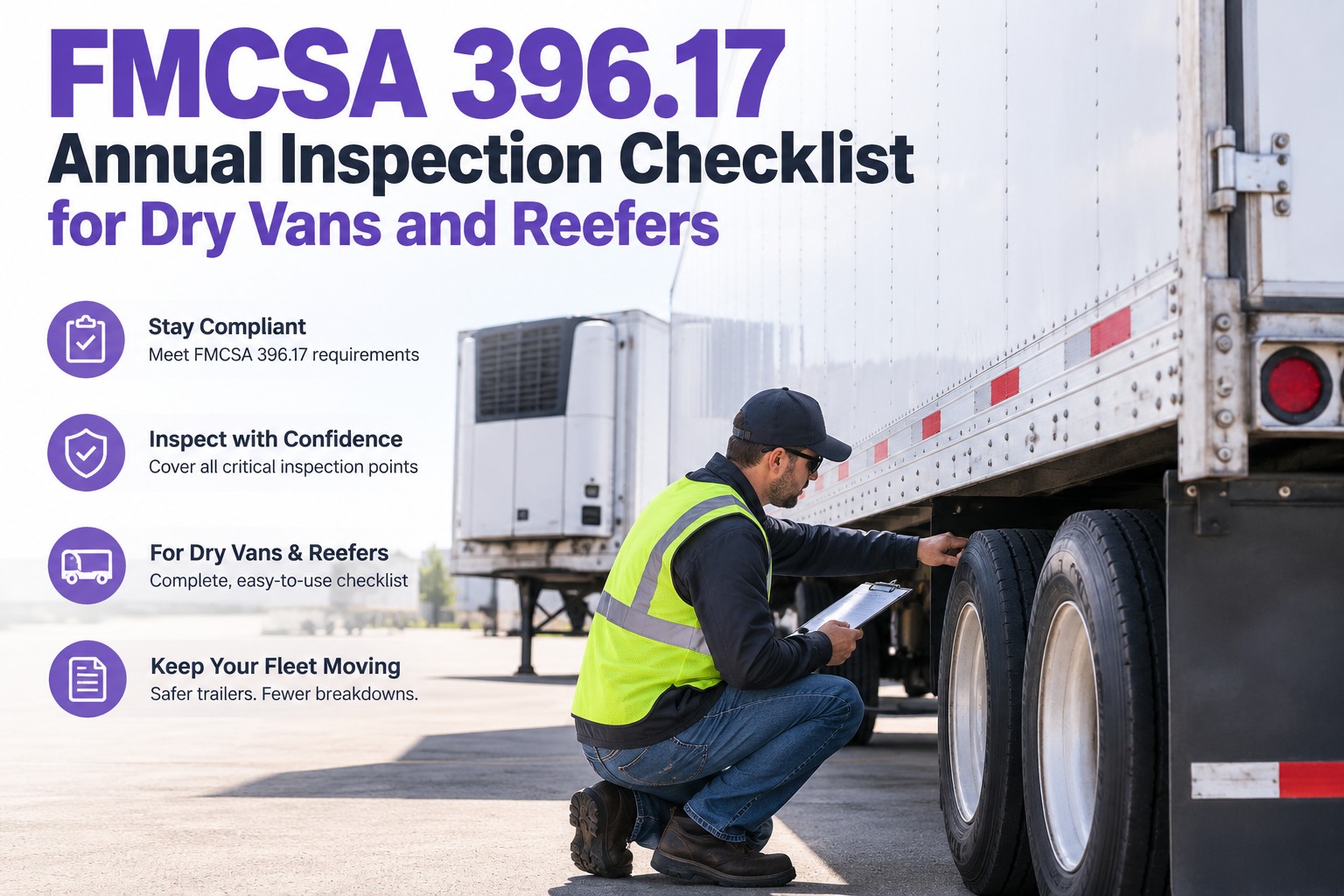
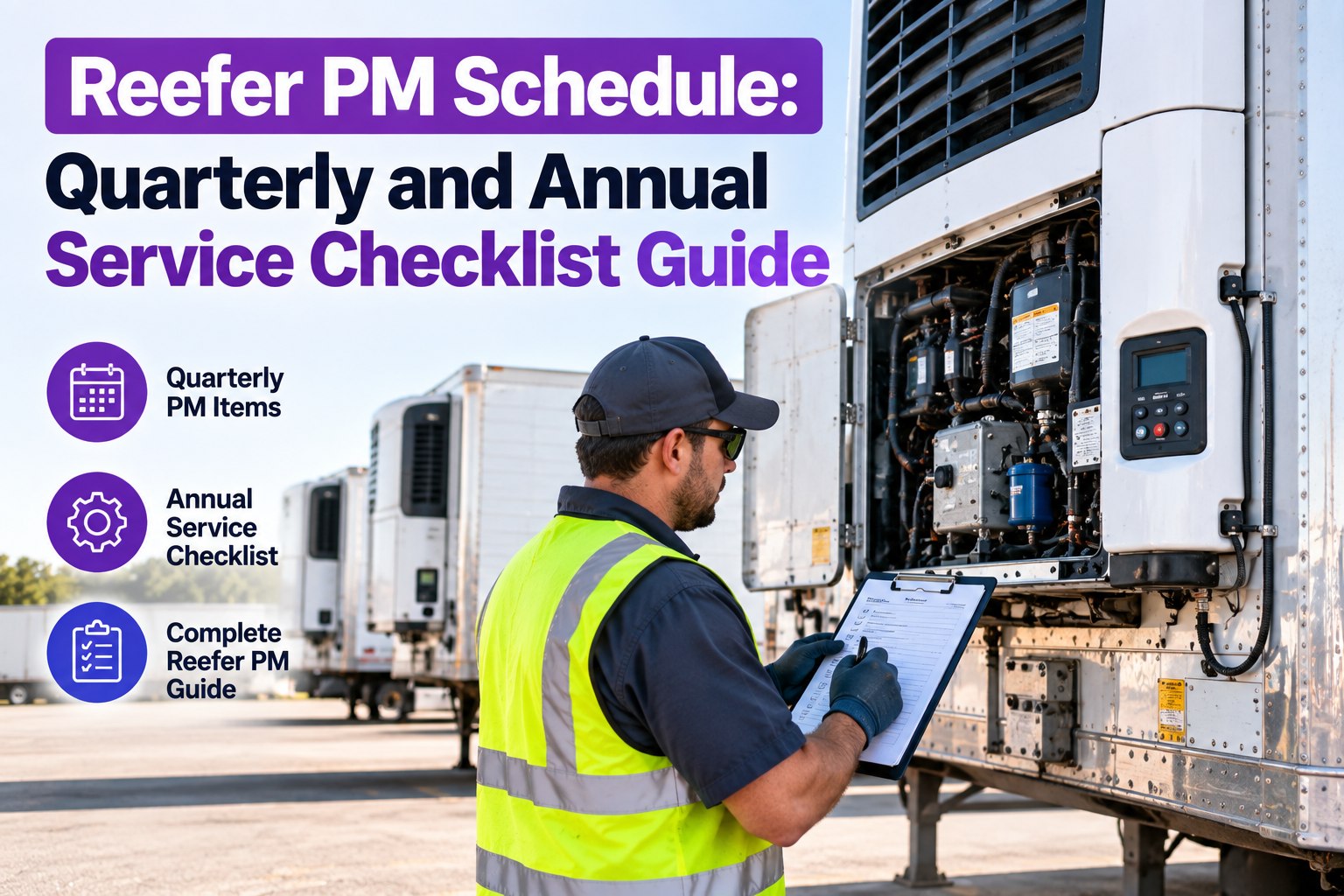
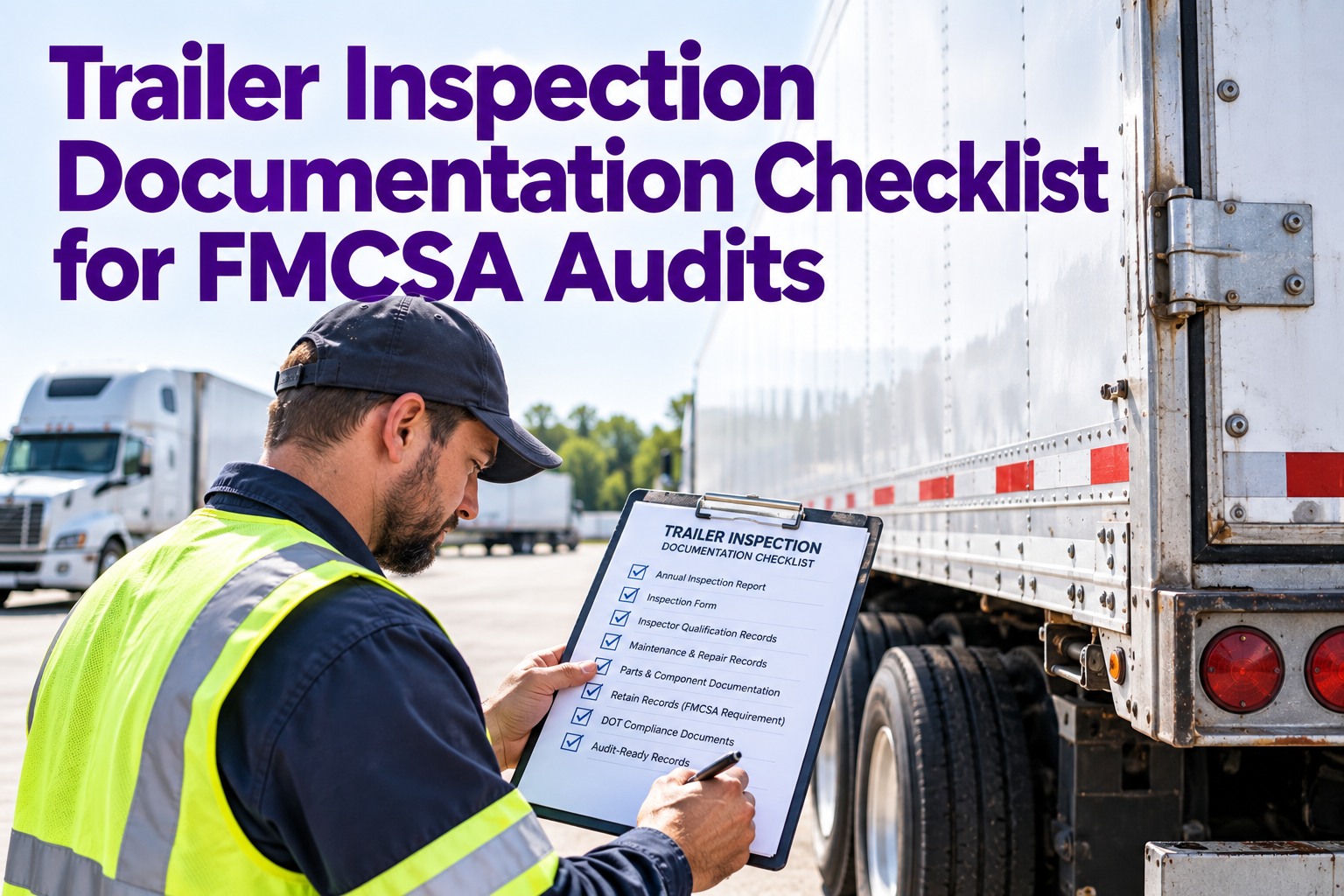
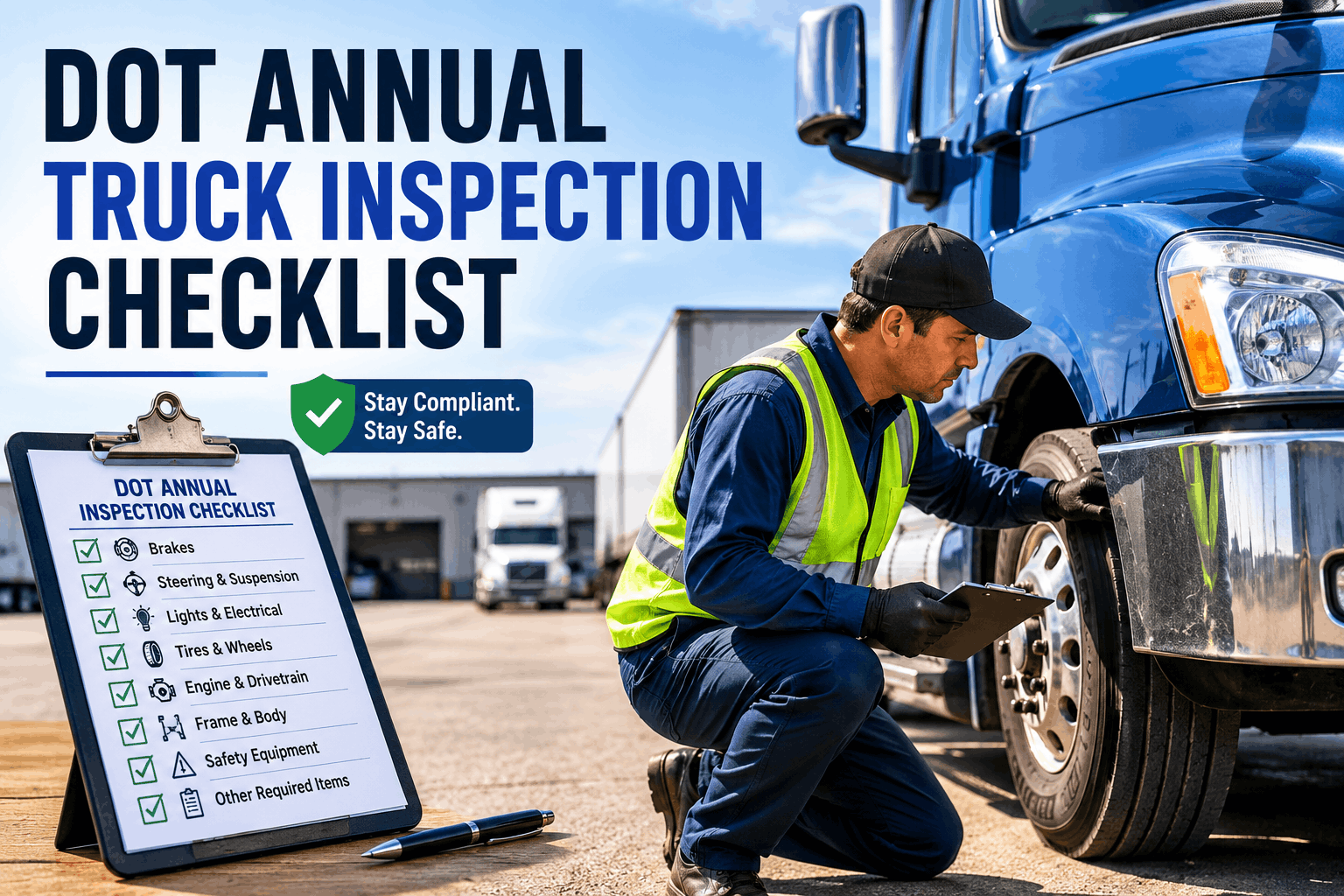
Every commercial trailer in the US needs a §396.17 annual inspection — a once-a-year, top-to-bottom check by a qualified inspector covering thirteen component areas set out in Appendix G of the FMCSA regulations. Miss it and the truck can be placed out of service; do it poorly and you're still liable when a component fails between annuals. The rule is federal, but the execution is shop-level: a dry van, a reefer, and a flatbed all get inspected against the same thirteen categories, but each has trailer-specific hotspots that decide whether the sticker gets applied. This is that checklist — grouped by component, with the actual defect thresholds inspectors apply. Start free and put the full §396.17 checklist on your inspector's phone.
§396.17 · Annual Inspection · Dry Van & Reefer
The Full §396.17 Annual Inspection Checklist — Every Category, Every Threshold
A missed annual isn't a paperwork slip — it's an OOS order waiting for the next roadside. Truck Inspection & Maintenance Management Software runs the full Appendix G walkaround on a tablet, records every measurement, captures inspector signature and credentials, and files a §396.21-compliant report that stands up in a DOT audit.
13Appendix G component categories
12 morequired inspection interval per §396.17
14 morecord retention per §396.21
What §396.17 Actually Requires
Before the checklist itself, the rule in plain terms. §396.17 says every CMV must be inspected at least every 12 months to Appendix G standards, by a qualified inspector defined under §396.19, with a signed report retained per §396.21. What follows is what "to Appendix G standards" means, category by category.
§ 396.17
The interval
Every CMV must be inspected at least once every 12 months. State equivalency accepted from 23 approved jurisdictions per FMCSA list.
§ 396.19
The inspector
Must have combination of training and one year of experience OR completed a federally-approved training program. Credentials retained per §396.19.
§ 396.21
The record
Report retained 14 months from date of inspection at the location where the vehicle is normally garaged. Sticker on the vehicle proves compliance to roadside inspectors.
The 13 Appendix G Component Categories
The rule lists thirteen categories, and every inspector uses the same list regardless of trailer type. What differs by trailer is which categories are most likely to fail — a reefer's aftertreatment isn't relevant, but its refrigeration unit adds its own check; a flatbed adds cargo-securement hardware; a dry van's box structure gets deeper scrutiny. The list itself is fixed.
1Brake System
2Coupling Devices
3Exhaust System
4Fuel System
5Lighting Devices
6Safe Loading
7Steering Mechanism
8Suspension
9Frame
10Tires
11Wheels & Rims
12Windshield Glazing
13Windshield Wipers
Trailer scope For a trailer-only annual, the applicable categories collapse to about eight — brakes, coupling, lighting, safe loading, suspension, frame, tires, wheels. The other five (exhaust, fuel, steering, glazing, wipers) apply to the tractor. This is why an inspector charges differently for a tractor annual vs. a trailer annual — different scope.
Brakes — The Category That Fails Most Annuals
Brakes are the single largest source of §396.17 failures and roadside OOS orders. Every brake gets inspected individually — chamber, pushrod stroke, slack adjuster, lining, drum. On a tandem-axle trailer that's eight brakes; miss one and 20% of the brakes are defective, which is an automatic OOS under FMCSA §393.47.
Brake chamber mounting
No cracks, no missing bolts, secure to bracket
Pushrod stroke (applied)
Within chamber-size spec — Type 30: ≤ 2.00", Type 24: ≤ 1.75"
Slack adjuster
Aligned, no free play > 1", ASA functioning
Lining thickness
Above rivets at thinnest point (min ¼" for drum brakes)
Drums / rotors
No cracks through friction surface (CVSA-2026 focus)
Air lines & glad hands
No chafing, no leaks; 3 psi/min max loss applied (combo)
ABS malfunction lamp
Illuminates then extinguishes after 5 mph — lit = OOS
Breakaway system
Function test — cut air, pull plunger, brakes must apply
Coupling & Structure
The coupling is the load path between tractor and trailer, and the frame is what holds the whole thing together. Both get scrutiny under §396.17 because a failure of either isn't a repair — it's a runaway or a rollover.
🪝Coupling Devices
- Kingpin — no wear beyond spec (typical max 0.500" wear)
- Upper coupler (trailer apron) — no cracks, flush contact
- Locking mechanism — engages fully, safety latch present
- Fifth-wheel plate — no cracks, all mounting bolts present
- Air & electrical connections — glad hands sealed, 7-way clean
- Safety chains (where applicable) — no wear, hooks secure
🏗️Frame & Structure
- Frame rails — no cracks, no unauthorized welds or repairs
- Crossmembers — none missing, no cracks at gussets
- Landing gear — legs straight, crank operational, pins secure
- Mud flaps — present, correct height (§393.86)
- Body panels — secure, no protruding hardware
- Rear impact guard — proper attachment, no cracks (§393.86)
Tires, Wheels & Suspension
Tires and wheels together account for about a quarter of every roadside OOS report — and the annual is the one time a shop lifts the trailer, spins every wheel, and checks what the driver never sees.
Tread depth
Trailer tires min 2/32" at any point across tread
Tire sidewall
No cuts, bulges, exposed cord, or ply separation
Wheel condition
No cracks in rim or spokes; no elongated stud holes
Lug nuts
All present, torqued to spec, no rust streaks (loose nut indicator)
Wheel-end hub oil
Visible in sight glass, no leaks at seals — clear (not milky)
Suspension — springs
No cracked or broken leaves; U-bolts tight; no shifted axle
Suspension — air
Airbags intact, no leaks; height control valve functioning
Bushings & hangers
No wear beyond spec; frame attachment secure
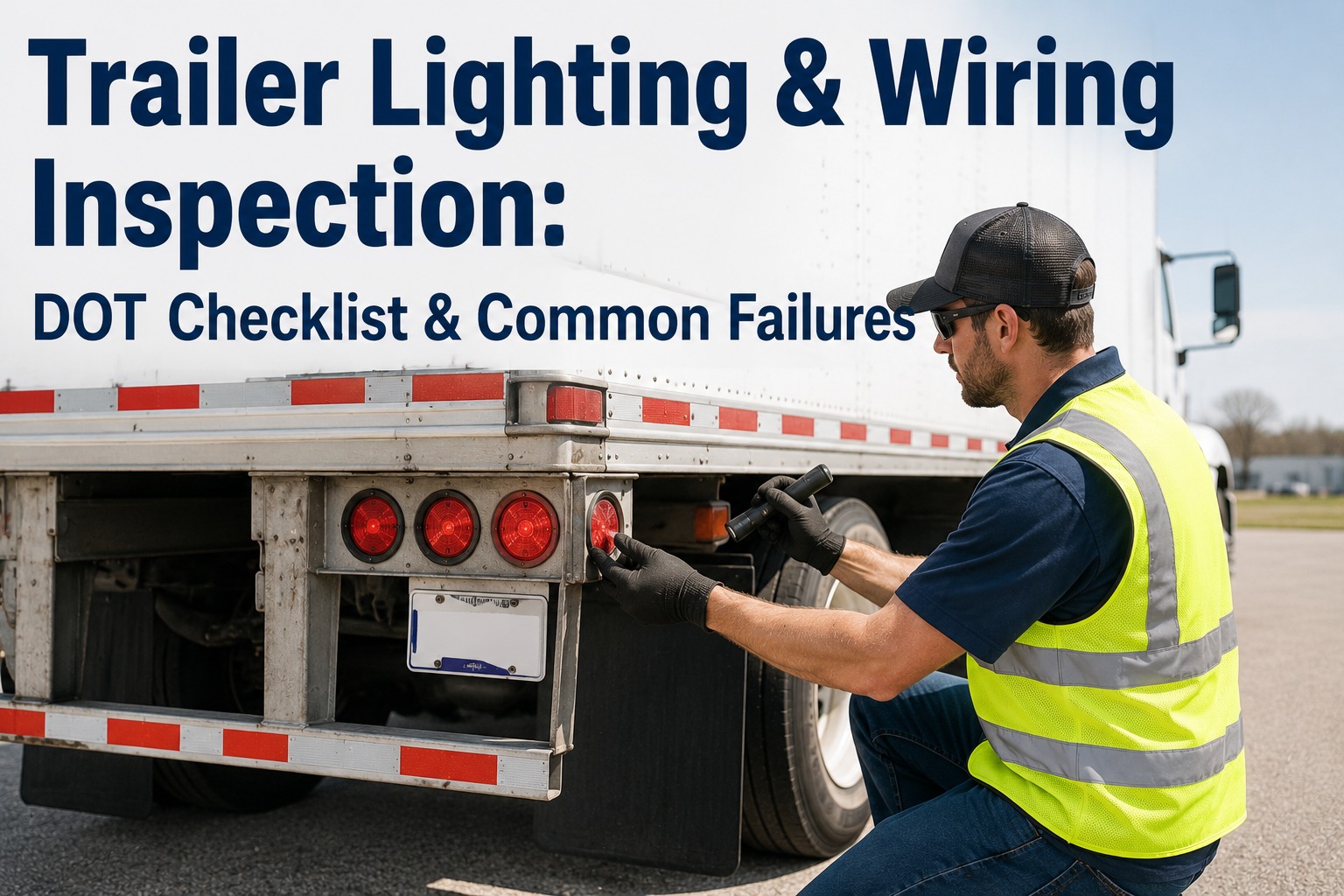
Lighting & Reflective Devices
Every lamp, every reflector, every conspicuity strip. A single burned-out marker lamp isn't automatic OOS — but a pattern of them in an annual usually means the harness is compromised, which is.
💡
Marker & Clearance
All amber & red lamps functional; correct position & count per §393.11.
🛑
Brake & Tail
Both stop lamps + both tail lamps functional; ID lamps at top of trailer.
↩️
Turn Signals
Rear turn signals functional both sides; front (if equipped) checked at combined lamps.
⬅️
Reflective Tape
Conspicuity tape continuous along both sides & rear; no more than 50% degraded.
Trailer-Specific Additions — Dry Van vs. Reefer
The Appendix G list is the floor, not the ceiling. Two trailer types add checks specific to how they're built and what they carry. A dry van gets deeper structural scrutiny; a reefer adds its refrigeration unit, its fuel supply, and its cargo-area seal.
📦
Dry Van — Additional Focus
- Roof — no visible cracks, seam separation, or moisture staining inside
- Sidewall panels — no bulges, delamination, or unrepaired impact damage
- Floor — no soft or rotting boards; forklift-load rating intact
- Rear doors — close & latch flush; seals intact; hinges tight
- Interior lighting — all dome/loading lights functional
- Load-securement points — logistics tracks intact, E-track secured
❄️
Reefer — Additional Focus
- Refrigeration unit — pull-down test, temp control, alarm history reviewed
- Diesel fuel tank — no leaks, secure mounting, cap sealed
- Engine oil & coolant — clean, at level, no contamination
- Air seals & door gaskets — no compression damage; clean seal at closure
- Insulation integrity — no interior damage; no moisture staining or ice buildup
- Evaporator & condenser coils — clean, no bent fins, drain unobstructed
- Data logger / telematics — recording, download tested for FSMA audit trail
Why the reefer scope is bigger A reefer trailer is essentially a dry van plus a small engine — and that engine has its own oil, coolant, fuel, and emission systems that need annual attention. FSMA also treats a reefer's temperature record as food-safety evidence, so a §396.17 that ignores the refrigeration unit isn't just incomplete — it leaves the fleet exposed on a separate regulation entirely.
Run the Full Annual on One Tablet
Truck Inspection & Maintenance Management Software runs the entire §396.17 checklist as a guided digital walkaround — trailer-type-specific templates (dry van, reefer, flatbed) with per-wheel measurement fields, photo capture on defects, and automatic §396.19 credential capture on the inspector. The signed report files back into the asset record, retained per §396.21, exportable for any DOT auditor on demand.
Pass · Flag · Fail — What Each Grade Actually Means
Every item on the annual gets one of three grades, and each grade has a downstream action. A grade without an action is just paper.
PASS
In spec
Measurement inside FMCSA thresholds; no defect. No further action; recorded on the report.
FLAG
Marginal / monitor
Approaching threshold — e.g., lining at ⅓" (min ¼") or air loss 2.5 psi/min. Repair queued in the next PM cycle.
FAIL
Out of spec
Below threshold — component must be repaired or replaced before the annual sticker is issued. Trailer OOS until fixed.
The Record — Report, Sticker & Retention
The report itself has to survive for 14 months at the vehicle's home location, and the sticker on the trailer has to survive roadside scrutiny. Both need the same six pieces of information, in the format §396.21 sets out.
01
Inspection date
Day, month, year — trailer is legal for 12 months from this date.
02
Inspector's name & signature
Qualified per §396.19 — credentials retained separately by the carrier.
03
Motor carrier & asset info
Carrier name/DOT number, trailer VIN, unit number, license plate.
04
Components inspected
All 13 Appendix G categories listed; each marked pass, flag, or fail.
05
Defects & repairs
Every fail listed with the repair action taken to bring it back to pass.
06
Sticker on vehicle
Displayed where roadside inspectors can see; matches the report on file.
Frequently Asked Questions
Who is qualified to perform a §396.17 annual under §396.19?
The inspector must have either (a) documented training and one year of relevant experience in the inspection of commercial motor vehicles, or (b) completion of a federally-approved training program. A state or federal inspector, a certified brake inspector, or a mechanic with the documented training-plus-experience combination all qualify. The carrier must retain proof of the inspector's qualifications for as long as the inspector is used. Our software captures inspector credentials at the start of every annual, so the qualification record is attached to the report itself.
Start free and capture §396.19 credentials automatically
Does state periodic inspection count toward federal §396.17?
Sometimes — the FMCSA maintains a list of 23 approved jurisdictions (states plus DC) whose periodic inspection programs are recognized as equivalent to §396.17. If your trailer is inspected in one of those states through the state program, the state sticker satisfies the federal requirement. If your trailer is inspected outside those states, or the state program doesn't cover your trailer type, you need a separate §396.17. Common trap: some states cover only buses or LPG carriers, not general freight trailers. Check the scope, not just the state.
Contact us to map your fleet against the equivalency list
How long do we keep the annual inspection report?
Fourteen months from the date of the inspection, per §396.21 — kept at the location where the vehicle is normally garaged, not necessarily HQ. That extra two months over the 12-month interval is deliberate: it lets a DOT auditor find the record even if the trailer was recently re-inspected. The sticker on the vehicle also has to display the same information the report contains, so a torn or missing sticker is a violation even if the report itself is on file. Our software stores every report indefinitely with the asset record, so retention is automatic.
Start free with automatic 14-month retention
What's the penalty for operating without a current annual?
A vehicle without a current §396.17 inspection can be placed out of service at any roadside inspection — no exceptions, no grace period after the anniversary date. Civil penalties for operating in violation of §396.17 can reach the four-figure range per violation, plus CSA Vehicle Maintenance BASIC points that stay on the carrier's record for 24 months and affect inspection frequency and insurance premiums downstream. Missing a single annual on a single trailer isn't catastrophic; a pattern of them is what turns an audit into an intervention.
Contact us to build a rolling annual-due tracker
13 Categories · 14 Months · One Clean Trail
Give Every Trailer a §396.17 That Passes on the First Try
Truck Inspection & Maintenance Management Software runs the full Appendix G walkaround on a tablet with trailer-specific templates for dry van, reefer, and flatbed, captures inspector credentials per §396.19, records every measurement and photo against a numeric threshold, and files a §396.21-compliant report that stands up to a DOT audit — with the sticker printed the moment the inspection closes. Fleets use it to run cleaner annuals, shorten inspection time, and end the paper-file scramble at audit season.
No credit card required. Free for up to 3 trucks. Built for FMCSA-compliant fleets.