Roughly 133,000 annual inspection citations get written every year, making it the second most common FMCSA violation category — and the striking thing is how few of them involve a genuinely unsafe truck. Carriers get cited because a trailer was forgotten in a combination, because the inspector who signed the report didn't formally meet the qualification standard, because the report wasn't retained for the full fourteen months, or because no proof of inspection was on the vehicle when an officer asked. The annual inspection under 49 CFR 396.17 is one of the most straightforward regulations in the book: every commercial motor vehicle, every twelve months, every component in Appendix A, signed by someone qualified under 396.19. The failures are almost always administrative. Track every inspection due date free. This guide covers what gets inspected, who's allowed to inspect it, how the twelve-month clock actually works, what proof must ride on the truck, and the retention rules behind the citations.
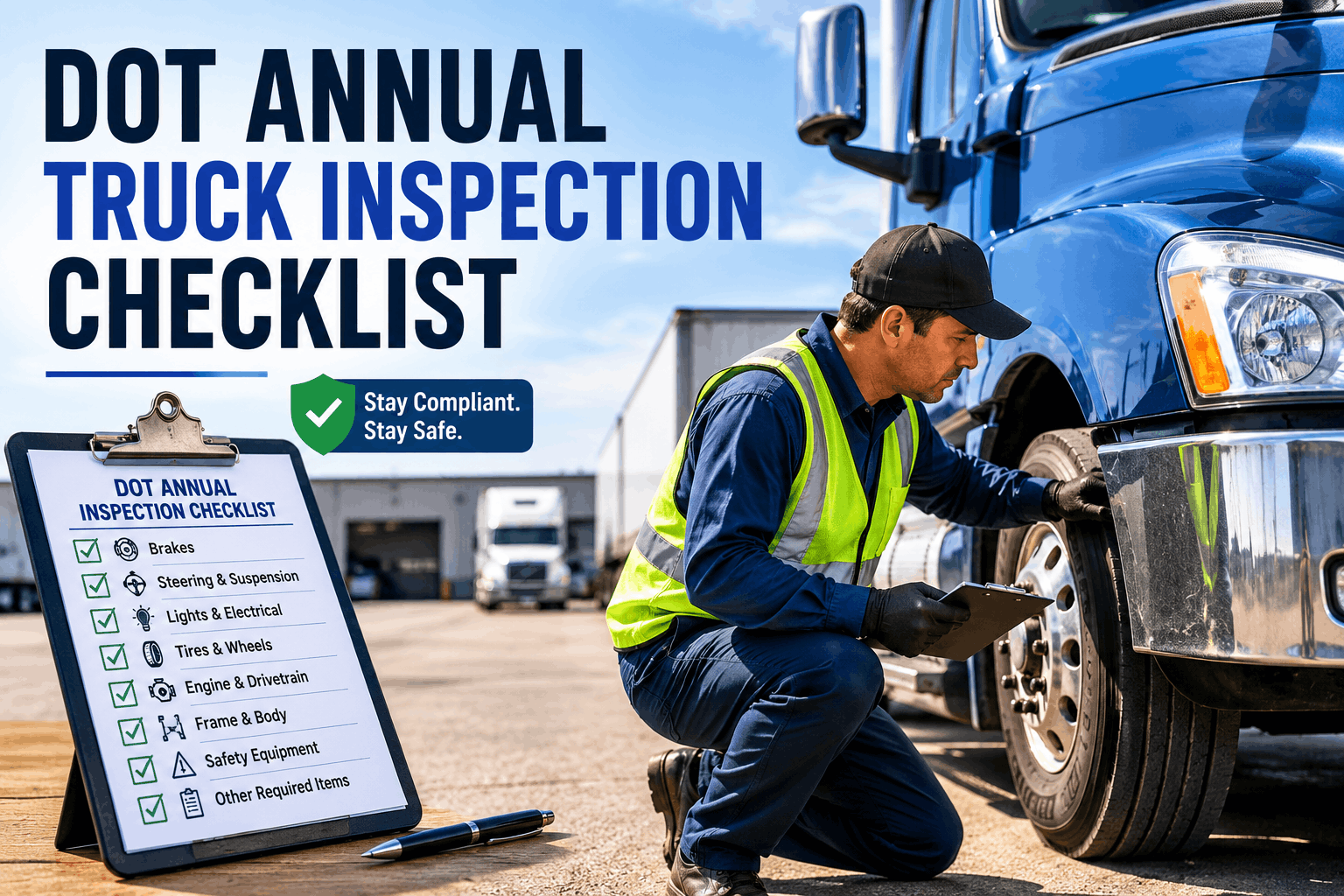
Annual DOT Inspection Checklist: The FMCSA Guide for Trucks
Every CMV, every twelve months, every component in Appendix A — certified by a qualified inspector. Here's the full scope, who can sign it, how the clock works, and the paperwork rules behind 133,000 citations a year.
The Rule in Four Numbers
Strip away the detail and the annual inspection comes down to a handful of hard requirements. Miss any one of them and the citation follows regardless of the truck's actual condition.
How the Twelve-Month Clock Works
The expiration isn't twelve months from the inspection date exactly — it runs to the end of the month, which gives you a small but useful buffer to plan around.
What Gets Inspected
Appendix A to Part 396 — the standard many still call Appendix G — defines the minimum periodic inspection scope. It isn't a simple pass/fail list: each system carries specific rejection criteria that define exactly which defect conditions fail the vehicle.
Service and parking brakes, drums, rotors, hoses, air system integrity, and pushrod travel within adjustment limits. The leading cause of failure.
Steering wheel free play, column, gearbox, linkage, pitman arm, tie rods, and power steering components.
Springs, air bags, hangers, U-bolts, torque rods, and shock absorbers for cracks, breaks, and displacement.
Frame members, cross members, and mounting points for cracks, bends, corrosion, and loose fasteners.
Tread depth, sidewall condition, inflation, and no regrooved or unsafe tires on a steering axle.
Cracks, unseated locking rings, broken or missing fasteners, and elongated stud holes.
Headlamps, tail lamps, stop lamps, turn signals, marker and clearance lamps, and reflectors. The most commonly cited deficiency.
Leaks, secure mounting, and discharge routed away from the cab and fuel system.
Tanks securely mounted, no leaks, and caps in place — a system inspected for both fire and spill risk.
Fifth wheel, pintle hooks, safety devices, and saddle mounts for wear, cracks, and secure locking.
Cracks, discoloration, and vision obstructions within the driver's swept area.
Windshield wipers, rear-vision mirrors, horn, emergency equipment, and — where fitted — rear impact guards.
Who Is Actually Allowed to Sign
This is where carriers get caught most often — using a competent mechanic who doesn't formally meet the standard. Under 49 CFR 396.19, an inspector must satisfy three requirements together.
Brake components carry their own additional qualification standard under 49 CFR 396.25. A brake inspector needs training, experience, or both totaling at least one year, plus demonstrated mastery of brake-specific methods, procedures, tools, and equipment. Being qualified for the general inspection does not automatically qualify someone to inspect and certify brakes.
The Documentation Is the Compliance
Every one of those 133,000 annual inspection citations is a paperwork failure at heart — a due date nobody watched, a trailer nobody tracked, a report filed somewhere nobody can find in 48 hours, or an inspector whose qualification records were never documented. Truck Inspection & Maintenance tracks the inspection due date for every unit including trailers and dollies, alerts you well before expiry, stores each signed report against the vehicle for the full retention period, and keeps your inspectors' qualification records where an auditor can see them.
Annual Inspection vs. Roadside vs. DVIR
Three different inspections get confused constantly, and mixing them up creates real compliance gaps. They serve different purposes on different schedules.
A scheduled, comprehensive Appendix A examination once every 12 months. Planned, thorough, and documented on a retained report.
An unannounced enforcement inspection that also covers driver credentials and hours of service, and can put a vehicle out of service on the spot.
The driver's report of vehicle condition at the end of each day's work, retained for three months with its repair certification chain.
Why Trucks Actually Fail
Failures cluster in a few predictable systems, and nearly all of them are findable in your own shop before an inspector finds them.
Brake adjustment out of specification, cracked drums, and air system leaks top the failure list year after year.
Inoperable required lamps are the single most commonly cited deficiency — and the cheapest possible thing to prevent.
Tread depth, sidewall damage, and wheel fastener problems that a disciplined pre-trip should catch first.
What to Keep, and For How Long
The annual inspection generates several records with different clocks. Keeping the report but losing the inspector's qualification file is still a finding.
How often is a DOT annual inspection required?
At least once every 12 months under 49 CFR 396.17, and the inspection is valid for twelve months from the last day of the month in which it was performed — so an inspection completed on March 12 runs through March 31 of the following year. Every commercial motor vehicle needs one, and critically, each vehicle in a combination is inspected separately: a tractor pulling a semitrailer and a full trailer requires three distinct annual inspections with three separate reports. Converter dollies count as their own units too. Note also that federal rules are a minimum, and some states impose stricter intervals — New York, for instance, requires inspections every six months for CMVs over 10,000 pounds GVWR. If you operate in multiple states, confirm the interval that applies to each vehicle rather than assuming twelve months everywhere. Start a free trial to track due dates.
Who is qualified to perform an annual DOT inspection?
Under 49 CFR 396.19, an inspector must meet three requirements together: understand the inspection criteria in Part 393 and Appendix A well enough to identify defective components, be knowledgeable in and have mastered the methods, procedures, tools, and equipment used to perform an inspection, and be capable by reason of training or experience — meaning either they completed a Federal or State-sponsored training program (or hold a qualifying certificate from a State or Canadian Province), or they have a combination of training and experience totaling at least one year. Brake work carries an additional standard under 396.25, requiring at least a year of brake-specific training or experience plus mastery of brake-specific methods and tools. Carriers can use qualified in-house mechanics, third-party commercial garages or truck stops, or state-certified stations — but in every case the inspector's qualification documentation must be kept on file and available for audit. Ask about inspector qualification records.
How long must the inspection report be kept?
The carrier must retain the original annual inspection report for 14 months from the inspection date under 49 CFR 396.21 — deliberately two months longer than the inspection's own twelve-month validity, so there's always overlap with the current cycle. Separately, proof of the current inspection must be on the vehicle at all times, either as a compliant decal or sticker or as a copy of the report, and that proof stays until the next inspection replaces it. Other related records run on their own clocks: roadside inspection reports (DVERs) are kept for 12 months, daily DVIRs for 3 months, and general maintenance records for one year plus six months after the vehicle leaves your control. Inspector qualification records also need to be maintained and produced on request. Because these periods differ, a single blanket retention policy either hoards everything or discards something too early. Start free and automate retention.
What's the most common reason trucks fail?
Brake system defects are the leading cause of annual inspection failures — specifically brake adjustment outside specification, cracked drums, and air system leaks. Lighting violations, meaning inoperable required lamps, are the most commonly cited deficiency overall, and they're also the cheapest and easiest problem to prevent. Tires and wheels round out the top group, with tread depth, sidewall damage, and fastener issues appearing regularly. What's notable about all three is that they're exactly the components a disciplined daily pre-trip inspection should be catching first, which means most annual inspection failures represent a gap in routine maintenance rather than a sudden problem. Fleets that run real pre-trip inspections and route reported defects promptly to repair tend to walk into the annual inspection with very little to fix. Start free and catch defects earlier.
Does a roadside inspection replace the annual inspection?
Sometimes, but don't assume it. Under 49 CFR 396.23, a qualifying inspection can be used to satisfy the periodic inspection requirement — the substitution generally requires that the inspection actually covered all the components in Appendix A and that the vehicle passed. In practice, guidance and enforcement around this vary, and relying on a roadside inspection you haven't verified against the periodic standard is a risk. The safer approach is to treat scheduled annual inspections as your compliance baseline and treat any substitution as something to confirm specifically before you skip a scheduled inspection. It's also worth remembering the reverse doesn't hold either: a current, valid annual inspection is no guarantee of passing a roadside inspection, because that's a different vehicle condition on a different day, and roadside inspections additionally review driver credentials and hours of service, which the periodic inspection never touches. Start free and keep the baseline solid.
Never Let a Unit Go Overdue
Annual inspection citations are administrative failures, not mechanical ones — a trailer nobody tracked, a due date nobody watched, a report nobody could produce. Truck Inspection & Maintenance tracks every unit's inspection clock including trailers and dollies, alerts you well before month-end expiry, stores signed reports for the full 14 months, keeps inspector qualification records audit-ready, and links the pre-trip defects that cause most failures straight to repair.