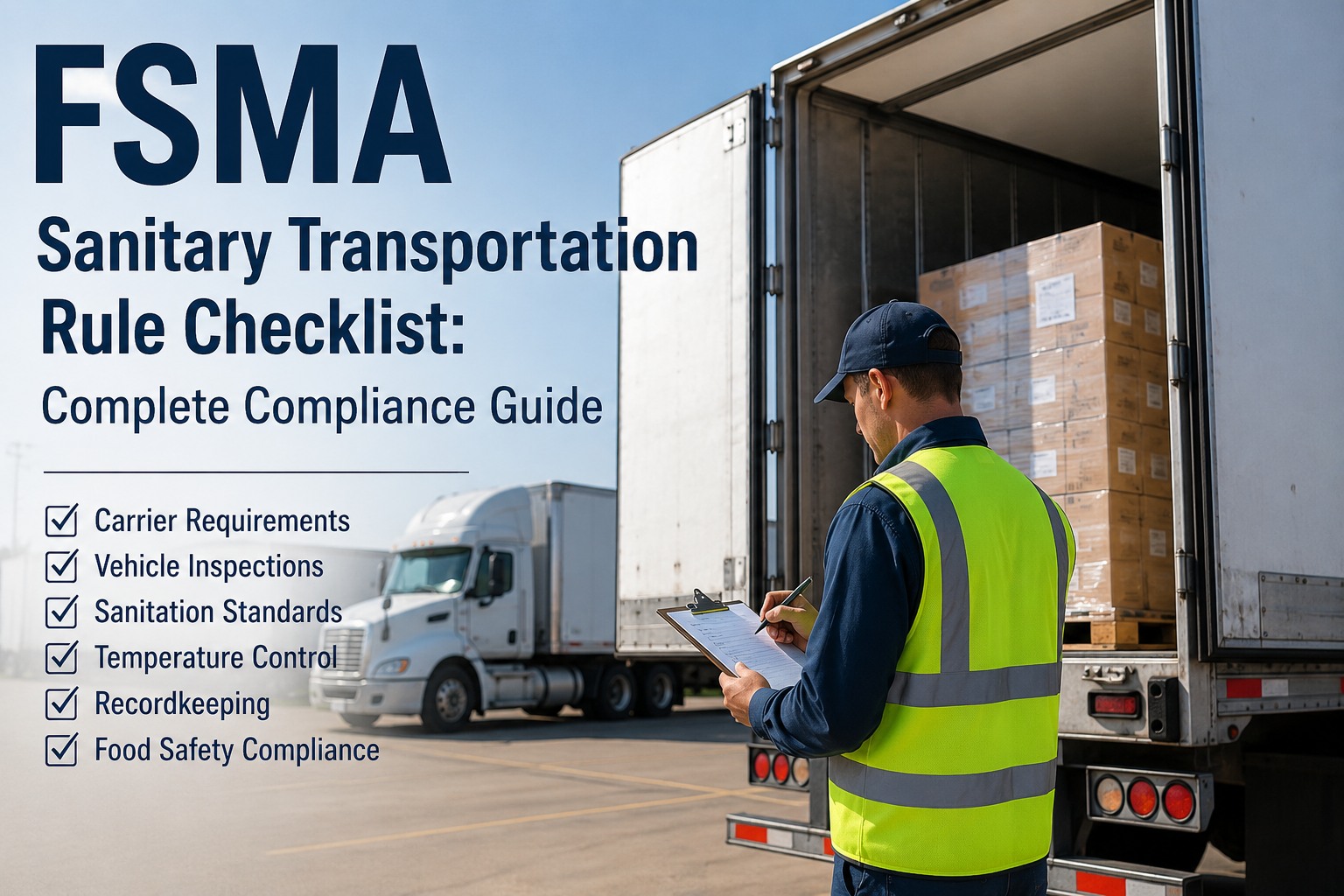
Under FDA rules, a refrigerated trailer can hold food at a perfect 34°F the entire trip and still fail compliance — if the temperature was never recorded, the vehicle's cleaning wasn't documented, or the driver was never trained. That's the hard truth of the FSMA Sanitary Transportation Rule (21 CFR Part 1, Subpart O): under FSMA, if it wasn't documented, it didn't happen. The rule sets enforceable federal requirements for shippers, loaders, carriers, and receivers to keep food safe in transit — covering vehicles and equipment, transportation operations, recordkeeping, and training — and non-compliance means cargo detention, rejected loads, and regulatory penalties. This guide breaks down who's covered, exactly what each role must do, and a complete compliance checklist you can put to work, so a clean load is also a defensible one. Run digital FSMA inspections free.
FSMA Sanitary Transportation Rule Checklist: Complete Compliance Guide
FDA compliance requirements for food carriers, shippers, drivers, and receivers — vehicle inspections, sanitation, temperature control, recordkeeping, and training, in one checklist for 2026.
What the Rule Is — and Who It Covers
Codified at 21 CFR Part 1, Subpart O and effective since 2016, the Sanitary Transportation Rule was the first federal law to specifically govern temperature control and sanitation in food transport by motor or rail vehicle. It assigns responsibility across four roles, and the key is knowing which one you are.
Arrange transport and bear primary responsibility — they specify temperature, sanitation, and handling requirements in writing for every load. Brokers and 3PLs count as shippers.
Before loading, verify the vehicle is in sanitary condition and adequately pre-cooled for the food — free of pests and residue from previous cargo.
Under written agreement, provide temperature-capable equipment, pre-cool, monitor temperature in transit, and demonstrate it was maintained. Must train staff.
On arrival, assess the food was kept under adequate temperature control and sanitary conditions, and reject loads that show evidence of compromise.
The Four Requirement Areas
Strip away the legal language and the rule comes down to four things you must control — and be able to prove you controlled. Every checklist item below maps to one of these.
Designed and maintained in sanitary condition — food-contact surfaces cleanable, corrosion-resistant, and temperature-capable where needed.
Practices that prevent contamination — pre-cooling, temperature monitoring, separating raw from ready-to-eat, and cleaning between loads.
Written procedures, agreements, temperature logs, cleaning logs, and training documentation — retained up to 12 months.
Carrier personnel trained in sanitary transport practices when the carrier is responsible for sanitary conditions — and the training documented.
Turn the Rule Into a Checklist Drivers Actually Run
Truck Inspection & Maintenance puts pre-load sanitation, pre-cool verification, and temperature checks on the driver's phone — timestamped and stored, so every load is compliant and provable.
The Compliance Checklist
Here's the practical checklist, grouped by stage. Run it on every temperature-controlled and exposed-food load — and capture each item as a record, because an undocumented check doesn't count under FSMA.
Recordkeeping & Training: Where Fleets Fail
Most FSMA findings aren't about dirty trailers — they're about missing paper. The food may have been handled perfectly, but without the records to prove it, the FDA treats it as non-compliant. Two obligations cause the most trouble.
Written procedures, shipper-carrier agreements, temperature logs, and cleaning records must be retained — generally up to 12 months — and produced on request. Paper logs get lost, smudged, or never filled in; that gap is the violation, even when the load was fine.
When a carrier is responsible for sanitary conditions, all personnel in transport operations must be trained in sanitary practices — covering food-safety risks and basic practices — and that training must be documented and kept 12 months after the person leaves those duties.
Why a Digital Checklist Wins
The rule doesn't require software — but paper makes compliance fragile, and "if it wasn't documented, it didn't happen" is a brutal standard to meet with clipboards. Digital inspection turns each requirement into a captured, timestamped record automatically.
Every pre-cool, sanitation, and temperature check is logged with time and driver — no blank lines on a clipboard nobody filled in.
Pull 12 months of temperature and cleaning records for any vehicle or load instantly when the FDA or a customer asks.
Store each employee's sanitary-transport training record and retention clock, so the training gap never opens.
A failed pre-load check flags the unit before it's loaded — stopping a violation instead of documenting one after.
Frequently Asked Questions
Shippers, loaders, carriers, and receivers who transport human or animal food by motor or rail vehicle in the U.S. Brokers and 3PLs are classified as shippers. Non-covered businesses — those with less than $500,000 in average annual revenue — are exempt, along with food transshipped through the U.S., imported-for-export food, and most direct-to-consumer deliveries. Transport by ship or air isn't covered. If you handle covered food in any of those four roles and exceed the revenue threshold, the rule applies. Contact our team to confirm your obligations.
Responsibility is shared and assigned by who controls each activity. The shipper must specify the required temperature and conditions in writing. When a written shipper-carrier agreement makes the carrier responsible for sanitary conditions, the carrier must provide temperature-capable equipment, pre-cool the vehicle, monitor temperature in transit, and demonstrate on request that the operating temperature was maintained. Clear written agreements are what keep this from becoming a finger-pointing dispute after a problem.
Retention periods vary by record but generally do not exceed 12 months. Written procedures must be kept as long as they're in use plus 12 months after; shipper records of specifications and agreements are kept 12 months after the contract ends; and carrier training records must be kept 12 months after the employee stops performing those duties. All required records must be furnished to the FDA on request, typically within 24 hours. Start a free trial to keep records audit-ready.
When a carrier agrees to be responsible for sanitary conditions, it must train all personnel involved in transportation operations on potential food-safety problems, basic sanitary transportation practices, and their responsibilities under the rule. The training must be documented, and records kept for 12 months after the person stops those duties. The FDA provides a free one-hour training module that meets this requirement, making compliance straightforward once you have a system to track who's been trained.
Because the rule is federal law rather than guidance, violations carry real consequences: cargo detention, product rejection, and regulatory penalties, plus the reputational and financial damage of a recall if contaminated food reaches consumers. Beyond enforcement, customers increasingly require documented FSMA compliance as a condition of doing business. A systematic checklist with captured records is the most reliable way to avoid both the regulatory and the commercial fallout.
Make Every Food Load Compliant and Provable
Truck Inspection & Maintenance turns the Sanitary Transportation Rule into digital pre-load, in-transit, and delivery checklists, captures temperature and sanitation records automatically, tracks driver training, and blocks non-compliant loads — so your fleet protects the food, satisfies the FDA, and keeps every customer's compliance requirement met.