A hydrovac crew can do everything right at the dig and still create a compliance disaster on paper. An expired one-call ticket, a spoil load dumped at an unlicensed site, a missing utility-verification photo — any one of these turns a clean daylighting job into a struck line, an environmental fine, or a contract you lose at audit. Pipeline daylighting sits at the intersection of three regulatory worlds at once: state 811 dig laws, OSHA's utility-location standard, and environmental spoil-disposal rules — and the records that prove compliance live in five different places per job. This guide breaks down the four compliance pillars every hydrovac fleet must satisfy, the daylighting job lifecycle, and how centralizing tickets, inspections, and disposal records keeps your fleet audit-ready. Centralize your hydrovac compliance free.
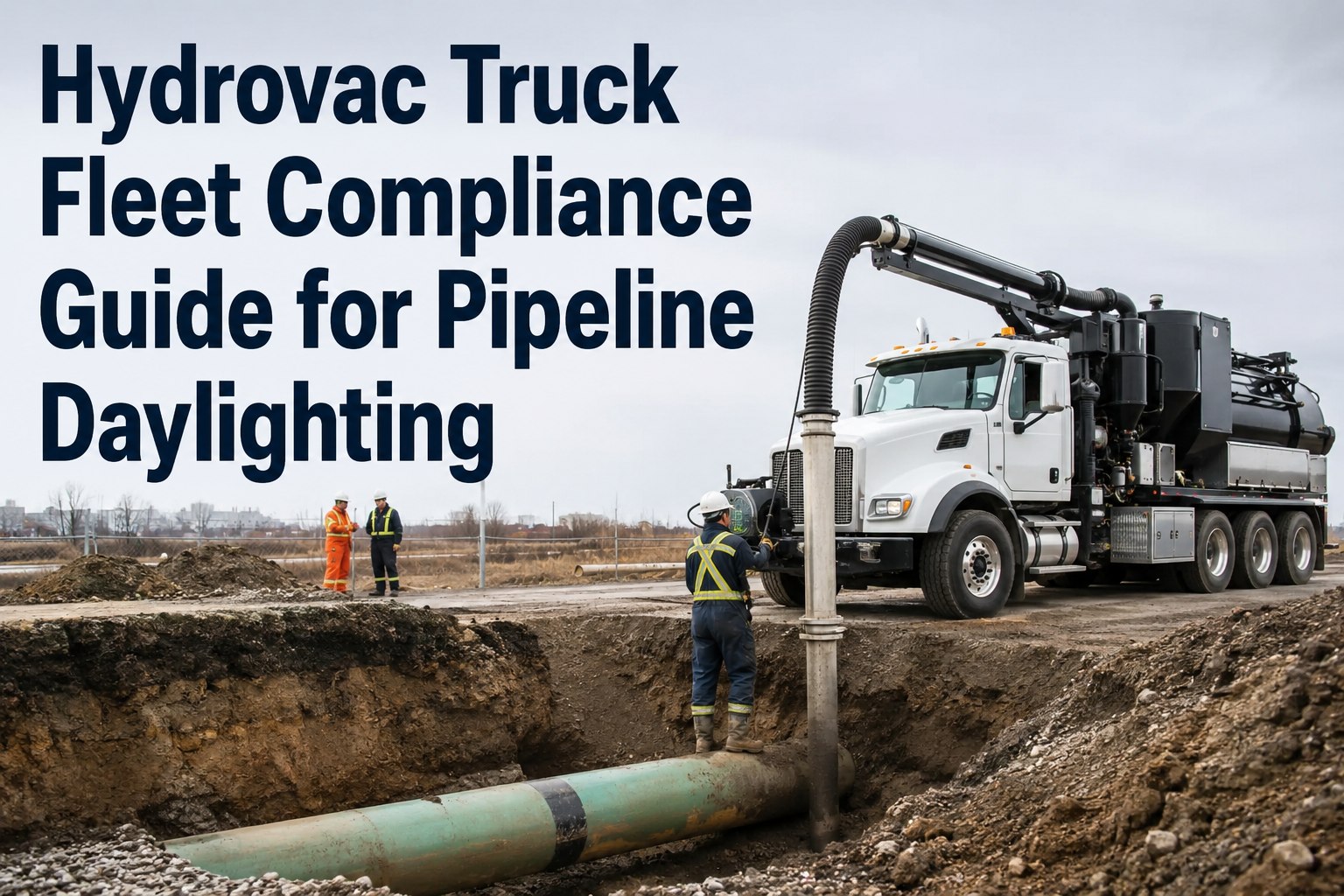
Hydrovac Truck Fleet Compliance Guide for Pipeline Daylighting
A compliance guide for hydrovac fleets running pipeline potholing and daylighting. Centralize one-call tickets, utility verification, inspections, and spoil disposal records — so every dig is provably legal.
Why Hydrovac Compliance Is Uniquely Hard
Most fleets answer to one regulator. A hydrovac daylighting operation answers to three at once — and the records that satisfy each live in a different system, on a different timeline, with a different consequence for getting it wrong. That fragmentation is exactly where compliance breaks down.
State 811 one-call rules require advance notice — typically 48 to 72 hours — before any excavation. Tickets expire, and digging on a stale ticket is a violation.
Standard 1926.651(b)(1) requires the exact location of underground utilities be determined before crews work near them — the whole reason daylighting exists.
Vacuumed slurry and soil must go to licensed disposal facilities. Unauthorized dumping brings legal consequences, fines, and project delays.
The Four Compliance Pillars
Every legal daylighting job rests on four documented pillars. Miss any one and the job is exposed — to a struck line, a citation, or a failed audit. Truck Inspection & Maintenance keeps all four in one place per job.
A valid 811 ticket for every dig, tracked to its expiration. Re-notify before it lapses — the most common avoidable violation in the trade.
Proof that marks were located and visually confirmed before excavation — photos and notes that satisfy OSHA 1926.651 and protect the crew.
A manifest for every load showing licensed-facility disposal. The paper trail that turns a dump run into provable environmental compliance.
Truck, vacuum, boom, water system, and DOT items inspected and logged. A hydrovac is a heavy CMV that must stay roadside-legal too.
Keep All Four Pillars in One Job Record
Truck Inspection & Maintenance ties the 811 ticket, utility photos, spoil manifest, and equipment inspection to each daylighting job — so the proof is together, not scattered across five systems.
The Daylighting Job Lifecycle
Compliance isn't a single checkpoint — it runs the length of the job. Each stage generates a record, and a gap at any stage is where the liability hides. Here's the chain from notification to closeout.
The Spoil Problem Nobody Plans For
Spoil is where productivity and compliance collide. The debris tank fills fast on a big daylighting job, dump runs eat the day, and every load has to land at a licensed facility with a manifest to match. Manage it loosely and you lose hours or risk a violation.
Debris tanks fill rapidly on full-day digs — even extended 15-cubic-yard rigs cycle to dump. Untracked, it's surprise downtime.
Slurry and soil must go to approved sites. Pre-mapped dump stations near the job keep crews legal and moving.
Every dump needs a record tying the spoil to a licensed facility — the document that proves it wasn't dumped illegally.
What an Audit-Ready Record Looks Like
When a pipeline operator, regulator, or insurer asks you to prove a job was done right, the answer should be one export — not a scramble across trucks, phones, and filing cabinets. Centralized records turn a compliance review into a non-event.
Frequently Asked Questions
Yes. State dig laws require advance notice through 811 before any excavation, including hydrovac potholing and daylighting — typically 48 to 72 hours depending on the state. The provider usually coordinates the locate, though final compliance often rests with the project owner. Either way, the contractor needs a valid, unexpired ticket on file for every dig, since digging on a stale ticket is a violation.
OSHA Standard 1926.651(b)(1) requires that the exact location of underground installations be determined by safe and acceptable means when employees work near them. Daylighting with hydrovac is one of the safest accepted methods of doing exactly that — exposing utilities with high-pressure water and vacuum rather than mechanical digging. Documenting the verification protects both the crew and the contractor.
Vacuumed slurry and soil must be disposed of at licensed facilities in accordance with local and environmental regulations. Unauthorized dumping leads to legal consequences, fines, and project delays. Best practice is to establish partnerships with approved disposal sites and pre-map dump stations near job locations, then capture a manifest for every load proving where the spoil went.
Expired one-call tickets and missing spoil manifests. Tickets lapse on a clock most crews aren't watching, and dump runs happen fast without the paperwork to match. Both are entirely avoidable with tracking that flags a ticket before it expires and requires a manifest before a job closes — turning the two most common failures into automatic checkpoints.
It centralizes the four pillars per job. Truck Inspection & Maintenance tracks 811 tickets with expiration alerts, stores utility-verification photos, logs equipment and DOT inspections, and captures spoil disposal manifests — all tied to the specific daylighting job. When an operator or auditor asks for proof, it's one export instead of a hunt across trucks, phones, and paper.
Keep Every Daylighting Job Audit-Ready
Truck Inspection & Maintenance ties one-call tickets, utility verification, equipment inspections, and spoil disposal manifests to each job, alerts you before a ticket expires, and keeps it all in one export — so your hydrovac fleet stays compliant across dig law, OSHA, and environmental rules at once.